The Makeup on His Hand, the Fog Over His Republic: Why 59% of Americans No Longer Believe the White House About Donald Trump’s Health
A new Quinnipiac University poll released on June 25, 2026 — and quickly amplified by The Independent — finds that a clear majority of the country believes the White House is not telling the truth about an 80-year-old president’s physical and mental condition. This is not a scandal about bruised hands. It is a scandal about who is actually running the government, and who Republicans have chosen to defend.
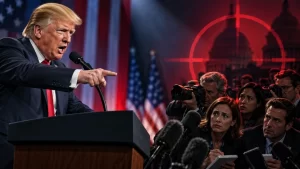
The number is 59. Not 51, not 53. Fifty-nine percent of American voters told Quinnipiac University’s pollsters in a survey released on June 25, 2026 that the White House is not being transparent about Donald Trump’s health, against only 34 percent who believe the administration has been open — a nearly two-to-one margin of distrust in the president’s own communications operation. The finding, reported that same day by The Independent, arrived in the middle of a week in which Trump had been photographed once again in the Oval Office with makeup caked over a bruise on his right hand, the swelling in his ankles once again visible below the cuff, and once again refusing to release the underlying documentation from his May physical at Walter Reed. The White House says everything is fine. Six in ten Americans have decided that the White House is lying to them.
That gap — between what the administration insists and what the country believes — is the political story of the summer of 2026. It is also a constitutional one. Because in a system where the president holds nuclear command authority, sets the pace of foreign policy, and is meant to be the accountable head of a co-equal branch of government, the question of whether he is physically and mentally capable of doing that job is not tabloid material. It is the whole ballgame. And the country now believes, by a decisive margin, that the truth about that question is being withheld from them on purpose.
1. What the Poll Actually Said
The Quinnipiac survey, conducted in the days surrounding Trump’s 80th birthday on June 14, is worth reading precisely rather than in slogans. Its polling analyst, Tim Malloy, put it in a single sentence: “Is the president physically and mentally well? On both questions, half of voters have their concerns, and a majority think the White House is keeping them in the dark.” Fifty percent of voters believe Trump is not physically healthy. Fifty-one percent believe he is not mentally healthy. And the 59 percent who reject the administration’s transparency claim includes not only 88 percent of Democrats — which is expected — but 62 percent of independents, the very bloc that put Trump back in office in November 2024.
Only among self-identified Republicans, 70 percent of whom continue to believe the administration is being transparent per The Daily Beast’s breakdown of the crosstabs, does the White House’s story hold. In other words, the president’s health disclosures are now believed only by the people who have already committed to believing him about everything else. Every other American — the ones the president is also supposed to be serving — has concluded that they are being told less than the truth.
2. Why the Country Stopped Believing
The White House would like voters to treat this as a partisan smear campaign. It is not. It is the accumulated weight of a long list of specific, documented incidents that ordinary Americans have watched with their own eyes over the course of eighteen months.
None of these events, taken alone, would necessarily justify a majority verdict of concealment. Taken together, they explain why the concealment verdict is now the majority position. And they explain why Representative Ted Lieu of California, in a June congressional hearing, did not accept Secretary of State Marco Rubio’s assurance that he had “never seen” the president fall asleep. Lieu simply played a video of Trump apparently dozing off during a Cabinet meeting on national security and delivered the line that ought to be nailed above every editor’s desk in Washington.
“You are literally talking about issues of war and peace, and Donald Trump is sleeping right next to you.”
— Rep. Ted Lieu (D-CA), Congressional Hearing, June 2026
3. What This Says About Leadership
Leadership is not, at its core, a matter of temperament. It is a matter of accountability — of a public official’s willingness to submit himself and his conduct to the scrutiny of the people he governs. Every modern president before Trump, including Dwight Eisenhower after his 1955 heart attack and Ronald Reagan during his cognitive decline in the final year of his second term, ultimately understood that the presidency belongs to the country, not to the man occupying it, and that the country therefore has a right to know whether the man occupying it can do the job.
Donald Trump does not accept that premise. He has instead constructed a health-disclosure regime built around a single physician — Navy Captain Sean Barbabella — whose public memos consistently declare the president in “excellent health” and “fully fit,” and around a communications strategy of ridiculing anyone who asks follow-up questions. When Rep. Jamie Raskin asked Barbabella in writing this spring to conduct a comprehensive cognitive and neurological evaluation and disclose the findings, the request was met with what House Democrats described as silence. When bioethicist Dr. Sara Rosenthal of the University of Kentucky proposed to statnews.com that an independent medical organization review the health of the president and those in the line of succession, the idea was not even acknowledged by the administration. The pattern is unmistakable: information flows in one direction only, from the president’s chosen doctor to the public, on the president’s chosen terms.
This is not leadership. It is a form of unaccountability that pretends to be strength. And it has a cost. The de Beaumont Foundation / Harvard poll published in June found that trust in federal health institutions themselves has collapsed by double digits under this administration, with only 34 percent of Democrats and 47 percent of independents now trusting CDC recommendations. When the president treats his own medical record as a state secret, he does not merely damage his own credibility — he corrodes the credibility of every institution that speaks about public health under his authority.
Get Involved Today
Contribute to our mission and turn your concerns into action.
4. What This Says About the Republican Party and MAGA
For nine years, congressional Republicans have argued that Donald Trump is uniquely fit for the presidency — sharper than his critics, more energetic than his predecessors, in “the best shape of anyone” who has ever held the office. That framing is no longer sustainable, and yet the party continues to repeat it verbatim. When Raskin introduced his 25th Amendment Commission bill in April 2026, White House spokesman Davis Ingle did not engage the substance. He told Fox News Digital, per its own reporting, that “Lightweight Jamie Raskin is a stupid person’s idea of a smart person” — the kind of insult-first, evidence-never response that has become the party’s default whenever the president’s fitness is raised.
The MAGA movement’s response to the Quinnipiac numbers has been to attack the messenger. But the messenger, in this case, is the American public. When 62 percent of independents tell a nationally respected pollster that they have been lied to, the correct political response is to release the data that would prove otherwise: the full physician’s memo, the raw cognitive test results, an on-the-record briefing by Dr. Barbabella. The White House has offered none of these things. Instead it has offered Vance’s CBS interview, Karoline Leavitt calling all such concerns “baseless,” and Trump himself reposting old video of his own subordinates praising him.
What this says about the Republican Party in 2026 is that it has now inverted its traditional relationship with executive-branch accountability. The same party that spent 2024 demanding that Joe Biden’s cognitive assessments be publicly released — a demand we considered legitimate at the time — now insists that even asking the same question of Donald Trump is a form of derangement. That is not a governing philosophy. It is a loyalty test. And the country, per Quinnipiac, has noticed.
“Public trust in Donald Trump’s ability to meet the duties of his office has dropped to unprecedented lows… We are at a dangerous precipice, and it is now a matter of national security for Congress to fulfill its responsibilities under the 25th Amendment.”
— Rep. Jamie Raskin (D-MD), Statement on Introduction of the Presidential Capacity Commission Act, April 14, 2026
5. What This Says About His Priorities
A president who was actually confident in his health would release the underlying data. A president who was actually focused on the country’s business — an ongoing conflict in the Middle East, an inflation crisis that has driven his own economic approval to a documented -47 net, per Morris/Verasight tracking, and a midterm campaign that his party is currently losing among every non-partisan demographic — would not be spending Sunday evenings reposting two-week-old Vance interviews to prove he has energy.
The priorities revealed by this administration’s response to the health question are the priorities of a man who has confused his personal legacy with the national interest. Time spent covering makeup on his hand is time not spent on the border. Time spent litigating whether he was “resting his eyes” is time not spent responding to the June Reuters/Ipsos poll finding that 73 percent of Americans disapprove of his handling of the cost of living. Every hour of the White House’s attention that is spent managing the president’s image is an hour that is not spent doing the work of the presidency.
This is, in the end, the answer to the question every progressive should be putting to persuadable voters: what exactly is Donald Trump doing with his presidency? The answer, in the summer of 2026, is that he is spending a substantial portion of it trying to convince the country he is not the age he obviously is.
The 25th Amendment, Section 4: A Mechanism Designed for Exactly This Moment
The 25th Amendment to the U.S. Constitution, ratified in 1967 in the shadow of the Kennedy assassination, contains four sections. The one now under public discussion is Section 4, which provides that the Vice President, together with either a majority of the Cabinet or a body established by Congress, may declare in writing that the President “is unable to discharge the powers and duties of his office” — at which point the Vice President immediately assumes those powers as Acting President.
Congress has never established that body. It has had the constitutional authority to do so for nearly six decades, and has simply never used it. That is what Rep. Jamie Raskin of Maryland — a constitutional law professor and the ranking Democrat on the House Judiciary Committee — proposed to change on April 14, 2026 when he introduced the Presidential Capacity Commission Act with 50 Democratic co-sponsors.
Raskin’s legislation would create a 17-member, scrupulously bipartisan Commission composed of retired executive-branch officials — former presidents, vice presidents, cabinet secretaries, surgeons general — appointed in equal numbers by the four congressional leaders. On the concurrent adoption of a resolution by both houses, the Commission would conduct a medical and cognitive examination of the president within 72 hours and report its findings. Only if the Commission and the Vice President agreed that the president was incapable of discharging his duties would power transfer. The president would have the right to contest the finding and reclaim his office, subject to a two-thirds vote of Congress. In other words: a fair process, with due process built in, using a mechanism the Constitution itself provides.
The Argument Being Made
The constitutional case, as Raskin has framed it in public statements to TIME and elsewhere, is straightforward. The Framers of the 25th Amendment anticipated exactly the scenario the country now faces — an aging president whose capacity to execute the office is publicly in question and whose party is unwilling to hold him accountable through impeachment. Section 4 exists so that the constitutional order does not depend on the political courage of any single Cabinet, and so that a partisan Vice President is not the sole gatekeeper of presidential fitness. The polling now shows a national majority that no longer trusts the administration’s own account of the president’s condition. That is precisely the informational deficit Section 4 was designed to address.
An Honest Assessment of the Barriers
The barriers to actually invoking the 25th Amendment in 2026 are substantial and this editorial board will not pretend otherwise. Republicans control both chambers of Congress; Raskin’s bill will not move to markup in a Judiciary Committee chaired by a Trump loyalist. Vice President JD Vance has publicly praised Trump’s health as “off the charts” and would be the last person on earth to sign a Section 4 declaration. The Cabinet is composed entirely of officials selected precisely for their unwillingness to challenge the president. As one MSNBC opinion writer noted, impeachment may be the more constitutionally honest tool for what is fundamentally a political and legal problem rather than a medical one.
Why the Barriers Do Not Negate the Case
The fact that Congress will not act does not mean Congress lacks the authority — or the duty — to act. The 25th Amendment sits in the Constitution regardless of whether the current majority chooses to activate its mechanisms. Raskin’s bill matters not because it is likely to pass in this Congress, but because it forces every member of Congress to go on record. It establishes the constitutional predicate for a future Congress to act. And it names, in the plain language of law, what a majority of the country has already concluded: that the president’s fitness is a legitimate matter of public concern, that the current disclosure regime is inadequate, and that the constitutional system contains a remedy. The moral case does not depend on Republican courage. It depends only on the truth.
6. What Comes Next
The next test is whether the Democratic caucus, having spent the spring debating whether Trump’s “civilization will die tonight” post on Iran justified 25th Amendment action, is willing to keep the pressure on now that a national majority has independently arrived at the same underlying conclusion. Raskin has done the legislative work. The polling has done the political work. What is required now is the moral work — a sustained, disciplined, on-the-record demand from every Democratic senator and representative that the White House release the complete physician’s memo, the raw cognitive assessments, and Dr. Barbabella himself for questioning under oath.
The persuadable middle of the country — those 62 percent of independents who now believe they are being lied to — will not be moved by hysteria. They will be moved by a Democratic Party that treats this as the serious institutional question it is. This is the moment, in other words, for the opposition to be exactly what a majority of the country is asking it to be: the party of accountability.
Editorial Conclusion
A republic cannot function when its president will not tell the truth about whether he is capable of running it, and when the party controlling Congress will not compel him to. The fifty-nine percent of Americans who no longer believe the White House about Donald Trump’s health have not lost faith in the presidency — they have lost faith in the current occupant’s willingness to be accountable to them. The 25th Amendment exists precisely for the moment when that gap becomes constitutionally intolerable. Rep. Raskin’s Commission bill will not pass this Congress. Its case does not depend on this Congress. It depends on whether we are still a country in which the health of the president is a matter for the people who elected him — or a country in which we are simply told, by a small and shrinking group of loyalists, to stop asking.
Sources & References
- The Independent (via MSN): “Most Americans say White House being untruthful about Trump’s health,” June 25, 2026.
- The Independent (via AOL): “Majority of Americans say White House is not being truthful about Trump’s health.”
- The Daily Beast: “Poll Shows Americans Are Not Buying White House’s Trump Health Claims,” June 25, 2026.
- Raw Story: “Half of Americans think the Trump White House is fibbing about president’s health: poll.”
- Quinnipiac University Poll: Official polling data and Tim Malloy commentary, June 2026 release.
- CNN Politics: “White House breaks from precedent by not releasing Trump’s medical report,” May 29, 2026.
- CNN: “Polls show increasing concerns about Trump’s mental acuity,” February 26, 2026.
- PBS NewsHour: “Trump’s 4th medical checkup renews public scrutiny of his health,” May 27, 2026.
- STAT News: “Trump wraps up medical visit to Walter Reed and declares ‘PERFECTLY,'” May 26, 2026.
- House Judiciary Democrats: Rep. Jamie Raskin, “Ranking Member Raskin Introduces Legislation Establishing Independent Commission on Presidential Capacity,” April 14, 2026.
- Axios: “House Democrats file long-shot 25th Amendment bill targeting Trump,” April 14, 2026.
- Fox News: “House Dems unveil bill to examine removing Trump using 25th Amendment,” April 14, 2026.
- TIME: “Jamie Raskin on Trump, the 25th Amendment and Impeachment,” April 2026.
- MSNBC Opinion: Andy Craig, “Jamie Raskin’s push for 25th Amendment to end Trump presidency is a mistake,” April 18, 2026.
- The Daily Beast: “Desperate Trump, 80, Tries to Prove He’s Still Healthy,” June 29, 2026.
- The Hill: “Poll: Trust in federal health agencies dropped sharply during Trump’s first year,” June 2026.
- Ipsos: Reuters/Ipsos June 2026 Poll: Trump approval and cost of living.
- Wikipedia (background): “Age and health concerns about Donald Trump.”
Related News