The 95 Percent Verdict: A Country in Crisis, a President Who Doesn’t Care
A new Harris Poll for The Guardian reports something close to national unanimity — nearly every American now says the country is in an affordability crisis. And the president has told us, on the record, that this is not his concern.
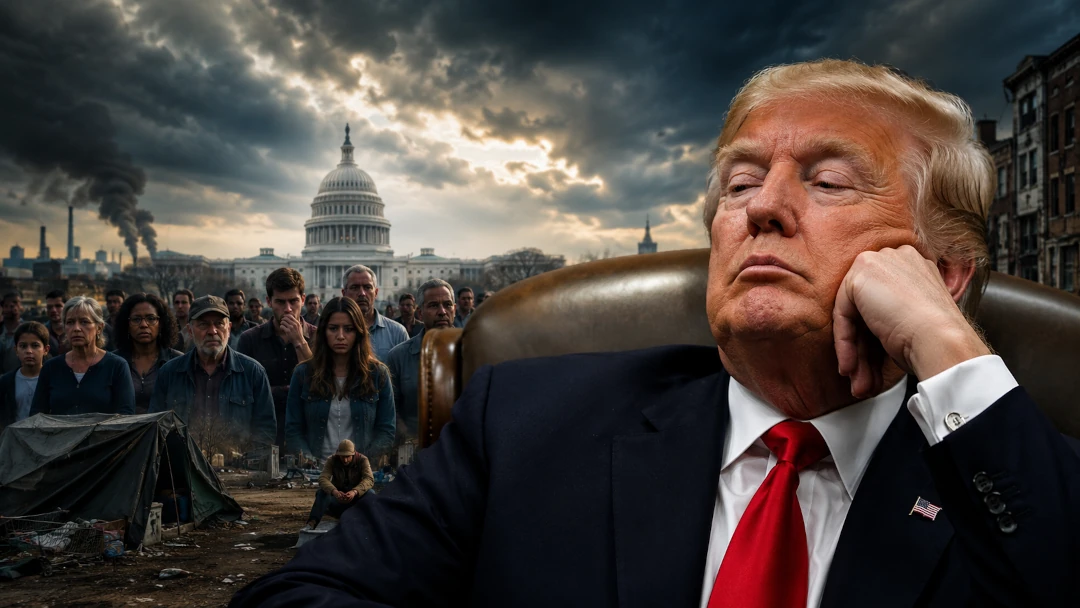
Ninety-five percent. That is the share of American adults who now tell pollsters the United States is suffering an affordability crisis, according to a Harris Poll conducted May 28 through June 6 for The Guardian, sampling 4,100 U.S. adults with a margin of error of 1.9 points. In modern American polling, 95 percent is not a majority — it is a verdict. It is the number you get when a question stops being political and becomes something closer to a description of daily life. Democrats, Republicans, and independents all arrive at the same conclusion by roughly the same margins. The country agrees on the diagnosis. The country does not, however, have a president who agrees to treat it.
What makes the finding staggering is not that Americans feel squeezed — inflation, gas, and grocery costs have been front-of-mind for years. It is that the Trump administration has spent the last five months insisting the numbers say something else, while the electorate that put him back in office has quietly, and then loudly, stopped believing him. The same Harris survey found that 57 percent of Americans now believe the economy is getting worse — a jump of roughly eleven points from February, before the administration and Israel opened a war with Iran that has since sent gas prices, then inflation, then consumer confidence in the wrong direction. Only 16 percent still say the economy is improving.
These numbers were not written by Democrats. They were reported by a British newspaper commissioning one of the country’s most established polling firms. And they arrive alongside another data point the White House cannot easily spin: the collapse of the president’s own base. Republican optimism about the economy has fallen from 49 percent in February to 27 percent today, according to the same poll. Among rural Americans — the demographic bedrock of the modern GOP — 64 percent now say the economy is deteriorating, up from 46 percent five months ago. Inside the MAGA coalition itself, 56 percent report struggling financially; 63 percent say they cannot comfortably afford gas; 61 percent say the same about groceries.
I. What the Poll Actually Says
The Guardian’s headline number is easy to remember and easy to underestimate. Ninety-five percent agreement on anything in twenty-first century American life is nearly extinct. It is worth understanding what sits beneath it before pivoting to the political implications.
The Headline
Share of U.S. adults who now say the country is in an affordability crisis, according to the Harris Poll for The Guardian.
The Direction
Say the economy is getting worse — up from 46 percent in February, before the Iran war disrupted global oil markets.
The Republican Slide
Republicans who still say the economy is getting better, down from 49 percent in February — a 22-point collapse in five months.
The Vote of No Confidence
Roughly two-thirds of Americans, including 49 percent of Republicans, expect no help from the federal government.
Two-thirds of Americans — and, remarkably, nearly half of the president’s own party — told Harris they have little faith the federal government will improve the cost-of-living crisis they now face. Among independents who acknowledge the crisis, 54 percent said neither party has a solution. That last number is a warning shot fired straight into the hull of both parties, but it does not distribute the political damage equally: incumbents catch the blast, and the incumbent in the White House catches it first.
II. The Cost of Living, By the Numbers
A recession is a technical term. An affordability crisis is a felt one. And what the poll captures is the felt reality: that ordinary transactions Americans used to take for granted have become the site of daily anxiety.
The average U.S. price of a gallon of gas has hovered around $3.79 as of early July, even after peace deal negotiations with Iran began. It peaked above $4.50 during the war, up more than 50 percent from where it stood before the Trump administration and Israel launched strikes on Iran in late February, according to AAA data cited by NBC News. May’s Consumer Price Index came in at 4.2 percent — the highest annual inflation reading in three years, reported by The Hill. And the average household utility bill is up roughly $110, or 6.4 percent, over last year, following the Republican Party’s elimination of tax credits for solar and wind and the administration’s push for unregulated expansion of AI data centers, according to a Joint Economic Committee analysis.
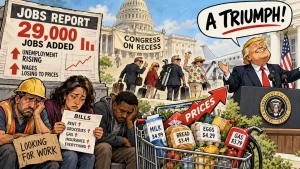
Behind those aggregate numbers are policy choices. Trump refused to sign a bipartisan affordable housing bill Congress had already passed, calling it, in remarks reported by Yahoo News, “a big yawn.” The administration terminated the Biden-era SAVE income-based student loan repayment program, exposing millions of borrowers to steeper payments just as grocery and utility bills climbed. Tariffs — the president’s chosen instrument of economic warfare — have kept import prices elevated across categories from produce to appliances. Corporate consolidation in the meatpacking industry, which the administration has declined to confront, continues to push grocery bills higher, as Common Dreams and other outlets have documented.
None of this is a mystery. Every one of these lines connects a specific administration decision to a specific line-item on the American household budget. The 95 percent number is not a mood. It is a receipt.
III. A President Who Said the Quiet Part Out Loud
Most administrations, confronted with numbers like these, deploy the standard playbook: acknowledge the pain, promise a plan, blame their predecessor, redirect. This administration has done something different. It has told Americans, in the president’s own voice, that their pain is not the president’s problem.
On May 12, ahead of a diplomatic trip to Beijing, a reporter asked Donald Trump to what extent Americans’ financial situations were motivating him to reach a deal with Iran. His answer, captured in footage broadcast by PBS NewsHour and reviewed by Snopes for context: “Not even a little bit.” He continued: “I don’t think about Americans’ financial situation. I don’t think about anybody.” Days later, on Fox News, he was shown a clip of his own remarks and defended them — calling the statement, in his words, a perfect one he would make again.
“I don’t think about Americans’ financial situation. I don’t think about anybody.”
— President Donald J. Trump, White House South Lawn, May 12, 2026
Then came June 10. Asked at the White House about a new report showing inflation had hit a three-year high, the president responded — according to The New Republic and MSNBC’s opinion desk — with the phrase “I love the inflation,” before pivoting into a rambling non-sequitur about a supposedly secret oil operation involving millions of barrels. The ranking Democrat on the House Intelligence Committee, Rep. Jim Himes of Connecticut, said on CNN the same night that the president’s oil claim was, in his assessment, flatly untrue.
Sen. Kirsten Gillibrand, chair of the Senate Democrats’ campaign arm, questioned in a public post whether the president was, in her words, happy that working people were losing money. Sen. Chuck Schumer, the Senate Minority Leader, resurfaced the earlier “I don’t think about Americans’ financial situation” clip with a two-word caption: “We can tell.” Democratic campaign adviser Andrew Mamo, quoted by The Hill, put the political calculus bluntly: any day the president publicly loves something Americans plainly hate is a good day for the opposition.
Even the president’s own Energy Secretary, Chris Wright, declined to defend the underlying sentiment. Asked during a House Science Committee hearing whether he too loves inflation, Wright answered that no, he would prefer it lower — describing his boss, per The Hill’s account, as an entertaining and hyperbolic figure. That is the political posture the president’s own cabinet has been reduced to: treating on-camera statements from the Commander-in-Chief as performance rather than policy.
IV. The Republican Base Is Breaking
For most of Trump’s political career, the rural, white, working-class coalition that anchors the modern Republican Party has been treated by pundits as a fixed asset — a bloc whose loyalty was assumed regardless of policy outcomes. The Guardian’s poll suggests that assumption is no longer safe.
49% of Republicans said the economy was getting better. Only 22% said it was getting worse. Rural pessimism sat at 46%.
The U.S. and Israel launched military strikes against Iran. Gas prices began a five-month climb that peaked above $4.50 per gallon nationally.
Trump, en route to Beijing, told reporters he was “not even a little bit” motivated by Americans’ financial situations when negotiating with Iran.
Asked about a three-year-high inflation reading, Trump responded that he “loves the inflation” — a comment his own Energy Secretary declined to defend on Capitol Hill.
Trump publicly dismissed a bipartisan affordable housing bill as “a big yawn,” refusing to commit to signing it.
The Harris Poll for The Guardian is published. Republican economic optimism has fallen to 27%. Rural pessimism has climbed to 64%.
Get Involved Today
Contribute to our mission and turn your concerns into action.
That is a twenty-two point drop in Republican economic optimism, and an eighteen-point rise in rural pessimism, in five months. Political analysts do not typically encounter numbers of that magnitude outside a national crisis. This time, they arrived alongside one.
The consequences are already visible at the strategic level. Mike Madrid, the veteran Republican strategist, told Newsweek that “desperate” GOP candidates may be forced this cycle to distance themselves from the president — an option, he added, they may pursue not because they expect it to work but because they see no alternative. History is unkind to first-term parties in midterm elections under normal conditions. These are not normal conditions. Republicans defending narrow majorities in both chambers head into November confronting an electorate that has looked at the president’s economy and rendered a 95 percent verdict.
“Desperate Republican candidates may be forced to distance themselves from Trump. Is it likely to work? No. Do they have any other choice? No.”
— Mike Madrid, GOP strategist, to Newsweek, July 2026
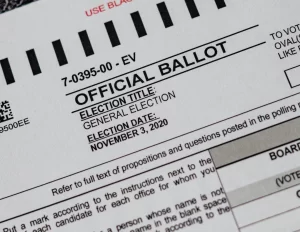
What the Guardian data also shows — and this is important — is that Democrats have not yet earned the credit for the collapse. Fifty-four percent of independents who see an affordability crisis say neither party has an answer. That is the space where the midterms will be decided. A blank ballot with a partial signature from the incumbent party is not the same as a filled ballot for the opposition. Democrats who read this poll and see only Republican weakness are misreading it. What the electorate is asking for is a plan, not a hashtag.
V. What Leadership Looks Like — And What It Doesn’t
The word “leadership” appears rarely in polling summaries, because it is difficult to quantify. But it is what the 95 percent number is really measuring. Americans are not simply saying that costs are high. They are saying that no one at the top is treating those costs as an emergency.
A president who understood the mandate of the office in a period of economic pain would say, publicly and repeatedly, that reducing the cost of living for working families is the single most important thing on his desk. This one has said the opposite. He has refused to sign the housing bill in front of him. He has said in a live setting that Americans’ financial straits do not enter his thinking. He has said, when confronted with a three-year inflation high, that he loves it. He has spent political capital on a $70 billion immigration enforcement package, a proposed granite triumphal arch across from the Lincoln Memorial, and a sixteen-day birthday festival on the National Mall — not on cost-of-living relief.
These are not gotcha quotes assembled by unfriendly journalists. They are statements the president has repeated, defended, and, in the case of the “I don’t think about Americans’ financial situation” line, described as one he would gladly make again. That is a leadership signal. It communicates priorities. And the priorities it communicates are not the priorities of the electorate whose confidence he requires.
The 25th Amendment, the Duties of the Office, and the Question of Fitness
Section 4 of the Twenty-Fifth Amendment, ratified in 1967, provides a mechanism for the vice president and a majority of the Cabinet — or, in the Amendment’s own words, “such other body as Congress may by law provide” — to declare a sitting president “unable to discharge the powers and duties of his office.” It is not a mechanism designed for policy disputes. It is designed for a president who can no longer perform the job.
Progressive constitutional analysts have argued that “unable to discharge” was written broadly for a reason. It covers physical incapacity, cognitive decline, and — the harder case — a persistent refusal to attend to the duties the office demands. The question the Guardian poll forces onto the table is whether a president who publicly and repeatedly declares that he is not thinking about the financial welfare of the citizens he serves has, in a constitutionally meaningful sense, walked away from a core duty of the office.
Who is raising this?
On April 10, 2026, Rep. Jamie Raskin (D-Md.), the ranking member of the House Judiciary Committee, formally requested that the White House physician conduct a full neuropsychological assessment of the president. Four days later, Raskin introduced legislation to create the independent commission the Amendment’s own text contemplates — co-sponsored by fifty House Democrats. On April 30, Sens. Sheldon Whitehouse and Jack Reed of Rhode Island entered into the Congressional Record a statement from 36 physicians — neurologists, psychiatrists, and cognitive specialists from Harvard, Tufts, Columbia, and George Washington — warning of what they called a rapidly worsening decline and describing the president as, in their assessment, unfit, as reported in The Hill.
The affordability crisis and the fitness argument
The connection between the poll and the Amendment is not that inflation is grounds for removal — it plainly is not. The connection is that the president’s public response to a documented, near-universal national crisis has been to state, on the record, that he does not think about it. When paired with the pattern documented by lawmakers and clinicians — described in Raskin’s letter as, in the congressman’s phrase, “profound medical difficulty and concern” — the affordability data becomes another exhibit in a longer record. A president who cannot or will not attend to the material welfare of the citizens he governs is, on the plainest reading of Section 4, a president who is not discharging the duties of the office.
The barriers, honestly stated
The practical obstacles are enormous. Section 4 requires the vice president to initiate the process, and there is no realistic scenario in which Vice President J.D. Vance does so. Raskin’s commission bill requires a Republican-controlled Congress to pass it and, absent a veto override, a president’s signature. Neither is coming. As Axios reported, the effort is, by any honest accounting, a long shot in the current Congress.
But the barriers do not negate the case. They describe the political failure of the guardrails, not the constitutional legitimacy of the argument. The Amendment exists precisely because the Framers of the twentieth century understood that a president can become unable to serve without acknowledging it, and that the ordinary political system may lack the will to respond. That the machinery is stuck is not a reason to stop naming the disease. It is the reason the Amendment was written in the first place.
VI. The Road to November
Midterm elections are usually referenda on the party in the White House. This one appears likely to be a referendum on whether the party in the White House believes the country still exists as a going concern. The Guardian’s numbers describe an electorate that has arrived at consensus on the diagnosis, has lost faith in the doctor, and is now shopping for a second opinion. The Democratic Party has not yet earned that second opinion. Independent voters are telling pollsters, in essentially equal measure, that neither party has a plan.
What Democrats have — and what they should not squander — is the clarity of the contrast. Republicans control the White House, the Senate, and the House. They have chosen tariffs that raise prices, a war that raised gas prices, a housing bill they refused to sign, and a president who has said publicly that Americans’ finances are not his concern. Democrats have to say what they would do instead, in words a person paying $4 for gas can hear. A serious jobs agenda for rural and working-class communities. Direct downward pressure on grocery, housing, and utility costs. Restoration of the student loan protections stripped by the administration. Anti-monopoly enforcement in the industries where consolidation is most obviously translating into higher prices at checkout.
The 2028 primary conversation has already started, according to political analysts tracking early candidate positioning. Names like Gavin Newsom, Kamala Harris, Alexandria Ocasio-Cortez, Josh Shapiro, and Wes Moore are already circulating. None of that matters if the party cannot first meet this moment. Every one of the 95 percent is a voter. Every one of them is watching.
VII. The Stakes
The affordability crisis is not, in the end, a story about numbers. It is a story about what happens to a democracy when a supermajority of the people it serves conclude that their government does not intend to serve them. That conclusion, held across parties and regions and demographics, is the raw material from which real political instability is made. Not the instability of a single election, but the deeper instability of consent slipping away from a system that no longer produces material results for the people bound by it.
A president who publicly declines to think about the financial welfare of his citizens is not merely committing a political error. He is, in the language of the Twenty-Fifth Amendment, telling the country what he considers the duties of his office to include, and what he considers outside their scope. Ninety-five percent of Americans have now stated the terms on which they judge him. He has stated the terms on which he judges them. The gap between those two positions is the gap the November election will be fought across.
Editorial Conclusion
The Harris Poll for The Guardian is not a bad news cycle. It is a diagnostic reading of a country whose government has lost consent on the most basic promise it makes — that hard work and civic participation will be met with a livable economy.
A president who says publicly that he does not think about Americans’ financial situation, who says he loves inflation, and who dismisses affordable housing legislation as a yawn, is telling the country the terms on which he intends to serve. Ninety-five percent of the country has now answered.
Those terms are unacceptable in a constitutional republic. The remedy exists in the Twenty-Fifth Amendment for a reason. The remedy exists at the ballot box in November for a reason. Both must be exercised. Democracy is not a mood — it is a machine, and it works only when the citizens who own it demand that it work. The demand is now overdue.
Sources & References
- The Democratic Strategist — Harris Poll: Half of Americans Struggle to Afford Groceries and Gas (July 2026)
- The Hill — 95 percent say US in affordability crisis: Survey (July 9, 2026)
- Common Dreams — 95% of Americans Say Country Faces Cost-of-Living Crisis (July 7, 2026)
- Newsweek — Republican faith in the economy plummets (July 2026)
- The Guardian (via syndication) — Half of Americans struggle to afford groceries and gas (Gaya Gupta, July 7, 2026)
- Blog for Arizona — Trump’s Cost-of-Living Crisis Is Now His Ballot Box Crisis (July 2026)
- The Hill — Inflation hits back hard at Trump, who spins heads with comments (June 2026)
- MSNBC Opinion — What’s most worrying about Trump’s ‘I love the inflation’ statement (June 11, 2026)
- The New Republic — Um, What? Trump Says He Loves Inflation (June 10, 2026)
- PBS NewsHour — WATCH: ‘I don’t think about Americans’ financial situation’ (May 12, 2026)
- NBC News — Trump defends saying he isn’t thinking about Americans’ finances (May 16, 2026)
- Snopes — Fact check: Trump ‘I don’t think about Americans’ financial situation’ (May 14, 2026)
- Yahoo News — ‘A big yawn’: Trump says he’s unsure on signing affordable housing bill (June 2026)
- U.S. House Judiciary Committee Democrats — Raskin Demands Immediate Cognitive Evaluation of Trump (April 10, 2026)
- Axios — Raskin demands Trump cognitive test in 25th Amendment push (April 10, 2026)
- Mediaite — House Democrats File Bill to Form 25th Amendment Commission (April 14, 2026)
- The Hill Opinion — Concerns Grow Over Trump’s Mental Fitness for Presidency (June 2026)
- ABC News — Trump on Americans’ financial situation in Iran negotiations (May 13, 2026)
Related News