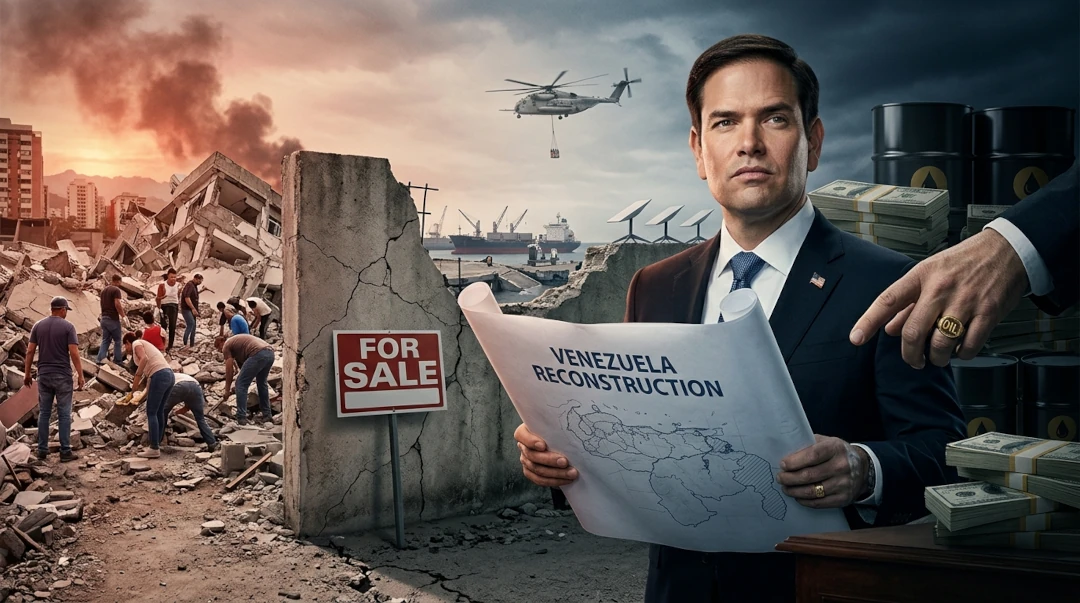
Ruins for Sale: How the White House Is Turning Venezuela’s Earthquake Into a Corporate Land Grab
The president is calling it the largest disaster response in a generation. Strip away the press releases and the reality is unmistakable: $300 million in aid theater while $10 billion of Venezuela’s own money stays frozen, a two-year Starlink contract signed thirteen days before the ground even shook, and a president who has publicly said the quiet part out loud — this is about the oil.
On June 24, twin earthquakes measuring 7.2 and 7.5 tore apart the coast west of Caracas. Buildings pancaked. The Port of La Guaira collapsed. Hospitals filled and then, in some places, buckled themselves. Venezuela’s foreign minister now puts the death toll above 3,600, with nearly 17,000 injured. The United Nations Development Programme has placed the material damage at $37 billion — roughly a third of Venezuela’s entire GDP. This is one of the worst natural disasters in the country’s modern history, and it landed on a nation already hollowed out by nearly a decade of American economic warfare.
Within forty-eight hours, the Trump administration announced what Secretary of State Marco Rubio promised NPR would be a “big, fast, and effective” response. On paper, the numbers arrived quickly: $150 million within twenty-four hours, then $300 million, and now more than $386 million. The USS Fort Lauderdale steamed to La Guaira. C-17s ferried in urban search-and-rescue teams from Fairfax County, Los Angeles County, and Miami-Dade. SOUTHCOM tweeted heroic photographs of Marines climbing rubble. It is, by the White House’s own framing, a resurrection of American humanitarian power after the same administration dismantled USAID earlier in the year.
But this is a case where the press release and the policy point in opposite directions. Once you follow the money, the corporate logos, and the president’s own words, the response begins to look less like a mercy mission and more like a carefully staged prospectus for the next phase of what Donald Trump himself has christened the “Donroe Doctrine” — a modern imperial claim over the Western Hemisphere’s resources dressed up in the language of humanitarian assistance.
I. The Money That Isn’t Money
The $386 million pledge is real. It is also, when set against the scale of the catastrophe, cosmetic. The United Nations puts reconstruction needs at $37 billion. Even the more conservative UNDP damage estimate — $6.7 billion for homes and infrastructure alone — dwarfs the American commitment by more than seventeen to one. Meanwhile, the far larger sum sits in a place no press release mentions: Venezuela’s own vaults, held abroad.
Writing at Just Security, economists Francisco Rodríguez and George A. Lopez document that at least $10 billion in Venezuelan central bank holdings — cash and special drawing rights — remain blocked by U.S. sanctions and foreign policy directives, despite a limited license issued in April. Economist Asdrúbal Oliveros estimates total frozen Venezuelan assets abroad at roughly $22 billion, with about $8 billion of oil-sale proceeds under direct U.S. Treasury control. The Tricontinental Institute puts the aggregate figure at more than $30 billion in Venezuelan public assets held out of reach. This is Venezuela’s money. It could rebuild every hospital in La Guaira several times over. It is not being released.
The Treasury did issue Venezuela-related General License 60 on June 25, authorizing earthquake-related transactions. The catch is in the fine print: it expires on October 23, 2026 — a total of 120 days. Rodríguez and Lopez are blunt about what that timeline actually purchases: “A few months of relief is not a serious response to an emergency of this scale.” They recommend extending the license for at least two years to cover reconstruction. The administration has done no such thing.
Compounding the mockery, banks routinely refuse to process even authorized humanitarian payments. The same Just Security analysis notes that “even when food and medicine are formally exempt from sanctions, banks routinely refuse to process the payments, fearing they could be penalized for an inadvertent violation.” Washington is telling the world it has opened the tap. The plumbing tells a different story.
The State Department’s latest total commitment, largely channeled through vetted contractors and faith-based NGOs. Not directly disbursed to the Venezuelan state.
Cash and SDRs held out of reach despite an April license. Rodríguez and Lopez, Just Security.
Estimated by the Tricontinental Institute. Includes 31 tonnes of gold held at the Bank of England.
Unilateral coercive measures still in effect against Venezuela, per the Tricontinental Institute.
More than one hundred economists and scholars — organized by the Center for Economic and Policy Research — signed a letter this week demanding immediate action to unfetter Venezuela’s humanitarian response from ongoing sanctions, asset freezes, and debt burdens. Their warning is precise: sanctions on the central bank, public banking, and oil sector do not, as the letter puts it, “land surgically on officials”; they collapse the plumbing of an entire economy.
“Venezuela’s people must not be made to pay twice: first through disaster, and then through sanctions, frozen assets, and unpayable debt.”
— Letter of 100+ Economists and Scholars, organized by CEPR, July 2026
II. The Logistics of a Photo Op
The military footprint is real too. The Trump administration is right when it says a Disaster Assistance Response Team of more than 250 people is on the ground, that three specialized Urban Search-and-Rescue teams brought more than 200,000 pounds of specialized equipment, and that MV-22 Ospreys and C-17s have transported search and rescue crews to the epicenter. In the first days after an earthquake, this is the work that saves lives. Nobody serious disputes it.
The dispute is over what happens next. The days after a disaster are for pulling people from rubble. The years after are for rebuilding grids, water systems, hospitals, and homes. As Refugees International president Jeremy Konyndyk, who ran USAID’s disaster response under President Obama, told NPR, “The administration clearly wants to avoid a black eye of not deploying a robust immediate response, but whether they will sustain the kind of follow through that can save lives in the months that follow, I think that’s an open question.” He was being generous.
Because the same administration that is now surging military hardware into Venezuela is also the one that gutted USAID earlier this year, sent $9 million and three people to Myanmar after a 2025 earthquake that killed more than 3,500, and abolished the very institutional muscle that would normally be doing this work. The Venezuela response is not a repudiation of that policy. It is the exception that proves the rule — a country where the president has publicly said the United States has direct commercial interests, receiving a level of care no other victim of natural disaster has been offered under this White House. The scale of the response is not humanitarian principle. It is portfolio management.
An amphibious ship offshore and a few weeks of cargo flights can distribute rations. They cannot rebuild La Guaira’s collapsed regional electrical grid, restore its ruined water infrastructure, or reconstitute a hospital system that had already lost between 30 and 50 percent of its skilled personnel to sanctions-driven emigration before the earthquake. That kind of rebuilding requires enormous, patient capital — and the release of the very assets the White House refuses to unfreeze.
Get Involved Today
Contribute to our mission and turn your concerns into action.
III. The Starlink Tell
Nothing exposes the true architecture of this response like the Starlink deal. On June 11, 2026 — thirteen days before the earthquake struck — the State Department quietly signed a two-year Memorandum of Understanding with Elon Musk’s Starlink. The signing announcement described it as a general framework for future disaster response. In practice, the ink was barely dry when Venezuela became “one of the first major activations of this partnership.”
The U.S. Chamber of Commerce Foundation, in its own coordination call with State Department officials, reported that the partnership involves providing 1,600 Starlink units on the ground. On that same call, a State Department official told American companies, in words that should end any pretense about what this response is for: “There’s a strong commercial intersection here. If there’s any use case where you’re best likely to be involved — in the energy sector, the water sector, or any other sectors — please contact those of us here at State Department. We’d love to see where you fit into this response.”
That is not the language of an emergency response. That is the language of a trade show. And it exposes the underlying logic of the entire operation: an American humanitarian intervention branded as a private-sector market opening, with the State Department acting as the pipeline.
Starlink is not, by itself, evil in a disaster zone. Rapid connectivity saves lives. But a two-year MOU signed before the earthquake, “free” service that still requires new customers to buy a Starlink receiver to access the network, and 1,600 units seeded into a country whose telecommunications ministry has been publicly hostile to Washington for two decades — that is not disaster relief. That is a corporate footprint being planted, at public expense, in a market the U.S. government has spent seven months prying open by force. The Venezuelan earthquake did not create the Starlink deal. It activated one already sitting on the shelf.
The same logic runs through the entire private-partner ecosystem. Walmart mobilized in South Florida through Global Empowerment Mission. Amazon just launched a weekly humanitarian air bridge from Miami to Maiquetía. Each of these arrangements is defensible in isolation. Stacked together — a private satellite monopoly, a private retailer, a private airline logistics provider, and $50 million routed through South Florida faith-based NGOs — they add up to something recognizable: the substitution of American public capacity with American private capacity, on the taxpayer’s dime, on foreign soil.
“Right now, what we want to do is fix up the oil… We’re going to have our very large United States oil companies — the biggest anywhere in the world — go in, spend billions of dollars, fix the badly broken infrastructure — the oil infrastructure — and start making money for the country.”
— President Donald J. Trump, describing U.S. objectives in Venezuela after the Maduro capture, January 2026
IV. The Donroe Doctrine, Applied
This is the context the president himself provided, in his own words, six months before the earthquake struck. In January 2026, after U.S. forces captured Nicolás Maduro and installed interim President Delcy Rodríguez, Trump was asked whether the administration would push for free and fair Venezuelan elections. His answer, reported by The New Republic: “Well, it depends… We’re going to have to have big investments by the oil companies.” Asked whether he would demand amnesty for opposition figures or release of political prisoners, he answered: “We haven’t gotten to that. Right now, what we want to do is fix up the oil.”
The president is not hiding this. He has coined a name for it. The “Donroe Doctrine” — a vanity riff on the Monroe Doctrine — is his shorthand for hemispheric dominance under U.S. corporate management. Foreign Policy’s Stephen M. Walt described the strategic logic, or absence of it: not a coherent foreign policy so much as a mechanism for delivering resource extraction rights to American oil majors. The Union of Concerned Scientists put the point even more sharply, writing that the Venezuela operation is “another manifestation of the Trump administration’s deep ties to Big Oil and its naked prioritization of private profit and corporate interests over the public interest.”
The earthquake did not disrupt this project. It accelerated it. Where else does a president get to send warships, cargo planes, satellite terminals, and vetted private contractors into a country his government spent seven months seizing, and call it a humanitarian mission? Where else does the phrase “reconstruction” become a euphemism for restructuring an entire economy around American corporate access? The answer is: nowhere. This is the doctrine operating exactly as advertised.
V. The Sequence That Tells the Story
VI. The Domestic Cost
None of this happens in a vacuum. The same president who found $386 million for Venezuela in six days spent the first quarter of 2026 dismantling the disaster response infrastructure that would have prevented such improvisation. He gutted USAID. He fired career diplomats. He installed loyalists at Treasury. And he did all of it while bipartisan concerns about his mental fitness were escalating in Congress.
Consider what this response actually signals about presidential decision-making. The president is willing to surge resources when he perceives a personal or commercial interest, and to withhold them when he does not. Myanmar’s dead did not have oil under their feet. Jamaica’s after Hurricane Melissa in 2025 did not. Venezuela’s do. This is not foreign policy. It is portfolio allocation, conducted from the Oval Office, with the resources of the United States government treated as venture capital for allied billionaires. The coalition letter to Trump and Rubio from Just Foreign Policy, the Latin American Working Group, the Quincy Institute, and CEPR could not be clearer: “Anything short of a full lifting of sanctions will hobble the overall response before it gets off the ground.” A president operating in the national interest, rather than his own, would have already done it.
The 25th Amendment Was Written for Exactly This
Section 4 of the Twenty-Fifth Amendment permits the Vice President and a majority of the Cabinet — or another body designated by Congress — to declare that a president is “unable to discharge the powers and duties of his office.” The amendment does not define “unable.” It does not define “inability.” The framers, working in the aftermath of the Kennedy assassination and Woodrow Wilson’s concealed stroke, chose that ambiguity deliberately. They understood that no fixed medical definition could anticipate every form presidential incapacity might take. The test is functional, not diagnostic.
What the drafters did not want to write into the Constitution — but what the record of the 1965 Senate hearings makes plain — is that “inability” was meant to reach not only comatose presidents, but presidents who could speak and move but could no longer, in Senator Birch Bayh’s phrase, meaningfully “discharge” the office. The category was designed to be capacious precisely because it needed to hold.
A president who redirects the machinery of American disaster response toward corporate partners who financed his campaign, who admits on camera that “what we want to do is fix up the oil” while people are trapped under rubble, who signs a two-year contract with a private satellite monopoly thirteen days before invoking it in an active disaster zone — is that a president discharging the office? Or is that a president who has confused the office with a family business? The Constitution allows Congress and the Cabinet to answer that question. It does not require them to wait for a medical emergency.
Who Has Already Called For It
On April 14, 2026, House Judiciary ranking member Rep. Jamie Raskin (D-Md.) introduced legislation to establish a bipartisan “Commission on Presidential Capacity to Discharge the Powers and Duties of the Office.” Fifty House Democrats co-sponsored. Raskin’s statement was direct: “We are at a dangerous precipice, and it is now a matter of national security for Congress to fulfill its responsibilities under the 25th Amendment.”
On April 30, Senators Sheldon Whitehouse and Jack Reed entered a statement into the Congressional Record signed by 36 physicians — neurologists, psychiatrists, and cognitive specialists from Harvard, Tufts, Columbia, and George Washington — describing what they called a “rapidly worsening, reality-untethered, increasingly dangerous decline.” Rep. Alexandria Ocasio-Cortez has publicly joined the call. So has Rep. Al Green (D-Tex.). Even the International Bar Association has revisited the amendment’s Section 4 as a live question, not a hypothetical one.
The Practical Barriers Are Real
Section 4 requires action by Vice President JD Vance and a majority of a Cabinet the president himself selected. That is unlikely. The Raskin commission bill sits in a Republican-controlled House. That too is unlikely to pass. None of this is a secret.
Why the Barriers Do Not Retire the Case
The moral and constitutional record must still be built. Section 4 was designed, in part, to force a political conversation — to put the question of a president’s capacity into the public sphere so the electorate, Congress, and history can weigh it. The commission bill matters even when it does not pass. The physicians’ statement matters even when it is not acted on. Because the alternative — treating a president who openly conducts foreign policy as personal enrichment as if he were merely eccentric — is not neutrality. It is complicity. The framers left “inability” undefined so that a serious Congress would define it when the moment came. This is the moment.
Editorial Conclusion
A functioning administration does not sign a two-year Starlink deal thirteen days before invoking it in someone else’s earthquake. A functioning administration does not freeze $10 billion of a devastated nation’s own money while pledging a fraction of that in aid. A functioning administration does not treat the machinery of American disaster response as a marketing channel for the president’s donor class.
What is happening in Venezuela is not humanitarianism. It is disaster capitalism, conducted under the banner of the American flag, by a president who has repeatedly told the country that his interests and the country’s are the same thing. They are not.
The 25th Amendment does not require unanimity. It requires seriousness. Congress must convene the Commission on Presidential Capacity. The Cabinet must be forced to answer, on the record, whether a president openly running foreign policy as a private business meets the constitutional standard of ability to discharge the office. And every voter in this country must decide whether the machinery of American power will keep being auctioned off in the aftermath of tragedies — or whether the republic still means something when the cameras leave.
Sources & References
- U.S. Department of State — “Update on the Trump Administration’s Continued Delivery of Life-Saving U.S. Assistance to Venezuela” (July 2026)
- U.S. Department of State — “Update on the Trump Administration’s Robust and Rapid Delivery” (June 29, 2026)
- U.S. Department of State — “Trump Administration Leads a Robust Life-Saving Response” (June 26, 2026)
- U.S. Department of State — “United States and Starlink Announce Cooperation on Critical Disaster Response” (June 11, 2026)
- U.S. Department of State — “Responding to Venezuela Earthquakes” (Landing Page)
- The Washington Post — “After gutting foreign aid, Trump goes big on Venezuela earthquake relief” by Adam Taylor (July 2, 2026)
- NPR — “U.S. pledges generous earthquake relief to Venezuela” (June 26, 2026)
- Just Security — “To Help Venezuelans After the Quake, End U.S. Sanctions” by Francisco Rodríguez and George A. Lopez
- Common Dreams — “100+ Economists, Scholars Demand End to Sanctions on Venezuela”
- Common Dreams — “As Post-Quake Misery Mounts in Venezuela, Demand Grows for Total End to US Sanctions”
- Euronews — “Venezuela calls for release of frozen assets to help earthquake recovery efforts” (July 8, 2026)
- Tricontinental Institute — “Red Alert no. 22: Truth Amid the Rubble”
- Foreign Policy — “Trump’s ‘Donroe Doctrine’ for Venezuela Makes No Sense” by Stephen M. Walt
- The New Republic — “The Donroe Doctrine Is a Scam”
- Oil Change International — “Trump’s reckless grab for power, riches, and oil in Venezuela”
- Union of Concerned Scientists — “President Trump’s Imperial and Illegal Grab for Venezuelan Oil”
- The Hill — “Rep. Jamie Raskin introduces bill to assess president’s fitness under 25th Amendment”
- The Hill (Opinion) — “Concerns Grow Over Trump’s Mental Fitness for Presidency”
- House Judiciary Committee Democrats — “Raskin Demands White House Physician Immediately Evaluate Donald Trump’s Cognitive Fitness”
- U.S. Chamber of Commerce Foundation — “Earthquakes in Venezuela Coordination Call Recap”
- PBS NewsHour — “Venezuelan medics fear earthquake aftermath will trigger widening medical crisis”
- The Hill — “Venezuela earthquakes deepen rift between GOP hawks and Trump-backed regime”
- Central Oregon Daily / USA TODAY — “Free Starlink in Venezuela helps recovery after deadly twin earthquakes”
- ABC News — “Trump’s vow to ‘run’ Venezuela, sell oil, part of plan to dominate Western Hemisphere”
- Green Left — “The political, social and economic impact of Venezuela’s twin earthquakes”
- International Bar Association — “President Trump and the 25th Amendment”
Related News