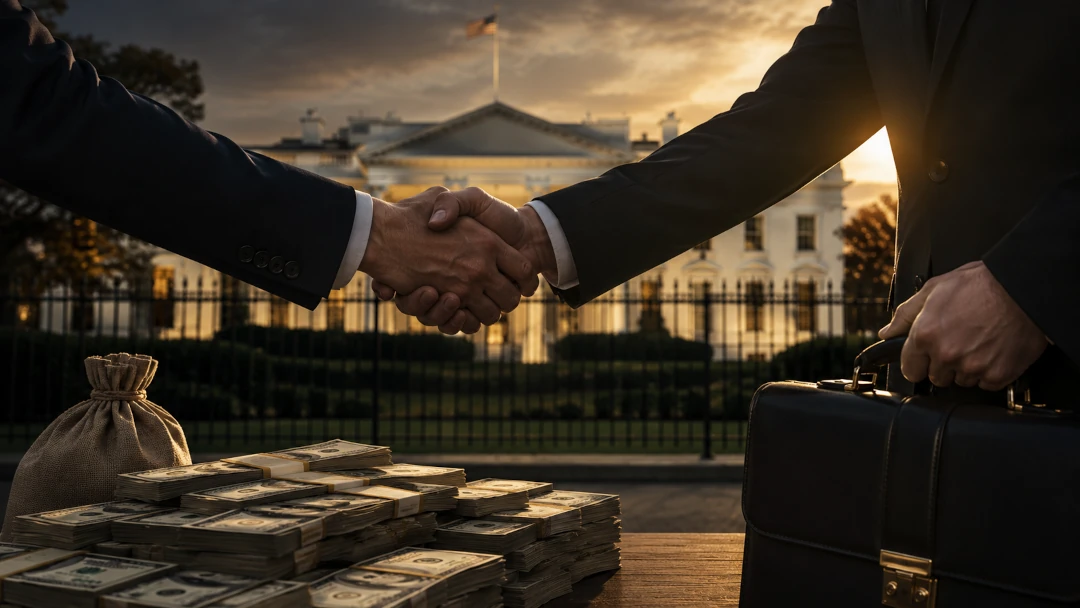
Access for Sale. A President for Hire.
A former Trump-world operative has confirmed what watchdogs, senators, and financial disclosures have been screaming for a year: the West Wing is running a pay-to-play marketplace where the highest bidder gets favorable rulings, dropped lawsuits, dismissed investigations, and rewritten regulations. The country is paying the bill in food, medicine, and rent.
The whistleblower testimony reported this week by More Perfect Union — a former insider describing a network of MAGA-aligned lobbyists in Washington who, in the whistleblower’s own framing, can get corporations “anything you want from the White House, legal or not” — is not a scoop out of nowhere. It is the missing narrator for a stack of documents already sitting in plain sight. Federal lobbying disclosures. Senate Banking Committee letters. Financial statements from Trump’s own personal disclosure form. Court dockets in dropped SEC cases. What the whistleblower supplies is the confession that the rest of us have been reading around for eighteen months.
The picture that emerges is not the cartoon of a rogue president acting alone. It is the picture of an institution: an established, staffed, well-funded corridor between corporate America and the Oval Office, marketed openly, billed monthly, and paid for — indirectly — by every American who has lost food assistance, health coverage, or a shot at affordable housing to fund the tax cuts that reward the buyers on the other end.
I. The Storefront on K Street
Three lobbying firms sit at the center of the operation, and their names appear again and again on federal disclosures: Ballard Partners, founded by longtime Trump fundraiser Brian Ballard; Miller Strategies, founded by Trump 2025 inaugural finance chair Jeff Miller; and Michael Best Strategies, a firm led by former Republican National Committee chair Reince Priebus. The scale of the trade they are running is not a matter of dispute; it is a matter of arithmetic.
According to a February 2026 analysis by the investigative outlet Sludge, six Trump-tied firms pulled in $145 million from new lobbying clients in 2025 alone, with Ballard Partners’ revenue quadrupling year-over-year to a record $88.1 million. ABC News reported that Ballard’s firm made $14.3 million in the first quarter of 2025, and that its client roster now includes Blue Origin, Palantir, Nasdaq, the NFL, TikTok, and the Kingdom of Saudi Arabia. Miller Strategies signed more than 100 new clients in 2025, including OpenAI and SoftBank.
Ballard Partners — 2025 Revenue
A nearly fourfold increase over 2024, per Sludge’s analysis of OpenSecrets data. More than 200 new federal clients signed in a single year.
Miller Strategies — 2025 Growth
Founder Jeff Miller served as finance chair for Trump’s 2025 inaugural committee. Firm’s revenue tripled over 2024, taking in over $27.3 million in new business.
The Bondi Pipeline
Attorney General Pam Bondi and White House Chief of Staff Susie Wiles both worked at Ballard Partners before joining the administration, according to CBS News reporting. The firm now lobbies the agencies they run.
The Ballroom Donor Overlap
CBS News found that the majority of corporate donors to Trump’s $300 million private White House ballroom project are represented by Ballard, Miller, or Michael Best. Guests dined with Trump in the East Room while their firms lobbied his cabinet.
What the whistleblower confirms is that this is not a coincidence of demand meeting supply after an election. It is a marketed service. The pitch, according to reporting synthesized across ABC News, Sludge, and Jacobin, is uncomplicated: retain the right firm, cut the right check to the right Trump-adjacent vehicle — the inaugural committee, the presidential library foundation, the ballroom fund, the meme coin — and the door opens.
II. How the Cabinet Became the Client Roster
The revolving door has not simply spun; it has fused. Attorney General Pam Bondi lobbied at Ballard until her January 2025 confirmation. White House Chief of Staff Susie Wiles was Ballard’s Florida managing partner from 2011 to 2022. The two most consequential gatekeepers in Trump’s second-term government — the person who decides who gets prosecuted, and the person who decides who gets a meeting — came from the same firm that is now the highest-earning lobby shop in Washington, and that firm’s clients are, in many cases, precisely the entities benefiting from those decisions.
Sen. Elizabeth Warren, ranking member of the Senate Banking Committee, has been among the most direct in naming the pattern. Addressing the Council of Institutional Investors, Warren told an audience of $5 trillion in assets under management that “money talks with the Trump Administration” and that markets face corruption “so massive and so unprecedented that it could literally break our entire financial system.” She has separately characterized the second term as a “non-stop Trumpian extravaganza of corruption and incompetence.”
“Corporations came knocking at the White House door to get their pro-monopoly deals approved.”
— Sen. Elizabeth Warren (D-Mass.), Open Markets Institute, June 24, 2026
III. The Receipts, In Chronological Order
Every element of the whistleblower’s testimony can be corroborated with a public document — an agency decision, a lobbying filing, a settlement. What follows is not speculation. It is a timeline built entirely from named reporting.
Ripple Labs gives $4.9 million to the Trump-Vance Inaugural Committee days after Election Day and hires Ballard Partners. Payward (parent of Kraken) gives $1 million. Blockchain.com also retains Ballard, per ABC News.
Paul Atkins’ SEC drops the Biden-era securities fraud case against Ripple, reducing the penalty to a $125 million fine, as Jacobin documented. Ripple had by then paid Ballard Partners roughly $260,000 to lobby on crypto regulation.
Justice Department, under Bondi, cancels its antitrust challenge to American Express Global Business Travels’ $540 million acquisition after Amex paid Ballard $200,000 to lobby DOJ on antitrust, per Jacobin’s review of disclosures.
DOJ signs off on UnitedHealth’s $3.3 billion acquisition of Amedisys, expanding the insurance conglomerate into end-of-life hospice care. UnitedHealth had paid Ballard more than any other client that year — part of a $7.8 million lobbying blitz, double its 2024 spend.
Trump’s DOJ announces a surprise settlement with Live Nation/Ticketmaster days into trial — a “slap on the wrist” fine of $280 million, according to MSNBC’s Michael Cohen. Live Nation had “hired Trump administration-favored lobbyists” specifically to settle. A federal jury ruled against the company anyway on the underlying monopoly.
The Justice Department dismisses a criminal probe of Abbott Laboratories’ baby formula facility for potentially life-threatening contamination. Abbott had donated more than $500,000 to Trump’s inauguration and has ties to a cabinet member, per More Perfect Union’s reporting.
Trump’s annual financial disclosure reports $2.2 billion in 2025 income — with $1.4 billion from crypto ventures including World Liberty Financial and the $TRUMP meme coin, per ABC News. Paramount, Disney, and Meta legal-settlement payments were directed to the Trump Presidential Library Foundation.
Get Involved Today
Contribute to our mission and turn your concerns into action.
IV. When the President Personally Trades on the Trades
The lobbying scheme sits inside a larger pattern in which the president has become an active participant in the markets he regulates. Financial disclosures reviewed by NOTUS show that Trump made more than 3,600 stock trades in the first three months of 2026, and that several of them coincided with imminent policy decisions his own administration was about to announce. On February 10, according to that reporting relayed by Common Dreams, Trump purchased between $1 million and $5 million of Nvidia stock — one week before Nvidia announced a major computing deal with Meta and days before the Commerce Department signed off on advanced chip sales to the United Arab Emirates, whose national security advisor had personally invested half a billion dollars into Trump’s crypto company.
Asked directly whether the SEC should investigate the president, Treasury Secretary Scott Bessent repeatedly refused to answer, telling Warren that Trump “is not sitting in the Oval Office engaging in high frequency trading” — a defense that concedes the trades happened but pretends the beneficiary was unaware. As The New Republic noted, if these trades were made on inside information, they would clearly be illegal.
The pattern extends into the president’s own family. Sen. Warren, joined by Sens. Richard Blumenthal and Andy Kim, wrote to the Pentagon in January and again in June 2026 after ProPublica reported that the White House had personally intervened to secure a $620 million Defense Department deal for a company tied to Donald Trump Jr.’s venture capital firm, 1789 Capital. The senators’ letter uses the phrase “influence peddling” and asks, in effect, whether Pentagon procurement is now being routed through the president’s family portfolio.
V. Who Actually Pays
Every dollar that flows into the presidential library, the inaugural fund, the ballroom foundation, or the meme coin has to come out of the economy somewhere. The One Big Beautiful Bill Act — signed on July 4, 2025 — is where the bill was passed to the American public. The math is almost obscene in its clarity.
SNAP / Food Assistance
Americans lost food benefits between July 2025 and February 2026, per Center on Budget and Policy Priorities data reported by CNBC. The OBBBA cut $187 billion — the largest reduction in program history.
Medicaid Coverage
People at risk of losing Medicaid under new work-reporting rules, per Urban Institute analysis. The AMA estimated 11.8 million uninsured. CBO projects $1 trillion in total Medicaid cuts through 2034.
Housing Assistance
People — over half of them children — at risk of losing rental assistance under HUD’s proposed time limits and work requirements, per the Center on Budget and Policy Priorities. HUD’s FY26 budget proposed a 43% cut to rental assistance.
Tax Cut for the Top 1%
Over ten years — larger than the total net tax cut for the bottom 80% of Americans combined, per ITEP analysis. Households under $15,000 face a projected 9% tax increase in 2027.
Consider the shape of that trade. The lobbying clients whose deals have been rubber-stamped — UnitedHealth, expanding into hospice on the same Medicaid system now being cut by a trillion dollars; Live Nation, whose settlement kept ticket prices high while millions of concertgoers pay them; the crypto firms whose regulatory relief just added $1.4 billion to the president’s personal net worth — these are the winners. The losers are named too. They are named in the CBPP data. They are named in the PBS interview with Harvard’s Sara Naomi Bleich, who noted that food insecurity is rising nationwide as a direct result of the law. They are named in NBC News reporting from Arizona, where 51% of SNAP beneficiaries have been cut off, and where Brookings fellow Lauren Bauer called the new work requirements “a cruel policy to try to use hunger as leverage over people.”
“These SNAP cuts — the largest reductions to food assistance in modern history — are increasing hunger.”
— NY Attorney General Letitia James, coalition letter to Senate, June 2026
The wealth divide, meanwhile, is the widest it has been in at least a generation, according to Federal Reserve figures cited by NBC. The Congressional Budget Office finds that households in the bottom decile lose roughly $1,200 per year under the combined tax-and-spending package, while households earning over $700,000 gain roughly $13,600. The Yale Budget Lab estimates the top 0.1 percent gain about $97,260 per household. This is not the incidental math of a policy tradeoff; it is the policy.
VI. What This Says About the Man in the Chair
A president’s calendar and a president’s budget are moral documents. They tell you what he thinks his time and the country’s money are for. This president’s schedule is dominated by ballroom dinners with lobbying clients and social-media stock announcements. This president’s budget is dominated by cuts to food, medicine, and shelter for the people who cannot afford lobbyists. This is not a hidden agenda. It is the agenda.
Rep. Josh Shapiro of Pennsylvania has accused the administration of “rewriting history” as it purges cultural institutions. Sen. Warren has warned that markets themselves are being corrupted at a scale that could “break our entire financial system.” Rep. Jamie Raskin, the ranking Democrat on House Judiciary, has cited “unprecedented lows” in public trust regarding Trump’s ability to meet the duties of his office. Sen. Chris Murphy of Connecticut, after a particularly unhinged Truth Social post threatening Iran, publicly called on cabinet members to “spend Easter calling constitutional lawyers about the 25th Amendment.”
What the Founders left undefined — and why it matters now.
The Twenty-Fifth Amendment, ratified in 1967 after the Kennedy assassination, contains a phrase its drafters chose with intent. It authorizes the Vice President and a majority of either the Cabinet or an “other body as Congress may by law provide” to declare a president “unable to discharge the powers and duties of his office.”
The record makes clear that section four was not intended as a means of removing the president simply because he or she makes an unpopular decision.
That caveat, from Fordham law professor Joel Goldstein via PBS NewsHour, is honest and important. But the drafters also deliberately declined to define the word unable. Legal experts told PBS the language is “intentionally vague and open-ended” because the framers “recognized they couldn’t predict every scenario in which a president could be deemed disabled.” Inability was left elastic on purpose. The framers were not thinking only of coma or stroke. They were thinking of a spectrum of impairment — cognitive, temperamental, and, yes, ethical — that would leave the officeholder unfit to execute the public trust.
A president who is spending his days directing federal contracts to his son’s firm, timing stock purchases to his own agency’s announcements, personally soliciting corporate payments through a ballroom foundation, and running lobbying-client policy through cabinet officials drawn from those same lobbying firms is not “discharging the powers and duties of his office.” He is discharging them in the wrong direction. The office exists to serve the public. It is being run to serve a client roster.
On April 14, 2026, Rep. Jamie Raskin introduced legislation to create the Commission on Presidential Capacity to Discharge the Powers and Duties of Office — the “other body” the amendment envisions but that Congress never created. As Raskin put it, Congress has “a solemn duty to play our defined role under the 25th Amendment by setting up this body.” More than 85 House and Senate Democrats had by then called for Trump’s removal, per Axios reporting.
The honest assessment of the barriers. Section 4 requires the Vice President plus a Cabinet majority (or the Raskin commission) to trigger the transfer. That will not happen: the Vice President will not move, the Cabinet will not move, and Republican leadership in Congress will not entertain the two-thirds vote a contested removal would require. Any candid analyst has to say so.
Why the barriers do not negate the case. A constitutional argument does not lose its force because the political path is closed. The record is being made now, and it will be examined later — by historians, by courts reviewing the corruption cases that will eventually be brought, and by future Congresses considering whether to finally stand up the Section 4 body Raskin has proposed. The measure of a democracy is not only what it manages to fix in the moment. It is whether it names, clearly and on the record, what has gone wrong.
VII.The Country the Whistleblower Describes
Strip the story down to one sentence, and here it is: a set of connected operatives is selling access to a president who has effectively agreed to be sold, while the government’s remaining resources are being pulled out of the households of the poorest Americans and handed to the buyers as tax cuts, dropped cases, and rubber-stamped mergers. That is not a partisan gloss. It is the arithmetic of the disclosures.
Every institution that could push back — the SEC, the DOJ, the Office of Government Ethics, the Cabinet, the Republican-controlled Congress — has either been captured, staffed with the lobbyists themselves, or persuaded that silence is politically survivable. The one institution that has not been captured is the record. That record is what the More Perfect Union whistleblower has added to. It is what Senate letters, ProPublica, ITEP, CBPP, and the CBO keep adding to. It is what makes the constitutional case — even when the political case cannot yet be won.
Editorial Conclusion
A presidency is not a franchise, and the executive branch is not a concierge service for the president’s donor list. The whistleblower’s testimony is not a scandal to be litigated in the next news cycle. It is confirmation of a governing philosophy already visible in every federal disclosure filed since January 2025 — one in which the powers of the office have been retasked from the public to a paying clientele.
The 25th Amendment left the word “unable” undefined because the framers understood that fitness for the presidency is not only a medical question. It is a question of whether the officeholder is discharging the duties of the office at all, or is instead discharging the interests of paying customers under color of authority. On the evidence now sitting in the public record, this president is doing the second, not the first.
That is what must be named. That is what must be documented. And that is what the next Congress, the next electorate, and the next generation of prosecutors will have to answer for — regardless of whether this one does.
Sources & References
- More Perfect UnionTrump Whistleblower Exposes the New Corporate Playbook to Rig the Economy, July 2026.
- Sludge (Donald Shaw)K Street’s Trump Boom, February 13, 2026.
- ABC NewsTrump-aligned lobbyists flourish as companies flock to try to gain administration’s favor, April 23, 2025.
- CBS NewsMajority of corporate Trump ballroom donors represented by 3 lobbying firms, November 19, 2025.
- JacobinBallard Partners Is the Lobbyist King of the Trump Era, August 11, 2025.
- U.S. Senate Banking Committee (Warren)Warren Delivers Warning to Institutional Investors on Trump’s Corruption, 2026.
- MSNBC (Michael Cohen)The Live Nation verdict is a faceplant for the Trump administration, April 17, 2026.
- ABC NewsReal estate, watches and guitars: Trump’s 2025 $2.2B income, July 2026.
- Common Dreams (Jake Johnson)Citing Shady Stock Trades, Warren Asks Bessent If SEC Should ‘Be Knocking on President Trump’s Door’, June 4, 2026.
- The New RepublicTreasury Sec. Attacks Elizabeth Warren in Freakout Over Trump’s Stocks, June 3, 2026.
- U.S. Senate (Warren, Blumenthal, Kim)Letter to White House on 1789 Capital / Trump Jr. Pentagon Contracts, June 2, 2026.
- CNBCAt least 3.5 million people have lost food stamp access as Trump’s ‘big beautiful bill’ cuts take effect, May 30, 2026.
- PBS NewsHourMillions lose SNAP benefits as OBBBA’s stricter requirements kick in, 2026.
- NBC NewsChildren in Arizona are going hungry because of Trump’s food stamp cuts, May 12, 2026.
- Urban InstituteMedicaid Cuts in the OBBBA Leave 3 in 10 Young Adults Vulnerable, August 7, 2025.
- Center on Budget and Policy PrioritiesNearly 3.7 Million People at Risk of Losing Rental Assistance, April 24, 2026.
- Institute on Taxation and Economic Policy2025 Trump Tax Law One Year In: Who Won, Who Lost, June 2026.
- House Judiciary DemocratsRaskin Introduces Commission on Presidential Capacity Legislation, April 14, 2026.
- PBS NewsHourCould the 25th Amendment be invoked against Trump? Here’s how it works, April 2026.
- AxiosHouse Democrats file long-shot 25th Amendment bill targeting Trump, April 14, 2026.
- NY Attorney General Letitia JamesAG James Urges Congress to Restore SNAP Benefits, June 2026.
- National Constitution CenterThe 25th Amendment: Presidential Disability and Succession — Full Text.
Related News