The Court’s Capitulation: A Power Unknown Even to the English Crown
In overturning ninety years of settled precedent, the Supreme Court has handed Donald Trump a presidency without brakes — and made the constitutional case for the 25th Amendment more urgent than the political moment may yet allow it to be.
On a single Monday morning in late June, six justices of the United States Supreme Court rewrote the architecture of the federal government. In Trump v. Slaughter, the conservative majority overturned Humphrey’s Executor v. United States — the 1935 precedent that for nine decades had shielded independent regulatory commissions from the political whims of any one president. The vote was 6 to 3. The author was Chief Justice John Roberts. And the consequence, as Justice Sonia Sotomayor warned from the bench in a rare oral dissent, is a President with “far greater power than ever before” — a power, she wrote, that neither the People, nor Congress, nor the Constitution ever granted him.
The ruling did not arrive in isolation. It came stapled to a second decision, Trump v. Cook, in which the same Court declined to let the President fire Federal Reserve Governor Lisa Cook. Together, the two opinions tell a story the majority did not intend to tell: that the constitutional principle being announced is not a principle at all, but a result. The Federal Reserve survives because the markets demand it. The Federal Trade Commission, which polices monopolies and consumer fraud, does not.
This is the moment to be honest about what just happened. The Supreme Court did not simply resolve a separation-of-powers dispute. It dismantled the legal foundation on which the modern administrative state has rested since the New Deal — and it did so on behalf of a President whose personal conduct has provoked thirty-six physicians to publicly declare him mentally unfit, whose own party’s congressional leaders have called him erratic, and whose impulses now reach every corner of American economic life without statutory restraint.
1. What the Court Actually Did
The case began in March 2025, when President Trump fired Federal Trade Commissioner Rebecca Kelly Slaughter — a Democrat appointed to her seat by Trump himself in 2018 and reappointed by Joe Biden in 2024. The letter informed her only that her continued service was inconsistent with the administration’s priorities. No cause was cited, because none could be: the Federal Trade Commission Act of 1914 permits removal of a commissioner only for “inefficiency, neglect of duty, or malfeasance in office,” and Slaughter had committed none of these.
The federal district court ordered her reinstated. The D.C. Circuit agreed. The Supreme Court, on its emergency shadow docket, intervened in September 2025 to let the firing stand while the case was argued — and on Monday, the same six conservative justices made the result permanent by overruling Humphrey’s Executor outright.
Roberts, writing for the majority, reasoned that the FTC today administers some eighty federal statutes and exercises substantial executive authority. Officers who execute the law, he wrote, must answer to the Chief Executive. Justice Neil Gorsuch’s concurrence put it more bluntly, declaring that independent agencies are no longer independent at all. The implications are immediate and vast. Per the ruling’s logic, the President now possesses the unilateral authority to fire commissioners at the National Labor Relations Board, the Equal Employment Opportunity Commission, the Federal Energy Regulatory Commission, the Nuclear Regulatory Commission, the Consumer Product Safety Commission, the Merit Systems Protection Board, and most other multi-member regulatory bodies Congress has created over the last century.
2. Sotomayor’s Dissent: A Warning From the Bench
That Justice Sotomayor read her dissent from the bench is itself a signal. She does this rarely; the practice is reserved for decisions she considers fundamentally wrong in ways the country must be told about directly. Joined by Justices Elena Kagan and Ketanji Brown Jackson, she did not soften the indictment.
The majority, she wrote, had distorted the structure of government to fit a theory of unitary, total executive control. She compared the practical effect to a power unknown even to the English Crown against which the Founders revolted. She warned that dozens of independent commissions would now likely collapse into purely executive agencies, transferring vast sectors of American economic and civic life — energy, labor, consumer safety, civil service — into the President’s direct hands.
“The result is a President who emerges with far greater power than ever before. It is a power, however, that neither the People, nor Congress, nor the Constitution bestowed upon him.”
— Justice Sonia Sotomayor, Dissenting
She also identified the contradiction at the heart of Monday’s pair of rulings. If, as the majority insisted, the Constitution requires presidential control over all who execute federal law, then there is no principled reason the Federal Reserve’s removal protections should survive while the FTC’s do not. Justice Clarence Thomas, dissenting in Trump v. Cook, agreed — and called the majority’s reasoning incorrect. The Court, in other words, had announced a constitutional rule it was not prepared to apply consistently. What it had announced instead was a political outcome dressed in the language of doctrine.
Sotomayor’s closing observation was perhaps the most quoted line of the day, and it deserves to be: the one thing that does appear clear going forward, she wrote, is that chaos will follow.
3. What Americans Lose
It is tempting, in moments like this, to treat the ruling as an abstract constitutional dispute. It is not. The independent agencies the Court has now placed at the President’s mercy are the agencies that touch ordinary American lives every day.
The FTC’s antitrust mandate
The FTC enforces some eighty statutes covering nearly every facet of the economy — from anti-monopoly suits against trillion-dollar tech firms to fraud actions against scammers targeting seniors. The Consumer Federation of America warns that politicized leadership will erode every one of those protections.
The NLRB and EEOC
The same legal logic strips removal protections from the National Labor Relations Board and Equal Employment Opportunity Commission — the bodies that enforce union rights and workplace anti-discrimination law. NPR notes both are now exposed.
The CPSC and NRC
The Consumer Product Safety Commission keeps unsafe toys, cribs, and appliances out of American homes; the Nuclear Regulatory Commission keeps reactors from melting down. Both are now subject to presidential at-will firings, with no buffer between technical expertise and political pressure.
The MSPB
The Merit Systems Protection Board protects career federal employees from politically motivated retaliation. Under the new ruling, the very board designed to shield civil servants from a vengeful president now serves at that president’s pleasure.
The structural collapse
Federal law requires several commissions to be bipartisan. As Sotomayor noted, those requirements can now be evaded simply by firing all commissioners of the opposing party. The current FTC, reduced to two Republican members, is the proof of concept.
The expertise problem
Rebecca Slaughter herself put it plainly after the ruling: FTC policy will now unquestionably become more political. When citizens cannot trust that regulators are deciding cases on the merits, they stop trusting the regulators — and the markets and democracy that depend on them.
The cost is not theoretical. When the Federal Trade Commission is reduced to a partisan instrument of the White House, the businesses connected to that White House escape scrutiny, and the consumers, workers, and small competitors who depended on its even-handed enforcement pay the bill. When the NLRB serves at presidential pleasure, every labor dispute becomes a political negotiation. When the Nuclear Regulatory Commission can be reshaped by tweet, the question of which reactor gets a license stops being a question of physics and becomes a question of fundraising.
Rep. Frank Pallone, the ranking Democrat on the House Energy and Commerce Committee, did not mince words in his statement responding to the ruling: the decision, he said, decimates the independence Congress gave the FTC and clears the path for the oligarchs allied with Trump to escape accountability while ordinary consumers pay the price. Senator Maria Cantwell, ranking member of the Senate Commerce Committee, called for immediate legislative action to preserve agencies’ ability to deliver expert, fact-based decisions. Senator Dick Durbin, ranking member on Senate Judiciary, observed that the President may now fire whomever he perceives as his enemy at any of these agencies, without even pretending to cite cause.
Get Involved Today
Contribute to our mission and turn your concerns into action.
4. Trump’s Reaction — and What It Tells Us
The President’s response to the decision was characteristically revealing. Within hours, Trump took to Truth Social to celebrate, declaring the ruling a “BIG WIN” that had “greatly increased” his presidential power. He boasted that ninety years of precedent had been “completely and unequivocally overruled” at a time when expanded presidential power was, in his words, “most needed.”
This is the tell. A president who understood the gravity of being handed authority the Founders specifically withheld would receive such a ruling with humility. A president who grasped what it means to be entrusted with the executive power of a constitutional republic would speak, at minimum, about restraint, about precedent, about the burden of stewardship. Trump did the opposite. He treated the Court’s invitation to break a century of constitutional balance as a personal trophy.
This is not an incidental rhetorical flourish. It is a window into a worldview. The President does not see the federal regulatory state as a set of public-interest institutions Congress designed to deliver expertise and stability. He sees it as a set of personal obstacles to be removed — and now, by the Court’s grace, removable. The same President who has spent eighteen months firing inspectors general, replacing apolitical career officials with loyalists, and threatening prosecutors who decline to follow his instructions, has now been told by the Supreme Court that he may extend that purge into the regulatory commissions Congress built to be insulated from exactly this.
“By overruling Humphrey’s Executor, the Court has handed the President unchecked power to purge expert, nonpartisan commissions for purely political reasons.”
— Gary DiBianco, Lawyers for Good Government
What does this say about Trump’s priorities and his understanding of leadership? It says that his model of the presidency is not the model the Constitution describes. It is not the model of a chief magistrate executing laws written by Congress. It is the model of a proprietor — a man who believes the federal government is his property to manage, his subordinates his employees, his policy disagreements personal affronts to be punished. When he wrote that the ruling came “at a time when it is most needed,” the question every American should ask is: needed for what? The President was not specific. He never is. But the answer is visible in his conduct: the consolidation of authority in a single office, accountable to no one but the man who holds it.
5. The Constitutional Argument
The case for restraint is not partisan. It is structural. The Founders did not design a presidency of unlimited executive supervision because they had just fought a war to escape exactly that. They wrote a Constitution that distributed power, anticipated misuse, and trusted institutional friction more than they trusted any single officeholder.
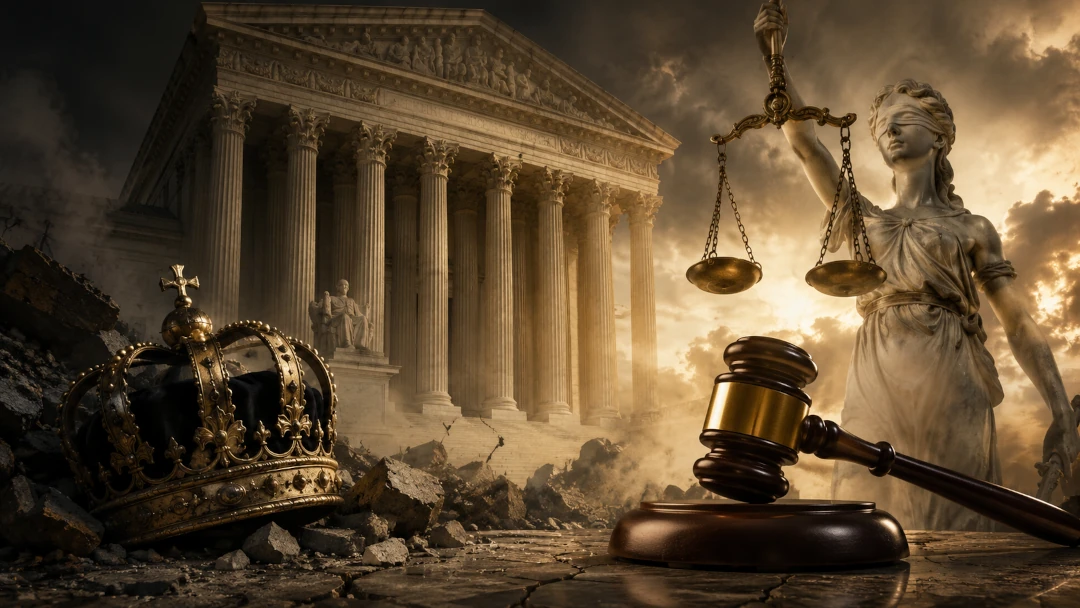
Justice Sotomayor’s invocation of the English Crown was not rhetorical excess. It was historical accuracy. The unitary executive theory that Chief Justice Roberts now embraces — the theory that the entire executive power vests in the President alone, and that any congressional limitation on his ability to fire subordinates is unconstitutional — is a theory the Founders explicitly rejected. The first Congress created executive officers Congress could insulate. The Court spent ninety years acknowledging that this design was lawful. The Court’s six-justice majority on Monday decided, against the unanimous weight of its 1935 decision and against decades of subsequent practice, that the country had been wrong all along.
It is worth being explicit: this is not constitutional interpretation. It is constitutional revision. And it has been performed on behalf of a single man at a moment of his choosing.
The 25th Amendment and the Word “Unable”
The 25th Amendment was ratified in 1967, in the wake of John F. Kennedy’s assassination, to provide a structured constitutional response to a President who cannot do the job. Its drafters wrote carefully. Section 4 authorizes the Vice President and a majority of either the Cabinet “or of such other body as Congress may by law provide” to declare that the President is “unable to discharge the powers and duties of his office.”
The word “unable” is never defined. The word “inability” is never defined. As PBS NewsHour reported in its review of the legislative history, the drafters chose intentionally vague and open-ended language because they understood they could not predict every scenario in which a president might be unfit. That choice was deliberate. The Constitution does not require a coma. It requires a judgment, by people the Constitution designates, that the office is not being discharged.
This is no longer a fringe argument. On April 14, 2026, House Judiciary Ranking Member Jamie Raskin introduced legislation to create the very “other body” the Amendment contemplates — a Commission on Presidential Capacity, composed of retired statespersons and physicians. Two weeks later, Senators Sheldon Whitehouse and Jack Reed entered into the Congressional Record a statement by thirty-six physicians — neurologists, psychiatrists, cognitive specialists from Harvard, Tufts, Columbia, and George Washington — warning of the President’s “rapidly worsening, reality-untethered, increasingly dangerous decline” and calling for his removal under Section 4. The pattern of conduct they catalogued — grandiose and delusional beliefs, reckless threats of violence against foreign civilizations, compulsive late-night communications, fixation on perceived enemies — is now joined by a celebratory boast about being handed unprecedented power by a Supreme Court majority.
The constitutional argument is straightforward: a president who treats the receipt of expanded power as a personal victory rather than a constitutional responsibility, who responds to his own legal vindications with the language of grievance and conquest rather than stewardship, who governs by impulse and reprisal rather than judgment and law, is a president whose capacity to “discharge the powers and duties” of the office is, in the plain meaning of the Amendment’s text, in serious doubt.
The practical barriers are real, and we will not pretend otherwise. Section 4 requires Vice President JD Vance to act, and he will not. It requires a majority of the Cabinet — a Cabinet of loyalists — and they will not. If invoked, the President can override the determination with a single letter declaring “no inability exists,” and resumes power instantly. To overcome that override requires a two-thirds vote of both chambers of Congress, an arithmetic the current Congress will not produce. Raskin himself acknowledges these constraints.
But the political impossibility of the remedy does not negate the constitutional reality of the diagnosis. The 25th Amendment exists in the Constitution whether or not the present Congress is willing to use it. The vague language was a feature, not a bug — a deliberate choice by the drafters to leave room for the country to respond to circumstances they could not foresee. A President who celebrates being given “power unknown even to the English Crown” is one of those circumstances. The country should say so plainly, build the body Raskin’s legislation contemplates, and stop pretending that “unable” means only “in a coma.” It does not. It never did. And the framers were explicit that it never would.
6. The Path Forward
The remedies available are several, and they are not mutually exclusive. They demand to be pursued in parallel.
Congress must restructure independent agencies to comply with the new doctrine while preserving as much insulation as possible — fixed terms, staggered appointments, statutory criteria for dismissal that can be defended on textual grounds the Court has not yet foreclosed.
Pass Rep. Raskin’s Commission on Presidential Capacity bill — establishing the “other body” the 25th Amendment expressly contemplates. The Constitution authorizes it. Congress has neglected for fifty-nine years to create it. That neglect ends now.
Make the Court itself the issue. A six-justice majority that overturned a unanimous ninety-year precedent on behalf of a single sitting president has placed its own legitimacy on the ballot. Voters deserve to know which candidates will pursue ethics reform, term limits, and expansion proposals.
Build state-level enforcement parallels — antitrust suits brought by state attorneys general, consumer protection laws enforced by state agencies, labor protections written into state statute. Where the federal government will not regulate, states must.
Refuse the normalization. A presidency that consumes the regulatory state is not the presidency the Constitution describes. Saying so — loudly, repeatedly, in every forum — is not partisan noise. It is constitutional defense.
None of these is sufficient alone. Together they constitute a serious response to a serious moment. What is not serious — what is, in fact, a quiet form of complicity — is treating Monday’s ruling as a routine adjustment in administrative law. It was not. It was, as Justice Sotomayor said from the bench, the reshaping of our government. The country either understands what was reshaped, and acts, or it does not.
Editorial Conclusion
The Supreme Court did not interpret the Constitution on Monday. It rewrote it — on behalf of a sitting president whose own physicians warn he is unfit, whose own conduct demonstrates the warning, and whose first response to being handed a power “unknown even to the English Crown” was to celebrate it as a personal trophy.
The 25th Amendment was written in deliberately open language because the drafters knew they could not name every form a presidential incapacity might take. They left that judgment to the country, to the Vice President, to the Cabinet, and to the body Congress was supposed to create and never did. That body should now be created. The diagnosis should be made honestly. And the political difficulty of the cure should not be allowed to silence the constitutional reality of the disease.
What is at stake is not Donald Trump’s tenure. It is whether the United States remains a republic of laws enforced by institutions, or becomes a presidency of one man and the cabinet that serves him. The Court has chosen. The country must now choose differently.
Sources & References
- Democracy DocketSotomayor: Supreme Court just gave Trump ‘far greater power than ever before’
- Supreme Court of the United StatesTrump v. Slaughter, Opinion of the Court (No. 25-332)
- CBS NewsSupreme Court expands presidential firing power, overturning 90-year-old ruling
- NPRSupreme Court cements Trump’s power over agencies long considered independent
- CNBCSupreme Court lets presidents fire independent regulators, rules for Trump in FTC case
- Reuters / U.S. NewsSupreme Court Backs Trump’s Firing of FTC Member, Overturns Precedent
- NewsweekTrump Says FTC Slaughter Ruling Greatly Increases His ‘Presidential Power’
- Senate Commerce CommitteeCantwell Statement on Supreme Court Ruling in Trump v. Slaughter
- House Energy & Commerce DemocratsPallone Blasts Supreme Court Decision Allowing Trump to Fire FTC Commissioner Slaughter
- Consumer Federation of AmericaCFA Statement on US Supreme Court Trump v. Slaughter Ruling
- House Judiciary DemocratsRanking Member Raskin Introduces Legislation Establishing Independent Commission on Presidential Capacity
- PBS NewsHourCould the 25th Amendment be invoked against Trump? Here’s how it works
- TIMEJamie Raskin on Trump, the 25th Amendment and Impeachment
- The HillConcerns Grow Over Trump’s Mental Fitness for Presidency
- The ConversationWhen a president is unfit for office, here’s what the Constitution says can happen
- National Constitution Center25th Amendment — Presidential Disability and Succession
- Constitution Annotated, Library of CongressOverview of Twenty-Fifth Amendment, Presidential Vacancy and Disability
- WikipediaHumphrey’s Executor v. United States
Related News