The president has declared the Strait of Hormuz “New U.S. Territory” from his phone, threatened to bomb a decades-old ally over the same strip of water, and reversed himself twice in a fortnight on whether Iran talks even exist. What remains of American statecraft is being conducted by post — and the country, and the world, are paying the bill.
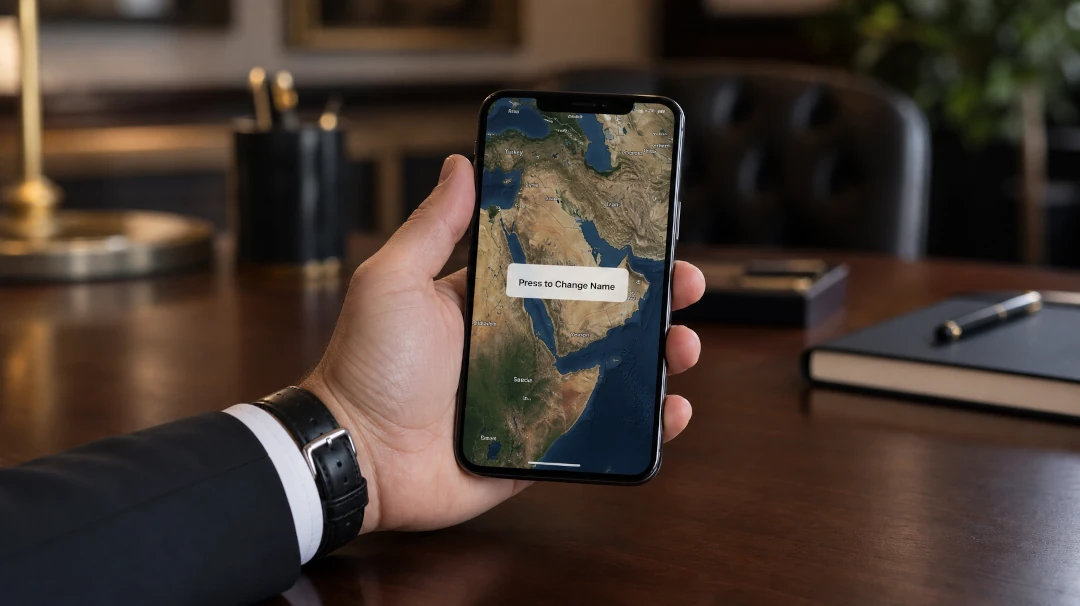
On Tuesday morning, from the same Truth Social account he uses to hawk sneakers and rage at cable pundits, President Donald Trump posted an image of the Persian Gulf with a strip of open water re-captioned in the graphic vernacular of a 1940s propaganda poster: “NEW U.S. TERRITORY.” The waterway in question was the Strait of Hormuz — a passage that lies, indisputably and by every recognized instrument of international law, within the territorial seas of Iran and Oman. It has never been American, is not American, and cannot be made American by a JPEG.
The post was not a slip. It was a doubling-down. Four days earlier, at a campaign-style event, the president had told a crowd he would soon declare the strait a U.S. territory. Asked to elaborate the following Monday from the Oval Office, he confirmed the intent, telling reporters that the United States already “controls it with the blockade” and that he “liked the idea of declaring it a territory.” Iran’s response, delivered through Deputy Foreign Minister Kazem Gharibabadi on X, was to call the whole exercise “delusional.” Even Trump’s own former ambassador to Oman, Marc J. Sievers, told CNN he was “puzzled” by the escalation — a diplomatic term of art meaning, roughly, that a career professional has run out of professional things to say.
What the map represents is not an act of foreign policy. It is a symptom. Six months into a war of choice that the president appears to have grown bored of, U.S. diplomacy is being conducted through a social platform whose stated business model is now the sale of millisecond access to the president’s mood swings. The result is a spectacle: contradictory posts within a single news cycle, threats issued to allies who have been trying to help, and an American public paying for it in $4 gasoline and $58-billion quarterly windfalls for Exxon and Chevron.
I. The Map Heard Round the World
The Hill’s reporting on the August 18 post is remarkable chiefly for how ordinary it treats the extraordinary. The Strait of Hormuz — through which roughly a fifth of the world’s oil passes in normal times — is not a legal grey zone. It is a body of water governed by the United Nations Convention on the Law of the Sea and jointly bordered by two sovereign nations. To label it a U.S. territory is to assert something no post-war American president has asserted about anyone else’s coastline. To do it by meme is worse.
The president’s Oval Office remarks made the mindset behind the map explicit. Iran, he said, “can be a nuisance. They can put a mine in the water, and people don’t like having mines hit their billion-dollar ships.” The framing is telling: not the U.S. Navy patrolling international waters under long-standing convention, but a landlord annoyed at tenants. Hours after the post, the UAE’s Ministry of Defense reported two ballistic missiles fired from Iran toward its territory. This is what escalation by graphic design looks like in practice.
“The Strait of Hormuz has been Iranian, is Iranian, and will remain Iranian. This strait will only be closed and opened under Iran’s command.”
— Kazem Gharibabadi, Iranian Deputy Foreign Minister, responding to Trump’s map
II. A Presidency Governed by Feed
The map was not an aberration in the president’s Truth Social output — it was a genre entry. In the roughly 72 hours surrounding the post, Trump insisted the U.S. is in “full control” of the strait; declared “there are no talks or conversations going on, or scheduled, with the Islamic Republic of Iran”; announced that “the Naval Blockade remains in full force and effect”; and called Iranian leadership “unbelievably duplicitous” for denying the very talks he now says do not exist. Two weeks earlier he had insisted the same talks were underway “whether Iran wants to admit it or not.” Fortune reported in April that Trump’s own officials, speaking anonymously, warned his social media posts risked “killing peace talks.”
Ambassador Paul Webster Hare, a three-decade veteran diplomat now at Boston University, has documented the pattern in detail. Trump’s use of Truth Social as a diplomatic instrument, Hare writes, produces content that is regularly “false, contradictory, or an outright lie” and hands foreign governments leverage they would otherwise have to earn. Where Vladimir Putin and Xi Jinping communicate sparingly and each word buys them a small measure of strategic ambiguity, Trump’s “unbridled, unfiltered direct diplomacy” spends American credibility with every scroll.
What makes this particular news cycle worse than the usual is that the reversals are no longer even performative. On the same day his media company began selling Wall Street firms a paid, low-latency feed of his posts — a fact worth pausing on — the president teased new negotiations he had, only hours before, denied were happening. The posts move commodity prices, currencies, and stocks. Someone is being paid to know first. The rest of the country is being asked to accept this as foreign policy.
III. The Ally He Wants to Bomb
The clearest evidence that a president who has run out of interest in a war is not the same as a president willing to end one arrived on August 17. Asked by Fox News reporter Trey Yingst about ongoing negotiations between Iran and Oman — negotiations aimed at reopening the strait Trump insists he already controls — the president delivered a threat so casual it read like a punchline: “If Oman gets in the way, we’ll bomb the sh-t out of them.”
Oman is not a rival. Oman is the country the United States has relied on for three decades to talk to Tehran when Washington could not. The current negotiations were explicitly authorized by a memorandum of peace Trump himself signed at Versailles, which provided that Muscat would “conduct dialogue” with Tehran on the strait. Threatening to bomb an ally for doing what your own signed agreement asks it to do is not statecraft. It is the behavior of someone who has forgotten what he agreed to and does not care to be reminded.
“Blow them up”
At a Cabinet meeting, Trump warned Oman would “behave just like everybody else, or we will have to blow them up,” after reports of Muscat–Tehran talks on maritime service fees. Daily Beast.
“Bomb the sh-t”
Asked by Fox News’ Trey Yingst about Iran–Oman negotiations, Trump repeated the threat in more graphic terms. Omani commentators publicly accused Washington of choosing “escalation and threats” against a partner. CNN.
Warnings Ignored
Half a dozen Middle Eastern officials, including foreign ministers from Saudi Arabia, the UAE and Oman, traveled to Washington in the month before the initial strikes to caution against war. They were disregarded. AP via Yahoo News.
“Impotent” U.S.
Laleh Khalili, professor of Gulf studies at the University of Exeter, told Al Jazeera that an Oman–Iran solution reached without Washington would “show how impotent the United States is and has been.” Trump’s threats look like a president trying to prevent a deal he could not close. Al Jazeera.
IV. The Price at the Pump
Any American who has filled a tank this summer knows the cost of a president who governs by post. The national average for gasoline stood at $3.699 in mid-March, up from $2.927 a month earlier — a roughly 26 percent jump. Trump’s own energy secretary, Chris Wright, told Meet the Press he could offer “no guarantees” prices would fall in weeks and acknowledged Americans should expect “some elevated pricing” until the war ends.
The wider picture is worse. The Bipartisan Policy Center reports that the effective closure of Hormuz took roughly 14 million barrels per day off the global market — about 14 percent of projected 2026 supply — sending diesel prices up 58 percent and jet fuel up 106 percent year-over-year. Middle Eastern crude yields more of both per barrel than U.S. shale, meaning America’s status as a top producer does not insulate American truckers, farmers, or airlines from the shock. CNBC’s economic analysis put it plainly: the war “will erode Americans’ standard of living this summer even if the actual fighting stays more contained.”
Meanwhile, ExxonMobil and Chevron posted record quarters. The president responded not by convening his cabinet on price relief but by complaining on Truth Social that Chevron’s CEO hadn’t credited the administration in a television interview. This is the priority set of a man who has confused public office with a brand.
Get Involved Today
Contribute to our mission and turn your concerns into action.
V. A Timeline of Contradictions
To grasp the scale of the incoherence, it helps to see the posts alongside one another. What follows is a short, deliberately conservative accounting of the president’s own words in the weeks surrounding the “New U.S. Territory” map:
Any one of these posts, in isolation, would have been a scandal in any prior administration. Together, in the space of a fortnight, they constitute a coherent portrait of an incoherent process — one in which negotiations are announced, denied, resumed, and threatened over a single weekend, and in which American allies must consult a phone to know whether they are partners or targets.
“The 25th Amendment exists for a reason. The President of the United States is a deranged lunatic, and a national security threat to our country and the rest of the world.”
— Rep. Yassamin Ansari (D-AZ), April 6, 2026
VI. A World Watching in Confusion
The Center for American Progress’s Trump Global Weakness Watch catalogues what career diplomats have been saying privately for a year: the administration prizes loyalty over expertise, has gutted the State Department and USAID, and has “broken trust with America’s allies and partners, significantly weakening America’s ability to pursue key interests abroad.” As Washington retreats and contradicts itself, China and Russia move in, not because they have grown stronger, but because the United States is leaving a vacuum.
The concrete evidence in the Gulf is damning. Gulf allies told AP they were not notified in advance of the initial strikes on Iran. Public figures with close ties to their governments have suggested Israeli Prime Minister Benjamin Netanyahu “dragged” Trump into a needless war. Saudi Arabia is now privately arguing to Washington that ending the war on Trump’s terms will not produce a settlement that guarantees regional security. Iran, for its part, has bypassed the U.S. entirely and is negotiating with Oman — a fact the president appears to find personally intolerable and constitutionally unmentionable.
This is what the erosion of American leadership looks like from the inside of the room. Not a dramatic collapse. A slow leakage of the assumption, held by allies for eight decades, that the American president speaks for a country capable of keeping its word for more than a news cycle.
The 25th Amendment Is Not a Fringe Idea. It Is a Growing Congressional Position.
The 25th Amendment to the Constitution, ratified in 1967, provides in Section 4 a mechanism by which the vice president and a majority of the Cabinet — or, in the alternative, “such other body as Congress may by law provide” — may declare a president “unable to discharge the powers and duties of his office.” The vice president then assumes those powers immediately, subject to a 21-day congressional review and, if the president contests it, a two-thirds vote of both chambers to make removal permanent.
It was designed for exactly the circumstance now unfolding: not treason, not a specific crime, but incapacity — a president whose judgment has become a national security liability and whose conduct is untethered from the office he holds.
The Growing List of Names
More than 85 House and Senate Democrats called for impeachment or 25th Amendment removal after Trump’s April post threatening that “a whole civilization will die tonight.” Rep. Jamie Raskin (D-MD), ranking member of the House Judiciary Committee, introduced legislation to establish the 17-member commission the Amendment explicitly contemplates. Sen. Chris Murphy (D-CT) called Trump’s Iran conduct “completely, utterly unhinged.” Reps. Mike Quigley (D-IL), Raja Krishnamoorthi (D-IL), Melanie Stansbury (D-NM), Eric Swalwell (D-CA), Sydney Kamlager-Dove (D-CA), and Yassamin Ansari (D-AZ) all issued explicit calls. Sen. Ed Markey (D-MA) joined them. Even Rep. Marjorie Taylor Greene (R-GA), no one’s Democrat, posted: “25TH AMENDMENT!!! Not a single bomb has dropped on America. We cannot kill an entire civilization. This is evil and madness.”
The Constitutional Argument
The case does not rest on any single post. It rests on a pattern — the threat of civilizational annihilation, the reversal on negotiations within the same day, the sale of the president’s mood to Wall Street, the threat to bomb an ally engaged in mediation Trump himself commissioned, and now the assertion of sovereignty over another country’s coastline by graphic. Section 4 does not require a diagnosis. It requires a judgment, by those closest to him, that the person holding the office cannot perform its duties.
The Practical Barriers, Honestly Stated
Section 4 has never been invoked. Vice President JD Vance has shown no public sign of doing so, and a Cabinet stacked for loyalty is an unlikely engine of removal. Raskin’s commission bill will not pass a Republican Congress and would be vetoed if it did. Impeachment faces the same wall. None of this is in serious dispute.
But procedural difficulty is not a rebuttal to constitutional argument. The Framers wrote Section 4 for a moment they hoped would never come and knew might. That the political path is hard does not make the moral and constitutional case any less clear: this president’s fitness for the office is now, by the testimony of members of his own party, a live question. The record is being built for history — and for whatever body eventually has the will to consult it.
VII. The Bill Comes Due
Every part of this crisis was avoidable. A war of choice, launched over the objections of Gulf partners, has produced the largest supply disruption in the history of the global oil market — an assessment offered not by a partisan critic but by the head of the International Energy Agency. Negotiations that could have ended it are being sabotaged by the same man whose signature authorized them. Allies who once trusted American promises are being publicly threatened with bombing. And the president’s response, day after day, is to reach for his phone.
What is being sold as leadership is, at best, improvisation. At worst, it is the conduct of a man for whom the presidency has become a stage set, whose posts serve his ego and his family’s businesses more reliably than they serve any American interest. Diesel drivers and airlines are paying for it. Sailors stranded in the Gulf are paying for it. Gulf partners quietly building a future in which Washington is optional are billing us for it in ways that will not appear on any receipt for years.
Editorial Conclusion
A president who cannot decide, from one morning to the next, whether he is negotiating with a country or annexing its coastline cannot be trusted with the powers of the office. The Strait of Hormuz map is not a joke. It is a confession — that the world’s most consequential foreign policy is now being written by a man who governs from grievance, whose word binds no ally and reassures no partner, and whose contradictions are literally being sold as a financial product.
The 25th Amendment was written for this. The political path is hard; the constitutional path is clear. Every member of the Cabinet who does not act, every member of Congress who does not speak, is choosing complicity. The record will show who was silent.
Sources & References
- The HillTrump posts map labeling Strait of Hormuz as US territory — Julia Manchester, Aug. 18, 2026.
- CNBCTrump says no talks scheduled with Iran as he teases action in Hormuz Strait — Aug. 18, 2026.
- CNBCTrump insists Iran talks are underway despite Tehran’s ‘duplicitous’ denials — Aug. 3, 2026.
- CNNTrump says no talks underway with Iran; UAE detects ‘missile threat’ — Aug. 18, 2026.
- CNNTrump calls Iranian leadership ‘unbelievably duplicitous’ after Tehran denies talks resumed — Aug. 2–3, 2026.
- CNNTrump’s threats anger Omanis, leave observers puzzled — Aug. 18, 2026.
- The Washington PostTrump threatens to bomb Oman if it ‘gets in the way’ — Aug. 17, 2026.
- TIMETrump Again Threatens to Bomb Oman — Aug. 18, 2026.
- Al JazeeraWhy has Trump threatened to bomb Oman — for a second time? — Aug. 18, 2026.
- TIMEWhat to Know About the 25th Amendment as Lawmakers Call for Trump’s Removal — April 6, 2026.
- AxiosHouse Democrats file long-shot 25th Amendment bill targeting Trump — April 14, 2026.
- ForbesHow the 25th Amendment Could Be Used to Remove Trump — and Who’s Supporting It — April 7, 2026.
- Krishnamoorthi.house.govKrishnamoorthi Calls for President Trump’s Removal Under 25th Amendment — April 7, 2026.
- Quigley.house.govQuigley Calls for Trump’s Removal Under 25th Amendment — April 7, 2026.
- FortuneTrump officials whisper that his Truth Social posts about Iran risk killing peace talks — April 21, 2026.
- USC Center on Public DiplomacyWhy Trump’s “Truth Social Public Diplomacy” Leads to Few Diplomatic Wins — Ambassador Paul Webster Hare.
- Bipartisan Policy CenterWhy the Iran Conflict Is Affecting Diesel and Jet Fuel Prices More Than Gasoline — June 2026.
- CNBCAnalysis: Iran war energy shock hits the U.S. economy as gas and diesel prices climb — July 22, 2026.
- AxiosTrump’s energy chief: ‘No guarantees’ gas prices will fall in weeks — March 15, 2026.
- The Daily BeastTrump Threatens to ‘Bomb the S**t’ Out of Key Ally — Aug. 2026.
- Center for American ProgressTrump Global Weakness Watch: How Trump Is Undermining American Power.
- Associated Press via Yahoo NewsUS Gulf allies rattled — and seeing few good options — following Iran strikes.
Related News