Disney vs. the FCC Censor: The Lawsuit That Claims Government Retaliation
For seven months, Trump’s FCC chairman has publicly threatened, quietly extorted, and openly celebrated the punishment of broadcasters who annoyed the president. On Tuesday, one of them finally said the word out loud in federal court: retaliation.
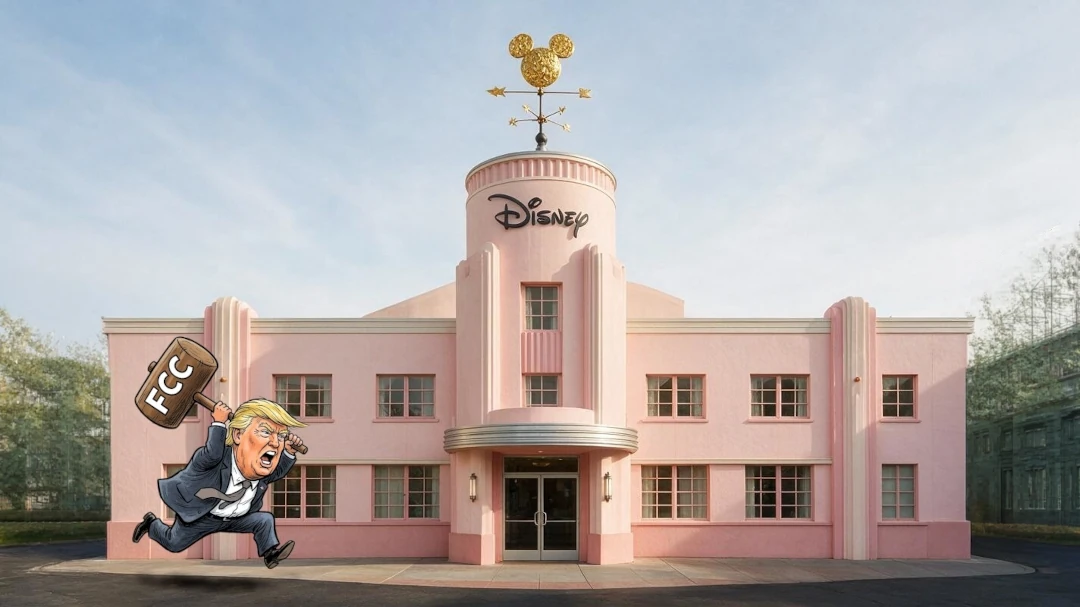
Government censorship is deeply un-American. That is the opening line of the 45-page complaint the Walt Disney Company filed against the Federal Communications Commission on August 18 in the U.S. District Court for the District of Columbia — and it is a sentence the Trump administration has spent nineteen months daring a major broadcaster to say. On Tuesday, ABC and its eight owned-and-operated stations became the first to say it in court. The lawsuit alleges what every media reporter in Washington has watched unfold in real time: that the FCC, at the direction of a chairman handpicked and repeatedly praised by Donald Trump, has “waged a retaliatory campaign against ABC for a single reason: it disapproves of what ABC broadcasts.” That is a First Amendment violation stated in plain English. That the country’s most valuable media company had to say it out loud in a federal filing is itself the measure of how far we have fallen.
The immediate trigger for the lawsuit is an FCC proceeding that has no precedent in modern regulatory practice. In April, chairman Brendan Carr — a Trump loyalist who wrote the FCC chapter of the Heritage Foundation’s Project 2025 — ordered early license renewal for Disney’s eight ABC-owned stations. Those licenses were not scheduled for renewal until 2028 through 2031. The FCC pulled them forward by two to five years and demanded the stations prove they are operating “in the public interest,” citing a supposed investigation into Disney’s diversity, equity and inclusion practices. As Disney’s complaint notes, and as CBS News reported, the accelerated review followed Trump’s public demand that Jimmy Kimmel be fired over a joke and Trump’s repeated call for ABC to lose its broadcast license over news coverage he found unflattering. The lawsuit cites the president’s own Truth Social posts, including one in which he complained that late-night hosts “are almost 100% Negative to President Donald J. Trump” and asked whether broadcast licenses should “be terminated?”
The FCC’s response to the lawsuit was to accuse Disney of “disinformation.” That is the reflex of an agency that has forgotten what it is for.
I. The Complaint
Disney’s filing does not mince words, and it does not rely on inference. It quotes the president. It cites the chairman. It documents the timeline. The company is asking the court for a temporary restraining order and a preliminary injunction to halt Carr’s license challenge before ABC has to submit early renewal filings that Deadline and other outlets have described as an unprecedented use of the agency’s licensing power against a specific broadcaster’s viewpoint.
The complaint opens by invoking a unanimous Supreme Court decision — the 2024 ruling in NRA v. Vullo — which held that the government “may not use the power of the State to punish or suppress disfavored expression.” That case involved a state financial regulator pressuring companies to cut ties with the National Rifle Association. It was written by Justice Sonia Sotomayor and joined by every conservative on the court. It is, in other words, a precedent Trump’s own judicial appointees have already endorsed. Disney is calling in that debt.
The complaint also details the operational chill the retaliation has already produced. ABC now says it has “chosen not to air clips” it otherwise would have used because they might be reclassified by the FCC as candidate “appearances.” An entire national broadcaster has begun self-censoring what it puts on air because it fears its regulator. That is the definition of a First Amendment injury, and it did not require a license to be revoked to occur. It only required the threat.
“Acting through the Federal Communications Commission, the Administration has waged a retaliatory campaign against ABC for a single reason: it disapproves of what ABC broadcasts. That campaign began in this Administration’s earliest days and has only intensified since.”
— Disney/ABC complaint, filed Aug. 18, 2026, U.S. District Court for the District of Columbia
II. The Pattern of Capitulation
To understand why Disney’s lawsuit matters, one must understand what came before it. The pattern is not subtle, and the sums are not small. Beginning in December 2024, in the weeks before Trump was even inaugurated, three of the four largest broadcast news organizations in the United States paid the president directly — or, more precisely, paid a “presidential library” fund controlled by him — to make lawsuits and regulatory pressure go away. In every case, media-law experts described the underlying legal claim as either frivolous or losing. In every case, the settlement money went into Trump’s pocket by another name. And in every case, the settling company had something before the government it needed approved.
ABC News / Disney — $15 million
Settled a defamation suit over George Stephanopoulos saying Trump was “found liable for rape” (a jury actually found sexual abuse and defamation, awarding E. Jean Carroll $5 million). ABC also agreed to a public apology and $1 million in Trump legal fees. Reported by Variety.
Paramount / CBS — $16 million
Settled Trump’s $20 billion suit over “60 Minutes” editing of a Kamala Harris interview. Legal experts called the case “meritless.” Paramount needed FCC approval for its $8.4 billion Skydance merger. Approval followed. Reported by CNN.
Nexstar & Sinclair preempt Kimmel
Two of the largest ABC affiliate owners in the country pulled “Jimmy Kimmel Live!” from their stations within hours of Carr saying “we can do this the easy way or the hard way.” Sinclair publicly thanked Carr. Both firms had major transactions pending. Reported by NBC News.
Comcast / NBCUniversal DEI probe
Carr’s FCC opened a formal investigation of NBCUniversal’s diversity practices in the middle of Comcast’s corporate restructuring. No comparable review has been opened against conservative-aligned broadcasters. Deadline coverage.
The leverage is always the same and the mechanism is always the same. Every major broadcast company owns local stations. Every local station holds a federal license. Every merger, transfer, or renewal of that license runs through the FCC. When the chairman of the FCC is a political operative willing to open pretextual investigations and slow-walk approvals until a company either settles a private lawsuit against the president or removes programming the president dislikes, the licensing power stops being a public-interest tool and starts being a shakedown mechanism. Former FCC chairman Tom Wheeler wrote in July 2025 that Trump had “weaponized” the agency he once ran. That is not partisan hyperbole from a Democrat. It is the professional judgment of a man who held Carr’s job.
III. The Enforcer
Brendan Carr is not shy about what he is doing. When “Jimmy Kimmel Live!” was pulled off the air on September 17, 2025, hours after Carr suggested on a right-wing podcast that broadcasters “can do this the easy way or the hard way,” Carr celebrated by sending a CNN reporter an animated GIF from “The Office” of Michael Scott and Dwight Schrute making “raise the roof” gestures. Two months later, testifying before the Senate Commerce Committee, Carr said out loud what most FCC chairmen would go to great lengths to deny: “The FCC is not an independent agency.” When pressed on whether Trump was his boss, he sidestepped, offering only that “President Trump has designated me as chairman of the FCC.”
The PBS NewsHour transcript of that hearing is worth reading in full. Democratic FCC commissioner Anna Gomez — the sole dissenting voice on the commission — told the panel that Carr’s actions were designed to “intimidate government critics, pressure media companies and challenge the boundaries of the First Amendment.” She was not alone. Senator John Kennedy of Louisiana, a Republican, told an FCC official at a separate hearing that the agency “scares me right now” and is “getting into the foothills of violating the First Amendment.” Senator Ted Cruz, the Republican chair of the Commerce Committee, compared Carr’s tactics to those of a “mafia” enforcer. When the ranking Republican on the committee overseeing the FCC uses the word mafia to describe how the chairman is doing his job, something has broken.
ABC settles first Trump suit. Disney pays $15 million to a “Trump presidential foundation” and issues an on-air apology. Days before Trump takes office.
AP banned from Oval Office. The White House indefinitely bars Associated Press reporters and photographers from presidential events after the wire service refuses to call the Gulf of Mexico the “Gulf of America.”
Trump seizes press-pool control. The White House strips the White House Correspondents’ Association of its historic authority to determine daily pool rotation and hands it to Karoline Leavitt’s press office. Reuters and HuffPost are booted the same day.
House Democrats open investigation. Reps. Frank Pallone, Doris Matsui, and Yvette Clarke launch a formal Energy & Commerce probe into Carr’s “weaponization” of the FCC.
Paramount settles for $16M. CBS’s parent company pays Trump’s foundation and agrees to release transcripts of future presidential candidate interviews. The Skydance merger is approved shortly after.
Kimmel is pulled off the air. Hours after Carr’s “easy way or hard way” comments, Nexstar and Sinclair preempt “Jimmy Kimmel Live!” ABC follows with an indefinite suspension. Kimmel returns five days later after public outcry.
Iran-coverage threat. After Trump calls Iran war reporting “fake news,” Carr posts publicly that broadcasters will lose their licenses if they don’t “operate in the public interest.” Democrats and free-speech groups call the threat “totalitarian.”
FCC orders early ABC license renewal. Carr accelerates the renewal proceeding for eight Disney-owned stations by two to five years, citing an “ongoing” DEI investigation.
Disney sues in federal court. The first major broadcaster to challenge the FCC directly. The complaint asks the court to halt the license proceeding as an unconstitutional retaliation.
IV. The Press Corps Purge
The FCC campaign against broadcasters is only the most legally consequential arm of a much larger project. The Trump administration has, since its first weeks in office, been systematically restructuring who is permitted to cover the president at all. In February 2025, the White House indefinitely barred Associated Press reporters and photographers from the Oval Office, Air Force One, and other pool events — not for anything they had reported, but because the AP’s stylebook continues to refer to the Gulf of Mexico by its historical name. A federal judge, Trump appointee Trevor McFadden, ordered the AP restored, writing that the discrimination against the wire service was “brazen” and that “if the Government opens its doors to some journalists — be it to the Oval Office, the East Room, or elsewhere — it cannot then shut those doors to other journalists because of their viewpoints.” The administration appealed. It then eliminated the AP’s permanent wire-service seat in the press pool entirely — a move the U.S. Press Freedom Tracker called an attempt to circumvent the injunction by rewriting the room.
At the same time, the Trump press office took over — from the independent White House Correspondents’ Association — the authority to determine which reporters travel with the president each day. Reuters and HuffPost were removed within hours. The rotation now heavily favors conservative outlets, single-host podcasts, and one-person “streamers” who arrive with prepared praise. The president does long, warm sit-downs with Sean Hannity, Maria Bartiromo, Laura Ingraham, and Dan Bongino — interviews that Poynter and the Columbia Journalism Review have documented as functionally scripted. He grants podcast slots to Barstool Sports founder Dave Portnoy and to Benny Johnson, the same podcaster to whom Brendan Carr chose to deliver the “easy way or hard way” threat against Kimmel. Meanwhile, real question-and-answer sessions with the White House press corps have all but disappeared. Karoline Leavitt’s briefings routinely open with a “new media” seat given to a MAGA content creator who asks the press secretary to comment on a Trump policy she is presumed to admire.
The pattern names itself. The president has constructed, at public expense and with the force of the federal government behind it, a two-tier press system: one tier for outlets that will flatter him, and one tier for outlets he intends to punish, delegitimize, or drive off the public airwaves entirely. This is not a preference. It is a policy.
Get Involved Today
Contribute to our mission and turn your concerns into action.
V. What Congress Is Doing — and Not Doing
The most honest thing to say about the congressional response is that the Democratic minority has done what a minority can do, and that Republican leadership has, with a handful of exceptions, done nothing at all. In the Senate, Commerce Committee Ranking Member Maria Cantwell — joined by Democratic Leader Chuck Schumer, Sen. Edward Markey, Sen. Ben Ray Luján, Sen. Jacky Rosen, Sen. Amy Klobuchar, and every Democrat on the committee — sent Carr a formal letter demanding he stop threatening broadcasters. In the House, Judiciary Ranking Member Jamie Raskin filed a formal public comment calling the ABC license proceeding “the most egregious assault on the First Amendment this FCC has taken to date.” Sens. Luján, Rosen, and Markey introduced the Broadcast Freedom and Independence Act, which would strip the FCC of its power to revoke licenses based on political viewpoint and would prohibit the president from firing commissioners at will. Rep. Ted Lieu, vice chair of the House Democratic Caucus, publicly urged ABC to sue — and told the network at a Los Angeles free-speech rally: “You can continue to be bullied or you can stand up for yourself. And if you do, we will be with you.”
These are the right words. They are also, at present, only words. Republicans control both chambers, and the Broadcast Freedom and Independence Act has no path to the floor. Speaker Mike Johnson has said nothing. Senate Majority Leader John Thune has said nothing. The two Republicans who have said something — Cruz and Kennedy — have not translated their unease into a single hearing, subpoena, or floor vote. That is the arithmetic. Democrats have introduced the bills, written the letters, and given the speeches. Republicans have made the political calculation that the president’s grip on their primary electorate is worth more than the First Amendment. Until that calculation changes — through midterm losses, through court rulings, or through a public revolt — the retaliation will continue.
“For months, the FCC has waged a campaign of censorship and control against Disney’s ABC stations, using the threat of broadcast license revocations to punish a company for speech this administration doesn’t like. I have long called on companies to push back against this kind of government intimidation, and I’m glad Disney has shown courage and stepped up.”
— Anna Gomez, Democratic FCC Commissioner, Aug. 18, 2026
VI. What This Costs the American Reader
It is easy, when a story is about billion-dollar media companies and a $16 million settlement here or there, to lose the ordinary citizen inside it. The ordinary citizen is the point. The reason the First Amendment forbids the government from picking which broadcasters may operate is that the ordinary citizen — the voter, the juror, the parent, the small-business owner — depends on a press that can report what the government is doing without asking the government’s permission first. When ABC chooses not to air a clip because the FCC might reclassify it as a candidate appearance, the person harmed is not the network’s shareholder. It is the voter who no longer sees the clip.
When Paramount settles a meritless suit to unlock a merger, the person harmed is not the CEO. It is the “60 Minutes” viewer who now knows that the show’s parent company negotiated with the subject of its investigations. When two hundred local TV stations decide it is safer to preempt a comedian than to broadcast a joke, the person harmed is not the comedian. It is the citizen who learns, one small self-censorship at a time, that dissent has a cost the government will help enforce. The chill is the injury. That is what the Supreme Court held unanimously in NRA v. Vullo. That is what Disney is asking the D.C. District Court to remedy. And that is what an informed electorate — the precondition for self-government — cannot survive the erosion of.
Fitness, the Free Press, and the Question Congress Is Trying Not to Ask
The Twenty-Fifth Amendment, ratified in 1967, permits the vice president and a majority of the Cabinet — or a body designated by Congress — to declare a president “unable to discharge the powers and duties of his office,” transferring authority to the vice president. It has never been invoked against a sitting president’s will. It was drafted for medical incapacity but its text is broader: it asks whether a president can, in fact, do the job.
Named lawmakers have argued, on the record, that the answer in this administration is no — and that the pattern of behavior driving the press-freedom crisis is itself evidence. On April 14, 2026, Rep. Jamie Raskin (D-Md.) and fifty House Democrats introduced legislation to establish the bipartisan commission the Twenty-Fifth Amendment expressly authorizes Congress to create. Two weeks later, Sens. Sheldon Whitehouse and Jack Reed of Rhode Island entered into the Congressional Record a statement from thirty-six physicians — neurologists, psychiatrists, and cognitive-disorder specialists from Harvard, Tufts, Columbia, and George Washington — warning of a “rapidly worsening, reality-untethered, increasingly dangerous decline” and calling for the amendment’s invocation. Raskin has separately demanded that the White House physician conduct and disclose a full neurological evaluation.
The constitutional argument
Article II vests the president with the duty to “take Care that the Laws be faithfully executed.” A president who directs an independent regulator to punish broadcasters for constitutionally protected speech — and who publicly celebrates that punishment — is not faithfully executing the First Amendment. He is faithfully executing his private grudges with the tools of the federal government. That is not a policy disagreement. It is a category of conduct the amendment’s framers, writing after Kennedy’s assassination and with Nixon on the horizon, understood a functioning constitutional order must have a mechanism to address.
The practical barriers
Honest analysis requires stating what the amendment’s supporters know: Section 4 requires Vice President J.D. Vance and a majority of the Trump Cabinet — a Cabinet screened for personal loyalty above all — to initiate a transfer of power. They will not. The Raskin commission bill has no Republican co-sponsors and cannot pass a Republican House. Even a commission report, on its own, cannot remove a president; the amendment still requires the vice president’s assent to invoke Section 4. These are real obstacles, and they will not disappear because critics wish them to.
Why the case still matters
None of that negates the moral or constitutional argument for making the case. Amendments exist to be invoked when the country needs them, and the record has to be built in public, in real time, by people willing to state on the record what they see. Every congressional letter, every physician’s warning, every documented instance of a president using federal power to punish speech is a brick in the foundation of the political and legal accountability that comes next — whether in the 2026 midterms, in the courts adjudicating Disney’s lawsuit, or in the historical judgment that will be rendered on the members of Congress who watched and stayed silent. The barrier is Republican political will. The barrier is not the Constitution. The Constitution is, and remains, the argument.
Editorial Conclusion
A free press is not a courtesy the government extends to journalists it likes. It is the constitutional precondition for every other freedom the American people possess. When the president of the United States uses the licensing power of the federal government to punish broadcasters for their viewpoints — and when three of the four largest media companies in America have already paid to make him stop — the question is no longer whether the First Amendment has been violated. The question is whether the institutions built to defend it will hold.
Disney’s lawsuit is the first real test. The D.C. District Court now holds, in its hands, the case for whether the government of the United States may punish speech it dislikes. The answer must be no. The record must say no. And the Congress that has, so far, allowed the retaliation to continue must decide, before the next election, whether the free press is a value it still holds — or a relic it is prepared to let this president bury.
Sources & References
- NBC News — Disney and ABC sue FCC, seeking to stop early license renewal process
- CNN — Disney sues Trump’s FCC over ‘retaliatory campaign’ against ABC
- CBS News — Disney and ABC sue FCC over early license renewals
- NPR — ABC and Disney sue FCC, alleging First Amendment violations
- CNBC — Disney-owned ABC files First Amendment lawsuit against FCC
- Deadline — ABC Files First Amendment Lawsuit Against FCC
- Slate — Disney’s lawsuit against Trump’s FCC is a battle for the First Amendment
- CNN — Paramount settles Trump’s ’60 Minutes’ lawsuit for $16 million
- Variety — ABC News Settles Trump’s Defamation Suit for $15 Million
- CNN — ABC News settles defamation suit with Trump for $15 million
- NPR — Jimmy Kimmel’s suspension shows the power of FCC’s Brendan Carr
- NBC News — Kimmel suspension puts spotlight on Brendan Carr, Trump’s FCC chair
- CNN Business — How Brendan Carr helped take down Kimmel with words, not actions
- PBS NewsHour — FCC chair says agency is ‘not independent’ during Senate hearing
- Senate Commerce (D) — Cantwell, Schumer, and Committee Democrats’ letter to Carr
- House Judiciary (D) — Raskin: FCC’s ABC action is ‘most egregious assault on the First Amendment’
- House E&C (D) — E&C Democrats launch investigation into Carr’s attacks on First Amendment
- Semafor via Rep. Matsui — Democrats introduce Broadcast Freedom and Independence Act
- Press Freedom Tracker — AP reporters barred from White House events
- Harvard Kennedy School — Tom Wheeler: ‘Trump has weaponized the FCC I once chaired’
- House Judiciary (D) — Raskin demands White House cognitive evaluation of Trump
- Mediaite — 50 House Democrats file bill to form 25th Amendment commission
- The Hill — Concerns grow over Trump’s mental fitness for presidency
- Rep. Ted Lieu — Lieu calls Carr a ‘radical extremist,’ urges ABC to sue
Related News