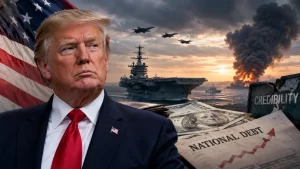
The Puppet and the Puppeteer: How Netanyahu Steered America Into a War Its Own Spies Never Believed In
The CIA has now openly questioned two Israeli intelligence claims that shaped Donald Trump’s biggest foreign-policy decisions. The president appears not to notice — or not to care. The consequences are being paid in dollars, missiles, credibility, and blood.
The most damning intelligence assessment of the Trump presidency did not come from a hostile foreign service, a partisan think tank, or a whistleblower with an axe to grind. It came from the Central Intelligence Agency, and it was delivered twice in six months about the same foreign ally. In April, The New York Times revealed that CIA Director John Ratcliffe told the president that Israeli Prime Minister Benjamin Netanyahu’s regime-change pitch on Iran was “farcical.” This month, The Washington Post reported that the same agency assigned “low confidence” to an Israeli warning of an Iranian plot to assassinate the president — a warning that sent Trump hiding in a catering truck to escape Ankara. Both times, the president acted on the Israeli claim anyway. Both times, senior American officials have concluded, privately and now publicly, that Israel was less interested in informing the United States than in steering the American president toward a predetermined outcome.
This is what capture looks like. Not a smoking-gun quid pro quo, not a suitcase of cash, but a pattern in which a foreign government identifies the vanity, the impulses, and the intelligence weaknesses of the American commander in chief and plays them — repeatedly — against the assessments of the American intelligence community. And the president, who campaigned as the man who could not be fooled, does not appear to know he has been played.
I. When the CIA Stops Believing Its Closest Partner
Intelligence sharing with Israel has been treated, for decades, as one of the load-bearing walls of American Middle East policy. That wall has now cracked in public view. According to reporting from The Washington Post summarized by The Times of Israel, CIA analysts did not find the Israeli tip about a plot to kill Trump in Turkey compelling, and communicated that skepticism to the Trump administration before the president was hustled onto a decoy-free flight last month. The Secret Service, acting on the raw warning rather than on the CIA’s assessment of it, moved the president anyway.
Former U.S. intelligence officials, quoted anonymously, told the Post that the Israeli warning fit “a broader pattern” of reporting that some officials believe is designed as much to shape presidential decision-making as to inform it. That is a diplomatic way of saying that America’s premier intelligence agency believes an allied foreign government is running an influence operation against the President of the United States — and that the operation is working.
“The warning was intended less to inform, and more to influence Trump.”
— Former U.S. intelligence official, quoted by The Washington Post and Ynet News, August 2026
II. The Situation Room Sales Pitch That Started a War
The Ankara episode did not happen in a vacuum. It followed a much larger and more consequential failure of judgment. On February 11, 2026, Netanyahu was ushered into the White House Situation Room and, over roughly ninety minutes, made what officials later described to The New York Times as a hard sell for a joint U.S.–Israeli war on Iran. The Israeli team told Trump that Iran was ripe for regime change; that a Mossad-choreographed uprising would sweep the mullahs from power; that Kurdish fighters could pour in from Iraq; that a montage of possible new Iranian leaders was ready to be introduced to the world. CIA Director John Ratcliffe used a single word to describe the plan to the president: farcical. Secretary of State Marco Rubio, according to the same reporting, translated it more bluntly for Trump: “In other words, it’s bullshit.”
The chairman of the Joint Chiefs, Gen. Dan Caine, went further, warning Trump that overselling was, in his experience, standard operating procedure for the Israelis — that they overstate, that they need the United States, and that they hard-sell precisely because they need us. Vice President JD Vance told Trump plainly that he thought it was a bad idea but would support the president if he went ahead.
Trump went ahead. On February 28, 2026, joint U.S.–Israeli strikes — Operation Epic Fury — hit Iranian military, nuclear, and leadership targets, killing Supreme Leader Ayatollah Ali Khamenei in the opening hours. The regime change Netanyahu had promised never materialized. The uprising did not come. What did come was a retaliatory Iranian missile barrage across seven countries, the closure of the Strait of Hormuz, a global oil-price shock, and an American Army that, according to Reuters, has since depleted most of its Army Tactical Missile Systems stockpile and burned through nearly 80 percent of its THAAD interceptors. Independent military analysts assess that rebuilding those stockpiles will take three to five years.
III. The Evidence Trail
The February 11 Pitch
Netanyahu personally briefed Trump in the Situation Room, presenting regime change as a plausible outcome. Top U.S. officials called the plan detached from reality.
The Ankara Escape
Israeli intelligence flagged an Iranian assassination plot in Turkey; the CIA rated it low confidence, but Trump was moved onto a catering truck and switched planes.
The Depleted Arsenal
Roughly 80% of THAAD interceptors and most Army Tactical Missile Systems are gone, with analysts estimating a 3–5-year rebuild.
The Gas Pump
National average gasoline prices are still above $4, a dollar per gallon higher than before the war, per AAA data reported by CBS News.
The Gaza Rewrite
Netanyahu rejected Trump’s 15-point Gaza plan in televised remarks even after Trump’s Board of Peace announced the deal.
The NDAA Merger
The House passed Section 219 of the FY2027 defense bill by a 216–212 vote, over the objection of a bipartisan bloc warning of a sovereignty risk.
IV. A Timeline of a Presidency Getting Played
V. The Puppet Strings Made Legal: Section 219
While Americans were focused on gas prices and body counts, the House Armed Services Committee quietly wrote the U.S.–Israel relationship into permanent law. Section 219 of the FY2027 National Defense Authorization Act — originally numbered Section 224 — creates a Pentagon executive agent charged with overseeing joint research, co-production, licensing, joint training, and information-sharing between the two militaries. Its explicit statutory purpose is to “promote the long-term integration of joint capabilities” between the United States and Israel. Rep. Ro Khanna, D-Calif., and Rep. Thomas Massie, R-Ky., moved bipartisan amendments to strike the provision. They were voted down, and the bill passed the House 216–212 on July 23.
Republican Rep. Massie, one of only seven Republicans to break ranks, told The Intercept that codifying such integration of technology and supply chains with any foreign country was dangerous. Democratic Rep. Alexandria Ocasio-Cortez warned that the language, however narrowly its supporters framed it, would merge parts of the U.S. military with the IDF. Defenders of the bill, including the American Israel Public Affairs Committee, insist it merely codifies existing cooperation. But the timing tells its own story: at the exact moment the CIA was learning it could not trust its Israeli counterparts on the most consequential intelligence questions of the presidency, Congress was voting to bind the two defense establishments together more tightly than at any point since Israel’s founding.
“Codifying the integration of our military technology and supply chains with those of any other country is dangerous.”
— Rep. Thomas Massie (R-Ky.), on Section 219, July 2026
VI. The Standing of a Superpower, Squandered
The strategic costs of the last six months have arrived faster than the administration will admit. The 12-day war did not end Iran’s ballistic-missile program. It did not eliminate its nuclear infrastructure, much of which is buried below the reach of American bunker-busters. It did not produce regime change; Iran remains under clerical rule, its posture harder, its Gulf neighbors absorbing retaliatory strikes on their own soil because they hosted American forces. Trump, on March 15, publicly asked NATO and China to help reopen the Strait of Hormuz. Both declined. A president who ran on the promise of no more foreign wars is now the president who was told by his own intelligence chief that a war was based on a fantasy and started it anyway.
Then there is the credibility cost. Allies watching the United States take military action on the strength of intelligence its own agencies do not credit are learning a lesson about the value of American judgment. Adversaries are learning a different lesson: that a foreign capital that knows how to manage this president can move American forces on the map. The dispatch from the Atlantic Council frames Operation Epic Fury as a decisive escalation designed to reshape the strategic equation. It has reshaped it, but not in a way that flatters American power.
Get Involved Today
Contribute to our mission and turn your concerns into action.
VII. What This Costs the Kitchen Table
None of this is abstract. Gasoline that averaged $2.98 a gallon before Operation Epic Fury sat at $4.06 by late April and remains above $4 nationally, according to AAA figures tracked by CBS News. Diesel — the fuel that moves food, packages, and construction — hit $5.62 a gallon at the pump, up nearly 50 percent since the war began, and the Center for American Progress has documented the cascading effect on food and fertilizer prices. The Dallas Fed estimates that even a comparatively short Hormuz disruption will add about 0.6 percentage points to headline inflation this year. EY-Parthenon economists put the odds of a U.S. recession over the next twelve months at 40 percent, up from 35 percent before the strikes, and PNC’s chief economist told CBS that if oil crosses $150 a barrel, the recession odds cross 50 percent.
These are not abstractions to the family in Pittsburgh deciding whether to make a mortgage payment or refill the oil tank. They are what happens when a president lets a foreign leader talk him into a war his own generals told him was a bad bet.
VIII. The Man Who Cannot See the Strings
The most extraordinary aspect of this record is not that Trump was misled. Presidents are misled all the time. The extraordinary thing is that Trump appears not to know it. In the four months since The New York Times published the “farcical” account of the Situation Room meeting, the president has offered no reassessment of the Israeli intelligence pipeline, no discipline of any Israeli-facing channel, no cooling of his personal enthusiasm for Netanyahu. Instead, he has continued to defer to the Israeli prime minister on Gaza — where Netanyahu publicly rejected Trump’s own 15-point plan just last week — and to sign off on defense-integration legislation that ties the two militaries more tightly together.
A president who cared about American sovereignty would treat the CIA’s twin low-confidence assessments as a five-alarm fire. A president who cared about American lives would treat depleted THAAD stockpiles as a national-security emergency. A president who cared about American voters would treat $4 gasoline as a problem to be solved, not “a little glitch.” Trump has done none of these things. What he has done, again and again, is respond to whatever Netanyahu tells him and rage on Truth Social at anyone who questions the result.
The 25th Amendment Was Written For Exactly This
Section 4 of the Twenty-fifth Amendment provides a mechanism — never yet invoked — for the Vice President and a majority of the Cabinet to declare, in writing to Congress, that the President is “unable to discharge the powers and duties of his office.” The Constitution does not require the President to be comatose. It requires that he be unable, in the honest judgment of those closest to him, to do the job. A president who orders American forces into combat on the basis of intelligence his own CIA director calls “farcical,” who is then flown out of a NATO summit hiding in a catering truck on the strength of a low-confidence Israeli tip, and who then rejects internal warnings about depleted arsenals and rising civilian costs, is a president whose capacity to weigh evidence has plainly failed.
Who Has Already Made the Call
The list of lawmakers who have called publicly for invocation or serious consideration of the 25th Amendment during the Iran war grew past 50 by early April. Sen. Chris Murphy of Connecticut said that if he were in the Cabinet he would spend Easter calling constitutional lawyers about the amendment. Sen. Bernie Sanders described the president’s Iran posts as the ravings of a mentally unbalanced individual. Sen. Andy Kim of New Jersey has now said outright that the president is unfit for office. Rep. Yassamin Ansari of Arizona has called him a deranged lunatic and a national security threat. Rep. Jamie Raskin, ranking member of House Judiciary, wrote the White House physician on April 10 demanding a formal cognitive assessment be transmitted to Congress. On April 9, House Minority Leader Hakeem Jeffries scheduled a full caucus briefing on the amendment.
The Legal Argument
The constitutional case is not that the president holds unpopular views. It is that the president has demonstrably lost the capacity to distinguish reliable information from foreign-sourced advocacy, and that this incapacity has already produced measurable harm to national security — a depleted arsenal, a broken intelligence-sharing relationship, a war whose objectives his own government told him were impossible. The 25th Amendment does not require impeachment’s standard of “high crimes.” It requires only that those with the clearest view of the president’s daily functioning conclude, in good faith, that he cannot do the job.
The Barriers — Honestly Named
The practical obstacles are enormous. Section 4 requires Vice President Vance and a majority of a Cabinet Trump personally chose to move against him. That Cabinet has, so far, shown no such willingness. Congress’s override power would require two-thirds of both chambers, and Republican majorities have closed ranks. None of this is likely to happen this year.
Why the Case Must Be Made Anyway
The point of naming a constitutional remedy is not only to invoke it. It is to establish, on the public record, that the framers anticipated exactly this failure mode — a president manipulable by a foreign leader, acting against the advice of his own intelligence community, doing measurable damage to American security — and left the country a legal instrument to address it. That the political will to use that instrument does not yet exist is a fact about our politics, not about the Constitution. History will note whether the officials who could have acted did.
IX. What Comes Next
The Iran war is not over. The Strait of Hormuz remains only partially reopened; U.S. Central Command was still running nightly strike waves as recently as July 20, according to CENTCOM operational releases. The Gaza ceasefire that Trump announced with such ceremony in late July is already being rewritten under Israeli pressure. The Section 219 defense-integration provision heads to the Senate. Every one of these open fronts is another opportunity for the same pattern: an Israeli claim, an American intelligence caveat, a presidential decision that discards the caveat.
What is required now is not another statement from another senator. It is the assertion, by Congress, of its constitutional war powers — a demand that any further American military action against Iran be authorized by a vote, on the record, in the light of day. It is oversight hearings on the intelligence-sharing relationship with Israel that treat the CIA’s two low-confidence assessments as the alarm they are. It is a Senate that strikes Section 219 from the NDAA before it reaches the president’s desk. And it is a country that stops pretending the last six months are normal.
Editorial Conclusion
A foreign prime minister walked an American president into a war his own intelligence chief called a fantasy, then switches planes to create a decoy-flight based on a warning his own analysts rated low-confidence, then rewrote his peace plan on live television. The president noticed none of it. That is not a scandal about Israel. It is a scandal about the capacity of the man in the Oval Office to hold the office.
The Twenty-fifth Amendment was written for a president who cannot see the strings. It exists whether or not this Congress has the courage to use it. The historical record now being written will remember which lawmakers, in which party, chose the country over the caucus — and which chose otherwise.
Sources & References
- The Times of Israel — CIA doubted Israeli intel on Iranian threat that led Trump to swap planes
- The New Arab — CIA doubts Israeli claims of Iranian plot to assassinate Trump
- Ynet News — CIA cast doubt on Israeli intelligence behind Trump’s secret Turkey escape
- The Times of Israel — Top US officials told Trump Netanyahu’s regime-change plan was ‘farcical’
- Middle East Monitor — Netanyahu led US into Iran war with ‘farcical’ regime-change pitch
- Ynet News — How Trump decided to strike Iran as aides dismissed Netanyahu’s plan
- The Jerusalem Post — How did Benjamin Netanyahu pitch the Iran war to Donald Trump?
- Council on Foreign Relations — Iran’s war with Israel and the United States (Global Conflict Tracker)
- Atlantic Council — Experts react: The US and Israel just unleashed a major attack on Iran
- Arab Center Washington DC — The US–Israel war on Iran: analyses and perspectives
- CNBC — Iran, Oman say Hormuz talks in final stages; U.S. missile stockpiles depleted
- CBS News — In 8 weeks, the Iran war has dented the U.S. economy
- CBS News — Iran war fallout raises odds of a U.S. recession
- Center for American Progress — The war in Iran will raise fuel prices and costs throughout the economy
- Responsible Statecraft — Congress quietly moves to integrate US and Israeli militaries
- The Intercept — GOP Rep. called Israeli–U.S. defense-tech integration ‘dangerous.’ The House passed it anyway.
- Newsweek — US and Israel military integration: what the NDAA vote does and does not do
- Haaretz — How Netanyahu convinced Trump’s Board of Peace to rewrite its Gaza deal
- CNBC — Israel rejects Trump’s 15-point plan for Gaza, Netanyahu says
- Al Jazeera — Democrats blast Trump for Iran ‘war crimes’ threat
- MS.now (MSNBC) — Over 50 Democrats push 25th Amendment as Trump threatens Iran
- House Judiciary Democrats — Rep. Raskin’s April 10 letter to the White House physician (PDF)
Related News