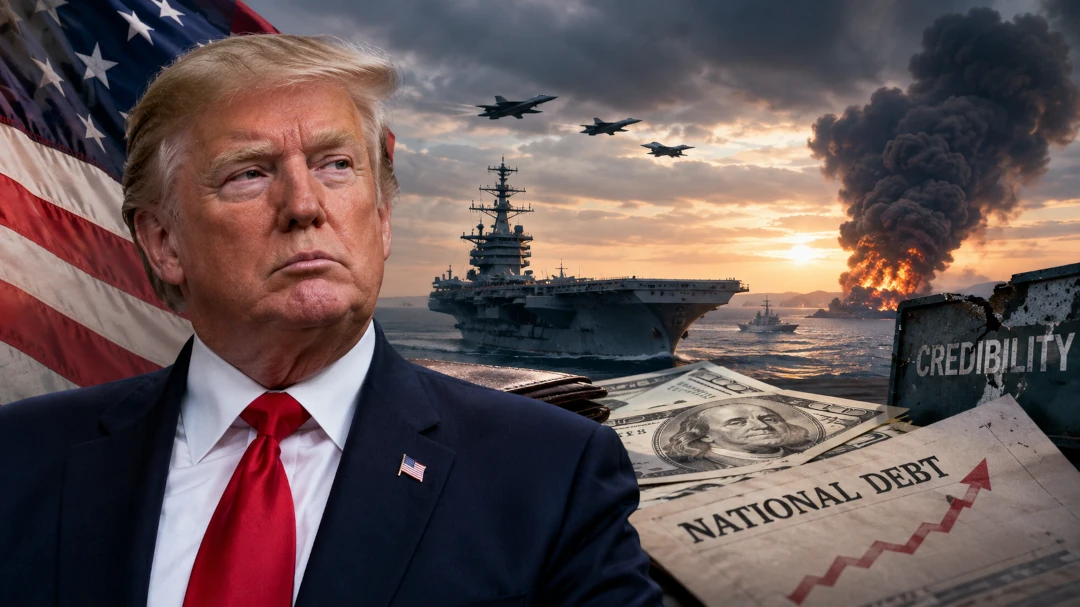
The Cost of a Lie: Trump’s Iran War Is Draining America’s Arsenal, Wallets, and Credibility — All at Once.
The Pentagon’s own watchdog says we are running out of weapons. The Congressional Budget Office says we are paying for it at the pump. The dead are being buried in Dover. And the pretext — that Iran was on the verge of a bomb — was a lie the president himself created when he tore up the deal that was keeping the bomb away.
On Monday, the Department of Defense’s own inspector general put a number on what the Trump administration has spent the past six months denying. The war in Iran — code-named Operation Epic Fury, launched on February 28 without congressional authorization — has cost American taxpayers $33.4 billion through June 30 alone. Of that, $22.3 billion was burned in expended munitions. The nation’s stockpiles of the very weapons designed to deter our next war have, in the words of the inspector general’s first mandatory report to Congress, produced “strategic inventory shortfalls.” The industrial base cannot resupply them fast enough. And a day later, on Tuesday, the nonpartisan Congressional Budget Office published its own accounting: total cost through August 1 is now $38 billion, climbing by roughly $3 billion every month. The war Donald Trump promised would last “weeks” is on pace to add half a percentage point to inflation into the first quarter of 2027, and analysts estimate it will take five years to rebuild what the Pentagon has already spent.
These are not the numbers of a war we are winning. These are the numbers of a war a president chose, without a mandate, on a pretext of his own manufacture — and that ordinary Americans, from the parents of dead service members in Kuwait to the drivers filling up in Ohio, are being made to pay for.
Defense Secretary Pete Hegseth spent the summer telling the public the munitions crisis wasn’t real. Trump, hours after his own inspector general’s report dropped, posted to Truth Social that the United States is producing more elite weapons than at any time in the nation’s history. It is worth reading that sentence again while remembering that the report published by his own Pentagon says the opposite. This is the pattern. It has been the pattern for eight months. And it is why more than seventy members of Congress, several of them senators, have now argued publicly that the president is unfit for the office he holds.
I. The Watchdog Confirms What the Secretary Denied
The inspector general’s report, mandated by Congress and covering the war’s first four months, is the first comprehensive public accounting of the conflict’s cost — and it is devastating on its own terms. The Pentagon has lost four F-15 fighters, damaged one F-35, damaged seven KC-135 aerial refueling tankers, and lost as many as 30 MQ-9 Reaper drones. Iranian strikes have damaged or destroyed hundreds of buildings at U.S. bases across the Middle East and caused an estimated $184 million in damage to U.S. diplomatic facilities in Bahrain, Kuwait, the UAE, and Saudi Arabia. This does not include the cost of repairing those facilities. It does not include a single dollar of the projected multi-year replacement of the missile inventories now depleted.
Mark Cancian of the Center for Strategic and International Studies told CBS News that if we’re only fighting Iran, we have enough weapons. If we suddenly had to defend Taiwan from China — a scenario the Pentagon has spent a decade preparing for — we might have munitions for a month before running dry. CNN previously reported that the U.S. military had nearly exhausted eighty percent of its THAAD interceptor stockpile prosecuting the Iran campaign. The Associated Press reports that experts say it will take roughly three years to restore advanced missiles and defensive interceptors to pre-war levels.
Read that plainly: the president who ran on strength has spent eight months emptying the arsenal that keeps America strong. And his defense secretary spent those eight months insisting nothing was wrong.
“The munitions expenditure on Operation Epic Fury has resulted in strategic inventory shortfalls and revealed industrial base bottlenecks for munitions resupply.”
— Department of Defense Inspector General, Report to Congress, September 15, 2026
The report also details the human toll the White House has worked hard to keep out of public view. According to Al Jazeera’s compilation of Pentagon statements, at least 17 American service members have been killed and more than 420 wounded since the war began — and the majority of those wounds have come in the summer, after the president assured the country the war was nearly over. The Intercept reported this week, citing two U.S. officials familiar with operations, that the military is on the brink of a “breakdown” in its ability to sustain the war Trump insisted would be over by April.
II. The Inflation Tax: What Every American Household Is Paying
The bill is not paid only in dollars from the Treasury or blood in Dover. It is paid at the gas pump, at the grocery store, on every monthly mortgage payment. The Congressional Budget Office, in the assessment released this week, projects that the Iran war will keep inflation roughly half a percentage point higher than it would otherwise have been well into 2027. The mechanism is not mysterious: the Strait of Hormuz — through which roughly a fifth of the world’s oil normally travels — has been effectively closed since March. Global crude prices have climbed above $100 a barrel. Gas has hit $4.29 a gallon on average, more than $1.30 higher than the day before Trump’s strikes began. Diesel is at record levels, driving up the cost of transporting everything — groceries, clothes, furniture — to every corner of the country.
Mark Zandi, chief economist at Moody’s Analytics, has calculated the direct cost of the war to the average American household. His figures, reported by NBC News in July, are unforgiving. Higher gas costs the average household $360 a year. Groceries have climbed $240. Other transportation, $110. Higher interest rates — the direct product of a Federal Reserve refusing to cut while war-driven inflation runs — are adding another $205 to household bills. Total: more than $1,200 a year, per household. And that was in July, before the CBO revised its forecast upward and before the war’s cost tipped over $38 billion.
Spent on expended munitions in the war’s first four months alone, per the Pentagon Inspector General. France 24
Total Defense Department cost through August 1, per the CBO. Growing by roughly $3 billion every month. Punchbowl News
Share of U.S. THAAD missile interceptor stockpile the military has burned through defending against Iranian strikes, per CNN. Northeast Times
Annual added cost to the average American household from the war, per Moody’s chief economist Mark Zandi. NBC News
Damage to U.S. diplomatic facilities across the Gulf caused by Iranian retaliatory strikes, per the IG report. The Hill
U.S. service members killed since the war began February 28. More than 420 wounded, with casualties concentrated in the summer. Al Jazeera
Rep. Brendan Boyle of Pennsylvania, the top Democrat on the House Budget Committee, put the trade-off in the plainest terms after the CBO release: for years, Trump and his party told working families the country could not afford to help them at home, and now those same officials have found tens of billions of dollars — with more to come — for a war they never asked Congress to authorize. The affordability crisis Republicans blamed on Joe Biden throughout 2024 is now their own war’s inflation, made in the White House and paid by the checkout line.
III. The Lie at the Center: There Was No Bomb
It is easy, six months into a war, to forget how it began. So it bears restating clearly: this war was launched on the premise that Iran was on the verge of building a nuclear weapon. That premise is not true. And it is not true because of a decision Donald Trump himself made, twice — first in 2018, then again in 2025 when he refused to restore what he had broken.
From 2015 to 2018, Iran’s nuclear program was constrained by the Joint Comprehensive Plan of Action, the deal negotiated by the Obama administration and later defended by Vice President Biden. Under the JCPOA, Iran capped uranium enrichment at 3.67 percent — well below weapons grade — cut its centrifuges, and accepted the most intrusive inspections regime in the history of nonproliferation. United Nations inspectors repeatedly certified Iran’s compliance. Every other signatory — Britain, France, Germany, Russia, China — continued to back the deal.
In 2018, President Trump withdrew the United States from the agreement over the strenuous objections of his own intelligence services and America’s closest allies. He did not replace it. He offered no diplomatic alternative. Instead he chose a “maximum pressure” campaign whose measurable effect, as documented by FactCheck.org and confirmed by nonproliferation experts, was to accelerate exactly the enrichment the deal had halted. Laura Rockwood, who spent 28 years at the International Atomic Energy Agency, has stated bluntly that Iran advanced its program to its pre-war level not despite the JCPOA but because Trump tore it up. Richard Nephew, who served as the State Department’s Iran envoy, calls Trump’s 2018 withdrawal an “accelerating effect” on the very program the president now claims to be stopping with cruise missiles.
In other words: Iran was not sprinting for a bomb under the treaty Barack Obama signed. Iran began advancing toward one only after Donald Trump made America a treaty-breaker — and Iran advanced faster still after he abandoned diplomacy a second time in 2025. Trump then used the very program he helped create as the justification to bomb the country he had spent seven years radicalizing against U.S. leverage. This is not strategy. This is arson followed by a bill for the firefighters.
“Iran advanced its nuclear program to its pre-war level not because of the JCPOA, but because President Trump withdrew the United States from it.”
— Paraphrased from Laura Rockwood, former IAEA official, quoted at FactCheck.org, March 2026
IV. A Timeline of the Cost — In Blood, Brick, and Dollars
The war did not arrive as a single event. It has landed, piece by piece, in the lives of American troops and their families across the Gulf. Each of the following was reported at the time. Read them together.
Get Involved Today
Contribute to our mission and turn your concerns into action.
V. What Congress Is Doing — and What It Cannot Do Without the House
The list of what congressional Democrats have already done is longer than most Americans realize. Since the war began in late February, House Democrats — led by Minority Leader Hakeem Jeffries, Foreign Affairs ranking member Gregory Meeks, Armed Services ranking member Adam Smith, and Rep. Ro Khanna working with Republican Rep. Thomas Massie — have forced war powers votes in every calendar month since March. Multiple resolutions have passed one chamber. One has passed both. None has changed Trump’s conduct, because the president has refused to acknowledge the legally binding character of the War Powers Resolution and because Speaker Mike Johnson has repeatedly refused to bring binding measures for a signature-ready floor vote.
In the Senate, Chuck Schumer has forced five separate war powers votes. One succeeded, in June. Four have failed, most recently 46–51 in April, because a small but decisive Democratic defection — Sen. John Fetterman has voted with Republicans on every one — combined with Republican discipline to block the resolution. Sens. Chris Murphy, Tim Kaine, Ed Markey, Ron Wyden, and Andy Kim have been the loudest floor voices. Rep. Pramila Jayapal has led parallel efforts in the House.
What Democrats are promising for the midterms is more concrete. The New Republic reports that House Democratic leadership has committed publicly that on the first day of a Democratic majority, they will pass legislation to compel an end to hostilities and require the administration to return to a nuclear framework — a JCPOA-style deal with verification. Rep. Greg Casar, chair of the Congressional Progressive Caucus, has argued that the affordability wave that Democrats need to ride to the House majority runs directly through the gas pump, and the gas pump runs directly through the Strait of Hormuz. Democratic strategy at this moment is unambiguous: link every dollar of price increase, every child of a fallen soldier, every empty missile silo, to the president who chose this war.
What Democrats cannot do without at least one chamber is force the war to end over Trump’s objection. That requires a majority in the House and, ideally, a filibuster-proof or war-powers-veto-proof coalition in the Senate. Which is why the midterms in November are, whatever else they are, a referendum on whether the American people are willing to keep paying — in gasoline, groceries, arsenal, and lives — for a war their president cannot end and will not defend.
The 25th Amendment: A Mechanism Designed for This Moment
The Twenty-Fifth Amendment, ratified in 1967 after the assassination of John F. Kennedy, provides for the removal of a president “unable to discharge the powers and duties of his office.” Section 4 — the one Democrats have invoked in relation to the Iran war — requires the vice president and a majority of the Cabinet to transmit a written declaration of incapacity to Congress. The vice president then assumes the powers of the presidency. The removed president can contest the declaration; if he does, Congress must resolve the dispute by a two-thirds vote in both chambers.
The lawmakers making the case. The public argument is not fringe. Since April, when Trump posted that “a whole civilization will die” if Iran did not accept his terms by an 8 p.m. deadline, more than seventy members of Congress have called for Section 4 to be invoked. Rep. Ro Khanna of California posted flatly that threatening war crimes required immediate removal. Sen. Chris Murphy of Connecticut said Cabinet officials should be “calling constitutional lawyers about the 25th Amendment.” Sen. Andy Kim of New Jersey called the president “unfit for office.” Rep. Robert Garcia, ranking member on House Oversight, joined the calls, as did Sens. Ed Markey and Ron Wyden, and Reps. Pramila Jayapal, Alexandria Ocasio-Cortez, Linda Sánchez, Diana DeGette, and Yassamin Ansari — the first Iranian American Democrat in Congress. Illinois Gov. J.B. Pritzker joined publicly. So did figures on the political right, including former Rep. Marjorie Taylor Greene, who called Trump’s language “evil and madness”.
The constitutional case. The argument is not merely that the president is unpopular, or that the war is unwise. It is that a commander in chief who publicly threatens the annihilation of a civilian population — a war crime under the Geneva Conventions the United States helped write — is by that act demonstrating an inability to discharge the office consistent with his oath to preserve, protect, and defend the Constitution. That the same president has now been contradicted by his own inspector general on the basic question of whether the American military has enough weapons; that he has publicly asserted the opposite of a fact certified inside his own Pentagon; that he has spent months insisting a war he cannot end is nearly over — each of these compounds the case.
The Practical Barrier
The 25th Amendment requires the vice president and a majority of the Cabinet to act. Vice President JD Vance has shown no willingness to break with Trump; the Cabinet is stocked with loyalists selected precisely for their unwillingness to constrain him. The Section 4 process, absent a break inside the executive branch itself, has no path to activation. Democrats know this. That is why the same lawmakers who have called for Section 4 have also introduced impeachment resolutions and pressed war powers votes.
Why the Barrier Does Not End the Argument
A remedy that cannot be exercised is still a remedy. The framers of the Twenty-Fifth Amendment built Section 4 precisely because they understood that presidential incapacity — whether from injury, illness, or the kind of untethered judgment on public display in April — is a threat the Constitution must be able to name. The public case for Section 4 is not merely legal but civic: it is the country’s way of stating, on the record, that what is happening is not normal, that a president threatening genocide is not fit, that a president lying about the state of the arsenal that defends the country has abdicated his responsibility to it. When the Cabinet refuses to act, the failure is theirs, not the amendment’s — and the case for their electoral removal, in 2026 and in 2028, becomes the case the amendment could not close on its own.
VI. The Sum of the Costs
Add them up. Thirty-eight billion dollars of Treasury spending, climbing at $3 billion a month, financed on credit at interest rates the war itself is holding up. Twenty-two billion dollars of the arsenal that deters our next war, gone. Eighty percent of a critical missile stockpile, gone. Three years or five years to replace it — the estimates vary; neither is short. Four F-15s, one F-35, thirty Reapers, seven refuelers. Hundreds of buildings across a half-dozen U.S. bases in a half-dozen countries. Nearly $200 million in damage to embassies. Seventeen dead Americans, and counting. Four hundred and twenty wounded. A gas price a dollar-thirty higher than before the war. A household budget $1,200 a year heavier. An inflation rate half a point higher into next year. A Federal Reserve unable to cut rates. A defense industrial base that Lockheed’s own missile chief has described as “controlled chaos.”
And for what? For a nuclear program the JCPOA had contained until Donald Trump broke the JCPOA. For a war he said would last weeks, that is now in its seventh month with no exit. For a “deal” the president has claimed to be close to at least 38 times, per a CNN analysis, and never delivered. For a Middle East less stable, allies more skeptical, adversaries in Beijing and Moscow watching the arsenal deplete in real time, and a dollar whose global standing has taken more damage from this presidency than from any single event since the 2008 financial crisis.
This is what happens when a country abandons its treaties, insults its allies, breaks its own laws to launch a war, and then lies to its own people about what the war has cost. It does not make America stronger. It does not make America safer. It makes America poorer, weaker, more isolated, and less able to fight the wars it might actually one day need to fight.
Editorial Conclusion
The Pentagon’s own watchdog has now confirmed on paper what the administration has spent months denying: this war has emptied the arsenal, exposed the industrial base, and left the United States materially weaker than it was on the day Donald Trump ordered the first strike. The Congressional Budget Office has confirmed the second half of the ledger: it is the American household — not the president, not his Cabinet, not the defense contractors — that is paying, and will keep paying, until the war ends.
A war launched without a congressional vote, on a nuclear pretext manufactured by the president’s own withdrawal from the deal that had contained it, defended by lies about the state of the arsenal, and prosecuted with rhetoric that named the destruction of a civilian population as an aim — this is not a foreign policy. It is a constitutional emergency the framers of the Twenty-Fifth Amendment tried to give the republic tools to name.
The tools of removal require officials willing to use them. The tool that does not is the ballot. In November, the American people will decide whether the arsenal, the budget, the alliances, and the lives of American service members are worth returning to Congress the power the Constitution assigns it — the power to declare, and to end, the wars fought in the country’s name. Nothing less than that is on the ballot. And nothing less than that will do.
Sources & References
- NBC News — Pentagon watchdog says Iran war has led to munitions shortfall
- NBC News — Iran war fuels inflation, mortgage rates and gas prices
- CBS News — $22.3B spent on Iran war munitions has caused “strategic inventory shortfalls”
- Washington Post — Iran war has caused ‘strategic’ munitions shortfall, IG report says
- France 24 — Iran war exposes U.S. munitions shortfall, industrial bottlenecks
- Al Jazeera — Dozens of aircraft, hundreds of buildings: US loss to Iran attacks revealed
- Al Jazeera — What we know about US soldiers killed in Iran war
- Al Jazeera — US Senate approves Iran war powers resolution: What that means for Trump
- Punchbowl News — Defense: Iran war costs near $40B, per CBO
- News 5 Cleveland — Iran war has cost the US more than $38B, budget office says
- The Intercept — Iran War Has the U.S. Military on the Brink of a “Breakdown”
- CNN — Democrats and right-wing voices call for removing Trump from office
- The Hill — Democrats intensify calls to invoke 25th Amendment, impeach Trump over Iran threats
- The Hill — Republicans join Democrats on war powers resolution
- NPR — For a 2nd time, House approves resolution to end the war in Iran
- FactCheck.org — Trump’s Claim About the Obama Nuclear Deal and Iran’s Nuclear Development
- PolitiFact — What was the Iran nuclear deal and why did Trump drop out?
- New Republic — Democrats’ Plan for Ending the Iran War
- Center for American Progress — The Interest Rate Penalty From Trump’s War With Iran
- NBC News — Dozens of Democrats call for Trump’s removal after his Iran threats
- Michigan Independent — Inflation hits 3-year high, fueled by Iran war
- Meeks (House Foreign Affairs) — Statement on Senate Passage of Iran War Powers Resolution
Related News