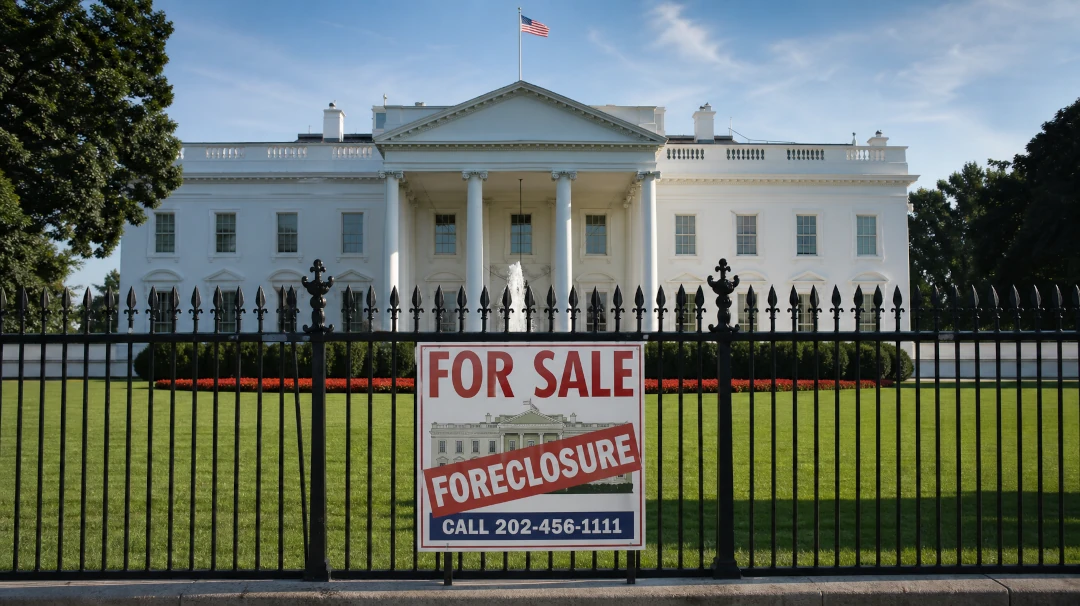
The $40 Trillion Verdict: A Nation Mortgaged for Ballrooms, Arches, and Wars of Choice
The debt has doubled in less than a decade. The Treasury just doubled its emergency bond-buying to keep the long end of the market from breaking. And the president wants to build a $900 million ballroom and a 250-foot arch — to himself — while telling Americans he cannot afford their Medicaid, their day care, or their Medicare.
On Tuesday, August 18, 2026, the odometer on the American republic quietly rolled over a number that no country in history has ever posted. The United States Treasury’s daily statement showed total public debt outstanding at $40.047 trillion — a figure so large that when spoken aloud it sounds less like a balance sheet than a threat. The federal government’s IOU has more than doubled in less than a decade, from $19.95 trillion the day Donald Trump first placed his hand on the Bible in January 2017 to more than $40 trillion the day his Treasury Secretary Scott Bessent had to intervene to keep the bond market from breaking.
That intervention came the very next morning. On Wednesday, the Treasury Department announced it would at least double the size of its buyback operations for long-dated government debt — from $2 billion per operation to at least $4 billion — after the 30-year Treasury yield hit 5.34 percent, its highest level since 2007. The bond market was, in plain English, refusing to buy what Washington was trying to sell at any price the country could afford.
The Trump White House called the debt milestone unremarkable. Asked whether Americans should worry about the bond market, the president told reporters, “No, I don’t think so.” This is the same president who, in 2020, reportedly told donors, “Who the hell cares about the budget?” It is not an accident that the two statements sound identical. It is the governing philosophy.
I. The $40 Trillion Threshold
The raw numbers are worth stating without euphemism. According to the Treasury’s own daily balances statement, public debt now stands at 123%-125% of gross domestic product — meaning the country owes nearly a quarter more than everything it produces in an entire year. Interest payments on that debt are on pace to exceed $1 trillion in 2026 and, as NBC News reported this week, are “on track to surpass Medicare as the government’s greatest expense.” Not defense. Not Social Security. Interest on money the country has already spent.
Since Trump was sworn in for a second time in January 2025, the debt has climbed by $3.8 trillion — bringing his personal tab across two terms to $11.6 trillion. President Biden added $8.4 trillion during his single term, much of it in unavoidable pandemic recovery spending and infrastructure investment. The nonpartisan Committee for a Responsible Federal Budget is clear that the policy choices of both men accelerated the debt trajectory beyond what existing law would have produced. That is honest, and it should be said. What follows from that honesty, however, is not “both sides” comfort. It is the recognition that only one of these presidents is currently in office, only one is currently designing new policy, and only one has responded to a $40 trillion milestone by announcing plans for a personal triumphal arch.
Total Federal Debt
$40.05T
As of Aug. 18, 2026, per the U.S. Treasury’s daily statement — more than double the $19.95T on Trump’s first inauguration day. Reuters
Debt to GDP
123%
The country now owes 23% more than it produces in a year. Moody’s stripped the U.S. of its last perfect credit rating in 2025. CNN Business
30-Year Treasury Yield
5.34%
Tuesday’s 19-year high, before Treasury’s emergency buyback intervention brought it to 5.19%. Every basis point costs taxpayers. Reuters via Yahoo Finance
Annual Interest Bill
$1T+
Interest payments in FY2026 will exceed one trillion dollars and are projected to surpass Medicare as the government’s largest single expense. NBC News
II. The Buyback Panic
To understand the significance of Wednesday’s Treasury announcement, it helps to know what a buyback is not. It is not new spending. It is not stimulus. It is not, as some administration officials tried to frame it, “improving liquidity.” A buyback is when the Treasury goes back into the market to purchase debt it has already issued, essentially propping up prices so that yields — the interest rate the government must pay to borrow — do not spiral upward.
On Wednesday morning, hours after the $40 trillion figure printed on the wire, Treasury Secretary Scott Bessent moved to at least double the government’s buyback capacity in the 10- to 30-year sector, effective September 9 through November 4. Yields dropped nine basis points on the announcement. Markets rallied. It looked, for an afternoon, like a save.
It is not a save. It is a warning flare. As Citigroup’s Dan Gottlander told Reuters, “It does not change deficits, obviously, and if you are going to buy back the long end, you still will need to issue” — meaning the same debt just comes back, in different packaging, at the short end of the curve. The Treasury is now essentially running an internal shell game to prevent the bond market from openly repricing American fiscal credibility. Rene Albrecht, a senior analyst at DZ Bank, was even blunter: policymakers “fear the pain of 5% or higher yields on the long end, not only because it raises the interest rate costs for the government but also for the private sector.”
“You can’t just keep borrowing money endlessly. It’s going to bite.”
— Jamie Dimon, CEO, JPMorgan Chase, January 2026
Every basis point on the long end is real money extracted from the American public. Higher Treasury yields push up mortgage rates, auto loan rates, credit card rates, and small business borrowing costs. They also lock in a permanently higher federal interest bill, because bonds issued today at 5.2 percent will still be paying 5.2 percent in 2056. This is the affordability crisis the White House refuses to name — because naming it would require admitting that its policies are its cause.
III. Who Pays: The Tax Bill’s Two Americas
To grasp why the debt trajectory has accelerated so sharply since January 2025, follow the money out the door. The One Big Beautiful Bill Act (OBBBA), which Trump signed on July 4, 2025, extends and expands more than $4.5 trillion in tax breaks — the overwhelming share flowing to corporations and the top 1 percent — while making the largest single rollback of federal health coverage in American history. According to the Congressional Budget Office, the bill raises the debt ceiling by $5 trillion and adds $3.3 trillion to the national deficit over the decade. It kicks 11.8 million Americans off health insurance.
The distributional math is unambiguous. The Center for American Progress found that the OBBBA’s cuts to Medicaid for low-income families and its tax giveaways to the top 1 percent of earners are almost identical in size — roughly $1 trillion each. Half of that top-1-percent windfall, $500 billion, goes to the top 0.1 percent: roughly 200,000 households earning more than $2 million a year. Meanwhile the Institute on Taxation and Economic Policy calculates that in 2026 alone, the middle 60 percent of Americans will pay $900 more on average than they would have under the tax code that existed before Trump took office. The poorest 20 percent will see their taxes rise by 3.1 percent of income. The top 1 percent will see a net cut worth 0.4 percent of income — an average check of $66,000.
The politically important part is what happens at the end of this year. Most of the modest, temporary sweeteners for working families — the tips deductions, the small overtime carve-outs, the marginally expanded standard deduction — are structured to expire. The permanent provisions overwhelmingly benefit the top decile. This is not an accident of drafting. It is the design. And whatever nominal relief the middle class received has, as most families can testify at any grocery store or gas station, been eaten alive by the president’s tariffs, by rising energy costs driven by the war in Iran, and by the slow structural inflation that a $40 trillion debt inevitably produces.
“It’s not possible for us to take care of day care, Medicaid, Medicare.”
— President Donald J. Trump, at a private event, 2026
IV. The Pillar the GOP Abandoned
There is a story Republicans still tell about themselves in campaign literature and cable-news chyrons: the party of fiscal responsibility, of the balanced ledger, of the frugal householder standing against Democratic profligacy. The historical record demolishes that story with a completeness that is almost embarrassing to review. According to the A-Mark Foundation’s compilation of federal deficit data since 1981, every Republican president in the modern era has left office with the deficit larger than he found it — Reagan by 94 percent, George H.W. Bush by 67 percent, George W. Bush by 1,204 percent, and Trump (first term) by 317 percent. The two completed Democratic presidencies in the same period both left the deficit smaller: Bill Clinton by 150 percent, Barack Obama by 53 percent.
The pattern is not accidental. It is doctrinal. Vice President Dick Cheney’s infamous 2002 line — “Reagan proved deficits don’t matter” — was not a slip. It was the moment a policy commitment was retired in favor of a marketing slogan. Deficits, from that day forward, were something Republicans discovered whenever a Democrat sat in the Oval Office and forgot about the moment one of their own returned. As former House Budget Committee Chair Jodey Arrington (R-TX) publicly conceded in 2023, a Republican balanced budget is now merely “aspirational.”
Trump has never — not in his first term, not in his second — proposed a genuinely balanced federal budget that did not achieve balance by hollowing out programs the working poor depend on. His 2018 budget, as the Associated Press documented, formally abandoned the balanced-budget promise while installing “an era of $1 trillion-plus yearly deficits.” His current administration’s fiscal outline is worse. Trump has requested a $1.5 trillion defense budget for FY 2027 — a 40 percent single-year increase, the sharpest since World War II — offset by $73 billion in cuts to Medicaid, day care, food assistance, and other domestic programs. The Committee for a Responsible Federal Budget estimates the defense request alone will add $5.8 trillion to the debt with interest. There is no balanced budget on this president’s desk. There has never been one on his desk. The claim that Republicans balance budgets is a fiction sustained by the durability of American amnesia.
Get Involved Today
Contribute to our mission and turn your concerns into action.
V. Ballrooms, Arches, and Wars of Choice
The stated fiscal emergency is real. The government cannot, the president tells us, afford Medicaid. It cannot afford day care. It cannot afford Medicare in the form Americans have earned across their working lives. What the government evidently can afford is a $900 million construction project on the White House grounds, a 250-foot triumphal arch across the Potomac from the Lincoln Memorial, and an unauthorized war in Iran now burning through as much as $2 billion a day.
The White House ballroom project — sold to the American public in the summer of 2025 as a $200 million private-donor gift — has, according to internal documents obtained by The Washington Post, ballooned to a total price tag approaching $1 billion, with taxpayers now on the hook for more than half. House Democratic Whip Katherine Clark (D-MA) put it directly: “How many times did Trump say zero taxpayer dollars would go to his gilded ballroom? He lied. Every time. But still not a dime to help lower costs for families.” A Washington Post-ABC News-Ipsos poll found 56 percent of Americans opposed the East Wing demolition and ballroom project — including 45 percent who said they strongly oppose it.
The triumphal arch is, if anything, more revealing than the ballroom. When Trump unveiled the arch idea at a White House dinner earlier this year, a reporter asked whom the monument would honor. Trump pointed at his own chest and said, “Me.” The 250-foot arch — taller than the Arc de Triomphe — is designed to be built on Columbia Island, obstructing the sightline between the Lincoln Memorial and Arlington National Cemetery. According to the National Endowment for the Humanities’ FY 2026 spending plan, $2 million in special initiative funds and $13 million in matching funds are already reserved for it. Vietnam War veterans and a federal historian have sued to stop construction on the grounds that the structure will impede the view of a war memorial to honor a war the president is currently escalating.
That war — the Iran war — has now lasted more than five months, killed 18 American service members, cost at least $37.5 billion in direct outlays, and driven up global energy prices for every American who fills a gas tank. It was launched without congressional authorization. Trump’s administration is now, per reporting from the Center for American Progress, dangling $300 billion in incentives to end a war the same administration started. This is not fiscal policy. It is not a foreign policy. It is a president governing as a personal brand, financed on the credit card of the American public and secured by the future labor of children not yet born. Ray Dalio, the founder of Bridgewater Associates, put it plainly in January: “My grandchildren and great grandchildren not yet born are going to be paying off this debt.”
When Fiscal Recklessness Becomes a Question of Capacity
The Twenty-fifth Amendment to the United States Constitution, ratified in 1967, provides in Section 4 that the Vice President and a majority of the Cabinet — or a body Congress creates by law — may declare that the President “is unable to discharge the powers and duties of his office.” Upon such declaration, the Vice President immediately assumes those powers. The provision exists precisely for a scenario in which a President remains physically alive and legally elected but has lost the judgment required to steward the country’s affairs.
On April 14, 2026, Rep. Jamie Raskin (D-MD), ranking Democrat on the House Judiciary Committee, introduced legislation with 50 co-sponsors to establish exactly such a body — a bipartisan Commission on Presidential Capacity to Discharge the Powers and Duties of Office. Raskin’s statement was unusually direct: “Public trust in Donald Trump’s ability to meet the duties of his office has dropped to unprecedented lows as he threatens to destroy entire civilizations, unleashes chaos in the Middle East while violating Congressional war powers, aggressively insults the Pope of the Catholic Church and sends out artistic renderings on-line likening himself to Jesus Christ. We are at a dangerous precipice.”
Two weeks later, on April 30, 2026, Senators Sheldon Whitehouse and Jack Reed (both D-RI) entered into the Congressional Record a statement signed by 36 physicians — neurologists, psychiatrists, and cognitive-disorder specialists from Harvard, Tufts, Columbia, and George Washington University — warning of the president’s “rapidly worsening, reality-untethered, increasingly dangerous decline” and calling for the 25th Amendment to be invoked “with the greatest urgency.” A February 2026 Reuters-Ipsos poll found that a majority of Americans, including 30 percent of Republicans, describe the president as erratic.
The Fiscal Dimension of the Argument
The constitutional case for capacity review does not rest on any single decision — it rests on the accumulating pattern. A president who tells donors “who the hell cares about the budget,” who signs a bill adding $3.3 trillion to the deficit while telling Americans he cannot afford their Medicaid, who redirects Secret Service and Military Office funds to build a personal ballroom while the bond market breaks around him, who demands a 250-foot arch in his own honor while depleting the munitions stockpiles his generals say are needed to defend the country — this is not, in the plain constitutional sense, a demonstration of the judgment required to discharge the office. Presidents may take unpopular fiscal decisions. They may not use the Treasury as a personal expense account while denying the country the capacity to govern its own finances.
The Barriers Are Real. The Case Is Also Real.
The practical obstacles to invoking the Amendment are substantial. Section 4 requires the sitting Vice President and a Cabinet majority to act — a Cabinet Trump personally selected. If overridden by the President, a two-thirds vote in both chambers is required to keep him removed. The Republican Senate has shown no appetite for such a step. This is real, and no serious analyst pretends otherwise. But the fact that a constitutional mechanism is politically hard to invoke does not extinguish its existence, nor does it silence the moral and legal case that the mechanism was written for a moment exactly like this one. The Founders did not write Section 4 for easy cases. They wrote it for the ones the political system would resist confronting. That resistance is not evidence the case is weak. It is evidence the system is being tested.
VI. What Comes Due
The affordability crisis Americans are living through — the higher grocery bills, the higher utility bills, the vanishing tax cuts, the medical premiums that keep climbing — is not a mystery. It is the downstream consequence of a governing coalition that has spent five decades cutting taxes for the wealthiest, borrowing to cover the shortfall, and then telling working families that Medicaid and food assistance are what the country cannot afford. As Sen. Mitt Romney (R-UT) put it in December, the country is on a fiscal cliff and “taxing the rich is now necessary given the magnitude of our national debt.” When even the party’s own recent presidential nominee is saying the tax cuts have to end, it is worth asking why the president is fighting to make them permanent for the top 10 percent while letting them expire for everyone else.
The Democratic path forward exists and has been described repeatedly. It includes letting the OBBBA’s tax cuts for high earners lapse on schedule, restoring the top marginal rate to its pre-2017 level, closing the carried-interest loophole, expanding IRS enforcement against high-end tax evasion (which the OBBBA specifically curtailed), and negotiating serious cost reductions in Medicare Part D pharmaceutical spending. None of these are politically easy. All of them are arithmetically necessary. And every one of them has been introduced, in some form, by Senate Democrats or by the House Progressive Caucus. The Republican counter-proposal, as summarized in the Joint Economic Committee’s analysis of the House GOP budget plan, is to raise the Social Security retirement age, cap Medicaid, and cut the rest of non-defense discretionary spending by 31 percent across the board. That is who they mean to have pay for the ballroom, the arch, and the war.
Editorial Conclusion
A country that crosses forty trillion dollars in debt while its president builds a ballroom, an arch, and a war — and then tells its citizens he cannot afford their health care — is not experiencing a fiscal accident. It is being governed by a leader who has forgotten what the office is for.
The 25th Amendment exists for the days when the presidency stops discharging its duties and starts consuming them. Whether or not Congress finds the political courage to invoke it, the constitutional case is now a matter of public record, entered by 50 House members and 36 physicians and signed by the country’s own bond markets.
The verdict is not partisan. It is arithmetic. And the arithmetic is finished with this presidency.
Sources & References
- NBC News — “U.S. debt crosses $40 trillion threshold after doubling under Trump and Biden”
- The Spokesman-Review / Reuters — Detailed Treasury balances breakdown
- CNBC — “Treasury doubles debt buybacks as Bessent moves to steady bond market”
- Washington Post — “Bond yields fall, markets rally after Treasury doubles debt buybacks”
- Reuters via Yahoo Finance — “Bessent doubles US long-bond buybacks in the face of surging yields”
- NBC News — “America’s borrowing costs are surging. Washington is shrugging.”
- CNN Business — “National debt reaches grim $40 trillion milestone. Here’s why that matters.”
- Institute on Taxation and Economic Policy — “Year One of Trump-Republican Tax Policy: The Consequences”
- ITEP — State-by-state estimates: “All But the Richest Americans Face Higher Taxes”
- Center for American Progress — “$1 Trillion in Medicaid Cuts, $1 Trillion in Tax Giveaways”
- Center for Medicare Advocacy — “Impact of the Big Bill on Medicare”
- Forbes — “One Year After Trump’s ‘Big Beautiful Bill,’ Here’s What Actually Happened”
- Washington Post — “Trump administration set to spend at least $900 million on White House construction”
- Office of Rep. Katherine Clark — “Trump ballroom soars to $600M, with taxpayers on hook for half”
- CNBC — “Trump’s 250-foot ‘triumphal arch’ would loom over Potomac”
- Center for American Progress — “Fact Sheet: Costs of the Trump Administration’s War in Iran”
- Gulf News / AFP — “Trump seeks $1.5 trillion defence budget as Iran war drives costs”
- MS Now — “Raskin offers bill setting up 25th Amendment process to remove Trump from office”
- The Hill — “Concerns grow over Trump’s mental fitness for presidency” (36 physicians letter)
- A-Mark Foundation — “U.S. Presidents and the Federal Deficit, 1981–2022”
- Belfer Center, Harvard — “Republicans Fight Deficits Only When A Democrat Is President”
- Washington Post — “The 40-year path that left the GOP unable to balance the budget”
Related News