Uranium for the Highest Bidder: How Trump Sold America’s Nonproliferation Firewall to the Saudis Who Paid His Family
A 30-year nuclear pact signed with a regime that murdered a Washington Post journalist, waged a devastating war in Yemen, and whose citizens carried out the deadliest terror attack on American soil. Meanwhile, the president’s son-in-law manages $2 billion of Saudi money — and the president’s family collects millions more in real estate and golf deals. The question is no longer whether the appearance of a conflict exists. The question is what the Constitution allows the American people to do about it.
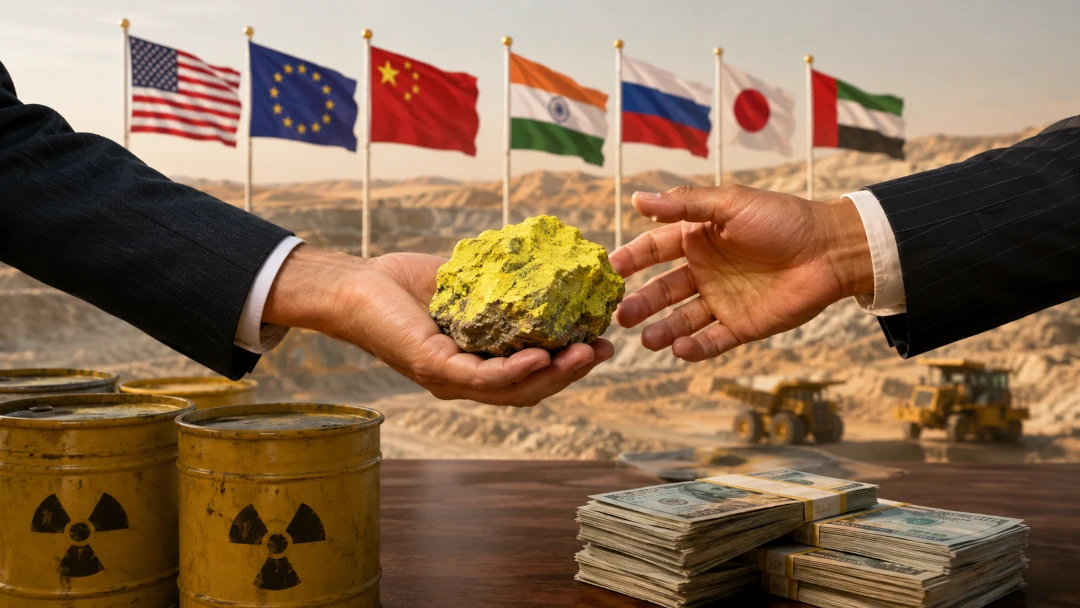
On July 22, 2026, in the middle of an ongoing war launched to prevent Iran from enriching uranium, the Trump administration signed a 30-year nuclear cooperation pact with Saudi Arabia that could permit American companies to build a uranium enrichment facility on Saudi soil. According to reporting by CNN, the Associated Press, and NBC News, the agreement — known as a “123 agreement” under the Atomic Energy Act — does not require Riyadh to accept the so-called “gold standard” of nonproliferation safeguards. It does not include the International Atomic Energy Agency’s Additional Protocol for intrusive inspections. And it is being handed to a Saudi crown prince who has said, on the record, that if Iran gets a bomb, so will Saudi Arabia.
The day after the deal was announced, President Trump took to Truth Social to insist, in his usual all-caps voice, that “There will be no enrichment of material!” — and that the pact was “totally subject” to Saudi Arabia joining the Abraham Accords. But as multiple outlets noted, the text of the deal has not been released, U.S. officials told the AP that a joint study on a Saudi enrichment facility is precisely what the agreement contemplates, and the president’s after-the-fact walk-back does not appear anywhere in the signed document. Alexander Bollfrass, a nuclear expert at the International Institute for Strategic Studies, called it “a revolutionary new approach to nuclear nonproliferation policy” — meaning the United States is now willing to transfer sensitive nuclear technology without the oversight one would ordinarily expect.
This is not, on its face, a mere diplomatic controversy. It is the deliberate erosion of a firewall built painstakingly across seven decades — the firewall that separates civilian nuclear power from the machinery of a bomb. And it is being erased by a president whose family has been the personal recipient of billions of dollars from the same regime now being handed the keys.
I. The Deal, in Plain English
A “123 agreement” is the legal instrument the United States uses to share peaceful nuclear technology with foreign governments. Under longstanding U.S. policy — followed by the deal signed with the United Arab Emirates in 2009 — Washington has demanded that any recipient give up, in writing, the right to enrich uranium or reprocess spent fuel. Enrichment and reprocessing are the two doorways to a bomb. Everything else in the civilian nuclear cycle can be walked back. Those cannot.
The Saudi deal does not include that pledge. According to PBS NewsHour, congressional documents obtained by nonproliferation experts, and reporting from the Associated Press, the pact envisions a joint U.S.-Saudi study of whether to build an enrichment facility inside the kingdom. It also does not include the IAEA’s Additional Protocol — the mechanism that permits short-notice inspections at undeclared sites and is considered essential for catching clandestine weapons work.
Congress will get a mandatory review period. But under the 1954 Atomic Energy Act, the deal takes effect automatically unless both chambers pass a joint resolution of disapproval — which the president would then veto, meaning opponents would need a veto-proof two-thirds majority in each house. In a Congress the president’s party controls, that is a near-impossible bar.
“This deal would make us all less safe. They are allowing Saudi Arabia, a belligerent and authoritarian nation, to develop nuclear weapons technologies while starting a war with Iran under the guise of preventing an Iranian nuclear bomb.”
— Sen. Edward J. Markey (D-Mass.), July 22, 2026
II. The Kingdom’s Ledger of Blood
Before we discuss the money, we must be honest about the recipient. This is not Norway. This is not Japan. Saudi Arabia is a hereditary autocracy that has, in the past eleven years alone, committed acts that any serious American government would treat as disqualifying for the transfer of sensitive nuclear technology. Nine of the pattern’s most consequential moments:
Any one of these entries would be disqualifying on its own. Taken together, they describe a state that uses violence, at scale, as an instrument of routine policy — abroad, at home, and against its own citizens even on foreign soil. This is the government that has now been handed the keys to a civilian nuclear program without the highest available safeguards.
III. Follow the Money
The style guide of American ethics used to be simple: if you cannot separate a policy decision from a personal payment, you do not make the decision. That principle has been shredded. In the years since Donald Trump left the White House and returned to it, the Trump family’s financial entanglements with Saudi Arabia have grown from opportunistic to structural.
Six months after leaving the White House, Jared Kushner received a $2 billion commitment from Saudi Arabia’s Public Investment Fund — over the objections of the fund’s own advisory panel, which cited Kushner’s “inexperience” and “public relations risks.” The panel was overruled by Crown Prince Mohammed bin Salman personally. Source: House Oversight investigation.
By 2026, Kushner’s firm — where 99 percent of assets come from foreign nationals, mostly Gulf sovereign wealth funds — reported $6.16 billion in assets under management, up $1.2 billion in a single year. Even as Kushner serves as one of the U.S. government’s chief Middle East negotiators, he is reportedly raising another $5 billion, largely from the same Gulf sources.
A Trump entity that appears to collect fees from the Saudi developer Dar Al Arkan reported $15.9 million in licensing revenue for the Trump Tower Jeddah project, according to Forbes reporting. Additional Trump-branded developments in Riyadh and a second Jeddah tower have been announced since Trump’s 2024 election victory.
The Saudi Public Investment Fund–backed LIV Golf tour has held marquee events at Trump National Bedminster, Trump National Doral, and Trump National Washington. A Yahoo/Reuters analysis pegged Trump’s total golf windfall from the PIF-LIV relationship at $395 million — money flowing directly to the president’s family business.
Less than a month before Kushner was again working the Middle East file for the White House, his firm teamed with Saudi Arabia’s PIF to take video game giant Electronic Arts private in a $55 billion deal — the largest leveraged buyout in history. Public policy and private profit are, at this point, indistinguishable. Source: Forbes.
The Trump Organization’s first new licensing deal after leaving office, announced in 2022, was with Saudi developer Dar Al Arkan for a resort project in Oman — reportedly delivering over $6 million to Trump personally. It was the beginning of what the Trump Organization has now described as its largest single foreign business relationship. Source: Forbes.
Get Involved Today
Contribute to our mission and turn your concerns into action.
Rep. Jamie Raskin, ranking member of the House Judiciary Committee, has opened a formal investigation into what he described as Kushner’s “staggering conflicts of interest,” noting that Kushner had publicly promised not to serve in government or fundraise during a second Trump term and has done the opposite on both counts. Kushner has defended the arrangements by insisting he “followed every law and ethics rule” and that no policy decision was influenced. That is not, in fact, the standard. The standard — long embraced by every previous administration — is that the appearance of a conflict is itself a disqualifying problem, because the American public cannot be asked to trust that policy is being set on the merits when the family running the government is on the payroll of the foreign government being negotiated with.
IV. The Iran Contradiction
Here is the moral and strategic incoherence at the center of this decision. In June 2025, without congressional authorization, the United States bombed Iranian nuclear facilities. The stated rationale — repeated by the president, the vice president, and the secretary of state — was that Iran could not be permitted to enrich uranium, because enrichment is the road to a bomb, and a nuclear Iran would destabilize the region. Americans were told that this was worth the risk of war. American service members were put in harm’s way for that principle.
One year later, in the middle of the same war, the same administration signed a deal that could permit enrichment on the soil of Iran’s regional rival — the country whose crown prince has stated publicly that Riyadh will build a bomb if Tehran does. Sen. Chris Murphy (D-Conn.), a member of the Senate Foreign Relations Committee, put it precisely: “Everything that happens in Riyadh has a reaction in Tehran.” The deal, he said, has “the potential to greatly destabilize the region” and pushes any durable nuclear settlement with Iran further out of reach.
The contradiction is not lost on the world. It cannot be. The message being sent to every regional government — to Turkey, Egypt, the UAE, Qatar, Oman — is that the U.S. nonproliferation standard is now for sale, and the price depends on how well-connected you are to the American president’s family. Henry Sokolski of the Nonproliferation Policy Education Center asked the question directly in CNN’s reporting: “What new standard is the Saudi deal going to set for the UAE, Turkey, and Egypt?”
“The president’s committing nuclear nonproliferation malpractice. Because he’s pulled out of the Iran agreement, and by selling to the Saudis nuclear technology, it makes it much more likely that the Iranians are going to restart their nuclear program, because they see that the Saudis have a head start. This is absolutely disastrous.”
— Sen. Chris Murphy (D-Conn.), on MSNBC
V. The Opposition — And What They Are Actually Saying
The rejection of this deal is not, contrary to White House framing, a partisan reflex. Sen. Ed Markey (D-Mass.), a co-chair of the bicameral Nuclear Weapons and Arms Control Working Group and the author of the pending No Nuclear Weapons for Saudi Arabia Act, issued a statement reminding Americans that Secretary of State Marco Rubio — when he was a senator — was himself a co-sponsor of legislation requiring congressional approval for exactly this kind of deal. What Rubio warned against in the Senate he now defends from the State Department podium.
The dissent extends to Israel, the U.S. ally most directly affected. Former Israeli Prime Minister Naftali Bennett, now a leading opposition candidate, has publicly opposed the deal on regional-stability grounds. Democratic Majority for Israel’s president Brian Romick called the failure to condition the pact on Saudi-Israeli normalization “a major strategic mistake.” The concerns cross ideological lines because the fear is not ideological — it is technical, historical, and grounded in the physics of what an enrichment cascade can be pivoted to produce.
The specific objections, distilled:
National security: The removal of the “gold standard” pledge weakens the strongest nonproliferation tool the United States has, and does so at the moment other nations are watching to see whether it still holds.
Global security: The Middle East already contains one nuclear state (Israel) and one nuclear-armed neighbor pledging arsenal-sharing (Pakistan). Adding Saudi enrichment infrastructure creates a “nuclear Wild West,” in Markey’s phrase — a term of art that describes a region in which multiple states have latent bomb capability with limited transparency.
Economic implications: The deal is worth billions to U.S. nuclear firms in the short term, but the long-term cost of a proliferation cascade — measured in defense spending, alliance strain, and the possibility of a regional exchange — dwarfs any commercial upside.
The optics — and the substance — of a two-tier standard: A country that bombs one nation to prevent enrichment while enabling enrichment in another has no credible nonproliferation policy left to defend. That is not a rhetorical point. It is what every future adversary and every future ally will learn from what just happened.
“Unable to Discharge the Powers and Duties of His Office”
The Twenty-Fifth Amendment, ratified in 1967, contains four sections. Section 4 is the one Americans should be studying now. It permits the Vice President and a majority of the Cabinet — or “such other body as Congress may by law provide” — to declare in writing to the leaders of both houses of Congress that the President is “unable to discharge the powers and duties of his office.” Upon that declaration, the Vice President immediately becomes Acting President.
The drafters chose the word “unable” — and left it undefined — deliberately. The historical record from the 1965 congressional debates makes clear that the framers of the Amendment considered and rejected narrower language. They did not restrict the mechanism to physical incapacitation, coma, or clinical mental illness. They understood — Rep. Jamie Raskin, a constitutional law professor before he was a congressman, has emphasized this point repeatedly — that presidential unfitness could take many forms, some of which had not yet been imagined. The Amendment is a constitutional answer to a constitutional problem: what does a democracy do when its chief executive can no longer be trusted with the duties of the office?
In April 2026, Rep. Raskin introduced legislation to establish the “Commission on Presidential Capacity to Discharge the Powers and Duties of Office” — the “other body” that Section 4 explicitly contemplates but that Congress has never actually created in nearly six decades. The bill, co-sponsored by 50 House Democrats, would create a 17-member panel of physicians, psychiatrists, and former high-ranking officials empowered to work alongside the Vice President in a Section 4 declaration. Rep. Raja Krishnamoorthi (D-Ill.) has publicly called for Vice President Vance and the Cabinet to invoke the Amendment directly, citing “a dangerous pattern of reckless escalation, erratic decision-making, and general conduct that raises grave questions about his fitness to discharge the duties of the presidency.”
The Constitution explicitly vests Congress with the authority to create a body that will guarantee the successful continuity of government by responding to presidential incapacity to discharge the powers and duties of office. We have a solemn duty to play our defined role under the 25th Amendment.
— Rep. Jamie Raskin (D-Md.)
The argument the Saudi nuclear deal supports: A president who authorizes a war to prevent uranium enrichment in one country, then signs a treaty enabling uranium enrichment in another country whose royal family has paid his family more than two billion dollars, is a president whose personal financial entanglements have compromised his capacity to discharge the constitutional duties of the office. “Unable” — in the framers’ broader sense — does not require a coma. It can encompass a president whose judgment on national security has become inseparable from his family’s bottom line. That is a form of incapacity the framers could not have named but plainly meant to cover.
The practical barriers, honestly stated: Republicans control both chambers of Congress. Vice President JD Vance is not going to invoke Section 4. The Cabinet — appointed by Trump himself — is not going to. A commission created by the Raskin bill would require passage by the current Congress, which will not happen, and any declaration under Section 4 that Trump contested would require a two-thirds vote of both houses within 21 days to sustain — a bar that has never been met and is not going to be met in this Congress.
But the impossibility of the political path does not negate the constitutional case. The framers of the Twenty-Fifth Amendment wrote it precisely because they understood that there would come a moment when the ordinary machinery of accountability — impeachment, elections, resignation — might be inadequate to the crisis at hand. That moment does not arrive with an announcement. It arrives one decision at a time. And the Saudi nuclear deal is one such decision. Building the mechanism now, so that it exists when it is needed, is the constitutional response of a self-governing people.
VII. What This Says About Leadership
Presidents are elected to protect the country, not to enrich their families. That is not a partisan sentiment; it is the founding premise of the office. The Emoluments Clauses of the Constitution — Article I, Section 9 and Article II, Section 1 — were written precisely because the framers understood that foreign payments to a chief executive would corrupt the office and endanger the republic. James Madison did not need to imagine a sovereign wealth fund; he understood the principle.
What the Saudi nuclear deal reveals about the character of this presidency is not new. It is confirmation. A president who told a reporter that the murder of a Washington Post journalist was a matter of “things happen.” A president who called the man U.S. intelligence has assessed ordered that murder “incredible on human rights.” A president whose son-in-law is simultaneously the U.S. envoy to the region and the manager of $2 billion of that regime’s money. A president whose company is licensing his name for skyscrapers in Riyadh and Jeddah while he negotiates the terms on which that regime will acquire nuclear technology.
The pattern is not obscure. It is documented in the CIA’s declassified findings, in the FBI’s Operation ENCORE files, in the New York Times investigation of the Kushner PIF deal, in Forbes’s ledger of Trump-family Saudi income, in the on-the-record statements of two dozen sitting United States senators, in the ODNI’s assessment of Khashoggi’s murder, in the House Oversight and Judiciary Committee investigations. What is required is not more evidence. What is required is that the country act as though the evidence matters.
Editorial Conclusion
A nuclear cooperation agreement is not a real estate deal. It cannot be unsigned. Once enrichment infrastructure is built and once the “gold standard” precedent is broken, no future administration can put the pieces back. The Trump family has been paid billions of dollars by the Saudi state. The president has just handed that state the most sensitive technology the United States possesses — without the safeguards every previous administration insisted upon, in the middle of a war justified by the very principle he has now abandoned.
That is not a policy disagreement. That is a constitutional emergency. Congress must exercise its authority under the Atomic Energy Act to reject this agreement. It must pass the No Nuclear Weapons for Saudi Arabia Act. And it must establish the Section 4 commission the Twenty-Fifth Amendment explicitly authorizes — not because removal is politically imminent, but because the constitutional machinery of self-government exists to be used before the crisis, not after.
The American republic was not designed to be governed by a family in business with the regimes it negotiates with. It is time to say so — clearly, on the record, and in the language the Constitution itself provides.
Sources & References
- NBC News — Trump approves landmark U.S.-Saudi nuclear deal
- CNN Politics — US signs deal with Saudi Arabia that could allow kingdom to enrich nuclear fuel
- PBS NewsHour — Critics warn U.S. nuclear power deal with Saudi Arabia could fuel proliferation
- Associated Press / PBS — Trump approves nuclear agreement that may allow Saudi Arabia to enrich uranium
- Al Jazeera — Proposed US-Saudi nuclear energy deal: What we know so far
- Semafor — Democrats prepare to resist Saudi nuclear deal
- Sen. Ed Markey — Markey Decries Trump-Saudi Nuclear Deal: “Irresponsible and Dangerous”
- House Oversight Democrats — Probe of Saudi Government’s $2 Billion Investment in Jared Kushner’s Firm
- Truthout — House Judiciary Investigating Jared Kushner’s Investments From Saudi Arabia
- MSNBC / MS.NOW — Jared Kushner’s conflicts of interest become even more controversial
- CBS News — Kushner defends his equity firm getting $2 billion from Saudis
- Forbes — Everything We Know About Trump’s Financial Ties To Saudi Arabia
- Yahoo / Reuters — Donald Trump’s $395m golf windfall revealed after PGA Tour and LIV intervention
- NPR — Biden Declassifies Secret FBI Report Detailing Saudi Nationals’ Connections To 9/11
- Motley Rice — Declassified FBI documents link senior Saudi official to suspected spy who helped 9/11 hijackers
- FactCheck.org — Trump at Odds with CIA Assessment on Khashoggi Killing
- NPR — Trump defends Saudi crown prince over question about killing of Khashoggi
- Human Rights Watch — World Report 2024: Saudi Arabia
- Al Jazeera — HRW: Saudi violating international law in war on Yemen
- House Judiciary Democrats — Raskin Introduces Legislation Establishing Independent Commission on Presidential Capacity
- Rep. Raja Krishnamoorthi — Krishnamoorthi Calls for President Trump’s Removal Under 25th Amendment
- QZ — Trump says Saudi nuclear deal contingent on Abraham Accords, no enrichment
Related News