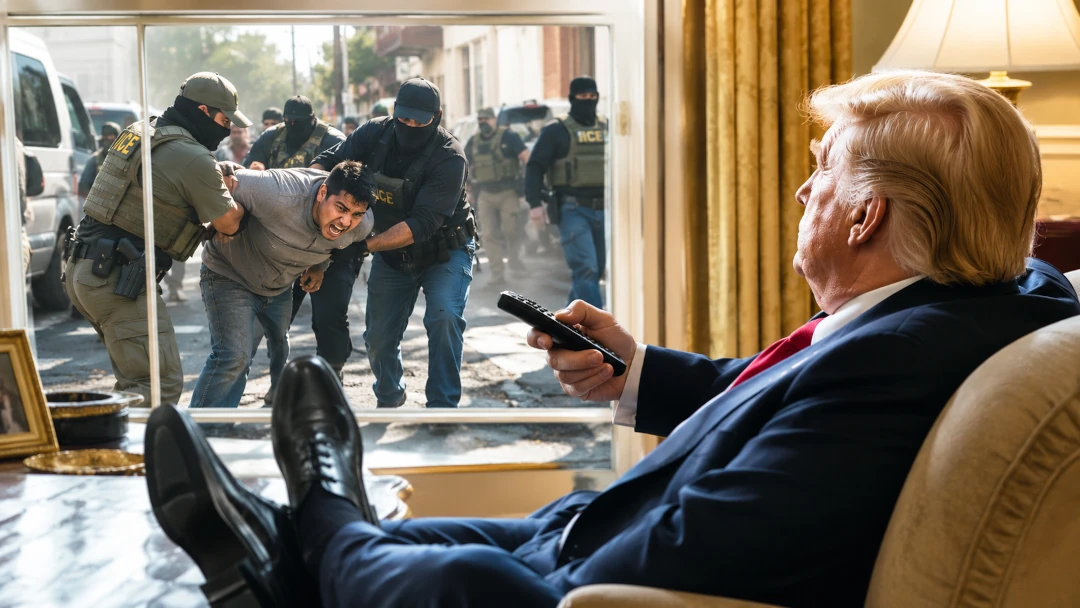
A DHS secretary tried to pause the vehicle stops that had just killed two men. Within a day, the president reversed him — after watching cable news. What this episode reveals about President Trump’s priorities is not a policy disagreement. It is a warning about who, and what, actually governs the United States.
On the morning of Wednesday, July 15, Homeland Security Secretary Markwayne Mullin was, however briefly, doing the job of a Cabinet officer. Two federal agents under his authority had killed two men in the span of a single week — Lorenzo Salgado Araujo, a 52-year-old father driving his construction crew to a Houston jobsite, and Joan Sebastián Durán Guerrero, a 25-year-old delivery driver in Biddeford, Maine, whose wife and three-year-old daughter watched him die on a residential street corner. Neither man was the target of the operations that killed them. Mullin, faced with two bodies and a national outcry, ordered Immigration and Customs Enforcement officers to pause most vehicle stops nationwide while the agency reviewed its training and tactics. It was, by every documented standard of federal law enforcement, an entirely defensible act of executive restraint.
Twenty-four hours later, the president of the United States overruled him on Truth Social, apparently after watching Steve Bannon and Tomi Lahren complain about it on television.
The reversal is being framed in the Beltway press as a management story — Mullin failed to secure White House sign-off, insiders are sniping, an administration source told NBC News the decision was “100%” a bad move made without presidential blessing. That framing is a category error. What happened last week was not a memo mishap. It was the clearest public demonstration to date that the federal immigration enforcement apparatus is now being steered, in real time, by whatever coalition of MAGA television personalities is loudest that morning — and that the president of the United States considers the appearance of toughness on cable news more important than whether federal agents are killing bystanders in the streets of American towns.
I. What Actually Happened
The chronology is not in dispute. On July 7, ICE agents in unmarked SUVs pursued and shot Lorenzo Salgado Araujo through the window of the white work van he was driving, as three passengers looked on. The agency’s initial statement claimed Salgado Araujo had tried to ram an officer — an account that has since been directly contradicted by the surviving passengers’ attorney and by preliminary information disclosed by a federal prosecutor. On July 13, agents in Biddeford, Maine, opened fire on Guerrero, who was not the subject of the warrant they were executing, at a Pool Street intersection where neighbors and his family heard six shots.
Following a plea from Republican Senator Susan Collins of Maine, Mullin ordered the pause. Time magazine reported the guidance directed agents under Enforcement and Removal Operations to stop initiating vehicle stops and work with partner agencies for warrant executions on people in vehicles. Border czar Tom Homan defended the pause to reporters on Tuesday, describing ICE’s vehicle-stop training as “quite extensive.” By Wednesday morning, Trump had reversed the order publicly on Truth Social, and Mullin was forced to post his own retreat on X, insisting he and the president were “on the same page.”
“We CANNOT give up one of I.C.E.’s most important and effective Crime Fighting tools, THE TRAFFIC STOP! Once we do, we are playing right into the criminal’s hands.”
— President Donald Trump, Truth Social, July 15, 2026
According to reporting by Jonathan Lemire and Nick Miroff of The Atlantic, corroborated by CNN and Axios, Trump was “livid” Tuesday night after seeing coverage of the stand-down. Cable news criticism, principally from Tomi Lahren, Steve Bannon and former Border Patrol chief Greg Bovino, convinced the president that pausing the stops would “make them all look weak.” Senior DHS and ICE officials told The Atlantic it would have been “highly unlikely” that Mullin issued the pause without White House sign-off. “Not a chance,” one official said. “Someone got into the big boss’s ear. Three-ring circus.”
II. The Two Men Who Are No Longer Alive
Any serious accounting of this reversal has to begin with the human cost the president waved away between one Truth Social post and the next.
Lorenzo Salgado Araujo · Houston · July 7
52 years old. Father of three. A homebuilder driving co-workers, including his brother, to a construction site at dawn. ICE agents pursued him in unmarked SUVs. The agency claimed he rammed an officer; his passengers, through their attorney Hugo Balderas, say no agent was ever in front of the vehicle. He was not the target of the operation.
Joan Sebastián Durán Guerrero · Biddeford · July 13
25 years old. Colombian, authorized to work in the United States, with a Social Security number. Delivery driver. Wife and three-year-old daughter present at the scene. Neighbors described a quiet, hardworking man. Portland Press Herald reporting confirms he was not the subject of the ICE warrant. The officers involved were not wearing body cameras — despite $20 million appropriated to ICE for that purpose in April.
What both cases share
Neither man was the person ICE was looking for. Both were killed during vehicle stops. Both official accounts have been challenged by witnesses, family, or investigators. Both are, in the language ICE itself uses for its warrantless arrests, “collateral.” This is the tactic Mullin briefly tried to pause. This is the tactic the president insisted must continue.
These two deaths did not occur in isolation. Two U.S. citizens were killed by immigration officers in Minneapolis earlier this year — the reason, The Atlantic notes, that Mullin took over DHS in the first place. Between February and October of last year, House Judiciary Democrats documented a surge in wrongful detention of American citizens, some held with violent force, some for over a week. In August 2025, fifty members of Congress led by Rep. Dan Goldman, Sen. Elizabeth Warren, Sen. Alex Padilla, Sen. Mark Kelly and Rep. Lou Correa demanded formal investigations into the wrongful arrest and deportation of U.S. citizens — including U.S. citizen children deported alongside their undocumented parents against their families’ wishes.
Get Involved Today
Contribute to our mission and turn your concerns into action.
III. Governance by Cable News
What Democrats and honest Republicans should be discussing this week is not whether Markwayne Mullin should keep his job. It is what the reversal tells us about how decisions of life and death are actually being made inside this White House.
Consider the sequence. A Cabinet secretary consults with the senior Republican senator from Maine — a state where a federal officer just killed a father in front of his family. He orders a pause, with input from career DHS and ICE officials, to review training and tactics. The border czar publicly defends the decision on Tuesday afternoon. That evening, the president watches television. By Wednesday morning, the decision is reversed by Truth Social post, and everyone below the president is scrambling to pretend they were “on the same page” all along.
“Someone got into the big boss’s ear. Three-ring circus.”
— Senior DHS official to The Atlantic, July 15, 2026
Set aside, for a moment, whether you agree or disagree with mass deportation as policy. Ask instead: is this how a functioning American government makes decisions about when federal agents may use deadly force? The answer, plainly, is no. Cabinet secretaries in a functioning administration do not have their public safety directives overturned within a news cycle because Steve Bannon complained on a podcast. Presidents in a functioning administration do not confuse cable news volume with constitutional duty. And press secretaries do not, as a matter of routine, insist that everyone was always in perfect agreement when the record shows they plainly were not.
The reversal was not a policy judgment. It was, by the administration’s own account to The Atlantic, a reaction to the fear that a stand-down would “make them all look weak.” The president of the United States, faced with two dead men and the possibility of more, chose the optics of strength over the substance of safety. That is not leadership. It is stagecraft with a body count.
IV. The Message to the American People
The message this episode sends to Americans — every American, of every status — is unambiguous.
To U.S. citizens: if you are stopped by ICE, and the agents get it wrong, this administration will not slow down to prevent it from happening again. It will do the opposite. The nonpartisan estimate is that roughly 2,000 U.S. citizens may be in ICE custody at any given time, with more than 170 documented wrongful-detention cases since expanded enforcement began. Some were held for a week or more. Some were physically assaulted. Some are children. In New Mexico, a U.S. citizen with an intellectual disability was held for approximately ten days after answering “yes” when officers asked if he was in the country. In one 2026 case, a U.S. citizen born in Colorado was deported to Mexico after being pressured into signing voluntary departure papers before his family could produce his birth certificate. The Senate Permanent Subcommittee on Investigations found that agents were regularly telling citizens with valid REAL IDs and U.S. passports that their documents appeared fake.
To people here legally — visa holders, green card holders, TPS recipients, asylees, work-authorized immigrants like Guerrero: your paperwork will not save you if an agent decides in the moment that you match a description. And if that agent kills you, the president will defend the tactic that killed you before your family has finished planning the funeral.
To everyone else: the routine safety of driving to work, of dropping a child off at school, of running an errand at 7 a.m., is no longer something the federal government considers worth protecting when it conflicts with a self-imposed arrest quota. Trump’s DHS is reportedly under pressure to deliver 2,000 to 3,000 arrests a day. That number is the entire architecture. Everything else, up to and including whether people go home alive, is subordinate.
V. The Economic Reckoning Already Underway
The president’s supporters insist all of this is being done to protect American workers and American communities. The economic data, produced by mainstream analysts and even by industry-aligned Republicans, tells a very different story.
The American Immigration Council, drawing on labor data compiled by Economic Insights and Research Consulting, found that between March and July 2025, the U.S. agricultural sector lost 155,000 workers, compared with a 2.2% employment increase over the same months in 2024. Construction employment fell in the ten states most exposed to enforcement even as other states saw a 1.9% gain. In California — the state that produces 75% of U.S. fruits and nuts and a third of its vegetables — enforcement raids in Oxnard alone were estimated to drive $3–7 billion in crop losses and produce-price increases of 5 to 12 percent.
The Federal Reserve Bank of Dallas, hardly a progressive think tank, found earlier this year that intensified enforcement creates a “chilling effect” that reduces labor supply even beyond the workers physically detained. The construction industry, according to Texas Public Radio reporting, could face a shortage of up to 500,000 workers if the Trump administration achieves its stated deportation goals. Rep. Henry Cuellar (D-TX) has said out loud what many Republican members will only whisper: “There’s not enough Americans to fill certain jobs.” Even Rio Grande Valley Republican Rep. Monica De La Cruz has called the raids at construction sites a crisis for builders.
NPR’s Planet Money, drawing on new economic research this spring, summed up the emerging consensus: mass deportation is not a growth policy. It is a labor-shortage generator, a food-price accelerant, a housing-cost multiplier, and — because undocumented workers are also consumers and taxpayers whose net contribution to federal revenue the CBO has documented — a fiscal drag. Every credible analysis by economists not on the White House payroll has reached some version of the same conclusion.
The president does not care. That, too, is a fact worth stating plainly. Told that his enforcement regime is killing bystanders and hollowing out the labor force that builds American houses and picks American food, the president chose to double down within twenty-four hours because Steve Bannon told him to.
VI. What This Says About the President’s Priorities
Let us be direct. A president whose Cabinet secretary tries to stop bystander shootings, and who reverses that order because cable pundits complained, has told the country what his priorities are. He values the aesthetics of cruelty over the reality of governance. He values the approval of a small set of MAGA media figures over the counsel of his own senior officials. He values the appearance of “strength” over the actual American lives — citizens, legal residents, and human beings — being ended in the streets by federal officers he commands.
This is not a hypothesis. It is the on-the-record account of his own senior DHS and ICE officials to The Atlantic. It is the on-the-record account of the administration source who told NBC News that Mullin’s decision was “100%” a bad move. It is the on-the-record account of the officials who told Axios the president was “livid” on Tuesday night. The people saying these things are, in every case, on his side.
The 25th Amendment Was Written for Presidents Who Cannot Discharge the Duties of the Office. This Is What That Looks Like.
The Twenty-fifth Amendment, ratified in 1967 after the Kennedy assassination, contains a mechanism the Framers of the original Constitution did not: a formal, peacetime procedure for removing a president who is “unable to discharge the powers and duties” of the office. Under Section 4, the Vice President and a majority of the Cabinet — or a body designated by Congress — may declare the president unfit and transfer authority to the Vice President. Congress, by two-thirds vote of both chambers, has the final say if the president contests the finding.
“Unable to discharge” is not defined solely as physical incapacity. Constitutional scholars, including the Framers of the Amendment itself, have long understood the phrase to include a president whose judgment and decision-making have deteriorated to the point where he cannot faithfully execute the office. A president who overturns his own DHS’s use-of-force review within a news cycle because he is watching cable television — and who does so after two documented bystander killings by his federal agents — is failing the most basic duty of the office he holds: to take care that the laws be faithfully executed and that the lives of the governed are protected.
Lawmakers already on record. Rep. Jamie Raskin (D-MD), Ranking Member of the House Judiciary Committee, has formally demanded a cognitive and neurological evaluation of the president and, in April, introduced legislation establishing an independent Commission on Presidential Capacity — the “other body” expressly contemplated by Section 4 — with fifty co-sponsors. Rep. Raja Krishnamoorthi (D-IL) has publicly called on Vice President Vance and the Cabinet to invoke the amendment. Sen. Bernie Sanders (I-VT) has described the president’s decision-making pattern as “the ravings of a dangerous and mentally unbalanced individual.” Sen. Chris Murphy (D-CT) has said that if he were in the Cabinet, he would be calling constitutional lawyers about Section 4.
The specific constitutional argument. A president who cannot resist a cable news segment for the length of one training review is a president whose impulse control has become inseparable from the exercise of federal police power. When that combination produces preventable deaths — Lorenzo Salgado Araujo, Joan Sebastián Durán Guerrero, the two Minneapolis U.S. citizens killed earlier this year — it ceases to be a political problem and becomes a constitutional one. The Amendment does not require a coma. It requires a president unable to faithfully discharge the duties of the office. That is the case that is being made, on the record, by sitting members of the House Judiciary Committee.
The honest assessment of the barriers
The practical obstacles are formidable and should not be glossed over. Vice President J.D. Vance and this Cabinet will not invoke Section 4 against the president who elevated them, absent a catastrophic public event. Congress is Republican-controlled and will not pass the Raskin commission bill in this session. Any Section 4 finding contested by the president must clear a two-thirds vote in both chambers, a threshold that has never been met in American history for any removal mechanism, including impeachment.
But those barriers do not negate the constitutional case; they only describe the political one. The 25th Amendment was written precisely to give the country a legal, orderly answer to a president who is unfit — an answer that does not require a coup, an assassination, or a civil war. When members of the president’s own party will not use it, that is a failure of political courage, not a failure of the constitutional text. The framework exists. The evidentiary record — including the events of last week — is being built in public. What is missing is the will of the Cabinet and Congress to use the tool the Constitution gave them. That absence is itself part of the emergency.
VII. What Is Actually Required
Two men are dead, and the president reversed the modest safety pause meant to prevent a third. This should be the political story of the summer. The Beltway coverage that treats it as an inside-baseball dispute between a president and his second-string DHS secretary is failing the country. The story is not Markwayne Mullin. The story is a presidency in which the actual chain of command runs from a Truth Social post to a Fox News chyron to a dead father on a Biddeford street corner.
Congressional Democrats must stop treating each new incident as an isolated scandal to be logged and move to a coherent framework: sworn testimony from DHS and ICE leadership on the use-of-force decisions in the Salgado Araujo and Guerrero shootings; a demand that Vice President Vance publicly state whether he considers the president fit to discharge the duties of the office; passage of the Raskin commission bill through the House, forcing every Republican to vote on the record. Republican members of Congress who understand what is happening — and there are more of them than are willing to say so publicly — must decide whether the political cost of speaking is greater than the moral cost of silence.
The American people are entitled to know that when a federal officer kills their neighbor, the government that officer serves will pause long enough to ask whether it can be prevented from happening again. Last week the president decided that basic principle was less important to him than looking tough on television. That decision was not a policy judgment. It was a revelation.
Editorial Conclusion
A president who overrules the safety review of a fatal federal shooting because pundits complained on television is not exercising the powers of the office he holds. He is performing them for an audience. The Constitution provides a mechanism for a president who can no longer faithfully discharge the duties of the office; the Twenty-fifth Amendment exists for exactly this. The political obstacles to invoking it are real and daunting. The constitutional case, after last week, is undeniable.
Lorenzo Salgado Araujo and Joan Sebastián Durán Guerrero were killed by agents of the United States government. Their deaths were the entire reason a Cabinet secretary tried to pause the tactic that killed them. The president of the United States reversed that pause within twenty-four hours because Steve Bannon and Tomi Lahren were angry on cable. If that is not a president “unable to discharge the powers and duties of his office,” the phrase has no meaning left in it. The question is no longer whether the case for Section 4 exists. It is whether anyone with the power to act on it is willing.
Sources & References
- NBC News · Tension between Mullin and White House appears to be growing, sources say
- Time · ICE Reverses Plan to Halt Vehicle Stops After Trump Complains
- CNN · Furious Trump overturns suspension of ICE traffic stops amid MAGA criticism
- Axios · How a fuming Trump reversed ICE’s pause on vehicle stops
- The Daily Beast · Panicked Donald Trump’s Real Reason for ICE U-Turn Exposed
- Mediaite · Trump Reportedly Unpaused ICE Traffic Stops After Tomi Lahren and Steve Bannon Criticized the Move
- CNN · What we know about Joan Sebastian Guerrero, killed by an ICE officer in Maine
- Portland Press Herald · Who was Johan Sebastián Durán Guerrero, the man killed by ICE in Biddeford?
- Texas Tribune · ICE agent fatally shoots migrant in Houston
- Houston Public Media · Salgado Araujo’s passengers dispute ICE’s account of fatal shooting
- PBS NewsHour · What to know about the fatal shooting of Lorenzo Salgado Araujo by ICE
- House Judiciary Democrats · Raskin Demands White House Physician Evaluate Trump’s Cognitive Fitness
- Deseret News · Democrats introduce Trump fitness bill under 25th Amendment
- Rep. Krishnamoorthi · Krishnamoorthi Calls for President Trump’s Removal Under 25th Amendment
- House Judiciary Democrats · Raskin, Jayapal Renew Demand on Wrongful Detainment of U.S. Citizens
- Rep. Goldman · Goldman, Warren, Padilla, Kelly and Correa Demand Investigations into ICE Detentions of U.S. Citizens
- American Immigration Council · Trump’s Immigration Actions Are Taking a Toll on Local Economies
- Texas Public Radio · Construction site ICE raids hurting economy and building industry
- NPR Planet Money · The economic chilling effect of Trump’s immigration crackdown
Related News