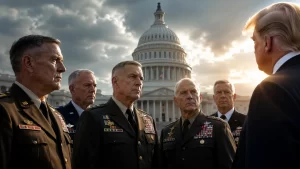
A $1.15 Trillion Blank Check for a War Congress Never Authorized
The House just handed Donald Trump the largest defense authorization in U.S. history — while simultaneously voting a second time to end the war he is fighting without their approval. Six Democrats crossed the aisle to make it possible. The bill fuses the American military to Israel’s, saddles taxpayers with another hundred billion in debt, and rides atop a voter-suppression law. It is a bill written for a president who no longer recognizes any limit on his authority.
On the same afternoon that the U.S. House of Representatives voted a second time to order President Donald Trump to end his unauthorized war on Iran, it also handed him $1.15 trillion to keep fighting it. The two votes were separated by a matter of hours. Both were held under the same Capitol dome, by the same members, on the same day. This is not a contradiction Congress can explain away. It is a portrait of a legislative branch that has surrendered — and of a president whose priorities are so far out of alignment with the country he governs that a formal constitutional response is no longer merely appropriate. It is required.
The fiscal 2027 National Defense Authorization Act passed the House on July 22 by a razor-thin margin of 216 to 212. Seven Republicans voted no. Six Democrats voted yes. Two members did not vote. Had those six Democrats held the party line, the largest military authorization in the history of the United States — a bill that institutionally merges the American and Israeli defense industrial bases, that funds a war Congress has twice tried to stop, that is bolted to a voter-suppression package Trump is holding the rest of the government hostage over — would have died on the floor. Instead, it heads to the Senate.
“Nothing to lower gas prices. Nothing to lower food prices. Just more spending on the most unpopular war in American history.”
— Rep. Brendan Boyle (D-PA), Ranking Member, House Budget Committee
What follows is what the American public was not told from the House floor: who the six Democrats were, what Section 219 actually does, why the White House wants this bill so badly, what it means for our alliances and our economy, and — inescapably — what it says about the man in the Oval Office.
I. The Six Who Made It Possible
The Democrats had the votes to kill this bill. They chose not to. The six members who crossed over are, in the language of the House, “frontliners” — Democrats representing swing districts, several of them defending seats in the November midterms. But that framing lets them off too easily. This was not a procedural vote. It was a vote to bankroll an unauthorized war, to lock American military technology to a foreign government, and to attach a voting-restrictions bill to what has historically been the most bipartisan legislation in Congress.
Per reporting from The Hill and confirmed by independent tallies, the six Democrats who voted yes were Henry Cuellar (TX-28), Don Davis (NC-01), Jared Golden (ME-02), Vicente Gonzalez (TX-34), Adam Gray (CA-13), and Marie Gluesenkamp Perez (WA-03). All six have made political brands out of breaking with their caucus. Most are running for re-election in districts Trump carried. Cuellar in particular — long the most conservative Democrat in the House on national-security issues — has taken repeated public heat, including from the San Antonio press, for a vote his own constituents describe as merging the American military with a foreign one.
The political calculus is transparent: these members believe survival in swing districts requires a “strong on defense” credential more than it requires party discipline. That may or may not be strategically correct. What is not in dispute is the effect. Without those six votes, this bill does not exist. The moral responsibility for what happens next — every additional American service member killed in a war Congress has voted twice to end, every dollar of new deficit-financed weapons spending, every provision of Section 219 — belongs, in part, to them.
II. What Section 219 Actually Does
The most consequential provision in a 1,000-page bill sits inside a section few Americans have heard of. Section 219, formally the United States–Israel Defense Technology Cooperation Initiative, directs the Pentagon to designate an executive agent to accelerate joint research, identify Israeli-origin technology for integration into American systems, support co-production of weapons, and fuse the two nations’ data, network, and industrial-base cooperation across drones, artificial intelligence, cyber, missile defense, and quantum computing. Per AIPAC’s own statement, the bill authorizes $750 million in direct funding for U.S.–Israel joint military projects — $500 million for missile defense, $100 million for counter-unmanned systems, $100 million for subterranean operations, and $50 million for emerging technologies — and extends the War Reserves Stockpile Authority for Israel.
Contrary to some hyperbolic characterizations, Section 219 does not literally merge command structures or place U.S. forces under Israeli control. What it does is more subtle and, over time, potentially more binding: it institutionalizes an industrial and technological dependency between the two militaries that will be extraordinarily difficult to unwind, regardless of who wins future elections or how Israel’s own government evolves. Rep. Thomas Massie (R-KY), one of the seven Republicans who voted no, wrote publicly that the provision “tragically merges our military technology and supply chains with Israel’s” and called it “a betrayal of our sovereignty.” Massie is neither a progressive nor a reliable ally of the left. When he and Rep. Pramila Jayapal are on the same side of a defense vote, something structural has broken.
Missile Defense
Direct funding for U.S.–Israel joint missile defense programs under Section 219, per AIPAC’s public statement.
Counter-Drone Systems
For joint development of counter-unmanned-aerial systems — technology directly relevant to Israel’s operations in Gaza and Iran.
Subterranean Operations
Tunnel-warfare capability — a category of spending shaped explicitly by Israeli, not American, operational requirements.
Iran War Total to Date
Pentagon’s own figure for the cost of the Iran war since Feb. 28 — with the department asking for another $67B.
III. What Trump Wants From This Bill
Peel back the rhetoric about “deterrence” and “readiness” and the bill’s purpose becomes clear. Trump wants three things this NDAA delivers, and a fourth that has been welded onto its side.
First, he wants the money to keep fighting Iran. The war he launched on February 28, 2026 — without a declaration of war, without a congressional authorization, and without, in Rep. Mike Levin’s words, “a coherent explanation to the American people of what he intends to achieve or how it ends” — has now dragged on for nearly five months. It has killed at least 18 American service members, injured close to 500, and, according to Pentagon figures, cost taxpayers $37.5 billion so far. The Pentagon originally requested $350 billion in supplemental war spending. The NDAA lifts the annual defense topline from $900 billion last year toward Trump’s stated target of $1.5 trillion. It is a legislative slush fund for a war that has no exit strategy and no authorization.
Second, he wants the Israel provisions. Section 219 is the codification of a strategic vision in which Israeli and American defense priorities become procedurally inseparable. This makes it structurally harder for any future president to condition U.S. military aid on Israeli conduct — in Gaza, in Iran, in the West Bank. Trump is not simply supporting an ally. He is welding the future of American defense policy to a specific foreign government’s priorities.
Third, he wants the domestic power boost. The NDAA codifies a number of Trump executive orders and funds the “Golden Dome” — a signature Trump defense priority for a continental missile-defense shield. It authorizes 5%–7% pay raises for service members, ensuring the president can claim personal credit for supporting the troops even as his war kills them.
Fourth — and this is the part the political press has largely underplayed — House Republicans attached the SAVE America Act to the NDAA before sending it to the Senate. As U.S. News and Reuters both reported, this is Trump’s voter-restriction bill — proof-of-citizenship requirements, restrictions on mail voting, tightened voter-ID rules that voting-rights advocates warn will disenfranchise millions. Trump has threatened to withhold his signature from any bill reaching his desk until SAVE passes. He is, in effect, holding the entire military budget — including troop pay — hostage to a voting-restrictions bill four months before a midterm election. This is not a defense authorization. It is a leverage instrument.
Get Involved Today
Contribute to our mission and turn your concerns into action.
IV. The Debt, the Debt Service, and the Kitchen Table
Ranking Budget Committee Democrat Brendan Boyle put it plainly during floor debate: this bill adds nearly $100 billion to the federal deficit at a moment when the national debt is racing toward $40 trillion. This is not a partisan characterization. The U.S. Treasury’s own real-time debt figure stood at $39.80 trillion as of July 20, 2026 — roughly $118,807 for every American man, woman, and child. Net interest payments on the debt will exceed $1 trillion in fiscal 2026 and have now surpassed the entire defense budget as a line item.
The Congressional Budget Office projects the fiscal 2026 deficit at $1.9 trillion, or 5.8% of GDP, with interest payments doubling to $2.1 trillion by 2036. The Peterson Foundation and the bipartisan Commission on National Defense Strategy have both warned that the debt itself has become the country’s largest national-security threat: it constrains future presidents’ ability to respond to genuine crises, it hands leverage to foreign creditors — foreign investors hold approximately $9.5 trillion in U.S. Treasuries — and it forces trade-offs that will eventually reach every household in America.
Those trade-offs are not abstract. While this administration authorizes another trillion for the Pentagon and adds $100 billion to the deficit for a war few Americans support, it is simultaneously slashing social programs — Medicaid, SNAP, housing subsidies. And the Iran war itself has already reached into every American’s grocery bag and gas tank. When Iran choked off the Strait of Hormuz in March, Brent crude broke the $100-per-barrel mark and, by mid-May, hit $110. Economists at CEPR project the resulting oil shock will add 0.6 percentage points to U.S. headline inflation in 2026. The Global Peace Institute estimates the war will strip roughly $1.3 trillion from global GDP this year alone.
The average American did not choose this war. They will pay for it three times over: at the pump, at the grocery store, and in the mounting cost of servicing the debt Trump is loading onto their grandchildren.
V. The Alliances We Have Left
The reason the United States has, since 1945, been able to project military power at manageable cost is that it has done so with allies. That system is now, by any honest reckoning, in serious disrepair. As Chatham House assessed ahead of the July NATO summit in Ankara, “2026 has been even more difficult” than 2025 for the transatlantic relationship. Trump’s threats to annex Greenland, his public musings about withdrawing from NATO, and his defense secretary Pete Hegseth’s characterization of European allies as “shameful” for declining to help him police the Strait of Hormuz have combined to produce what Lawfare recently called the end of “the transatlantic relationship you knew”.
Retired Lt. Gen. Mark Hertling told MSNBC that NATO headquarters personnel now openly discuss operating without American reliability. “They don’t trust Trump. They don’t trust Hegseth,” Hertling said. Congress’s own research arm confirms this: the Congressional Research Service report on the Ankara summit notes that European members have begun questioning “U.S. reliability and credibility as an ally” — language the CRS does not deploy casually.
Here is the strategic irony this NDAA embodies: at the exact moment the administration is systematically alienating the alliance structure that made American power affordable, it is doubling down on a bilateral defense integration with a single foreign government whose current leadership is under an International Criminal Court arrest warrant. This is not strategy. It is the opposite of strategy.
“The separation of powers exists for a reason, and only Congress has the power to declare war. In a time of extreme executive overreach, Congress must act to prevent the Trump Administration from asserting unilateral authority over the future of our nation.”
— Rep. Jennifer McClellan (D-VA), on the Iran War Powers Resolution
VI. A Timeline of a Presidency Losing Its Grip
To understand the significance of Wednesday’s votes, one has to see them in the context of the last six months. This is not a normal presidency proceeding through normal legislative channels. This is a presidency in visible dysfunction, and Congress is legislating around — and in this bill, funding — that dysfunction.
The 25th Amendment Was Written for This Moment
The 25th Amendment, ratified in 1967, provides a constitutional mechanism for removing a president who is unable to discharge the powers and duties of the office. Under Section 4, the vice president and a majority of the Cabinet — or a body Congress designates — can transmit to Congress a written declaration that the president is unable to serve. The vice president then immediately assumes the powers of the office. If the president objects, Congress decides by a two-thirds vote in both chambers. Section 4 has never been invoked in American history.
The case for its invocation now does not rest on partisan disagreement with the president’s policies. It rests on a pattern of conduct — public, documented, and cumulative — that meets the constitutional standard of inability. Trump launched a war in February without congressional authorization. He has continued that war despite both chambers voting to end it. He has publicly threatened to destroy Iranian civilian infrastructure — power plants, bridges, water systems — conduct that legal scholars and multiple members of Congress have identified as constituting war crimes. He has, per the physicians’ April 30 statement entered into the Congressional Record by Senators Sheldon Whitehouse and Jack Reed, exhibited what 36 medical experts described as “marked deterioration in cognitive functioning,” “grandiose and delusional beliefs,” and “reckless threats of violence.”
Rep. Ro Khanna (D-CA) put it directly: “We need to invoke the 25th Amendment and remove Trump. Threatening war crimes is a blatant violation of our constitution and the Geneva Conventions.” Rep. Shri Thanedar has formally written to the Cabinet demanding they act. Sen. Chris Murphy, Sen. Ed Markey, Rep. Alexandria Ocasio-Cortez, Rep. Eric Swalwell, Illinois Gov. J.B. Pritzker, and — remarkably — even former Rep. Marjorie Taylor Greene and former GOP Rep. Joe Walsh have joined the call. This is not a fringe position. It is a bipartisan reading of the constitutional facts.
The Practical Barriers
We will not pretend the path is easy. Section 4 requires the vice president’s cooperation, and Vice President J.D. Vance has shown no willingness to break with Trump publicly. It requires a majority of a Cabinet the president himself selected and who serve at his pleasure. If the president contests the declaration, it requires two-thirds of both chambers of a Congress in which Republicans hold the majority. These are political facts. They are not constitutional excuses.
Why the Barriers Do Not Negate the Case
The 25th Amendment does not require political feasibility to be constitutionally warranted. What it requires is inability. That standard has been met — by any honest reading of the president’s own public conduct, his defiance of two Congressional War Powers Resolutions, his threats of war crimes, and the assessment of 36 physicians entered into the official record of the United States Senate. That Cabinet officials and Republican legislators lack the courage to act on the evidence in front of them is a political failure. It is not a constitutional refutation. The record is being built. Historians and, one hopes, future prosecutors will note who spoke and who stayed silent.
VII. The Priorities of a Man Who Should Not Be President
Strip everything else away and ask the simplest question: what does this bill say Donald Trump values? It says he values a war he cannot win over the lives of the American service members fighting it. It says he values a foreign government’s technological priorities over the sovereignty of the American defense industrial base. It says he values a voter-restrictions law over the pay raises of the troops he is holding hostage to pass it. It says he values $1.15 trillion in additional debt over a single dollar of relief for the Americans whose grocery bills have surged, whose gas prices have climbed past levels not seen in three years, and whose social programs he is actively cutting.
These are not the priorities of a functioning presidency. They are the priorities of a man who has been told “no” by both chambers of the United States Congress and does not care, whose Pentagon is asking for another $67 billion for a war it cannot cost-account for, whose own physician cannot answer basic questions about his cognitive state, and whose response to a formal war-powers rebuke is to demand a trillion more dollars.
Editorial Conclusion
This is not a defense bill. It is an abdication. Six Democrats supplied the votes to hand a president who has twice been ordered by Congress to end a war the trillion dollars he needs to continue it — and to hand him leverage over the American vote in the process.
The 25th Amendment was written for a president who cannot discharge the duties of the office. The evidence is in the Congressional Record. It is in the war-powers votes. It is in the physicians’ statement. It is in this bill itself.
The stakes are not partisan. They are constitutional. What is required is not a better campaign message. It is the restoration of a functioning executive branch and a Congress that remembers its own Article I powers. History is not going to be kind to the members — of either party — who watched this and looked away.
Sources & References
- Al Jazeera / Reuters / AP — “US House passes $1.15 trillion military bill expanding Israel cooperation,” July 23, 2026.
- The Hill — “6 Democrats cross aisle, join GOP to back annual defense policy bill,” July 23, 2026.
- Antiwar.com — “House Passes 2027 NDAA With Section to Integrate US and Israeli Militaries,” July 22, 2026.
- Times of Israel — “US House passes defense bill including $750 million for security ties with Israel,” July 23, 2026.
- San Antonio Current — “South Texas Rep. Henry Cuellar votes to merge U.S. and Israeli militaries,” July 23, 2026.
- NPR — “House passes Pentagon funding bill and a blueprint to unlock new dollars for Iran war,” July 22, 2026.
- NPR — “In symbolic vote, Congress directs Trump to remove forces from Iran war,” July 23, 2026.
- Breaking Defense — “Senate Democrats block NDAA amid concerns on Iran War, budget topline,” July 14, 2026.
- TIME — “House Passes $1.15 Trillion Defense Spending Bill,” July 22, 2026.
- U.S. News / Reuters — “US House Passes $1 Trillion Defense Bill Despite Iran, Israel Concerns,” July 22, 2026.
- American Society of International Law — “Congress Passes Resolution to End the United States Involvement in Iran,” June 2026.
- NBC News — “Dozens of Democrats call for Trump’s removal after his Iran threats,” April 8, 2026.
- MSNBC — “Over 50 Democrats push 25th Amendment as Trump threatens to kill ‘a whole civilization’,” April 7, 2026.
- House Judiciary Democrats — “Ranking Member Raskin’s Letter to the White House Physician on the 25th Amendment,” April 10, 2026.
- IPPNW / Congressional Record — “Medical Concerns about President Donald J. Trump and His Fitness for Office,” entered into the Congressional Record April 30, 2026 by Sens. Whitehouse and Reed.
- IBTimes — “Doctors Flag Trump Cognitive Decline Worsening,” June 2026.
- Chatham House — “Tensions between the US and Europe loom large over NATO summit,” July 2026.
- Lawfare — “The Transatlantic Relationship You Knew Is Gone,” March 26, 2026.
- Congressional Research Service — “NATO: Issues for the July 2026 Ankara Summit,” CRS Report R49018.
- Congressional Research Service — “Iran Conflict and the Strait of Hormuz: Impacts on Oil, Gas, and Other Commodities,” CRS Report R45281.
- American Action Forum — “Highlights of CBO’s February 2026 Budget and Economic Outlook.”
- IndexBox — “U.S. National Debt Nears $40 Trillion as Interest Costs Surpass Military Spending,” July 2026.
- Bipartisan Policy Center — “Why the National Debt Matters for National Security.”
- Vision of Humanity / GPI — “The Hidden Price of the Iran War,” June 2026.
- Rep. Mike Levin — “Statement on Vote for War Powers Resolution,” March 5, 2026.
- Rep. Jennifer McClellan — “Statement on House Vote on Iran War Powers Resolution,” March 5, 2026.
- Rep. Shri Thanedar — “Congressman Thanedar Calls on Cabinet to Remove Trump from Office,” April 7, 2026.
Related News