The Coalition of One: Donald Trump’s “Economic D-Day” and the Death of the American Alliance
Beijing formally refused. Seoul is turning east. Europe closed its airspace. On the day the Treasury Department unveiled what it called the toughest sanctions in history, the world showed exactly what six months of Trumpian diplomacy has purchased for the United States: an audience of one, and a bill no one else will pay.
Treasury Secretary Scott Bessent stepped to the podium at 1 p.m. on Monday and announced what the Trump administration is calling “Operation Economic Outcast” — a global sanctions campaign against Iran targeting sixty entities, vessels, and individuals across the United Arab Emirates, Hong Kong, China, Singapore, Switzerland, and Europe. The president had spent the previous week promoting the moment on Truth Social in all-capital letters as an “ECONOMIC D-DAY” and the “MOST CRUSHING ECONOMIC OPERATION EVER TAKEN AGAINST ANY COUNTRY.” Bessent stripped the branding to its intended message: “Our objective is to sever every economic lifeline that sustains this tyrannical regime until Tehran stands alone.”
That last phrase — until Tehran stands alone — will be studied for years, though not for the reasons the Treasury secretary intended. Because at the moment it was uttered, the country actually standing alone was the United States. Beijing had already refused to comply. Seoul was hosting the Chinese foreign minister. NATO had spent months politely declining Washington’s requests for military assistance in a war it did not authorize. And the only ally Bessent could plausibly hold up as a model of loyalty — the United Arab Emirates — matters less to Iran’s balance sheet than a single Chinese “teapot” refinery on the Shandong coast.
This is what happens when a president spends a decade telling the world that alliances are rackets, that allies are freeloaders, and that only fools honor their commitments. Eventually the world believes him. The tragedy of “Economic D-Day” is not that it will fail — it will, and Iran hawks with any historical memory already know it — but that it lays bare a strategic condition the Trump administration has spent the entire year manufacturing: the United States, for the first time in eighty years, is a superpower without a coalition. The other superpower has all of them.
I. The Announcement No One Would Join
The scale of the sanctions package is genuinely large. According to the Treasury Department, the measures target Iran’s “five most vital lifelines” — digital assets, technology, gold, aviation, and shipping — and, more consequentially, threaten secondary sanctions against any foreign bank, insurer, or shipping firm that continues to touch Iranian oil. Bessent framed it as a binary: “Those who stand with the United States will reap the rewards of our partnership. Those who tether themselves to the Iranian regime should expect to share in the isolation of a withering regime.”
The trouble is that the sentence assumes there are countries lining up to be rewarded. There are not. As reporters at CNN documented on Monday, the Treasury has for months quietly refrained from imposing large-scale sanctions on the Chinese financial institutions that actually clear Iranian oil transactions, because doing so would collapse the diplomatic scaffolding around Xi Jinping’s planned visit next month. That single fact tells you everything: the Trump administration is threatening a maximum-pressure campaign it is also afraid to enforce.
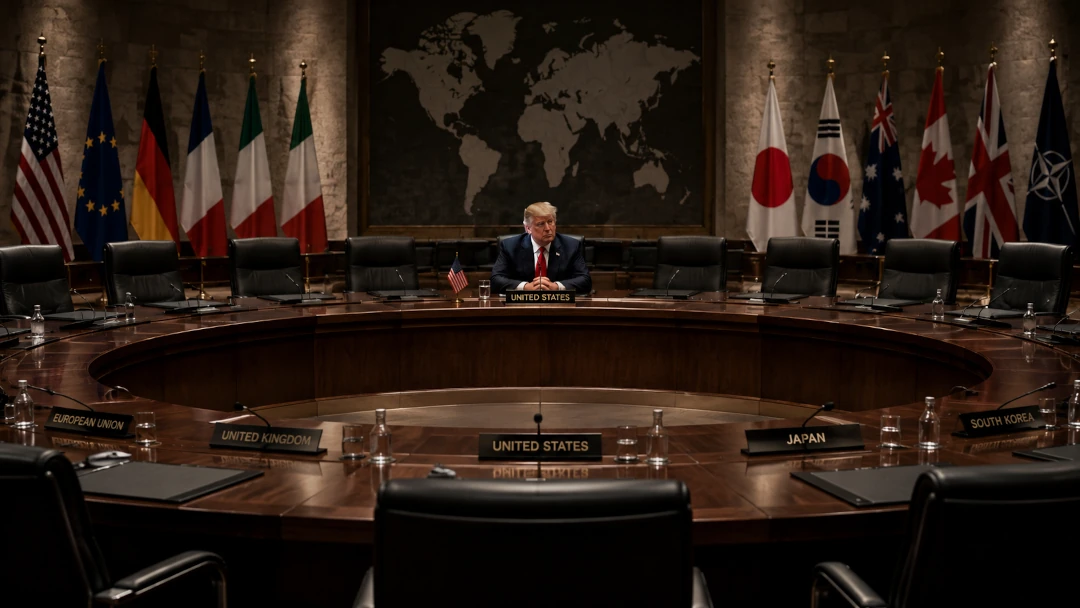
Behind the podium theater is a documented, months-long failure to build the coalition this policy requires. In March, Trump summoned NATO allies to Washington to demand base access, naval escorts, and direct participation in operations against Iran. Germany, France, the United Kingdom, Italy, and Spain uniformly refused. Germany’s chancellor, Friedrich Merz, offered the definitive statement of the European position: the alliance had not been consulted before the February 28 attack on Iran, and there was no United Nations authorization. Spain went further and closed its airspace. By June, an increasingly bitter Trump told NATO Secretary-General Mark Rutte in the Oval Office that the allies had “let down” the United States — an accusation Rutte gently corrected on the spot, noting that four to five thousand U.S. planes had taken off from European bases during the war’s opening weeks.
The pattern repeated at the Ankara NATO summit in July, where Trump departed with no new commitments and told reporters he was “not happy with NATO” because members had been “unwilling to help us”. The former French ambassador to China, the U.K., and Russia, Sylvie Bermann, offered the closest thing to an epitaph for the transatlantic bargain: “Allies, or at least the Europeans, aren’t willing to be at the beck and call of a demand from Donald Trump.”
II. Beijing’s Blocking Rule
China’s answer arrived in the deliberately flat language Chinese diplomacy reserves for its firmest rejections. Foreign Ministry spokesperson Lin Jian, briefing reporters within twenty-four hours of Trump’s D-Day announcement, said only that “sanctions and pressure will not help resolve the issue.” His colleague Guo Jiakun added, with equal precision, that Beijing would “firmly safeguard the legitimate rights and interests of Chinese enterprises.” The Commerce Ministry translated the diplomacy into policy: Chinese firms are formally ordered not to comply with the U.S. measures. The 2021 blocking statute — the one Beijing had spent years holding in reserve — has now been invoked twice against the Trump administration in a single calendar year.
“Our objective is to sever every economic lifeline that sustains this tyrannical regime until Tehran stands alone.”
— Treasury Secretary Scott Bessent, August 24, 2026
The math is unforgiving. China buys roughly ninety percent of Iran’s crude oil exports, most of it processed by the independent Chinese refineries known in the trade as “teapots.” The United States can sanction a teapot. It cannot sanction ninety percent of a country’s customer base without triggering a full financial confrontation with the world’s second-largest economy — a confrontation the Trump White House is manifestly unprepared to have while it still hopes Xi Jinping will show up at the White House in September to make Trump look like a statesman.
The Chinese Commerce Ministry’s injunction contained a provision worth reading in full: U.S. measures against Chinese firms “shall not be recognised, implemented, or complied with,” and Chinese companies harmed by third-party compliance may sue banks, insurers, and shipping firms in Chinese courts. In practical terms, Beijing has told every global bank on earth: choose. The Americans will fine you. We will sue you and freeze your operations here. The rational calculation for many will be to quietly stop touching Iranian trade — but also to quietly stop trusting the enforceability of American economic power.
That is the deeper cost. Sanctions are not a tool. They are an infrastructure. That infrastructure depends on the dollar’s centrality, on allied cooperation, and on the credible threat that Washington can and will enforce its rules against the largest economies. Each of those pillars has spent six months eroding — not because Beijing is stronger than it was in January, but because Washington has fewer friends and less credibility than it had in January. The core weakness of “Economic D-Day” is not that it is too weak. It is that the world Trump built cannot bear a policy this strong.
III. Seoul Looks East
Nowhere is the alliance decay more geopolitically consequential than in Northeast Asia. On Sunday, August 17, Trump announced on Truth Social that he had instructed the Pentagon to scale back the annual Ulchi Freedom Shield exercises with South Korea — drills that have anchored deterrence on the peninsula for decades — dismissing them as “inappropriate and hostile.” Within days, Chinese Foreign Minister Wang Yi was on a plane to Seoul — his first visit in nearly five years, timed with the precision that only a rival senses opportunity.
The Council on Foreign Relations analyst Joshua Kurlantzick wrote that the exercise cuts were “the latest in a series of actions draining Asian allies’ confidence in U.S. security commitments — and hands China another opening to exploit.” Even Xinhua, China’s state news service, could barely contain itself, writing that the U.S. alliance system was “bound to continuously erode and gradually head toward disintegration.” Coming from Beijing that is triumphalism; coming from Seoul, the response has been fear. South Korean officials are quietly discussing, again, whether a country abandoned in a crisis needs its own nuclear deterrent — a conversation no responsible American administration should ever cause.
This is not the standard story of great-power competition. This is the story of a superpower voluntarily lowering the drawbridge and inviting its rival across. Trump’s theory, insofar as one can be reconstructed from his social media posts, is that allies were cheating us and that punishing them will bring them to heel. What is happening instead is what happens in every relationship in human history: the abused partner leaves. Japan is rearming. Australia is hedging. The Philippines is quietly probing Beijing. And South Korea is entertaining a Chinese foreign minister at the exact moment Washington needs the free world to make a united stand against Tehran.
IV. The War That Wouldn’t End
None of this economic wreckage would exist without the underlying war — a war Congress never authorized, that has now entered its sixth month, and that the president is escalating precisely because he cannot win it. The joint U.S.-Israeli attack on Iran on February 28 was sold to the American public as a rapid, decisive strike. Trump himself claimed in June that the United States had “demolished” Iran “literally in the first week” — a boast whose only utility now is to embarrass the person who made it. In July, Trump publicly declared the interim peace deal “over,” calling Iran’s leaders “scum” and “vicious, violent people.” The Strait of Hormuz remains disrupted, gas prices remain high, and a Federal Reserve official said this weekend that the inflation target may be out of reach until the war ends.
The China Problem
Beijing has invoked its 2021 blocking statute ordering firms not to comply with U.S. sanctions. China purchases roughly 90% of Iranian crude exports through independent “teapot” refineries.
The NATO Collapse
Germany, France, the UK, Italy, and Spain all refused to join operations. Spain closed its airspace. Chancellor Merz cited the absence of consultation and UN authorization.
The Asia Pivot — In Reverse
Trump cut Ulchi Freedom Shield drills with South Korea on August 17. Chinese FM Wang Yi arrived in Seoul within 48 hours — his first visit in five years.
The Cost at Home
The Iran war’s price tag has hit $80 billion — more than double what Congress was initially told. Gas prices remain elevated and inflation persists.
What began as a war of choice has become a war of pride. And because the military campaign has failed to deliver a political outcome, the president has retreated to the last refuge of a losing hand: escalation as substitute for strategy. As the Center for International Policy’s Sina Toossi told Al Jazeera on Monday, the naval blockade of Iranian ports announced in April “has clearly hurt Iran, especially its oil exports, but it hasn’t produced the political outcome Washington wants. Iran hasn’t capitulated.” Neither will Iran capitulate to “Economic D-Day.” The country has withstood forty-six years of American sanctions. What it has not withstood is a country with functioning global alliances willing to enforce them together. That country is no longer the United States Trump inherited.
V. The Price at Home
Americans are paying for this in ways both concrete and invisible. Concretely: gasoline prices remain elevated, freight costs are up, and the eighty-billion-dollar cost of the war so far — twice what Congress was told to expect — is being financed on debt that will burden Americans for a generation. The Federal Reserve has told the country that the Iran war is now a direct obstacle to bringing inflation down. Every family paying a grocery bill or a rent check that has not fallen is paying for Trump’s war of choice.
Less visibly but more consequentially, Americans are paying with the erosion of the very security infrastructure that made this country safe and prosperous for eighty years. Alliances take decades to build. They can be destroyed in an afternoon by a Truth Social post. When the next American administration — Democratic or Republican — needs to call Berlin, Seoul, or Tokyo in a moment of genuine crisis, it will discover that the phone is still connected but that the person on the other end has learned to hedge. Restoring credibility takes generations. This administration is depleting it by the day.
There is also the matter of what this says about presidential priorities. A president who cannot pass a budget without shutting the government down has found the time and energy to personally telephone foreign leaders demanding they cut ties with a country whose oil their citizens buy. A president whose own base is fracturing over the war’s cost is spending political capital not on veterans, not on infrastructure, not on the American middle class, but on a coalition-of-one campaign that his own Treasury officials privately concede cannot succeed without Chinese cooperation they cannot obtain. The priorities on display are not the priorities of a functioning presidency. They are the priorities of a man performing power for an audience of himself.
Get Involved Today
Contribute to our mission and turn your concerns into action.
VI. The Democratic Response — What Congress Is Actually Doing
Democrats in Congress have been more organized than their critics acknowledge, and more constrained than they would like to be. Both chambers have now passed war powers resolutions demanding the president end hostilities in Iran without a congressional authorization. In early June, the Republican-controlled House passed the Democratic-led resolution 215 to 208, with four Republicans joining every Democrat. Later that month, the Senate followed suit, passing the House measure 50 to 48 — the first time in nine attempts that a Senate war powers vote had crossed the majority threshold. Both were symbolic. Trump’s administration has openly claimed the War Powers Act is unconstitutional and treats it as a suggestion.
House Democrats have opened a second front. Rep. John Larson of Connecticut is preparing a lawsuit against the administration’s war powers theory. Nearly fifty House Democrats have signed a letter demanding a detailed accounting of the war’s costs and casualties from Trump and Defense Secretary Pete Hegseth. Speaker Emerita Nancy Pelosi — who voted against the 2002 Iraq authorization — told CNN this summer that the Iran operation reflects “the sloppiest approach to our national security that I’ve ever seen.” House Minority Leader Hakeem Jeffries has made the annual National Defense Authorization Act a proxy vote on the war, holding Democratic caucus discipline to an unusual degree.
“It has not been approved by Congress. And we don’t see a plan, a purpose, an exit strategy. That’s the sloppiest approach to our national security that I’ve ever seen.”
— Speaker Emerita Nancy Pelosi, on Trump’s Iran War
The limits are structural. The president holds the veto pen. The Republican majorities in both chambers, though fractured on Iran, will not deliver the two-thirds needed to override anything meaningful. And the constitutional mechanism most directly available to constrain a president behaving this recklessly — impeachment — requires a Senate conviction the numbers do not permit. This is not a failure of Democratic will. It is the reality of divided government confronting a president who has decided the rules do not apply to him.
A Mechanism Written for Exactly This Kind of Presidency
Section 4 of the Twenty-Fifth Amendment, ratified in 1967 in the aftermath of the Kennedy assassination, permits the Vice President and a majority of the Cabinet — or “such other body as Congress may by law provide” — to declare a president “unable to discharge the powers and duties of his office” and to transfer authority to the Vice President as Acting President. The framers of the amendment understood that “inability” could mean physical incapacity, cognitive decline, or the erratic judgment that renders a commander-in-chief unfit to hold the nuclear codes. It has never been formally invoked.
Growing numbers of federal legislators and medical professionals argue it should be. On April 14, Rep. Jamie Raskin, ranking member of the House Judiciary Committee, introduced the Commission on Presidential Capacity Act, backed by fifty co-sponsors, which would establish the “such other body” the Amendment contemplates. Raskin’s accompanying letter to the White House physician cited a specific set of documented incidents — the president’s Truth Social threat that “a whole civilization will die tonight,” a profane Easter morning outburst, and rants about combat missions in the presence of children — as evidence that oversight was warranted. Rep. Raja Krishnamoorthi called on Vice President Vance and the Cabinet to invoke the amendment directly. Senators Sheldon Whitehouse and Jack Reed entered into the Congressional Record a statement signed by thirty-six physicians — neurologists, psychiatrists, and cognitive-disorder specialists from Harvard, Tufts, Columbia, and George Washington — warning of a “rapidly worsening, reality-untethered, increasingly dangerous decline.”
The constitutional argument
The case is not that Trump is politically wrong — Americans elected him, and voters remain the ultimate check. The case is narrower and older: that a president who threatens to extinguish civilizations on social media, who launches wars without congressional authorization, who dismantles alliances by tweet, and who cannot articulate a coherent strategy for a war he started, has crossed the line the Twenty-Fifth Amendment was written to police. “Economic D-Day” is precisely the sort of impulse-driven, coalition-blind escalation the amendment’s framers feared. The pattern — not any single episode — is the argument.
The honest assessment of barriers
The practical path is closed. Vice President JD Vance will not initiate proceedings against the president who chose him. This Cabinet will not vote against the man who appointed them. And a Republican Senate will not supply the two-thirds required for removal in the event of a presidential contest. The mechanism the Constitution provides depends on institutional actors willing to act against partisan interest, and this moment offers none.
Why the case still matters
Constitutional arguments are not made only for the moments they can be immediately deployed. They are made to establish the record that a functioning republic requires. When historians of this period ask how the country’s political class understood what was unfolding, the answer must not be that no one said the obvious thing. Fifty House members, thirty-six physicians of national standing, and a growing bipartisan chorus have said it. The failure is not of diagnosis. The failure is of the institutions written to respond to the diagnosis — and that failure is itself a fact the American public deserves to know.
VII. What This Presidency Has Cost, and Will Cost
The great irony of “Economic D-Day” is contained in its own name. The original D-Day was an act of coordinated allied power — American, British, Canadian, and French forces landing together on a coast liberated only because the United States had spent years earning the trust and interoperability of its partners. Bessent invoked that history to describe a policy that is its precise opposite: a solo American operation announced to a world that has, one government at a time, decided it no longer trusts the country giving the orders. Every allied refusal, every Chinese blocking rule, every South Korean overture to Beijing, is a receipt for damage the Trump administration has done — not to Iran, but to the United States.
The average American will feel this in gas prices and grocery bills before they feel it in a strategic study. But the strategic consequence is the one that will outlast this administration. The United States has spent eighty years building an alliance system that made war less likely, trade more prosperous, and American power more legitimate than the raw arithmetic of any nation’s economy or military would predict. That system was our comparative advantage over China — the one thing Beijing, for all its economic weight, could not simply purchase. Trump has spent his second term giving that advantage away. He has done it not because it served the country but because it served his sense of grievance. And when the bill comes due — in a crisis where allies matter, in a conflict where coalitions decide outcomes, in a moment when American credibility is the difference between deterrence and catastrophe — the American people will pay it.
Every democracy has a mechanism for confronting a leader whose judgment has failed. Ours are impeachment, the Twenty-Fifth Amendment, and the ballot box. Two of the three have been rendered inoperative by a Republican Party that has chosen loyalty over its constitutional duty. The third remains available to the American public in November 2026 — and, more consequentially, in 2028. The question is whether enough of the country will connect the price at the pump, the fear in Seoul, the smirk in Beijing, and the empty chairs at the coalition table to the man who caused all of it. That connection is the work of citizenship. It is also the work of a free press. This publication commits itself, without hedging, to making it.
Editorial Conclusion
“Economic D-Day” is not a foreign policy. It is a confession. It confesses that the president who spent a decade denouncing alliances now needs them and cannot summon them. It confesses that a war launched without Congress, prosecuted without allies, and escalated without strategy has arrived at the only place such wars ever arrive: the point at which the president shouts louder because he has nothing left to say.
The United States remains a great nation. It does not remain the sole superpower of the twenty-first century. That title, thanks to the deliberate choices of this administration, is being handed — meeting by meeting, refusal by refusal, sanction by unenforced sanction — to Beijing.
The constitutional mechanisms to constrain this presidency have been built. The political will to use them has not. That is the choice before Congress, before this Cabinet, before the American electorate, and before history. There is no neutral ground left. Silence, in this moment, is consent.
Sources & References
- NPR — “Treasury Secretary Scott Bessent unveils new economic sanctions on Iran” (Aug. 24, 2026)
- Al Jazeera — “Trump administration announces ‘economic D-day’ sanctions on Iran” (Aug. 24, 2026)
- CNN — “US Treasury threatens new sanctions on nations tied to Iran” (Aug. 24, 2026)
- Newsweek — “Iran’s Rial Slump Sets Stage for Trump’s Economic ‘D-Day’” (Aug. 24, 2026)
- OPB / AP — “Trump warns of ‘economic D-Day’ against Iran, but Tehran is well acquainted with sanctions” (Aug. 21, 2026)
- Asia Financial — “China Rejects US Call to Support Economic Sanctions on Iran” (Aug. 21, 2026)
- Press TV / GlobalSecurity — “China rejects ‘illegal, unilateral’ US sanctions over Iran, vows to protect firms” (May 11, 2026)
- AOL / Reuters — “China orders firms to ignore US Iran sanctions, daring US to enforce crackdown” (May 10, 2026)
- HNGN — “China Rejects ‘Economic D-Day,’ Exposing Core Weakness of Trump’s Iran Strategy” (Aug. 21, 2026)
- Bloomberg — “China Tests South Korea Opening as Trump Unsettles Alliance” (Aug. 18, 2026)
- South China Morning Post — “Wang Yi heads to Seoul as Trump cuts South Korea drills, opening door for China” (Aug. 2026)
- Council on Foreign Relations — “Trump’s South Korea Move Fuels Growing Fears of U.S. Retreat From Asia” (Aug. 19, 2026)
- CNN Politics — “NATO: Trump lashes out at European allies for rejecting his demands on Iran war” (Mar. 17, 2026)
- France 24 / AFP — “Trump says NATO allies ‘let down’ US by not backing Iran war” (June 24, 2026)
- CNBC — “Trump’s European allies add distance on Iran following testy NATO summit” (July 8, 2026)
- PBS NewsHour / AP — “Trump’s failed strong-arming of allies on Iran shows that pressure is losing its effect” (Mar. 18, 2026)
- NPR — “House passes war powers resolution directing Trump to end hostilities with Iran” (June 3, 2026)
- NBC News — “Senate rebukes Trump by approving House-passed measure calling for end to Iran war” (June 24, 2026)
- CNN Politics — “Inside Democrats’ united front against the Iran war” (July 26, 2026)
- Rep. Larson (Press) — “‘We Must Cut Off Funding’: House Dem Readies Legal Action to Halt Trump’s Iran War” (July 21, 2026)
- Deseret News — “Democrats introduce Trump fitness bill — Commission on Presidential Capacity” (Apr. 14, 2026)
- House Judiciary Democrats — “Ranking Member Raskin Demands White House Physician Immediately Evaluate Trump’s Cognitive Fitness” (Apr. 10, 2026)
- Rep. Krishnamoorthi (Press) — “Krishnamoorthi Calls for President Trump’s Removal Under 25th Amendment” (Apr. 7, 2026)
- The Hill (Opinion) — “Trump’s decline and the 25th Amendment” (June 10, 2026)
Related News