The Quiet Emergency: Inside the Hidden Suffering of Trump’s America
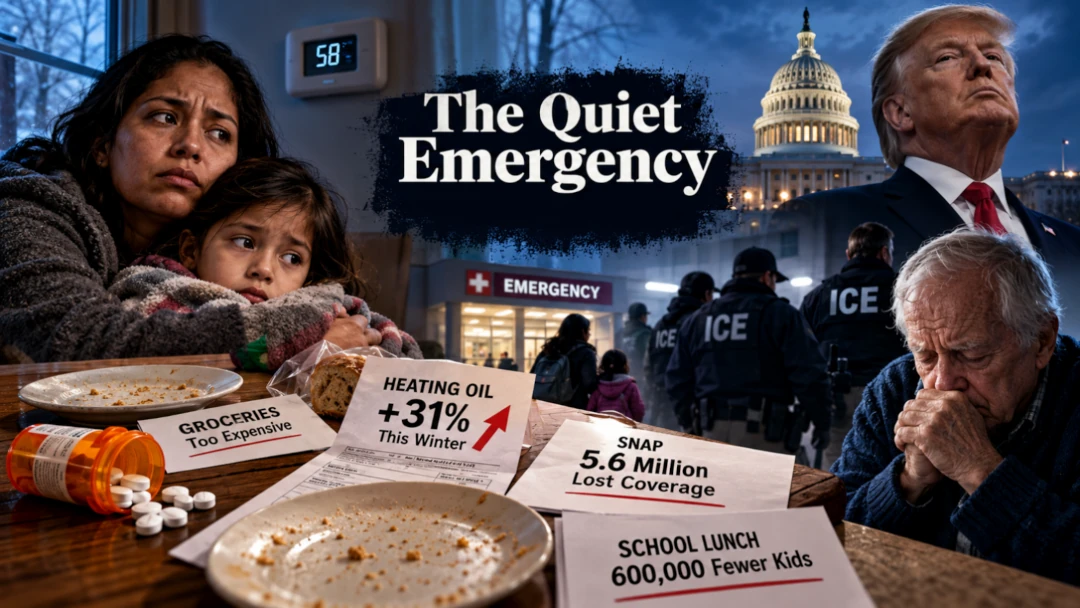
It does not trend on social media. It happens at kitchen tables, in emergency-room parking lots and in cold living rooms where the thermostat is set at 58. Across the country, the poor, the young, the old and the undocumented are absorbing the cost of tariffs, war-driven energy prices and the deepest safety-net cuts in a generation, while the president insists the country is “taking in a fortune.”
Hardship rarely announces itself. A mother skips a refill and tells no one. A grandfather turns down the heat and stays home because a round trip to the senior center now costs more than his lunch. A woman who has been assaulted decides the police are a greater danger to her family than the man who hurt her. None of these moments shows up in a stock index or a presidential speech, but together they describe the real state of the union in the autumn of 2026.
The numbers behind those moments are no longer anecdotal. A West Health–Gallup survey found that roughly one in three American adults, more than 82 million people, cut back on food, utilities or other necessities to pay for health care. The pressures compound: tariffs priced into nearly everything on store shelves, a war with Iran that sent fuel prices soaring, and a reconciliation law that is pulling food and medical coverage away from millions. This is what a perfect storm looks like from the ground.
I. Silence in the Shadows
The most hidden suffering belongs to people who are afraid to be seen at all. After the administration rescinded long-standing protections for “sensitive locations” in January 2025, immigrant families began avoiding the institutions meant to keep them safe. A survey of victim-service providers reported by HuffPost found that 76% said immigrant survivors are worried about contacting police to report domestic violence and sexual assault. Advocates note a grim corollary: abusers have always used the threat of deportation as a leash, and the mass-deportation agenda has handed them a stronger one.
The same fear is emptying exam rooms. In Minnesota, physicians told Axios that patients, including naturalized and U.S.-born citizens, were skipping necessary care after ICE agents were reported at and near Twin Cities hospitals. The Department of Homeland Security says ICE does not conduct enforcement at hospitals. Pediatricians tell a different story about the result: a national American Academy of Pediatrics survey conducted this spring found that 40% of pediatricians have seen families stay away from care because of immigration concerns. Those families include millions of children who are American citizens.
“They expressed to us a feeling of being hunted.”
— Minnesota physician describing patients amid ICE activity near hospitals · Axios
II. Food or Medicine, Heat or Breakfast
For low- and middle-income households, the monthly budget has become a series of forced choices. KFF polling updated in April found that 43% of U.S. adults did not take a medication as prescribed in the past year because of cost, and nearly one in five said their health got worse after skipping or delaying care. The Gallup data show the trade running in both directions: about a quarter of people stretched out prescriptions rather than refill them on time.
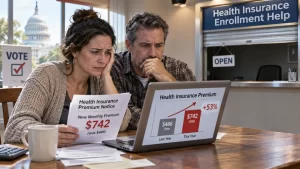
Washington made the arithmetic harder. Enhanced Affordable Care Act subsidies expired on January 1 after the Republican-led Congress failed to extend them. The Commonwealth Fund counted 1.2 million fewer marketplace enrollees, the largest annual decline since the exchanges opened, as premiums were projected to climb an average of 75%. KFF found that 9% of last year’s enrollees are now uninsured.
At the grocery store, the cuts are already visible. Between May 2025 and May 2026, more than 5.6 million people lost SNAP coverage, according to federal data. Senate Minority Leader Chuck Schumer warned in July that more than $180 billion in SNAP reductions over the decade would begin taking effect this month, with costs shifting onto counties and states, as WAMC reported.
Health vs. Necessities
82M
Adults who cut food, utilities or other daily spending to afford care, per West Health–Gallup.Food Assistance Lost
5.6M
People who lost SNAP between May 2025 and May 2026, per federal data reported by the North Dakota Monitor.School Lunch
−600K
Drop in students receiving free lunch between fiscal 2025 and 2026, per The Washington Post.Winter Heating
+31%
Forecast jump in heating-oil spending this winter; electric heat up 9%, per NEADA via ConsumerAffairs.Seniors Waiting
1 in 3
Meals on Wheels providers with a waitlist, averaging four months, per Meals on Wheels America.III. Children on the Sidelines
Children experience these policies as an empty stomach at 10 a.m. Because SNAP enrollment automatically qualifies kids for free school meals, every family pushed off SNAP risks pulling a child out of the lunch line too. The Washington Post reported this month that the average number of students receiving free lunch fell by 600,000 in a year. In Houston, 26 schools that offered free meals to every student lost eligibility, and one district reported school lunch debt 83% higher than the year before.
Preventive care is slipping away on the same track. Coverage losses mean missed well-child visits, the checkups where pediatricians catch developmental delays, update vaccines and screen vision and hearing. The immigration chill compounds it, since many of the children kept home are citizens entitled to care.
Then there is everything that makes childhood more than survival. The 2026 Good Sports Cost of Play Index, conducted by the Harris Poll and reported by GBH News, found that 53% of parents fear they will not be able to afford a sport for their child next year and 68% have seriously considered pulling a child out. Good Sports co-founder Christy Keswick said cost has become a reason families are walking away from play altogether. Surveys have focused on athletics, but the same household math decides whether a child keeps renting a trumpet or pays the fee for an after-school art class. When a family is choosing between groceries and the electric bill, enrichment is the first line cut.
IV. Locked In by the Cold
For older Americans on fixed incomes, this winter arrives with a price tag few can absorb. The National Energy Assistance Directors Association projects the typical household will spend about $1,030 on heating this winter, an 8.7% increase, and heating-oil users face a 31.3% jump, according to ConsumerAffairs. About one in six households is already behind on utility bills. The poorest fifth of households spent nearly 10% of income on electricity and natural gas last year, compared with about 1.25% for the wealthiest fifth.
The war with Iran, launched on February 28, made it worse. In an August release, NEADA estimated heating oil at about $5.55 a gallon, which would add roughly $700 to a typical oil-heated home’s winter bill compared with last season. At the pump, the Institute on Taxation and Economic Policy calculated that the war had cost the average household about $750 in extra fuel spending by late September, on track for more than $1,300 by year’s end.
Fuel costs do more than drain wallets. They confine people. When a tank of gas costs a day’s groceries, seniors stop driving to church, to the senior center, to a friend’s kitchen. Meals on Wheels America reports that 56% of seniors feel lonely, that escalating gas prices are among the top pressures on its providers, and that one in three local programs has a waitlist averaging four months. For many homebound elders, the volunteer at the door is the only person they see all day. Into this, the administration’s fiscal 2027 budget proposed eliminating the Low Income Home Energy Assistance Program entirely, the second year in a row it has tried.
V. The Policies Behind the Pain
None of this is weather. It follows from decisions, and the decisions have dates.
April 8, 2025
Trump tells a GOP dinner the country is “taking in a fortune in tariffs” as markets slide (Yahoo News).
July 4, 2025
The One Big Beautiful Bill Act becomes law, with CBO projecting about 10 million more uninsured by 2034 (AAPP).
December 2025
Trump calls affordability a “hoax” and a “con job” (Axios).
January 1, 2026
Enhanced ACA subsidies expire; marketplace enrollment falls by 1.2 million (Newsweek).
February 2026
The Supreme Court strikes down tariffs imposed under emergency powers; Yale’s Budget Lab still puts the remaining burden near $1,400 for the median household (PolitiFact via Poynter).
February 28, 2026
The U.S. war with Iran begins, driving gasoline, diesel and heating oil sharply higher (ITEP).
October 2026
SNAP cuts take effect as free-lunch rolls shrink and school meal debt climbs (WAMC).
December 31, 2026
Deadline for Medicaid work requirements, which CBO says alone will drive most new coverage losses (AAPP).
Tariffs work as a sales tax that falls hardest on families who spend most of what they earn. The reconciliation law paid for tax cuts largely by cutting Medicaid and SNAP. The war added an energy shock on top. Each policy might be defended on its own terms; together they land on the same households, at the same moment, heading into winter.
Get Involved Today
Contribute to our mission and turn your concerns into action.
VI. Who Is Helping, Who Is Hindering
Republican leaders have defended the cuts on principle. House Speaker Mike Johnson argued that Medicaid work requirements carry “a moral component,” framing coverage losses as accountability for people who could work, as KFF Health News summarized. Republicans say the changes target fraud and waste and return responsibility to states. Yet the Congressional Budget Office identifies the work requirements as the single largest driver of the law’s coverage losses, about 5.3 million people by 2034 (AAPP), and past state experiments lost enrollees mainly through paperwork rather than new jobs.
The party is not monolithic. Sen. Susan Collins of Maine and Sen. Lisa Murkowski of Alaska joined Democrat Jack Reed of Rhode Island in leading a bipartisan push to make HHS release remaining heating aid, and Congress refused the White House’s demand to zero out LIHEAP last year. That matters. It also shows how low the bar has fallen, when keeping the heat on for grandparents counts as a rebellion.
Democrats have used what leverage a minority has. They held out last fall for an extension of ACA subsidies. Schumer has said Democrats will not consider a farm bill that leaves the SNAP cuts in place, calling one that “abandons hungry families” a non-starter (WAMC). Bills to reverse the food and energy cuts have been filed in both chambers. Without majorities, those bills are statements of intent, and voters should judge both parties by what they pass, not what they promise.
The Law Already Promises Protection. Policy Is Teaching People Not to Trust It.
Emergency care. The Emergency Medical Treatment and Labor Act requires hospitals with emergency departments to screen and stabilize anyone who arrives, regardless of status or ability to pay. A right that people are too frightened to exercise protects no one, and enforcement policies that keep families out of ERs undercut the law’s purpose.
Crime victims. Congress created the U visa and the Violence Against Women Act’s immigrant protections because it understood that a frightened victim is a gift to a predator. Those protections still exist, but they depend on trust between immigrant communities and local police, the trust that current enforcement erodes.
The power of the purse. Article I gives Congress, not the president, the authority to appropriate funds. LIHEAP survived the White House’s first attempt at elimination because lawmakers of both parties funded it, and the fiscal 2027 proposal puts that test to Congress again. That authority carries a duty: appropriated aid must reach households on time, before the cold, not after a winter of letters begging the administration to release it.
The general welfare. The Constitution’s preamble names promoting the general welfare among the purposes of government. It is not enforceable in court, but it is a standard by which citizens may judge a government that cuts food and heat aid while its leader boasts of revenue.
VII. “We’re Taking In a Fortune”
Against this backdrop, the president’s message has been consistent: the economy is booming, and anyone who says otherwise is lying. He told Republicans in April 2025 that the government was taking in a fortune from tariffs. By December he was dismissing the affordability crisis as a hoax and a con job, according to Axios. His advisers explained that he believes the word itself is being used unfairly against him.
“‘We’re taking in a fortune in tariffs.”
— President Donald Trump, National Republican Congressional Committee dinner, April 8, 2025 · Yahoo News
Read that sentence again from the perspective of the people in this report. The fortune is real; it is collected one price tag at a time from families who now ration insulin and turn down the heat. Tariff revenue is not found money. It is a tax, and it falls most heavily on households with the least.
What it reveals about priorities is plain. A president who measured success by the welfare of ordinary people would talk about the pediatrician’s waiting room, the school cafeteria and the senior who has not left the house in a week. Instead the measure is revenue, markets and his own narrative. Leadership in a hard season begins with telling the truth about it. Denying hardship does not make it go away; it makes the people living through it feel invisible.
VIII. What You Can Do
Charity cannot replace public programs; food banks have said repeatedly that they cannot fill the hole left by SNAP cuts. But neighbors can keep each other from falling through the gaps while the political fight goes on. These five steps are realistic and immediate.
- Apply for heating help nowCall 211 or your state energy office to apply for LIHEAP and utility payment plans before arrears pile up. Funds are first come, first served in many states, and seniors often qualify for additional programs. Help an older neighbor fill out the forms.
- Check on the people near youKnock on the door of an elderly neighbor once a week, offer a ride to a medical appointment or the grocery store, or volunteer to drive for Meals on Wheels. Isolation is a health risk, and a visit costs nothing.
- Protect children’s meals and playIf your family has lost SNAP, fill out your school’s free and reduced-price meal application, since eligibility may not follow automatically. Ask leagues and music programs about fee waivers, and donate equipment or instruments your kids have outgrown.
- Share accurate rights informationMake sure immigrant neighbors know that emergency rooms must treat everyone and that crime victims may qualify for U visa protection. Point them to local legal aid and community health centers rather than leaving them to rumor.
- Press your representatives on two votesTell your House member and senators to restore SNAP in the farm bill and to fully fund LIHEAP for fiscal 2027. Constituent calls tracked by office staff do influence how members weigh close votes.
Editorial Conclusion
A nation is measured by what it allows to happen quietly. Right now it is allowing children to sit hungry in classrooms, seniors to shiver behind locked doors, sick people to choose between pills and groceries, and frightened families to suffer abuse and illness in silence, all while its president counts tariff receipts and calls the pain a hoax.
This is not inevitable, and it is not the price of prosperity. It is the result of choices made by people who hold power. Congress must restore food aid, fully fund heating assistance before the first hard freeze, and halt coverage cuts that strip care from millions. A republic whose government stops seeing its own people has broken its most basic promise. Americans must insist, loudly and at the ballot box, that it be kept.
Sources & References
- HuffPost (via Yahoo News) — Trump’s Immigration Agenda Is Making Things Even Worse for Domestic Violence Victims
- Axios — Fear of ICE Is Driving Patients Away From Medical Care
- NPR / WUNC — Pediatricians Raise the Alarm on the Effect of Trump’s Immigration Crackdown on Kids
- FOX6 News — Americans Skipping Meals or Cutting Back to Afford Health Care, Poll Finds
- KFF — Americans’ Challenges With Health Care Costs
- Newsweek — States Seeing Biggest Obamacare Enrollment Drops
- AAPP — CBO Affirms 10 Million Are Projected to Lose Coverage
- WAMC — Schumer Calls on Republicans to Delay SNAP Cuts
- North Dakota Monitor (via Valley News Live) — SNAP Cuts Could Lead to Kids Losing Free School Breakfast and Lunch
- The Washington Post (via Anchorage Daily News) — Free Meal Programs Vanish and School Lunch Debt Climbs After SNAP Cuts
- GBH News — New Survey Finds Parents Feeling Strain of Keeping Kids in Sports as Costs Rise
- ConsumerAffairs — Another Costly Winter Is Coming for U.S. Households
- NEADA — Six Months Into the Iran War, American Families Are Paying More for Energy
- Meals on Wheels America — What We Deliver: 2026 National Snapshot
- Institute on Taxation and Economic Policy — The Iran War’s Higher Gas Prices Now Top $100 Billion for Americans
- Poynter / PolitiFact — Do Trump Tariffs Cost Families $1,700?
- Yahoo News — Despite Market Tumult, Trump Says “We’re Making a Fortune With Tariffs”
- Axios — Trump’s Article of Faith: Economy Will Soar in ’26
- KFF Health News — Speaker Johnson Defends Tax Bill Changes to Medicaid, SNAP as “Moral”
- Office of Sen. Susan Collins — Collins, Reed, Murkowski Lead Bipartisan Group Urging HHS to Release Remaining LIHEAP Funds
Related News