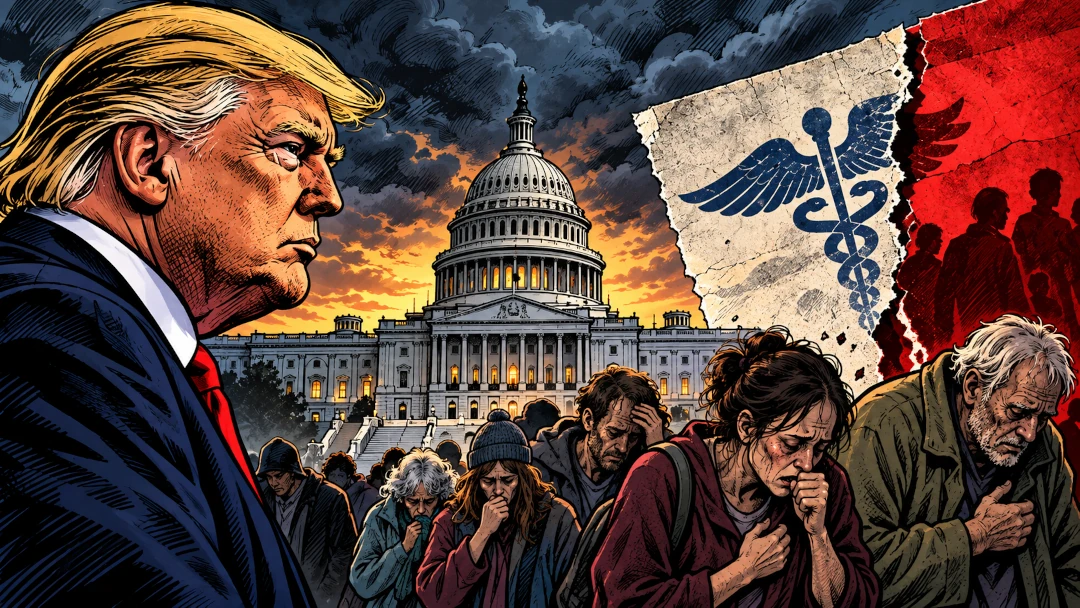
Phantom Fraud, Real Patients: The Trump Administration’s War on the Insured
Vice President Vance says 750,000 Obamacare enrollees were frauds. Dr. Oz has frozen new brokers on the eve of open enrollment. Neither has shown the public how the line between fraud and a missed letter was drawn, and it arrives on top of vanished subsidies, a trillion-dollar Medicaid cut, and a president who still has only “concepts” of the plan he promised a decade ago.
On Tuesday, September 22, Vice President JD Vance stepped to a podium in the Eisenhower Executive Office Building flanked by Centers for Medicare & Medicaid Services Administrator Dr. Mehmet Oz and announced that the administration was stopping Affordable Care Act enrollment for roughly 750,000 people it believes were fraudulently signed up. Speaking for the White House Task Force to Eliminate Fraud, which he chairs, Vance put the savings at $2.2 billion and called the broker-driven enrollment system “a scandal.” Oz followed with a second blow: a six-month national moratorium on new Obamacare brokers.
The press conference was staged as a victory lap. What it actually announced was already done. Federal rulemaking documents show CMS had quietly canceled about 315,000 policies covering more than 760,000 people on August 31, roughly 4 percent of everyone enrolled in the marketplaces. By the time the cameras rolled, those families had already lost their coverage. According to NBC News, the administration offered no details about who lost coverage or how they were told.
We will say plainly what the administration will not credit its critics for saying: enrollment fraud by unscrupulous brokers is real, it victimizes consumers, and it should be prosecuted. But a government that cancels the health insurance of three-quarters of a million people in a single stroke, publishes no methodology, and then locks the door to new enrollment helpers weeks before open enrollment is not fighting fraud with a scalpel. It is swinging an axe in a crowded room, and calling every person it hits a phantom.
I. What Vance and Oz Actually Did
The mechanics matter, because the administration’s framing obscures them. The August 31 cancellations targeted enrollments that CMS labeled “unauthorized”: people enrolled through agents or brokers without verified citizenship or immigration documentation, and for whom insurers could not find claims or establish contact. Vance told reporters his team had placed itself under “an extraordinary burden of proof.” Another 419,000 enrollees now face additional checks of legal residency and income.
Oz, meanwhile, cast the broker freeze as a temporary national pause aimed at the agents he blames for most of the fraud. It bars any agent or broker without a 2026 exchange registration from participating until February 1, 2027, and it was imposed through an emergency-style rule that skipped the normal advance public-comment period. As Healthcare Dive reported, that means no new brokers can register to help consumers during the open enrollment season that begins November 1. Oz, for his part, promised the $2.2 billion figure would grow, calling it the “tip of the iceberg.”
Coverage Canceled
People on roughly 315,000 policies terminated August 31, about 4% of marketplace enrollees, per CMS filings summarized by Morgan Lewis.
Next in Line
Additional enrollees now under residency and income review, with Vance saying officials expect most to be fraudulent, per Gray News.
Broker Freeze
No new agent or broker registrations until Feb. 1, 2027, straddling the entire open enrollment window, per Reuters.
Methodology Released
The administration gave no breakdown of who lost coverage or how they were notified, NBC News reported.
II. How “Phantom” Becomes a Real Person Without a Doctor
The administration’s case rests on a set of proxies for fraud, and those proxies are where the harm hides. Among the criteria Oz described was whether an enrollee had never filed a claim. Health policy experts note that it is entirely ordinary for a healthy young worker to go a year without using insurance; that is, after all, the point of insurance. Even Vance conceded that among a 50,000-person broker ring he cited, some enrollees were probably legitimate.
Cynthia Cox, who directs the ACA program at the nonpartisan research group KFF, drew the distinction that the administration has refused to draw. Fraudulent enrollments should be canceled, she said, but it is equally possible that many people “were legitimately enrolled and simply did not respond in time.” She also told NPR that the purge was carried out outside the normal regulatory process, raising the question of whether it was an appropriate way to identify fraud at all. The New Republic made the human version of the point: anyone who has let junk mail pile up knows that a short response window is easy to miss.
Consider who those people are. The marketplace is where the self-employed, gig workers, early retirees, farmers, and small-business employees buy coverage. Many move frequently, work odd hours, or don’t speak English as a first language. They are exactly the people most likely to miss a letter, and least able to absorb a hospital bill when they discover, at the pharmacy counter or in an emergency room, that their plan no longer exists.
The administration’s zeal also has a curious selectivity. The Democratic-aligned group Protect Our Care noted that this same administration reinstated 850 Obamacare brokers and agents suspected of fraud earlier this year. If the goal were solely to punish bad actors, the punishment would start with the brokers, not with the patients they allegedly exploited.
“Kick hundreds of thousands more people off their health insurance.”
— Senate Minority Leader Chuck Schumer, on the Trump administration’s answer to soaring costs, via Roll Call
III. The Constitution, the Statute, and the Process That Was Skipped
Is any of this unconstitutional? The honest answer is that the administration’s power to police fraud in the exchanges is real; the ACA gives HHS that authority, and a July report from the Government Accountability Office found CMS needed stronger controls, citing nearly 300,000 consumer complaints tied to unauthorized enrollments in 2025. The constitutional and legal problems lie not in the goal but in the method.
Due process. The Fifth Amendment forbids the federal government from depriving any person of property without due process of law. In Goldberg v. Kelly (1970), the Supreme Court held that statutory public benefits are a form of property interest that cannot be terminated without adequate notice and a meaningful opportunity to be heard. Premium tax credits are a statutory entitlement for those who qualify. Mass termination based on inferred criteria, with no published standard and no clear pre-termination hearing, invites exactly the challenge Goldberg contemplates. The administration says it sent letters and even went to people’s homes; the burden now is on it to prove that happened for every one of those 760,000 people.
The Administrative Procedure Act. The broker freeze was imposed through an interim final rule, with CMS invoking the APA’s exception for cases where advance notice would be “impracticable and contrary to the public interest.” That “good cause” exception is meant for genuine emergencies, not for problems the government has documented for years. Courts have already shown little patience for this administration’s shortcuts: U.S. District Judge Brendan Hurson in Maryland halted key provisions of CMS’s 2027 marketplace rule in July after finding the plaintiffs, a coalition of cities and physicians, likely to succeed, the second consecutive year a court has stopped such restrictions.
The Take Care Clause. Article II requires the President to “take Care that the Laws be faithfully executed.” The Affordable Care Act is the law. Its purpose, as written by Congress, is to expand access to affordable coverage. An executive branch that uses its enforcement power to shrink enrollment it dislikes, rather than to administer the program Congress created, strains that constitutional duty even when each individual step is dressed in the language of “integrity.”
IV. Piling On: The Cuts Already Coming
The 760,000 cancellations do not land on a healthy system. They land on one already bleeding. The enhanced premium tax credits that made marketplace coverage affordable expired at the end of 2025, driving a 58 percent average increase in what enrollees pay in 2026 and adding roughly $1,000 to deductibles. Paid enrollment fell from 21.8 million to 19.2 million. NPR reported that premiums doubled or tripled for many enrollees after the Republican-led Congress let the subsidies lapse.
And 2027 is worse. Insurers are proposing premium increases averaging about 15 percent, a second straight year of double-digit hikes. The Peterson-KFF Health System Tracker offers a concrete case: a 40-year-old in Indianapolis earning $65,000 who paid $316 a month with enhanced credits will pay $546 a month in 2027 if proposed rates are approved, a 41 percent increase in two years. Then, on January 1, 2027, the Medicaid work requirements in the One Big Beautiful Bill Act take effect, the leading edge of roughly $1 trillion in Medicaid cuts over the next decade.
V. You Don’t Have Obamacare? You’re Still Paying
It is tempting for Americans with employer coverage to treat this as someone else’s crisis. It is not. When people lose insurance, they do not stop getting sick; they arrive later, sicker, and uninsured, in emergency rooms that are legally required to treat them. Those costs are shifted onto everyone else’s premiums. KFF’s Larry Levitt warned that “open enrollment is when the healthcare affordability crisis is really going to hit home” for people with every kind of coverage, including job-based plans and Medicare.
The hospitals absorbing that uncompensated care are the ones least able to survive it. The Chartis Center for Rural Health reports that more than 40 percent of rural hospitals are operating at a loss and 417 are vulnerable to closure. Maternity care is going first: Georgetown’s Center for Children and Families found 96 labor and delivery units closed between 2024 and early 2026, many of them the only birthing facility in their county, and Medicaid finances nearly half of rural births. When a rural hospital closes, it closes for the insured and uninsured alike. The farmer with a Blue Cross card drives the same extra fifty miles as his uninsured neighbor.
Rep. Richard Neal of Massachusetts, the top Democrat on the House Ways and Means Committee, captured the compounding cruelty: after skyrocketing premiums and new red tape, he said, the administration is “doubling down to take it away entirely.”
VI. The Body Count No One at the Podium Mentioned
Coverage is not an abstraction. Decades of research link losing insurance to delayed diagnoses, skipped medications, and death. When researchers at the University of Pennsylvania and Yale modeled the health policies advanced by Republicans in 2025, they projected more than 51,000 preventable deaths every year, including roughly 8,800 attributable to the expiration of the enhanced ACA subsidies alone and some 11,300 from Medicaid and marketplace coverage losses. A separate analysis in the Annals of Internal Medicine led by Harvard’s Dr. Adam Gaffney estimated the House’s version of the Medicaid cuts would cause 16,642 additional deaths annually.
Those estimates were modeled on earlier versions of the legislation, and the final numbers will depend on how many people ultimately lose coverage. But the direction is not in doubt. The CBO projects that the reconciliation law combined with the lapse of enhanced subsidies will leave more than 14 million additional Americans uninsured by 2034. The 760,000 people removed in August are not in that projection. Neither are the 419,000 under review. Every one of them who was, in fact, a real and eligible American is a person now walking around without the protection the law promised them.
Get Involved Today
Contribute to our mission and turn your concerns into action.
VII. Congress: Democrats Push, Republicans Stall
Democrats have not been idle. Led by House Minority Leader Hakeem Jeffries, they used a rare discharge petition to force a floor vote over Speaker Mike Johnson’s objections, and in January the House passed a three-year extension of the enhanced subsidies 230–196, with 17 Republicans crossing over. The Senate had already voted down a similar extension in December, and bipartisan compromise talks produced nothing that has become law.
In response to the purge, Senate Minority Leader Chuck Schumer said Democrats would expand health coverage if they win back the Senate in November. Neal and other committee Democrats have condemned the cancellations, and outside the Capitol, a coalition of cities including Columbus, Chicago, and Baltimore, joined by Doctors for America, continues to litigate against the administration’s marketplace restrictions. Vance, for his part, used the press conference to demand that Democrats join his task force’s legislative push, framing any objection as siding with fraudsters.
The lesson is simple arithmetic. Democrats have the votes to pass relief in the House when a handful of Republicans break ranks. They do not control the Senate calendar or the White House pen. Until that changes, the administration can keep doing by executive action what it could not do by legislation in 2017: shrink the Affordable Care Act from the inside.
VIII. “Concepts of a Plan,” a Decade Later
Donald Trump has promised Americans a replacement for Obamacare since 2015, pledging something far better and far cheaper. As KFF Health News and PolitiFact documented, he promised a replacement plan five times in 2020 alone, always a few weeks away. In the September 2024 debate, pressed on the plan he had never produced, he offered the now-infamous admission that he had “concepts of a plan.”
What arrived in January 2026 was the “Great Healthcare Plan”: a one-page framework calling on Congress to codify drug-pricing deals, redirect subsidies toward health savings accounts, and demand price transparency. There is no bill text. The nonpartisan Committee for a Responsible Federal Budget found its ACA provisions could either save modest sums or add up to $350 billion to deficits “depending on the design,” which is to say, no design yet exists. Nine months later, while that framework sits idle, the administration’s most concrete health care action has been to remove people from coverage.
That is the tell. A president serious about replacing the ACA would build the replacement before tearing down the structure. This one has done the opposite for ten years: repeal attempts in 2017, the subsidy lapse in 2025, the Medicaid cuts in the same law that financed tax cuts, and now mass cancellations. The priorities are legible in the sequence. Coverage is the variable to be cut; the plan is the thing to be promised.
When Governing Becomes Unmooring: Fitness, Judgment, and Section 4
The mechanism
Section 4 of the 25th Amendment allows the Vice President and a majority of the Cabinet (or another body Congress designates by law) to declare in writing that the President is “unable to discharge the powers and duties of his office.” The Vice President immediately becomes Acting President. If the President contests the declaration, Congress decides, and removal stands only if two-thirds of both chambers agree. Section 4 has never been invoked.
Who has called for it
After the President’s April threat that a “whole civilization will die” in Iran, more than 85 House and Senate Democrats called for impeachment or 25th Amendment removal, and House Democrats led by Rep. Jamie Raskin introduced legislation to create the congressional body Section 4 contemplates. Rep. Raja Krishnamoorthi cited a “dangerous pattern of reckless escalation, erratic decision-making”; Rep. John Larson filed articles of impeachment and urged the Cabinet to act; and Sen. Ed Markey, joined by Reps. Sydney Kamlager-Dove, Eric Swalwell and Yassamin Ansari, called for invocation in January over the President’s Greenland messages.
The argument this health care crisis adds
Section 4 speaks of inability to discharge the duties of the office. Among those duties is the constitutional command to faithfully execute the laws. A decade of promised plans that never materialize, a signature “plan” that remains a single page, and an administration that governs health policy by press-conference purge rather than by law suggest a presidency that cannot, or will not, perform the basic work of governing a system on which millions of lives depend. Paired with the erratic conduct lawmakers have already documented, the argument is that this is not a policy disagreement but a sustained failure of the executive function itself.
The honest barriers
The obstacles are formidable, and we will not pretend otherwise. The 25th Amendment was written for incapacity, not for bad policy, and its drafters deliberately kept it out of the hands of political majorities. It requires the President’s own Vice President to initiate it. In this case, that Vice President is JD Vance, the architect of the very purge at issue. Cabinet members serve at the President’s pleasure. Raskin’s commission bill cannot pass a Republican Congress, and Trump could veto it in any event.
Why the barriers don’t end the case
Constitutional mechanisms are not measured only by whether they succeed. They define the standard to which officials can be held. Every Cabinet secretary swore an oath to the Constitution, not to the man who appointed them. Putting the question of fitness on the record, through hearings, through Raskin’s commission proposal, and through the ballot box in November, is how a constitutional democracy registers that a line has been approached. That the people best positioned to act are also those most complicit is not a reason for silence. It is the reason the question must be asked out loud.
IX. What Leadership Would Look Like
Real leadership on fraud would look like this: prosecute the brokers, publish the methodology, restore coverage automatically for anyone wrongly removed, and pair enforcement with the affordability that keeps honest people enrolled. Real leadership on health care would send Congress actual legislation, fight for the subsidy extension a bipartisan House majority already approved, and slow the Medicaid cuts before rural hospitals fold.
Instead, the country has been handed a vice president sharing a stage with posters of a convicted broker to justify canceling coverage for people who are not fraudsters, a CMS administrator shutting the door to new enrollment help just as prices spike, and a president whose health plan remains, after a decade, a concept. If you or someone you love received a cancellation notice, contact HealthCare.gov or your state marketplace immediately, request an explanation in writing, and ask your members of Congress to intervene. Then remember who made this happen when you vote.
Editorial Conclusion
A government that cannot tell the difference between a fraudster and a family that missed a letter should not be trusted with the power to strip either of them of care. Fraud is real; so is the Fifth Amendment, so is the law Congress passed, and so are the tens of thousands of Americans projected to die each year as coverage collapses around them.
What is required is not complicated: restore wrongly canceled coverage, extend the subsidies, halt the Medicaid cuts, and demand from this President the plan he has promised for ten years. Anything less confirms what the record already shows: this administration governs health care not to protect the people, but to shrink the number it must protect. The Constitution asks whether a President can faithfully execute the laws. On health care, the answer is written in cancellation notices.
Sources & References
- ABC News — Vance’s anti-fraud task force to remove 750,000 allegedly fraudulent enrollments from Obamacare
- Fox News — White House to yank 750,000 off ObamaCare, save taxpayers $2.2 billion, Vance says
- Gray News / Live 5 News — Vance says 750,000 removed from Obamacare over fraud concerns
- NBC News — Trump administration cuts ACA coverage for 750,000 people it says were ‘fraudulently’ enrolled
- NPR — Trump administration to remove 760,000 ACA enrollees over fraud claims
- Morgan Lewis — CMS cancels marketplace enrollments and imposes moratorium on new ACA broker registrations
- Reuters via U.S. News — US halts Obamacare enrollment for over 760,000 enrollees, claiming fraud
- Healthcare Dive — CMS freezes new ACA broker registrations for 2027, culls ‘unauthorized’ enrollees
- The Hill — Vance-led task force set to remove 750K ObamaCare enrollees, citing fraud
- Common Dreams — Anger mounts as Trump and Vance rip healthcare from 750,000
- The New Republic — Check your mail. JD Vance might have canceled your health insurance.
- Roll Call — Vance pushes for health fraud legislation in the Senate
- 6abc / ABC News — Rep. Richard Neal and Protect Our Care respond to Vance task force
- YourNews — Feds cancel 315,000 Obamacare policies; interim final rule bypasses notice-and-comment
- HFMA — Judge blocks key ACA marketplace rule provisions for 2027
- Fierce Healthcare — Federal judge temporarily blocks key provisions of final ACA exchange rule
- KFF — Insurers largely propose double-digit premium increases for 2027
- Peterson-KFF Health System Tracker — How much and why ACA Marketplace premiums are going up in 2027
- NBC News — ACA, Medicare or job-based insurance? Your health bills are about to go up
- KFF — How will the 2025 reconciliation law affect the uninsured rate in each state?
- Association of Health Care Journalists — Medicaid work requirement: How it will affect rural areas
- Chartis — 2026 Rural Health State of the State
- Georgetown CCF — One Big Beautiful Bill, one big rural maternity crisis
- Penn LDI — House bill seen causing 51,000 preventable deaths annually
- Healio — Study: Proposed Medicaid cuts could lead to thousands of preventable deaths annually
- CNBC — House passes ACA subsidies; fate of bill murky in Senate
- Committee for a Responsible Federal Budget — White House releases “Great Healthcare Plan”
- PolitiFact / KFF Health News — Back to the future: Trump’s history of promising a health plan that never comes
- MS NOW (Maddowblog) — Mr. ‘Concepts of a Plan’ pitches a health care idea
- Axios — House Democrats file long-shot 25th Amendment bill targeting Trump
- PBS NewsHour — Could the 25th Amendment be invoked against Trump? Here’s how it works
- Office of Rep. Krishnamoorthi — Krishnamoorthi calls for President Trump’s removal under 25th Amendment
- Office of Rep. Larson — Larson files articles of impeachment, calls for 25th Amendment
- Office of Rep. Kamlager-Dove — Markey, Ansari, Swalwell, Kamlager-Dove call for 25th Amendment
Related News