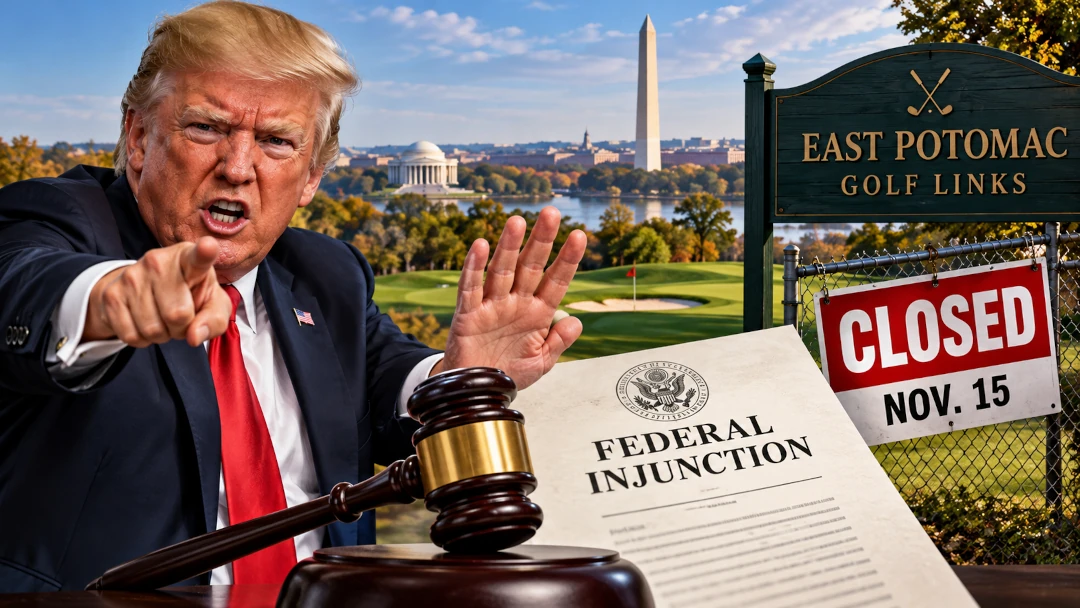
Hours after Judge Ana Reyes enjoined further work at East Potomac Park and required advance notice before any closure, the President announced the public course would close on November 15 anyway, declared the court’s order unconstitutional, and promised an appeal. His own Justice Department had told the same judge, one week earlier, that there was no plan to close it. A dispute that began over trees and tee times has become a test of whether the executive branch answers to the courts at all.
Late Monday night, President Donald Trump went to Truth Social and did what he has done to nearly every court that has told him “not yet.” Responding to a 70-page preliminary injunction issued that same day by U.S. District Judge Ana C. Reyes, he announced that the government would be closing the East Potomac Golf Course site as scheduled on November 15, that the judge had no right to hold up his project, and that the administration was asking the D.C. Circuit for immediate relief. He framed the closure as necessary for “Competitive,” “Safety,” “Modernization,” and “Aesthetic” reasons, according to ABC News.
On its face, this is a story about a 100-year-old municipal golf course on a man-made peninsula in the Potomac River. It is not really about golf. It is about whether a president may announce, in public, a plan his own lawyers deny in court; whether he may treat a judge’s notice requirement as an insult rather than an obligation; and whether the federal judiciary, having bent over backward to accommodate this administration, can still make its orders mean something.
I. What the President Posted
The Monday-night post went further than a routine vow to appeal. Trump asserted that the project is entirely “as of right” and that the judge lacks the constitutional authority to even ask for or receive notices, which he called time-consuming, expensive, and unconstitutional, WUSA9 reported. He derided Reyes as a judge with no expertise in golf, architecture, landscaping, or construction. On Tuesday he added a fresh rationale, calling the course “extremely dangerous” and insisting the remodel must continue at full speed.
“The judge has absolutely no right to hold up this very important and beautiful Project.”
— President Donald J. Trump, Truth Social, Oct. 26, 2026 (via Bloomberg)
This was not the first such attack. One week earlier, at roughly 6 a.m. on the morning of a scheduled hearing, the President called Reyes “a crazed lunatic” who “may be insane,” and declared that work would begin “IMMEDIATELY.” By the end of that day, Reyes told a packed courtroom that her family was alarmed by reports she was receiving death threats. “A federal judge is getting death threats over a golf course,” she said, as quoted by The Washington Post. “I really don’t think that’s what the founders envisioned.”
Precision matters here, because the President’s post mischaracterizes what the court actually did. As WUSA9’s Eric Flack noted, the order is far more than a request for notification: it bars Interior, the National Park Service, their contractors and anyone working with them from cutting or damaging any tree in East Potomac Park without court approval, including indirectly through grading or staging equipment in root zones. It separately requires at least ten business days’ written notice before any closure or irreversible change. Counting back from November 15 puts that deadline at roughly this Friday. As of Tuesday morning, no notice, no notice of appeal, and no stay request had been filed.
II. The Case: Who Is Suing, and Why
The lawsuit was filed in February by the DC Preservation League and two local golfers who play the course, represented in part by the legal advocacy group Democracy Forward. The defendants are the Department of the Interior, Secretary Doug Burgum, and the National Park Service. The complaint argues that the administration’s reconstruction of East Potomac Park would violate the 1897 Act of Congress that created the park, which dedicated it to the recreation and pleasure of the people, and that the government is evading the environmental and historic-preservation reviews federal law requires.
The plaintiffs’ central theory is what they call the “Washington National Plan”: a design by golf architect Tom Fazio, who has built courses for Trump before, to demolish the existing three courses and replace them with a single championship layout stretching shoreline to shoreline. Plaintiffs argue the government has deliberately broken that plan into smaller pieces — dumping East Wing demolition debris here, felling hundreds of trees there — to avoid triggering federally required environmental reviews, NPR reported. For eight months, government lawyers insisted no final plan existed.
III. Where the Case Stands Today
Monday’s ruling found, in substance, that the government’s stated reason for the October tree removal — restoring the course’s historic links character under a 2019 report — was a pretext for the larger Fazio plan. The judge concluded that the plan came into existence “well before October 15, 2026,” as NPR quoted her opinion, and that the administration likely violated environmental law in pursuing it. Here is the current posture:
The Injunction
No tree in East Potomac Park may be cut, removed or damaged without a court order. Ten business days’ notice required before closure or any irreversible change. CNN
The Contradiction
On Oct. 19, Woodward told the court there was no plan to close the course on Nov. 15. Reyes has now ordered DOJ to say whether that is still true. Alternet
Woodward Summoned
The Justice Department’s third-ranking official must appear in person Friday or Monday for a status hearing. Associated Press
Records Preservation
By Wednesday at 10 a.m., the government must show cause why it should not be ordered, including DOJ attorneys and staff, to preserve records on the tree cutting and what the court was told. WUSA9
The Promised Appeal
Trump says Interior will seek “immediate remedy” from the D.C. Circuit, but nothing had been filed on the docket as of Tuesday morning. Forbes
On the Ground
The course remains open. Roughly 300 more trees had been slated for removal under the plan the judge halted. WUSA9
IV. The Reluctant Guardian
The administration has spent weeks portraying Ana Reyes as a partisan. The record shows the opposite. This is a judge who has given the government every conceivable benefit of the doubt — far more patience than an ordinary private litigant caught saying one thing in court and another in public would ever receive.
In the summer, she denied the preservationists’ request for an injunction, pressed their lawyers on what power she even had to intervene, and said federal courts should not tell the executive or Congress what to do unless the Constitution or law requires it. At another hearing she quipped that she did not want to be “the overseer of Parks and Rec,” settling for a modest requirement that the government give notice before cutting more than ten trees. When early tree removals drew public fury, she sided with Interior, telling the courtroom, “I am not the Lorax. I do not speak for the trees.”
Her deference extends beyond this case. As The Hill catalogued and Alternet summarized, Reyes declined to reinstate inspectors general Trump fired even after finding the firings unlawful, declined emergency relief to an Iranian American legal group, and paused a fired National Mediation Board member’s case to await a Supreme Court ruling that ultimately went Trump’s way.
What changed was not the judge. It was the conduct. Reyes said repeatedly that she did not want to wake up to a “fait accompli” — another East Wing, already gone before any court could rule. The administration then cut down hundreds of trees over a holiday weekend in apparent disregard of its notice obligation, sought her recusal when she objected, and had its senior lawyer instruct subordinates not to answer her questions. When Woodward refused to say whether line DOJ attorneys would sign his filings, she invoked the rule used to sanction attorneys and asked them, per Lawfare’s live coverage, to raise their hands if they were willing to sign. Only then did she act.
“‘Separation of powers’ is not a talismanic incantation that permits the Executive to run amok, unchecked.”
— U.S. District Judge Ana C. Reyes, opinion of Oct. 26, 2026
Her opinion opens with a sentence that should be read in every civics classroom in America: rarely, if ever, she wrote, has the Justice Department urged a federal court not to believe the sitting President. The government’s defense amounted to asking the court to disregard Trump’s own repeated public announcements. Reyes pointed out the obvious remedy: if the President is wrong, Secretary Burgum could simply say so under oath. He has not. She also quoted National Mall Superintendent Kevin Griess testifying that he was aware of no urgency for the tree removal — directly contradicting the President’s claim that the work must begin immediately.
On Tuesday, as the AP put it, the question before the court had become simply who should be believed. Reyes put it more gravely: the case began over golf and long walks and has become an effort to reconcile sworn statements from administration officials with what the President says, ABC News reported.
What the Law Actually Requires — and What the President Claims
- Article III — The Judicial Power
- Federal courts have the power to decide “cases” and “controversies,” which necessarily includes enforcing their own orders. A notice requirement is among the mildest tools available; courts routinely impose them to preserve their ability to grant relief. The President’s claim that a judge lacks constitutional authority to “receive notices” has no footing in any doctrine we are aware of. The proper response to an order one dislikes is the one Trump also invoked: appeal. Announcing non-compliance in the meantime is something else.
- Article II, § 3 — The Take Care Clause
- The President “shall take Care that the Laws be faithfully executed.” That duty runs to the 1897 statute dedicating East Potomac Park to public recreation, to the National Environmental Policy Act and National Historic Preservation Act, and to the judgments of courts applying them. It is not a license to treat the laws as obstacles.
- The 1897 Organic Act for the Park
- Congress — not the executive — reserved this land for the people’s recreation. Plaintiffs argue a championship venue priced for elite play would effectively privatize a public trust. Under Article IV’s Property Clause, it is Congress that holds the power to dispose of and regulate federal property.
- NEPA & NHPA — No Segmenting
- Environmental and historic reviews cannot be evaded by slicing one project into pieces too small to trigger them. Judge Reyes found the Washington National Plan exists and that the government likely violated environmental law in carrying it out piecemeal.
- Candor to the Tribunal
- Lawyers, including the government’s, owe the court truthful representations. When a DOJ official tells a judge “no plan to close” and the President announces a closure date days later, the court is entitled — arguably obligated — to demand an explanation and to preserve the records that would show the truth. That is exactly what Reyes has ordered.
V. A Constitutional Crisis, or Already Past One?
Scholars have argued about the phrase “constitutional crisis” since early 2025. UC Berkeley Law dean Erwin Chemerinsky said then that “we are in a constitutional crisis, but it can get worse,” while others, including UVA’s Amanda Frost, described it as a “constitutional stress test.” Columbia’s Elora Mukherjee, discussing the administration’s handling of a Supreme Court order in a deportation case, warned that the government was building legal rationales after the fact rather than shaping its conduct to the ruling.
East Potomac is a near-perfect illustration of that pattern in miniature. Nobody has yet bulldozed a fairway in open violation of the injunction. But the elements of a crisis are all present: a President who publicly denies a court’s authority; a Justice Department defending positions its client contradicts in public; personal attacks that coincide with death threats against a sitting judge; and a deliberate pace of work designed to make judicial review arrive too late. A constitutional crisis is not only the moment of open defiance. It is also the steady normalization of the idea that court orders are suggestions for some people and binding for everyone else. By that measure, we are in one.
Get Involved Today
Contribute to our mission and turn your concerns into action.
VI. The Pattern: Ballroom, Arch, Reflecting Pool
East Potomac is one of several monuments-and-renovations projects the President is pushing through Washington faster than courts can examine them. The strategy is consistent: begin work before review, frame the project as urgent or as national security, attack the judge, and race to make the result irreversible.
White House Ballroom
The East Wing was demolished in October 2025 for a 90,000-square-foot ballroom. On Aug. 7, a divided D.C. Circuit held above-ground construction needed congressional approval; on Aug. 31 the Supreme Court, 5–4, stayed that ruling on standing grounds without deciding legality. Crews work 20 hours a day; completion is slated for August 2028. SCOTUSblog · WJLA
Status: Under construction; litigation continues
The “Triumphal Arch”
A planned 250-foot arch at Memorial Circle beside Arlington National Cemetery. Judge Tanya Chutkan has required 48 hours’ notice before any construction activity. After the Park Service signaled work could begin Nov. 5, veteran plaintiffs asked for an injunction. Arlington County filed a separate suit in Virginia. ARLnow · PBS
Status: Injunction motion pending; Nov. 5 target
Arch as “Military Complex”
As with the ballroom, the arch was later recast as a security installation: Trump said it would house drones and snipers. Plaintiffs called the Supreme Court’s ballroom outcome a “cautionary tale” and urged the court not to let the arch become a fait accompli. NPR · Law&Crime
Status: Same playbook as ballroom
Lincoln Memorial Reflecting Pool
A no-bid contract went to a firm that had worked at Trump’s Virginia golf club; the Cultural Landscape Foundation sued in May over the “American flag blue” resurfacing. Costs rose far beyond the $1.8 million Trump promised, and the pool suffered algae and peeling paint. Bloomberg Law · AP
Status: Work largely done; lawsuit filed
The lesson the administration seems to have drawn from the ballroom is that speed wins. Once the East Wing was rubble, there was nothing for a court to save. Judge Reyes plainly drew the same lesson, which is why she has insisted on notice. The President’s fury at that requirement tells you exactly what it threatens: not the project, but the strategy of outrunning the law.
VII. What This Means for the Average American
Most Americans will never tee off at Hains Point. But East Potomac was the busiest course in the D.C. region and one of the country’s great affordable public courses; lawmakers have noted tee times as low as $17, and a letter from 47 lawmakers warned that the cost models the administration has cited charge as much as double current prices. The administration says the redesign will offer championship golf at discounted local rates; it has not explained how.
The deeper stakes are universal. If the government can tell a judge one thing while the President announces another, then every person who ever sues the federal government — over a Social Security denial, a veterans’ benefit, a seized property, a wrongful deportation — is litigating against an opponent whose word in court may mean nothing. Public land set aside by Congress can be quietly converted into a showpiece. Taxpayer contracts can be awarded before Congress is told. And a judge who simply asks for notice can be branded insane by the most powerful person on earth and then receive death threats. None of that stays confined to a golf course.
VIII. What Congress and Democrats Are Doing
With Republicans controlling both chambers, Democrats’ tools have been limited to letters, disclosures, and the promise of oversight. They have used them. Rep. Jamie Raskin wrote to Secretary Burgum demanding to know whether walking and biking paths through the park would survive and whether casual golfers would be priced out; the White House, in response, dismissed the course as “decrepit.” Rep. Jared Huffman, ranking Democrat on House Natural Resources, revealed that the Park Service awarded East Potomac contracts on Sept. 10 without notifying Congress, with a later construction contract forecast at up to $49 million, and has said Democrats will pursue subpoenas, hearings and sworn testimony if they win the majority. Sen. Richard Blumenthal, top Democrat on the Senate Permanent Subcommittee on Investigations, has called the Reflecting Pool contracts “blatant corruption.”
On the broader rule-of-law front, Senate Democrats including Cory Booker, Chuck Schumer, Alex Padilla and Adam Schiff introduced legislation to move the U.S. Marshals Service, which protects judges, out from under executive-branch control. In 2025, they also forced the removal of a provision from the Republican megabill that would have curtailed courts’ ability to enforce injunctions through contempt. These are defensive victories. Real accountability requires a majority.
IX. What You Can Do
In plain terms: the courts can slow this down, but only voters and Congress can stop the pattern. Here is an honest assessment of the options.- Vote on November 3The midterms are one week away. Control of the House determines whether there will be subpoenas and sworn testimony on these projects, or more silence. This is the single most consequential step available.
- Call your members of CongressAsk them to support the Marshals independence legislation, to demand that Interior honor the court’s notice requirement, and to oppose any funding for East Potomac construction absent full environmental and historic review. The Capitol switchboard is (202) 224-3121.
- Back the plaintiffsThe DC Preservation League, Democracy Forward, Public Citizen and the National Trust for Historic Preservation are carrying these cases. Litigation is expensive; small donations and amicus support matter.
- Show up for public reviewFederal review bodies, including the National Capital Planning Commission, take public comment. The arch faces a scheduled Nov. 5 commission vote. Written comments become part of the record courts later examine.
- Watch the docket — and play the courseCourt filings in these cases are public on CourtListener. And if you’re local: book a tee time. A full, busy public course is its own argument.
Editorial Conclusion
A president who disagrees with a judge may appeal. A president who declares that a judge has no right to rule, while his own lawyers tell that judge the opposite of what he tells the nation, is not appealing. He is claiming to stand above the law.
Judge Ana Reyes did not go looking for this fight. She gave the administration the benefit of every doubt, and asked only to be told before the irreversible happened. That the most modest request a court can make has been met with insults, threats and a public vow to proceed anyway tells us everything about this President’s priorities: his monuments before the public’s land, his will before the law.
The Republic does not depend on golf. It depends on the principle that court orders bind the powerful as surely as they bind everyone else. That principle is now on the ballot, in the courtroom, and in our hands. It must be defended — this week, this election, and every time it is tested.
Sources & References
- Bloomberg — Trump Says Golf Course Project Will Proceed Despite Court Order
- WUSA9 / Yahoo News — Hours after a federal judge put his golf course project on hold, Trump said he’s closing East Potomac anyway
- NPR — Judge blocks Trump’s East Potomac golf course renovations
- CNN — Judge slams Justice Department for asking her to ‘disbelieve’ Trump in golf course case
- ABC News — Judge admonishes Trump administration over plans for Washington, DC, golf course
- Associated Press / WTNH — Who should be believed? Trump’s social media post on golf course leads lawyers back to court
- Forbes — Trump Says East Potomac Golf Course Will Close November 15 Despite Judge’s Injunction
- GOLF.com — Trump calls East Potomac ‘extremely dangerous’ after judge halts renovation
- UPI — Trump barred from removing more trees at East Potomac Golf Course
- Alternet — Judge puts Trump on notice as his own post blows up his court case
- Alternet — Trump attacks judge who keeps handing him wins
- Newsweek — Trump criticizes judge ahead of East Potomac hearing
- Raw Story — Judge floats sanctions for DOJ lawyers after Trump’s ‘lunatic’ post
- Bloomberg Law — Judge Clashes With DOJ Officials Over DC Golf Course Revamp
- Fortune / AP — Golfers sue over Trump’s overhaul of 100-year-old public course
- WTOP — Judge won’t stop East Potomac plans, but she’s not throwing the case out
- City Cast DC — “I am not the Lorax”: judge declines to intervene in tree removals
- SCOTUSblog — Supreme Court allows construction on White House ballroom to continue
- ARLnow — Arch construction could start as soon as Nov. 5, federal officials say
- PBS NewsHour / AP — Trump’s memorial arch faces a new lawsuit from Arlington County
- Axios — Congress presses Trump on D.C. golf course plans
- Quiver Quantitative — Huffman questions Park Service contracts for Trump golf course project
- NPR — Democrats seek to insulate security for judges from executive branch politics
- Courthouse News — The constitutional crisis is here, legal experts say
Related News