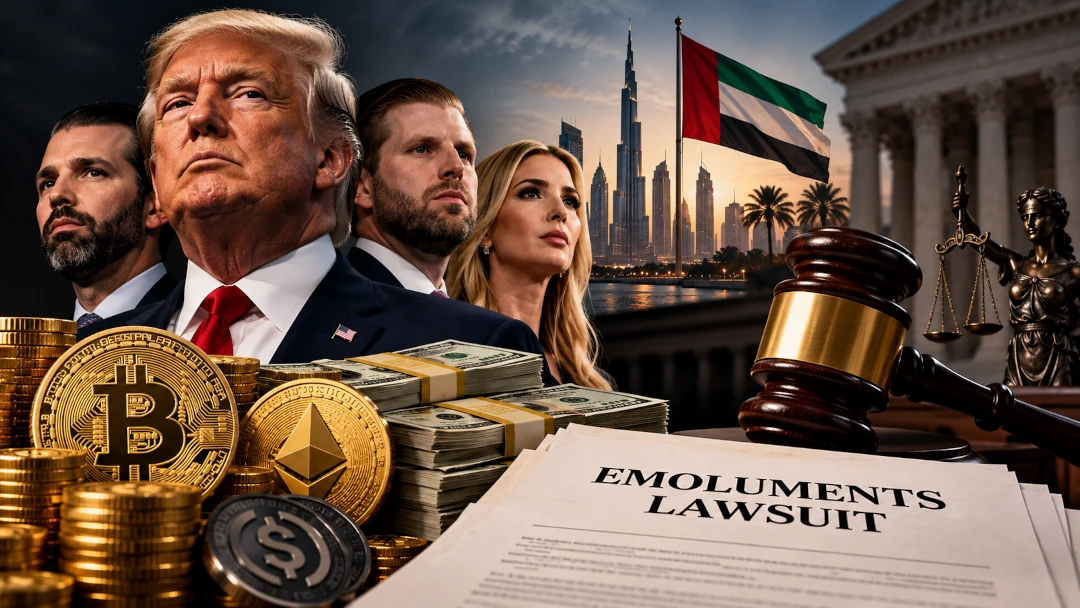
A federal lawsuit filed last Thursday accuses Donald Trump of pocketing foreign-government money through his family’s crypto empire. It is the first legal test of a business model that has made the president more than a billion dollars in a single year, left nearly a million of his own supporters holding worthless tokens, and turned American financial regulators into his family’s business partners.
On Thursday, October 22, J. Benjamin Greenberg walked into the U.S. District Court for the District of Columbia and did what the Republican Congress has refused to do for nearly two years: he asked a neutral body to examine the money. Greenberg, a shareholder in the stablecoin company Circle Internet Group, filed suit against President Trump, his special envoy Steve Witkoff, and World Liberty Financial, the crypto venture co-founded by the Trump family. As The Daily Beast reported, the complaint accuses the defendants of illegally cashing in on more than $2 billion in deals tied to the United Arab Emirates.
The legal theory is old; the facts are new. The suit invokes the Constitution’s Foreign Emoluments Clause, which forbids federal officeholders from accepting payments from foreign states without the consent of Congress. Greenberg argues that by steering foreign-government money into a Trump-owned business, the president also diverted business away from Circle, a direct competitor, and harmed its shareholders. According to CNBC, he is asking the court to declare the profits unconstitutional, to force disclosure of every other foreign crypto payment the president has received, and to order the return of anything found to be illegal.
“No president in American history has profited from his office so brazenly.”
— Greenberg v. Trump complaint, as quoted by The Daily Beast
The White House response was predictable. Spokesperson Lauren Bis told The Daily Beast that the president’s assets sit in a trust and that there are no conflicts of interest. World Liberty spokesperson David Wachsman called the claims meritless, according to CryptoPotato, and Circle itself has stressed that it did not authorize or participate in the filing. Those denials deserve to be weighed. But the “trust” in question is managed by the president’s own sons, the same men who run the business. That is not a blind trust. It is a family office with a press release.
I. Follow the Money: The UAE Pipeline
The heart of the case is a pair of transactions that, taken together, read less like venture capital than like a foreign policy instrument.
First, the stake. In early 2026, The Wall Street Journal revealed that an Abu Dhabi vehicle called Aryam Investment 1, backed by Sheikh Tahnoon bin Zayed Al Nahyan, the UAE’s national security adviser and brother of its president, quietly agreed to buy 49 percent of World Liberty for $500 million. The deal was signed by Eric Trump four days before the inauguration. Executives tied to Tahnoon’s AI conglomerate G42 took seats on World Liberty’s board. Per the Journal’s reporting, the first $250 million installment steered $187 million to Trump family entities; Benzinga, citing the president’s own disclosure, puts the eventual total that reached Trump family entities at $263 million.
Second, the stablecoin. Weeks after the inauguration, MGX, an Emirati state-created investment fund chaired by the same sheikh, announced a $2 billion investment in Binance, the world’s largest crypto exchange. MGX settled that deal in USD1, the dollar-pegged stablecoin World Liberty had just launched. Overnight, a brand-new Trump family product became one of the largest stablecoins in the world. The complaint calls this a “scheme” to inflate the value of the president’s crypto holdings, and alleges Trump received more than $75.5 million from that transaction after taking office, Quartz reported.
And then came the policy. As Spectrum News details, the lawsuit points to a 2025 Commerce Department approval of advanced Nvidia AI chip sales to an Abu Dhabi company chaired by Tahnoon, and to the Treasury Department’s August 2026 conditional approval of a World Liberty trust bank co-owned by the Trump family and UAE-linked investors. Chips that the previous administration had withheld over national security concerns flowed to the Gulf. Money flowed to the Trumps. Correlation is not proof of a quid pro quo, and a court has not ruled. But the Emoluments Clause was written precisely so that Americans would never have to guess.
Trump’s 2025 crypto income
The president’s 927-page disclosure showed crypto eclipsing real estate as his largest income source, including roughly $636M tied to his memecoin business, per Bloomberg Government.
Secret UAE stake
A Tahnoon-backed vehicle bought nearly half of World Liberty days before the inauguration, a deal first exposed by the Wall Street Journal.
State fund buys USD1
Abu Dhabi’s MGX used the Trump family stablecoin to pay for its Binance stake, making USD1 a heavyweight overnight, as Bitcoin.com News recounts.
Second UAE bet
Tahnoon and co-investors also back 49% of the holding company for World Liberty’s proposed national trust bank, The Block reported, citing the WSJ.
$TRUMP buyers underwater
Nansen data cited by The New York Times found 988,905 wallets in the red through June 2026, about two of every three buyers, via the Boston Globe.
Justin Sun’s investment
The Tron founder bought $75M of WLFI tokens; the SEC later paused and then dropped its fraud case against him, DL News reported.
II. The Timeline of a Crypto Presidency
Weeks after the election, Justin Sun buys $30M of WLFI tokens, more than doubling World Liberty’s sales; he later raises the total to $75M.
Eric Trump signs the secret $500M UAE deal for 49% of World Liberty, four days before the inauguration.
Trump launches the $TRUMP memecoin three days before taking the oath, urging followers on Truth Social to buy.
The SEC asks a court to pause its fraud case against Sun.
World Liberty announces USD1, a stablecoin backed by U.S. Treasuries and cash.
MGX settles its $2B Binance investment in USD1; weeks later, the administration unveils a framework giving the UAE access to advanced AI chips.
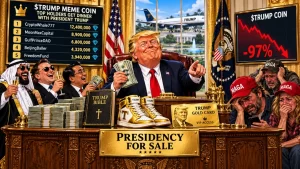
The memecoin gala dinner at Trump’s Virginia golf club, where top token holders, many apparently foreign, buy their way into the president’s company.
Trump signs the GENIUS Act, after Senate Republicans block amendments barring the president from profiting off stablecoins.
Trump pardons Binance founder Changpeng Zhao, who had pleaded guilty to an anti-money-laundering violation.
The SEC drops its case against Sun for a $10 million settlement with no admission of wrongdoing.
Trump’s financial disclosure reveals at least $1.4B in crypto income for 2025.
A Trump-appointed regulator conditionally approves World Liberty’s national trust bank.
Greenberg v. Trump is filed in federal court in Washington.
III. An Open Door for Dirty Money
Let us be precise, because precision is what separates accountability from propaganda: no court or prosecutor has found that the Trump family laundered money. What the record shows is something different and, in its own way, more alarming. The president has built a financial apparatus that is extraordinarily well suited to moving anonymous money into his family’s pockets, and then dismantled much of the government machinery that would detect it if it happened.
Consider what reporters and watchdogs have already documented. In November 2025, Senators Elizabeth Warren (D-Mass.) and Jack Reed (D-R.I.) wrote to Treasury Secretary Scott Bessent and Attorney General Pam Bondi citing a watchdog report that World Liberty had sold governance tokens to buyers with on-chain ties to North Korea’s Lazarus hacking group, a sanctioned Russian sanctions-evasion tool, an Iranian crypto exchange, and the mixing service Tornado Cash. Their letter warned that such sales indicate an absence of robust sanctions and anti-money-laundering controls. World Liberty told CNBC it runs rigorous KYC and AML checks on every pre-sale buyer.
Then, in August, The New York Times reported that the man behind Aqua 1, a little-known UAE fund that bought $100 million in WLFI tokens, had been arrested in Britain in 2021 on suspicion of money laundering and remains tied to an active investigation, though he has not been charged. The source of that $100 million, The Block noted, remains unclear.
Now add the president’s own decisions. Binance, which custodies most of the USD1 in circulation, had pleaded guilty in 2023 to failing to maintain an effective anti-money-laundering program; its founder served prison time. In October 2025, Trump pardoned Changpeng Zhao, a man the Associated Press noted had failed to stop criminals from moving money tied to child sexual abuse, drug trafficking, and terrorism through his platform. As Americans for Financial Reform has catalogued, the administration also shut down the Justice Department’s crypto enforcement team and watched the SEC drop case after case against firms entangled with the family business.
Memecoins and governance tokens can be bought pseudonymously, through offshore exchanges, by anyone on Earth. When a Bloomberg analysis found that most of the top holders competing for seats at the president’s memecoin dinner had used foreign exchanges that bar U.S. users, it confirmed the design flaw in plain sight. A foreign principal who wants to put money in the president’s pocket no longer needs a hotel suite. He needs a wallet.
IV. Your Treasury, His Interest Income
Stablecoins like USD1 are pegged to the dollar and backed mostly by short-term U.S. Treasury bills. The issuer keeps the interest. That means every dollar parked in USD1 is effectively lent to the United States government, and the U.S. government, which is to say American taxpayers, pays interest that flows to the Trump family’s company. World Liberty says its reserves earn an estimated $150 million a year in interest, according to the Journal’s reporting relayed by Mediaite.
The administration has not been a neutral referee in this market; it has been its loudest promoter. At the March 2025 White House crypto summit, Treasury Secretary Scott Bessent pitched stablecoins as a way to generate new demand for U.S. debt, as Forbes reported. Among the many dollar-backed coins already on the market, the president’s family happened to own one. The Democracy Defenders Fund has warned that USD1’s highly concentrated ownership makes it a potential source of stress for the Treasury market itself, and that the president now has a personal stake in how regulators would respond to a crisis.
And the stakes just rose. In August, the Office of the Comptroller of the Currency, led by Trump appointee Jonathan Gould, granted World Liberty conditional approval for a national trust bank that would issue USD1 directly. ABC News called it the first time in U.S. history a company owned by a sitting president’s family has been granted bank status. The president’s regulators now supervise the president’s bank.
V. The People Who Paid: Trump’s Own Supporters
If the UAE deals show who profits from the crypto presidency, the $TRUMP memecoin shows who pays. Launched three days before the inauguration, the coin rocketed to roughly $75 before collapsing. Through the end of June 2026, analytics firm Nansen found that 988,905 wallets, about two-thirds of all buyers, had lost a combined $3.81 billion, The New York Times reported. Early, fast-moving traders captured the gains; ordinary fans who bought on the hype absorbed the losses. Meanwhile the president booked roughly $636 million from the memecoin business in 2025 alone.
The pattern was visible from the start. Within 19 days of launch, a Chainalysis analysis commissioned by the Times found more than 813,000 wallets had already lost about $2 billion, Fortune reported. Later Chainalysis data shared with NBC News showed just 58 wallets had made more than $10 million each. World Liberty’s own token buyers fared little better: 85 percent of tracked WLFI wallets were in the red.
The coin’s own website warned that it was not an investment. But the president personally promoted it to millions of followers, dangled a dinner and a White House tour for the biggest holders, and earned fees on trades whether the price rose or fell. Supporters trusted their president. Their president sold them a lottery ticket in which the house always wins and the house lives in the White House.
VI. The Constitutional Question
The Foreign Emoluments Clause, Article I, Section 9, Clause 8
“…no Person holding any Office of Profit or Trust under them, shall, without the Consent of the Congress, accept of any present, Emolument, Office, or Title, of any kind whatever, from any King, Prince, or foreign State.”
The framers wrote this clause after watching European courts buy the loyalty of American diplomats with lavish “gifts.” Its logic is prophylactic: it does not require proof of a bribe or a changed vote. It bans the payment itself unless Congress consents, because divided loyalty is nearly impossible to prove after the fact.
Why this case is different from the first term. Several emoluments suits against Trump between 2017 and 2021 ended without recovering a dollar or stopping the challenged practices, Quartz notes. Greenberg’s case attempts to overcome three historic obstacles:
- Standing. He claims concrete competitive injury: business that would have gone to Circle’s USDC was steered to USD1 by a foreign state. Courts will have to decide whether a shareholder suing on the company’s behalf, over the company’s own disavowal, may proceed.
- “Foreign State.” MGX is a UAE government-created fund chaired by a sitting member of that government, and Tahnoon is the UAE’s national security adviser. That is far closer to a “Prince, or foreign State” than hotel bookings by diplomats.
- Congressional consent. There is none. Congress has never voted to approve any of these payments, and the Senate’s Republican majority blocked amendments that would have addressed them.
The statutory gap. Federal conflict-of-interest law, 18 U.S.C. § 208, exempts the president. The GENIUS Act’s ethics provisions cover members of Congress and executive-branch staff but, after Republicans rejected Democratic amendments, not the president who signed it. That is why the Constitution is now the last line of defense, and why Congress, not just the courts, must act.
VII. The Republican Congress: See No Evil
Oversight is a constitutional duty of Congress. For two years, the Republican majorities have treated it as optional. When the GENIUS Act stablecoin bill reached the Senate floor in 2025, Sen. Jeff Merkley (D-Ore.) repeatedly sought votes on amendments to bar the president and other officials from profiting off crypto. Republicans blocked them and passed the bill without considering any floor amendments, Merkley’s office reported. Sen. Chris Murphy (D-Conn.) tried to force Republicans on the record with a simple amendment extending existing ethics rules to the president.
“Trump’s ‘Government for Sale’ enterprise is the Mount Everest of corruption.”
— Sen. Jeff Merkley (D-Ore.)
In the House, Financial Services Committee Chair French Hill (R-Ark.) declined Ranking Member Maxine Waters‘s demand that crypto legislation include provisions blocking the president from profiting, The Hill reported, prompting Democrats to hold their own shadow hearing. Republicans who backed the stablecoin bill argued that restricting the president’s investments was beyond Congress’s authority. The result: no subpoenas, no hearings on the UAE stake, no investigation of the memecoin dinner, and no answer to the question every American deserves answered, which is who exactly is paying the president.
VIII. The Democrats: Letters Now, Subpoenas Later?
Out of power, Democrats have done what a minority can do. Warren and Reed have pressed Treasury and Justice to investigate World Liberty’s token buyers. Sen. Richard Blumenthal (D-Conn.) has questioned the SEC about whether Trump allies received favorable treatment in the Sun case. Reps. Waters, Brad Sherman, and Sean Casten warned that dropping that case may be part of a “pay-to-play scheme,” Cointelegraph reported. Top Democrats on five Senate panels jointly called for hearings on the national security implications of the president’s crypto holdings.
The bigger promise depends on next Tuesday. According to Bloomberg Government, Democrats across key House and Senate committees say Trump’s crypto connections will be front of mind if they reclaim their gavels. Reuters reported that Trump family crypto firms and Donald Trump Jr.’s venture fund 1789 Capital would be early targets, with investigations possible as soon as February 2027. Rep. Ro Khanna (D-Calif.), of the House Oversight Committee, told Reuters that Congress must examine these crypto transactions to see whether national security has been compromised, The Globe and Mail reported.
Promises are not results. A Democratic majority would win subpoena power and investigators, not the ability to overturn regulatory approvals or override a veto. But subpoenas matter: they are how the public learns who bought the tokens, who wired the money, and what was discussed before the chips were approved. Democrats should be held to their word, starting with legislation that bars every president, vice president, and member of Congress from issuing or profiting from digital assets while in office.
Get Involved Today
Contribute to our mission and turn your concerns into action.
IX. Still Cashing In
None of this has slowed the family down. World Liberty is building a federally chartered bank. Trump Media, the president’s publicly traded company, has partnered with Crypto.com on a digital-asset treasury company and a crypto rewards system for Truth Social. Pakistan’s government has signed agreements with World Liberty to bring its crypto into the national financial system. Eric Trump was in Singapore this month pitching the industry’s next boom. And the president’s regulators continue to approve, settle, and pardon.
What does it say about a president’s priorities when his single largest source of income is an industry he regulates, whose biggest foreign customers have business before his government? It says the office has become an asset. Every pardon, every chip license, every dropped case now carries an unavoidable question mark. That is the real cost of the crypto presidency: not only the billions moved, but the trust that every American can no longer place in the decisions made in their name.
X. What You Can Do
The crypto presidency affects you whether or not you have ever bought a token. It shapes how your bank is regulated, how fraud gets policed, and how much risk sits inside the Treasury market that underpins your retirement savings. Americans lost a record $11 billion to crypto-related fraud in 2025, more than half of all cybercrime losses reported to the FBI, Homeland Security Today reported. With federal enforcement in retreat, protecting yourself is now largely your job.
- Treat memecoins as gambling, not investingAny token whose value depends on a celebrity’s name, including a president’s, has no underlying business. Never put retirement, emergency, or borrowed money into one. Check any investment professional or offering through the SEC’s Investor.gov before you buy.
- Know what’s in your portfolioAsk your bank, broker, or 401(k) administrator whether any of your funds hold crypto or stablecoins, and what protections apply. Stablecoins are not FDIC-insured deposits.
- Report fraud, every timeFile complaints with the FBI’s Internet Crime Complaint Center at ic3.gov and with the FTC at ReportFraud.ftc.gov. Beware “recovery” services that promise to get lost crypto back; the FBI warns these are often a second scam.
- Demand an ethics law with teethCall your senators and representative through the Capitol switchboard (202-224-3121). Ask them, on the record, whether they support barring the president, vice president, and members of Congress from issuing or profiting from crypto while in office, and whether they will hold hearings on the UAE payments.
- Make oversight a voting issueBefore you vote, look up where every candidate on your ballot stands on presidential ethics and crypto conflicts of interest, and support watchdog journalism and nonprofits that track these deals. Accountability requires someone to be watching.
Editorial Conclusion
The framers did not ask Americans to prove that a foreign prince had bought their president. They forbade the purchase. Today a foreign government’s national security chief owns nearly half of the president’s family crypto company and nearly half of its bank, a foreign state fund made the president’s stablecoin a giant overnight, and nearly a million Americans who trusted his name are poorer for it.
A court must hear this case on the merits, and Congress must stop pretending the Constitution’s Emoluments Clause is optional. Full disclosure of every foreign dollar, sworn testimony, and a law barring every federal officeholder from profiting off the markets they govern: that is the minimum a republic owes itself. A presidency that can be paid for is no longer the people’s presidency.
Sources & References
- The Daily Beast — Trump Humiliated in Bombshell Crypto Lawsuit
- CNBC — Lawsuit accuses Trump of illegally profiting off foreign crypto deals
- Spectrum News — Lawsuit accuses Trump of illegally profiting from UAE investments
- Quartz — Circle shareholder sues Trump over $2 billion in UAE-linked crypto deals
- Quartz — Trump sued over alleged constitutional violations in UAE crypto deals
- The Block — UAE Sheikh secretly acquired 49% of World Liberty Financial: WSJ
- The Block — UAE ‘spy sheikh’ takes 49% stake in Trump family’s bank venture
- The Block — World Liberty received $100M from businessman investigated for money laundering
- Bloomberg Government — Trump’s $1.4 Billion Haul Makes Him Biggest US Crypto Moneymaker
- Boston Globe / NYT — Nearly a million investors lost money on Trump crypto coin
- NBC News — 58 wallets made millions on Trump’s meme coin while 764,000 lost money
- Fortune — Trump memecoin traders lose $2 billion
- U.S. Senate Banking Committee — Warren–Reed letter to Bessent and Bondi on WLFI token sales
- Associated Press / PBS — Trump pardons Binance founder Changpeng Zhao
- ABC News — Trump-linked crypto venture granted bank status in unprecedented move
- Sen. Jeff Merkley — Merkley Slams GENIUS Act Rubberstamping Trump’s Crypto Corruption
- Bloomberg Government — Democrats Raring to Probe Trump Crypto Ties If They Win Midterms
- The Globe and Mail / Reuters — Democratic wins could bring scrutiny for Wall Street, crypto firms
- Bloomberg — Top Trump Crypto Buyers Vying for Dinner Seats Are Likely Foreign
- Democracy Defenders Fund — Trump’s crypto entanglements threaten stability of U.S. financial markets
Related News