Running on Fumes: The ‘Hunger Winter’ Trump Built
A war launched without Congress has pushed diesel to all-time highs. A megabill has pushed millions off food aid. And a White House that says it can’t afford the basics is proposing to end home heating assistance just as winter arrives. America’s food banks are the last line — and they are buckling.
Every food bank in America runs on two things: food and fuel. This fall, the Trump administration has made both more expensive to deliver and more desperately needed. On the same day that WBTV reported that Second Harvest Food Bank of Metrolina had just finished a record-setting year of distribution — serving nearly half a million people across 24 counties in the Carolinas — its CEO, Kay Carter, pointed to the new SNAP work requirements and other federal nutrition restrictions as drivers of the surge. She is not alone. From Maryland to Michigan to Arizona, the people who run America’s charitable food system are describing the same thing: a demand curve bending upward, a cost curve bending with it, and a federal government that has chosen to step back at the precise moment it is needed most.
This is not a natural disaster. It is the predictable result of decisions — a war of choice, a budget law that cut food assistance to finance tax breaks weighted toward the top, and a string of executive actions that gutted programs Congress created and funded. The winter ahead will test whether any of it can be reversed in time.
I. The Perfect Storm at the Loading Dock
Food banks are being squeezed from both directions at once. On the demand side, families who never needed help before are showing up. Craig Rice, CEO of the Manna Food Center in Maryland, told Meidas News reporter Scott MacFarlane that his clients used to be mostly hourly workers — and that salaried employees are now arriving, knocked off balance by what they pay at the pump, according to Common Dreams. Amy Beros, president of the Food Bank of Central and Eastern North Carolina, reported that demand across her region has risen somewhere between 20 and 60 percent in a year, and warned that the country struggles to grasp the problem because hunger in America “doesn’t look like it looks on TV.”
On the supply side, the trucks that move the food have become a budget crisis of their own. Diesel is the lifeblood of the entire food system, and it is now more expensive than at any point in American history.
Record Demand · The Carolinas
People served by Second Harvest Food Bank of Metrolina after a record year; leaders say demand is only expected to grow as USDA projects food prices rising roughly 3% next year. WBTV
Shutdown-Level Surge · Michigan
Increase in people seeking help at Kalamazoo Loaves and Fishes, which its associate director compared to the rush during last year’s shutdown-driven SNAP delay. Common Dreams
“Emergency Mode” · Arizona
Share of Arizona’s SNAP participants lost since the megabill — the steepest drop in the nation. The Arizona Food Bank Network’s Terri Shoemaker says her network has been in crisis-management footing, and warns it cannot last. Axios
Fuel Shock · Nationwide
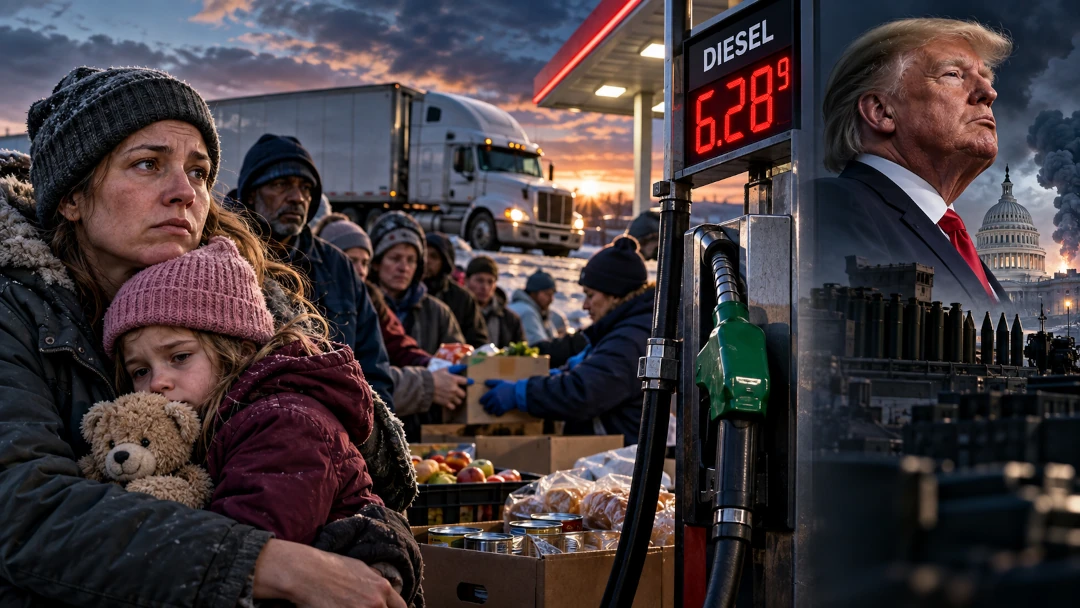
Rise in the national average diesel price since January, before the U.S. and Israel attacked Iran — from $3.52 a gallon to a record $6.28 in mid-September. The Conversation
In central Florida, Greg Higgerson of Second Harvest Food Bank told Spectrum News 13, as Common Dreams also noted, that his organization’s fuel bill is up sharply from a year ago — and that the next few months will bring both more people and higher costs to serve each of them. There is no federal line item that absorbs this. Food banks are paying for the president’s war out of their donation jars.
II. A War at the Pump, a Crisis at the Table
The fuel shock has a clear origin. According to an analysis in The Conversation, diesel averaged $3.52 a gallon in January 2026. After the U.S.-Israeli attack on Iran in late February, disruption to Middle Eastern refining — compounded by Russia’s diesel export ban — drove prices to repeated all-time records, up roughly two-thirds from a year earlier. The Energy Information Administration expects distillate inventories to stay tight through much of 2027. Diesel carries nearly everything Americans eat, from the farm to the warehouse to the pantry shelf.
Grocery prices, meanwhile, have not “soared” so much as refused to come down. The USDA’s own Food Price Outlook put food-at-home prices 2.7 percent above a year earlier in July, and forecasts overall food prices rising about 3 percent this year — increases stacked on top of the brutal spikes of 2022 and 2023 that never reversed. For a family already spending more to commute, heat a home and see a doctor, “moderating” inflation on an already-inflated base is cold comfort. The math of the household budget is cumulative, and the cumulative number is the one that sends people to the food bank.
What makes this moment different is not the price level alone. It is that the government deliberately withdrew the programs designed to cushion exactly this kind of shock — and did it while launching the war that caused it.
III. Policy by Subtraction: How Hunger Was Engineered
The centerpiece is the One Big Beautiful Bill Act, signed July 4, 2025. The Congressional Budget Office scored its cuts to the Supplemental Nutrition Assistance Program at roughly $187 billion, CNBC reported — the largest reduction in the program’s modern history. It extended strict work requirements to millions more adults, stripped exemptions from veterans and homeless Americans, and cut off many lawfully present immigrants. The results arrived fast. The Center on Budget and Policy Priorities estimates SNAP participation fell by more than 4.5 million people between the law’s enactment and April 2026, including more than 1.5 million children, per Axios. California’s food banks told CNBC they were serving 6 million people a month — more than at the peak of the pandemic.
The administration’s defense is that participation drops reflect recertification, people moving into work, or losing interest; a USDA spokesperson told Axios as much. The people who actually feed the hungry see it differently. Feeding America CEO Denis McDonough — who served as Secretary of Veterans Affairs — put it plainly to Axios: “The decline in SNAP participation is not necessarily evidence that fewer people need help.” The more likely explanation, he said, is that eligible people are simply finding the program harder to reach.
But the megabill is only the part that went through Congress. Much of the damage was done by executive action alone:
- March 2025
USDA froze or canceled roughly $500 million in TEFAP food deliveries to food banks and ended the Local Food Purchase Assistance program — another $500 million — prompting a letter from Sen. Amy Klobuchar and 25 colleagues demanding answers. (DTN) - April 1, 2025
HHS fired the entire federal LIHEAP staff — the team that runs home heating and cooling aid — and the White House proposed eliminating the program. (NEADA) - July 4, 2025
Trump signed the One Big Beautiful Bill Act, passed on party lines, cutting SNAP by about $187 billion. (CNBC) - September 20, 2025
USDA killed the 30-year Household Food Security report — the government’s primary measure of hunger — deriding it as “subjective, liberal fodder.” (The Hill) - Late February 2026
The U.S. and Israel attacked Iran without congressional authorization; diesel begins its climb from $3.52. (The Conversation) - April 2026
Trump’s FY2027 budget proposed zeroing out LIHEAP (about $4.1 billion serving roughly 6 million households), trimming SNAP funding, and slashing WIC’s fruit-and-vegetable benefit. (Hope Center) - September 2026
Diesel set successive all-time records above $6 a gallon as the war passed the six-month mark. (The Conversation)
Read that list again and notice what it adds up to. The administration cut the food, fired the heating-aid staff, started the war that spiked fuel costs — and then stopped counting the hungry. Ending the food security survey does not end hunger. It only makes the consequences of these choices harder to prove.
“We’re fighting wars. We can’t take care of day care.”
— President Donald Trump, White House Easter lunch, April 1, 2026, as reported by NBC News
IV. Priorities in Plain Sight
If anyone wondered how this White House ranks the needs of struggling Americans against its military adventure, the president answered the question himself. Speaking at a White House event in April, Trump said he had instructed budget director Russell Vought not to send money for child care, and argued that the federal government cannot handle programs like Medicaid and Medicare because its job is to focus on defending the country militarily, NBC News reported. He was not speaking about food banks specifically. He didn’t need to. The logic is the same one running through every item in the timeline above: the war comes first, and families are told to take their needs to the states — the same states the megabill is now billing for a growing share of SNAP.
That is the core of this editorial’s charge. Leadership in a crisis means seeing the pressure building across the country and acting to relieve it. Instead, as diesel broke records week after week, the administration offered food banks nothing — no emergency TEFAP purchases, no fuel relief, no pause on the SNAP cost shift that states are scrambling to absorb. The only federal budget document on the table proposes to make winter colder for 6 million households.
Equally troubling is how much of it happened without the consent of the people’s representatives. Congress appropriated TEFAP and LFPA dollars; the administration canceled deliveries. Congress funded LIHEAP; the administration fired the people who run it. Congress holds the constitutional power to declare war; the president went to war without asking. Even the one piece that did pass Congress — the megabill — squeaked through on a party-line vote, over the objection of every Democrat and the anguish of food banks nationwide. A government that governs this way is not merely making bad policy. It is ignoring the architecture of accountability the Constitution built.
Get Involved Today
Contribute to our mission and turn your concerns into action.
V. What Congress — and the Democrats — Are Doing
Democrats have not been silent, but they are outnumbered. In November 2025, Senators Ben Ray Luján, Chuck Schumer, Amy Klobuchar and Jeff Merkley, with Representatives Jahana Hayes and Angie Craig, introduced the Restoring Food Security for American Families and Farmers Act to reverse the megabill’s SNAP cuts. The Republican majority has not moved it. Food bank advocates, including Feeding America, are separately urging Congress to delay the tight deadline that will force states with SNAP error rates of 6 percent or more to start covering benefit costs in fiscal 2028 — a threshold only nine states met in 2025, Axios reported.
On the war that is driving the fuel crisis, Democrats have forced vote after vote. Last Thursday the Senate rejected a war powers resolution 49–50 — the 14th time the chamber has taken up such a measure since the bombing began — with only four Republicans, including Susan Collins, Lisa Murkowski and Rand Paul, joining Democrats, Stars and Stripes reported. Sen. Tim Kaine, who has led the effort, reminded his colleagues where the Constitution places that power.
“But it is not his decision; it’s our decision.”
— Sen. Tim Kaine (D-Va.), on the Iran war, September 24, 2026, via Stars and Stripes
On heating, the National Energy Assistance Directors Association has asked Congress for an additional $3 billion in LIHEAP funding to cover soaring oil and electricity costs, CNN reported. Congress has refused the president’s past proposals to abolish the program. Whether they will expand it — rather than merely keep it alive — is the question this Congress must answer before the first hard freeze.
The honest assessment is this: Democrats have the right bills and the right votes, and they lack the gavels. Until that changes, the minority’s most powerful tools are the record it builds, the pressure it applies, and the case it makes to voters.
VI. The Winter Ahead — and the Cliff Behind It
Everything described so far is the prelude. Four pressures are converging over the next fifteen months:
Heating. Households that heat with oil are forecast to pay 31.3 percent more this winter, according to NEADA’s latest analysis reported by CNN. The Northeast, where oil heat dominates, will be hit hardest — and every dollar that goes to the furnace is a dollar that doesn’t go to groceries. Anti-hunger workers have a name for it: heat-or-eat.
The SNAP cost shift. Starting next month, states must shoulder a larger share of SNAP’s administrative costs under the megabill, Common Dreams noted. States racing to cut error rates before benefit cost-sharing arrives are adding interviews, documentation checks and delays — hurdles that knock eligible families off the rolls.
Health care. On January 1, 2027, Medicaid work requirements take effect in most states. Manatt Health projects that, under the administration’s implementing rule, coverage losses will reach 2.8 million people in the first federal fiscal year and climb to 9.2 million by 2034, according to its 50-state analysis. Families who lose coverage will pay for care out of the same budget that buys food.
The 2027 ledger. The megabill was sold as a working-family tax cut. But for the poorest Americans, its modest tax benefits are outweighed by its cuts. An analysis cited by FactCheck.org finds the lowest-income fifth of households losing an average of $165 in 2027 once Medicaid and SNAP cuts are counted — a loss that deepens to roughly $885 by 2030. The temporary tax provisions touted for workers, meanwhile, are scheduled to lapse after 2028, while the program cuts keep growing.
Put those together and the forecast is not complicated. Food banks already running at record volume will face another wave of need this winter, and a larger one in 2027 — with fuel costs that show no sign of relief and a federal partner that has walked away.
When the Commander-in-Chief Chooses War Over Bread
The Mechanism
Section 4 of the 25th Amendment allows the Vice President and a majority of the Cabinet — or of another body Congress creates by law — to declare that the president is “unable to discharge the powers and duties of his office.” The Vice President immediately becomes acting president. If the president contests the finding, Congress decides, and keeping him sidelined requires a two-thirds vote of both the House and the Senate within 21 days. It has never been invoked involuntarily.
Who Has Called for It
In April, after Trump posted that “a whole civilization will die tonight” about Iran, more than 85 House and Senate Democrats called for his impeachment or removal, and House Judiciary Ranking Member Jamie Raskin introduced legislation creating the 17-member commission that Section 4 contemplates, Axios reported. Rep. Raja Krishnamoorthi formally called on Vice President JD Vance and the Cabinet to act, citing a pattern of erratic decision-making that raises grave questions about the president’s fitness.
The Argument
The case does not rest on any single policy. It rests on a pattern that bears directly on the “powers and duties” of the office: a president who launched and sustains a war Congress never authorized, declares openly that the country cannot afford to care for its own people because it is at war, and presides over an executive branch that cancels congressionally funded food deliveries, fires the staff of heating assistance programs, and stops measuring hunger as it rises. Faithfully executing the laws — including the ones that fund food banks and heating aid — is a constitutional duty. A president unable or unwilling to recognize the domestic emergency his own decisions produced is, supporters of invocation argue, unable to discharge that duty.
The Barriers — Honestly Stated
The obstacles are formidable. Section 4 requires Vice President Vance and a Cabinet majority — all Trump appointees — to act. Raskin’s commission bill cannot pass a Republican Congress, and Trump could veto it. A contested case would need two-thirds of both chambers. And many constitutional scholars caution that the amendment was designed for incapacity — a stroke, a coma, a breakdown — not for policies a president chooses, however harmful; for those, they argue, the remedies are impeachment and the ballot box.
Why the Barriers Don’t Erase the Case
Barriers speak to the odds, not to the merits. The 25th Amendment exists precisely so that the nation has a remedy when a president’s judgment has failed so badly that the country’s welfare is at risk — and building a documented, public record of that failure is itself a constitutional act. Every missed delivery, every family dropped from SNAP, every household left choosing between heat and food belongs in that record. If the Cabinet will not act, the record goes to the voters — and to the next Congress, which will have both the power to investigate and the duty to restore what was taken.
Editorial Conclusion
America is heading into winter with record fuel prices, millions fewer people on food aid, a heating program the president wants abolished, and food banks already stretched past their limits. None of this was inevitable. It was chosen — in a war launched without Congress, in a budget law that took from the hungry to reward the comfortable, and in executive actions that overrode the laws Congress wrote.
What is required is not complicated: restore SNAP, fully fund and expand LIHEAP, deliver emergency TEFAP purchases and fuel relief to food banks now, and bring the war back under the constitutional authority of Congress. A government that cannot feed its people in the richest nation on earth has not run out of money. It has run out of leadership — and the Constitution, and the voters, still hold the power to supply it.
Sources & References
- WBTV — Charlotte-based food bank sees record year of food distribution as demand, food costs rise (Sept. 29, 2026)
- Common Dreams — US Food Banks Under Strain as Trump Policies Drive Up Costs (Sept. 28, 2026)
- Axios — Food banks confront growing SNAP gap (July 25, 2026)
- The Conversation — Iran war pushes diesel to record high prices, with no relief on the horizon (Sept. 2026)
- USDA Economic Research Service — Food Price Outlook: Summary Findings (Aug. 2026)
- CNBC — At least 3.5 million people have lost food stamp access as ‘big beautiful bill’ cuts take effect (May 30, 2026)
- DTN Progressive Farmer — Senators Press USDA on Cuts to Food Banks (Mar. 25, 2025)
- NEADA — LIHEAP Still Here, But Threats Loom (2026)
- The Hill — Trump administration halts government hunger report (Sept. 22, 2025)
- The Hope Center, Temple University — The Administration’s FY 2027 Budget Proposes to Eliminate Crucial Basic Needs Investments (Apr. 2026)
- NBC News — Trump says it’s ‘not possible’ for the U.S. to pay for Medicaid, Medicare and day care (Apr. 3, 2026)
- U.S. Senate Agriculture Committee (Democrats) — Democrats introduce legislation to reverse SNAP cuts (Nov. 20, 2025)
- Stars and Stripes — Senate votes down attempt to halt Iran war (Sept. 24, 2026)
- CNN Business — Get ready for a 30% jump in heating oil costs this winter as Iran war drives up prices (Sept. 14, 2026)
- Manatt Health — CMS’ Medicaid Work Requirements Rule: A 50-State Analysis of Coverage Losses, FFY 2027–2034 (July 2026)
- FactCheck.org — GOP Ad Attacks Ossoff’s Vote Against Trump Tax Cuts (Sept. 2026)
- Axios — House Democrats file long-shot 25th Amendment bill targeting Trump (Apr. 14, 2026)
- Office of Rep. Raja Krishnamoorthi — Krishnamoorthi Calls for President Trump’s Removal Under 25th Amendment (Apr. 7, 2026)
Related News