Below Putin, Above Only Netanyahu: The World’s Verdict on Donald Trump
A new 36-country Pew Research survey of 42,151 adults finds the United States led by the second-least-trusted leader on the world stage. The president’s collapse in global confidence is not a vanity metric — it is bleeding into tourism, exports, alliances, and the wallets of ordinary Americans. And it raises a question Congress has begun to ask out loud.
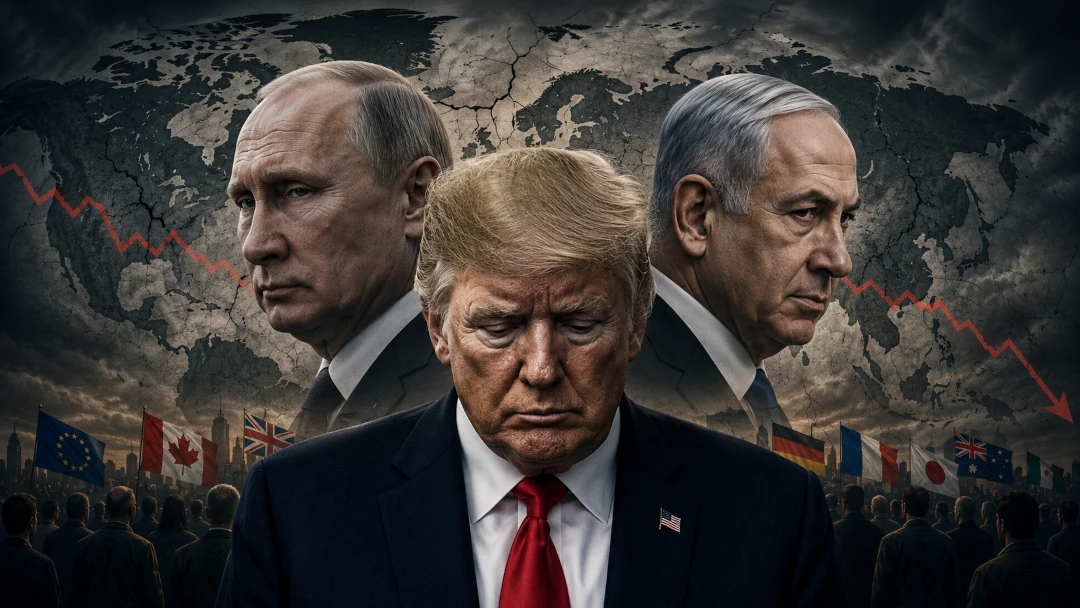
Across thirty-six countries, on five continents, in democracies and autocracies, in NATO capitals and middle-income republics, Pew Research Center’s pollsters asked 42,151 adults a simple question: do you have confidence in this leader to do the right thing regarding world affairs? The answer that came back about the President of the United States was the second-worst in the field. Of the six leaders tested — Emmanuel Macron, Volodymyr Zelenskyy, Xi Jinping, Vladimir Putin, Benjamin Netanyahu, and Donald Trump — only Israel’s Netanyahu finished lower. A median of just 23% of adults globally trust Donald Trump to do the right thing. The president of the world’s oldest constitutional democracy now polls beneath the leaders of Russia and China in the eyes of the planet.
This is not a partisan press release. It is the methodically gathered finding of a nonpartisan, nonadvocacy research institution that has measured global views of U.S. presidents for more than two decades. And the data tells a story far more damaging than a single number. In Canada, only 20% have confidence in Trump — less than the 35% who trust Xi. In Germany, Trump’s number is 16%; Macron’s is 72%. In Mexico, where 11% express confidence in the American president, even Netanyahu rates higher. In the Palestinian territories, the figure for Trump is 4%. In Turkey, it is in the single digits.
What the global public is telling the United States, in numbers Republicans and Democrats can both read, is that confidence in this presidency has cratered everywhere it can be measured. Pew found that Trump’s confidence ratings declined in 16 of the 24 nations where year-over-year comparison was possible — and improved in none. The world is not asking America for time to adjust. The world has adjusted, and turned away.
1. The Pew Findings, In Their Own Light
The headline number — 23% global confidence — understates the damage when broken apart. Pew’s parent report, “Trump Gets Negative Reviews Internationally as Fewer Say U.S. Is a Reliable Partner,” measured collapses on every axis a great power is supposed to care about. The share of foreign publics who say the United States is a reliable partner has dropped by 28 to 52 percentage points across most of Europe. In Canada, the figure fell from 83% in 2022 to 35% today. Among Germans, the share who say America considers other countries’ interests when making foreign policy fell from 60% in 2023 to 23% in 2026 — lower than during the Iraq War years under George W. Bush.
The deepest reading of the survey, however, is moral rather than diplomatic. A 36-country median of 56% now say the United States government does not respect the personal freedoms of its own people. In twelve of the thirteen countries asked, the share who said America does respect personal freedoms fell by double digits since 2021. As Pew notes, this measure is at its lowest point in many nations in the entire history of their polling, including some they have surveyed since 2002. The world, in short, has stopped seeing the United States as the country it once advertised itself to be.
“Public trust in Donald Trump’s ability to meet the duties of his office has dropped to unprecedented lows. We are at a dangerous precipice.”
— Rep. Jamie Raskin (D-Md.), Ranking Member, House Judiciary Committee, April 14, 2026
The Pew survey was conducted from February 8 through May 13, 2026. Most of the interviews took place after the United States and Israel launched a military conflict with Iran on February 28, 2026, and Pew’s own regression analysis suggests opinions of the United States grew more negative as the war progressed. The collapse, in other words, is not a snapshot. It is a trajectory.
2. Tariffs the World Detests, Markets the World Replaces
If the global confidence vote were merely symbolic — a popularity contest among capitals — Americans might be entitled to shrug it off. They cannot. Pew specifically tested approval of the administration’s handling of eight major international issues. Trump’s tariff policies were among the worst-rated in the entire instrument. In the United Kingdom, 27% approved of how the president was handling tariffs. In India, 18%. In Canada, 17%. In Japan, 15%. In South Korea, 14%. In Mexico, 11%. In Germany, 8%. Across Europe, a median of 85% of adults disapprove of the administration’s tariffs and its handling of Greenland.
These are not abstract grievances. Foreign publics that hold this view of American economic statecraft buy American goods, travel to American cities, and shape the trade policies of their own governments. And the consequences are now on the books. The Center for American Progress estimates that at least 2.6 million American workers are employed in industries exposed to retaliatory tariffs from China, Canada, and the European Union. The Tax Foundation, a center-right think tank no one would mistake for a progressive outfit, calculates the Trump tariffs as the largest U.S. tax increase as a share of GDP since 1993, and projects an average household cost of roughly $1,500 in 2026 alone.
Value of U.S. exports affected by threatened or imposed foreign retaliatory tariffs as of September 2025, according to the Tax Foundation. The same modeling projects a long-run GDP hit from retaliation alone.
Decline in international visitors to the United States in 2025 while the rest of the world saw roughly 4% growth in tourism, Euronews reported. Visits from Canada alone fell about 21%.
Estimated 2025 loss in international visitor spending in the U.S., per the World Travel & Tourism Council figures cited by multiple outlets. The U.S. is the only major economy where inbound tourism dropped.
Fewer leisure and hospitality workers employed in December 2025 versus a year earlier, federal data cited by The American Prospect shows. Theme parks, hotels, and restaurants are absorbing the loss.
Average loss on each acre of harvested soybeans in 2025, even after federal aid, per the American Soybean Association cited by PBS NewsHour. China has shifted its sourcing to Brazil.
Total federal emergency support to farmers since January 2025 — including a $12 billion Farmer Bridge package announced last December. Farmers are being paid by taxpayers to absorb losses caused by the president’s policies.
Notice what each of those cards has in common. None of them measures Donald Trump’s opinion of how the world ought to behave. Each measures what is actually happening, in volumes and dollars, to the United States as a consequence of the world’s response to him. As Time magazine put it in March, the president’s tariffs are functioning like termites — “introduced into the woodwork of global trade: not easily seen, but likely to make any structure crumble over time.”
3. What the Average American Actually Pays
It would be one thing if global condemnation of the president touched only the ambassadors and the trade lawyers. It does not. The Pew survey is, in its way, the world’s grim accounting of decisions that travel directly into American kitchens and American payrolls. Consider the through-line. Foreign publics lose confidence in the United States. Their tourism dollars stop arriving — a $12.5 billion gap in 2025 alone, according to the World Travel & Tourism Council. Hotel housekeepers, theme-park food workers, line cooks, and rideshare drivers lose hours and shifts. The American Prospect documented the human cost in Universal Studios Hollywood, in Miami hotels, and on the Las Vegas Strip, where occupancy has not recovered to pre-pandemic levels.
Foreign governments retaliate against U.S. tariffs by closing markets to American crops. China, once the single largest buyer of American soybeans, bought no U.S. soybeans at all from late May through November 2025. The buyers Beijing went to instead — Brazil chiefly, then Argentina — are not coming back. As former USDA chief economist Joseph Glauber and other agricultural economists have repeatedly noted, lost export markets are notoriously hard to recover once trading partners have built new supply chains.
And the costs of those tariffs, contrary to repeated White House claims, are overwhelmingly borne by American importers and consumers. Goldman Sachs analysts have estimated that roughly 37% of the tariff burden falls on U.S. consumers and 51% on U.S. importers, with foreign exporters absorbing only about 9%. The president has, in effect, raised taxes on Americans by hundreds of billions of dollars — without a single vote in Congress — and then handed about $30 billion of the proceeds back to farmers to compensate them for damage his own policies inflicted. The farmers themselves know it: in the New Republic‘s reporting, soybean producer Greg Neibling described the situation, in nearly two dozen variations, with a single word: tough.
4. A Year of Reputational Collapse
The shape of the decline is best understood as a sequence. None of these data points stands alone; together they describe a presidency whose decisions have systematically eroded American standing in a single calendar year.
The U.S. and Israel launch military conflict with Iran, without a congressional declaration of war. Pew’s regression analysis later finds that opinion of the U.S. grew more negative across surveyed countries as the war progressed.
House Judiciary Ranking Member Jamie Raskin (D-Md.) writes to White House Physician Capt. Sean Barbabella, demanding a comprehensive cognitive and neurological evaluation of the president and public disclosure of the findings. (House Judiciary Democrats release)
Rep. Raskin introduces H.R. 5830863-style legislation to establish a 17-member Commission on Presidential Capacity to Discharge the Powers and Duties of the Office. Fifty House Democrats co-sponsor; more than 70 members have already called for the president’s removal. (The Hill)
Sens. Sheldon Whitehouse and Jack Reed (D-R.I.) enter into the Congressional Record a statement signed by 36 physicians — including neurologists and psychiatrists from Harvard, Tufts, Columbia, and George Washington University — calling the president “mentally unfit” and urging invocation of the 25th Amendment. (The Hill)
Pew Research Center publishes its 36-country survey finding the United States led by the second-least-trusted of six world leaders measured, with confidence in Trump having fallen in every country where comparison was possible. (Pew Research Center)
Get Involved Today
Contribute to our mission and turn your concerns into action.
This is a presidency that is bleeding markets, allies, jobs, harvests, and its own credibility on parallel tracks. The Pew survey is one cross-section of a much larger pattern of breakdown. Lawmakers across both parties — yes, including some on the right — have begun to ask whether the cause is not merely policy disagreement, but presidential capacity itself.
“Unable to discharge the powers and duties of his office”
Ratified in 1967 in the wake of the Kennedy assassination, the 25th Amendment was the framers’ answer to a deceptively hard problem: what does the Constitution do with a president who cannot do the job? Section 4 of the amendment authorizes the vice president, together with a majority of the Cabinet — or, crucially, “such other body as Congress may by law provide” — to declare in writing that the president “is unable to discharge the powers and duties of his office.” Upon transmittal to the Speaker of the House and the president pro tempore of the Senate, the vice president immediately becomes Acting President.
The amendment never defines the word “unable.” It never defines “inability.” The drafters did that on purpose.
The deliberate ambiguity was a feature, not a flaw. The 1965 congressional debate over the amendment turned explicitly on the recognition that incapacity could take forms — physical, mental, psychological — that no statute could safely enumerate in advance. The Constitution therefore vested the determination in the people closest to the president, governed by procedure rather than by a closed list of medical diagnoses. The bar is functional: can the president discharge the powers and duties of the office? It is not a test of popularity, ideology, or even of policy soundness. It is a test of capacity.
On April 14, 2026, House Judiciary Ranking Member Jamie Raskin introduced legislation establishing precisely the “other body” the amendment contemplates — a bipartisan, independent Commission on Presidential Capacity composed of physicians, psychiatrists, and former senior executive officials chosen by congressional leaders from both parties. Fifty House Democrats co-sponsored. Even Fox News reported the bill’s text in full: the commission “shall carry out a medical examination of the President to determine whether the President is mentally or physically unable to discharge the powers and duties of the office.” Two weeks later, Sens. Sheldon Whitehouse and Jack Reed entered into the Congressional Record a signed statement from 36 physicians at Harvard, Tufts, Columbia, and George Washington University — neurologists, psychiatrists, and specialists in cognitive disorders — calling the president “mentally unfit” and urging the amendment’s invocation.
The constitutional argument they are making is straightforward. A president who, on the public record of a single year, has launched a war without congressional authorization, posted threats to “extinguish” foreign civilizations, demanded loyalty from senior officials in language alarming to career national-security professionals, and overseen the steepest documented collapse of international confidence in any U.S. president in the history of Pew’s polling — that president is, by the functional test the framers wrote into Section 4, plausibly unable to discharge the powers and duties of the office. The economic data in this article — the cratering exports, the lost markets, the empty hotel rooms, the bankrupted farms — are not separate from the constitutional question. They are evidence of an office whose powers and duties are not, in fact, being discharged in a manner the country can survive.
The practical barriers are real and worth naming honestly. Section 4 requires the vice president — currently JD Vance — and a majority of the Cabinet, hand-picked by Trump himself, to initiate the process. Congress can substitute its own designated body for the Cabinet, but Republicans control both chambers, and any commission bill would face a presidential veto. A two-thirds vote of both chambers would ultimately be required to override the president’s contestation. None of these hurdles is small. But none of them changes the constitutional fact: the mechanism exists, it was designed for exactly this kind of crisis, and the failure to even debate it openly is a failure of the legislative branch, not of the framers’ design. The political path is hard. The moral and constitutional case is not.
5. What the World Is Actually Telling Us
The Pew report is not a controversial argument. It is a survey of 42,151 adults conducted by professional interviewers in 36 countries over thirteen weeks. Its authors — Richard Wike, Laura Silver, Moira Fagan, and Jonathan Schulman — present the findings in the dry register of social science. But the picture they paint is unsparing. A median of 35% of adults across the surveyed nations now believe the United States contributes to peace and stability in the world. A median of 32% believe the U.S. takes the interests of other countries into account. A median of 39% believe America respects the personal freedoms of its own people. These are not the numbers of a great power leading. These are the numbers of a great power failing.
And the costs of that loss of standing are not paid by Donald Trump. They are paid by the soybean farmer in Kansas whose Chinese buyer is now Brazilian. They are paid by the Universal Studios food-service worker whose hours have been cut because Canadian families are vacationing in Mexico instead. They are paid by the manufacturing worker in Michigan whose plant exports to a Europe that no longer trusts American supply chains. They are paid by the American family with a $1,500 higher annual cost of living courtesy of a tax-by-tariff that Congress never voted on. The world’s verdict on this president is, in the end, a verdict the American economy is being made to enforce.
Editorial Conclusion
A president the world ranks below Putin and Xi, whose tariffs are emptying American hotel rooms and American grain elevators, whose own party’s allies have begun questioning his fitness in writing, has crossed a threshold the framers anticipated. The 25th Amendment was not written for ordinary disagreement. It was written for a moment when the office is no longer being discharged. Congress’s duty is not to wait for catastrophe to certify what the world, the markets, and 36 American physicians have already documented. The Constitution gave Congress the authority to convene the body that asks the question. It is past time to ask it.
Sources & References
- Pew Research Center — “How do views of Trump compare with other global leaders?” (June 23, 2026).
- Pew Research Center — “Trump Gets Negative Reviews Internationally as Fewer Say U.S. Is a Reliable Partner” (June 23, 2026).
- Pew Research Center — “European views of Trump and the U.S. are especially negative” (June 23, 2026).
- The Hill — “Rep. Jamie Raskin introduces bill to assess president’s fitness under 25th Amendment” (April 14, 2026).
- House Judiciary Committee Democrats — “Ranking Member Raskin Demands White House Physician Immediately Evaluate Donald Trump’s Cognitive Fitness” (April 10, 2026).
- The Hill (Opinion) — “Concerns Grow Over Trump’s Mental Fitness for Presidency” (June 2026).
- Fox News — “Rep. Jamie Raskin introduces bill to assess Trump’s fitness for office” (April 14, 2026).
- Deseret News — “Democrats want a medical check on Trump’s fitness for office” (April 14, 2026).
- The Conversation — “When a president is unfit for office, here’s what the Constitution says can happen” (April 2026).
- Tax Foundation — “Tariff Tracker: 2026 Trump Tariffs & Trade War by the Numbers” (updated 2026).
- J.P. Morgan Global Research — “US Tariffs: What’s the Impact?” (April 2026).
- Center for American Progress — “How Retaliation Against the Trump Administration’s Trade War Makes Each State Vulnerable” (February 26, 2026).
- PBS NewsHour — “Already under financial pressure, farmers squeezed further by tariffs and Iran war” (April 13, 2026).
- The New Republic — “The Farmers Caught in the Middle of Trump’s Tariffs and the Iran War” (May 13, 2026).
- Euronews — “US tourism is experiencing a ‘Trump slump’. Will the FIFA World Cup reverse the trend?” (March 30, 2026).
- Skift — “Overseas Travel to the U.S. Declines for 8th Straight Month” (January 12, 2026).
- NPR — “Foreign tourism to the US dropped last year. What’s behind the decline?” (February 19, 2026).
- The American Prospect — “Trump’s Deportation Crackdown Is Hurting Tourism” (February 27, 2026).
Related News