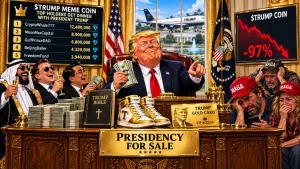
The $1.4 Billion Presidency: When the Oval Office Became a Cash Register
A 927-page financial disclosure. Nine figures in memecoin royalties. A Boeing 747 from Qatar. A prison-stock buying spree that tracked the growth of ICE detention. Every president in modern memory divested. This one is monetizing the office in real time — and the Constitution has a word for it.
On the evening of June 30, 2026, the U.S. Office of Government Ethics posted a document 927 pages long. It was President Donald J. Trump’s annual financial disclosure — a filing every president must submit. President Barack Obama’s final disclosure was eight pages. President Joseph R. Biden’s was eleven. Vice President JD Vance’s was seventeen. Trump’s was longer than most novels. Inside that document is the most extraordinary catalog of presidential self-enrichment in the history of the Republic: more than $1.4 billion in cryptocurrency earnings alone, harvested during the first year of his second term — a year in which he made cryptocurrency deregulation, by his own admission, a cornerstone of his presidency.
Read that sentence again. The President of the United States personally earned more than a billion dollars from a single industry — an industry he was simultaneously writing the rules for. In every prior generation of American governance, from Eisenhower to Obama, that sentence would have been the end of a presidency. In 2026, it is a Tuesday.
This is not a story about one bad quarter or one questionable licensing deal. It is a story about the deliberate erasure of a two-hundred-year tradition of presidential financial separation — a tradition designed not for the comfort of critics, but to prevent exactly what the founders feared most: a chief executive whose loyalty runs to his own balance sheet before it runs to the country. What follows is a documentation of what has been erased, what the Constitution requires, and what the framers of the 25th Amendment gave the country the power to do about it.
1. The Ledger: What the Disclosure Actually Says
The June 30 disclosure was released to the Office of Government Ethics and reported by both NBC News and ABC News. Its numbers are staggering not because they are large — the presidency has been held by wealthy men before — but because of where they came from and when they arrived.
The pattern here is not incidental. It is architectural. In the same year Trump was signing executive orders that liberalized U.S. cryptocurrency regulation and championing the GENIUS Act — a stablecoin bill that Senator Elizabeth Warren has noted contains “zero provisions” to prevent presidential self-dealing in the industry it regulates — he was personally taking home over a billion dollars from crypto. In the same year his administration was rapidly expanding ICE detention capacity, his investment accounts were buying up the stock of the company that would house those detainees.
A White House representative responded to the disclosure with a statement that reads, in isolation, as an act of defiance against the plain meaning of English: “Neither the President nor his family has ever engaged — or will ever engage — in conflicts of interest.”
“Certainly, I don’t think it was contemplated by the founders when they created the Emoluments Clause. We are seeing the greatest onslaught of corruption in the history of mankind in the last 18 months.”
— Ty Cobb, Former White House Special Counsel to President Trump, on CNN, June 2026
2. What Every Other President Did
The word “unprecedented” is worn thin in modern political writing. It applies here in the strict, historical sense. For more than forty years — spanning six administrations and both parties — every president who took office with more than a plain-vanilla investment portfolio placed his holdings into a blind trust before governing. This was not a legal requirement. It was a norm so strong that departing from it was not seriously considered by anyone who held the office.
The blind trust norm was not created because prior presidents were morally superior. It was created because they, and the country, understood a simple thing: a president who profits from his decisions is not making his decisions for the country. This is not a partisan observation. It is the reason the norm existed at all.
3. The Emoluments Clauses: The Constitution’s Anti-Bribery Language
The framers wrote two provisions into the Constitution specifically to prevent what is now happening. The Foreign Emoluments Clause of Article I, Section 9 forbids any federal officeholder — the president included — from accepting “any present, Emolument, Office, or Title, of any kind whatever, from any King, Prince, or foreign State” without the consent of Congress. The Domestic Emoluments Clause of Article II, Section 1 prohibits the president from accepting compensation from the federal government or any state, beyond his fixed salary.
These are not obscure procedural rules. As Citizens for Responsibility and Ethics in Washington explains, the framers drafted the Emoluments Clauses broadly precisely because they had seen how European monarchs used gifts and payments to buy influence — including, famously, King Louis XVI’s diamond-covered snuffbox to Benjamin Franklin. The clauses were the Constitution’s original anti-bribery statutes, designed to ensure that “corruption does not undermine public faith in democracy.”
In the eighteen months since Trump’s second inauguration, three episodes have raised these constitutional concerns in stark terms:
The UAE-Binance-WLF deal. In May 2025, Senators Jeff Merkley and Elizabeth Warren wrote to the Office of Government Ethics demanding an inquiry into a $2 billion transaction in which MGX — a state-backed Emirati investment firm — used World Liberty Financial’s USD1 stablecoin to invest in the crypto exchange Binance. Their letter states plainly that the arrangement “may violate the Emoluments Clause of the U.S. Constitution” and “criminal provisions barring bribery.” A stake in the transaction, they argue, flows to the Trump family.
The Qatari 747. Also in May 2025, the government of Qatar transferred a Boeing 747-8, valued at up to $400 million, for use as Air Force One — with reported plans to move the aircraft to Trump’s presidential library foundation before he leaves office. In response, Senator Jeanne Shaheen wrote that the gift “would violate the Foreign Emoluments Clause”. Senator Bernie Sanders called it “farcically corrupt” and “blatantly unconstitutional”. Senate Minority Leader Chuck Schumer called it “premium foreign influence with extra legroom.” Trump himself, asked about the gift, said: “I would never be one to turn down that kind of an offer.”
The memecoin trading. On the disclosure itself, more than $635 million in memecoin royalties — a category of income that did not exist for any prior president — flowed to Trump personally through a shell licensing group with no traceable digital footprint. Because a memecoin’s value can be moved by the actions of a small number of large purchasers, the memecoin industry gives foreign governments, wealthy individuals, and anyone else a novel vehicle to transfer money to a sitting president that could not exist in a pre-crypto age. Ty Cobb, a Republican attorney who served as Special Counsel in Trump’s first White House, told CNN he does not believe the arrangement is legal.
“In just one year in office, the President and his family have raked in at least $1.4 billion in gains from crypto deals alone, and yet this bill stunningly includes zero provisions to prevent that. The American people are watching.”
— Senator Elizabeth Warren, Ranking Member, Senate Banking Committee — May 2026 statement on crypto market structure legislation
4. The Prison Stock and the Detainees
Of all the numbers in the 927-page disclosure, none is more disturbing than the sequence of GEO Group purchases. GEO Group is a private prison company. It is one of the largest contractors with U.S. Immigration and Customs Enforcement. As Common Dreams reported, GEO Group posted a company-record $254 million profit in 2025 — a 700% increase over 2024 — driven directly by the expansion of ICE detention under the Trump administration.
The NBC News reporting on the disclosure documents that Trump’s investment accounts began buying GEO Group shares just ten days after his inauguration. As the number of immigrant detainees swelled from roughly 35,000 to nearly 70,000, the purchases accelerated — ranging from $143,000 to $445,000. The final buy is dated late November.
Set aside the constitutional analysis for a moment and consider what this sentence describes. The President of the United States, through his investment vehicles, was buying more of the company that runs ICE detention at the same time his administration was ordering more people into ICE detention. The financial vehicle and the policy vehicle were operated by the same person. In any other executive branch position, this would be a criminal violation of 18 U.S.C. § 208, the federal conflict-of-interest statute. The president is legally exempt from that statute — an exemption granted because, historically, presidents did not need it. They divested.
Get Involved Today
Contribute to our mission and turn your concerns into action.
5. The 25th Amendment Question
We arrive, finally, at the question that grows louder each week in progressive constitutional circles: does what has been documented above constitute a president who is “unable to discharge the powers and duties of his office” within the meaning of Section 4 of the Twenty-fifth Amendment?
The instinctive objection — that Section 4 was written for coma patients and stroke victims, not for corruption — turns out to rest on a misreading. As it happens, the drafters of the amendment were asked exactly this question when the language was being written in 1965, and their answer is a matter of public record.
The Framers Left “Inability” Undefined — On Purpose
Section 4 of the 25th Amendment allows the Vice President and a majority of the Cabinet — or such other body as Congress may by law provide — to transmit a written declaration that the President is “unable to discharge the powers and duties of his office.” The Vice President then immediately assumes those powers as Acting President.
The framers specifically rejected any definition of the term, prioritizing flexibility. Those implementing Section 4 should focus on whether — in an objective sense taking all of the circumstances into account — the President is “unable to discharge the powers and duties” of the office.
That is not a progressive gloss. It is the summary in the Constitutional record itself. As PBS NewsHour reported in April 2026, legal experts confirm that the drafters “used intentionally vague and open-ended language” because “they recognized they couldn’t predict every scenario in which a president could be deemed disabled.” National Affairs put it more sharply: the ambiguity “was intentional” — the drafters trusted the Vice President and Cabinet to know a disabled presidency when they saw one, and refused to write a checklist that a future president could game.
What does “unable” mean in the context of a president whose financial interests operate as an active, real-time bid mechanism for his policy attention? What does “unable to discharge the powers and duties” mean when the powers being discharged include cryptocurrency deregulation whose direct beneficiary — by hundreds of millions of dollars — is the officeholder himself? These are not rhetorical questions. They are the questions Section 4 was written to allow the political branches to answer.
The named callers. Section 4 calls have already been made against this president, on other grounds. Senator Chris Murphy of Connecticut, along with Representatives Yassamin Ansari and Melanie Stansbury, publicly urged the invocation of the 25th Amendment following the President’s April 2026 threats against Iranian civilian infrastructure. Governor JB Pritzker of Illinois, as recorded by the International Bar Association, has stated on the record that he is “concerned for his health.”
The constitutional argument. The financial disclosure adds a distinct and cumulative dimension. A president who cannot separate his private financial interests from his public duties — and who structures both so they cannot be separated — is a president who is, in the plainest reading of the amendment, unable to discharge the duties of the office as those duties are constitutionally defined. The duties do not merely include signing bills. They include, as the Foreign Emoluments Clause makes plain, executing the office without foreign entanglement. A president in structural violation of the Emoluments Clauses is not performing the duties of his office. He is performing a different job.
The barriers. The practical obstacles are large and should be named honestly. Section 4 requires Vice President JD Vance plus twelve of the twenty-three Cabinet officers. If the President contests the finding — as he certainly would — a two-thirds supermajority of both chambers of Congress is required to sustain it. Neither is remotely likely in the current Congress. Section 4 has never been invoked. It may not be invoked now.
Why the barriers do not negate the case. The Constitution does not condition the moral force of a constitutional argument on the tactical likelihood of its enforcement. The barriers describe the political situation. They do not describe the constitutional situation. The record — 927 pages of it, filed by the President’s own office — makes plain that this is a presidency the framers would recognize as the problem they wrote the Emoluments Clauses to prevent. Naming that is not a call for a coup. It is a call to remember the vocabulary the Constitution gives us for exactly this circumstance, and to use it.
6. What This Says About the Presidency
The 927-page disclosure is not primarily an ethics document. It is a portrait of what happens when a president chooses not to serve the country. Every figure in it is a choice — a choice to license, to invest, to accept, to keep. Each choice has an alternative, and the alternatives are not hypothetical. They are Jimmy Carter, losing his family peanut business rather than allow the perception of a conflict. They are Barack Obama, closing his blind trust because even the appearance of one was too much. They are John F. Kennedy, declining a foreign honor rather than test the Emoluments Clause.
A presidency is a public trust. The framers used that phrase — Office of Profit or Trust — with precision. Trust is not compatible with a $635 million royalty payment from a shell licensing group. It is not compatible with a $2 billion foreign transaction routed through a family stablecoin. It is not compatible with a prison-stock buying schedule that tracks a detention build-out. And it is not compatible with a White House statement that closes the question by asserting, against all documented evidence, that no conflict exists.
The question posed by this disclosure is not whether Donald Trump has become wealthier during his presidency. That is not in dispute. The question is whether we are still governed by the rule that a president’s private balance sheet must sit behind — and never in front of — the country’s interests. On the evidence in front of us, we are not. And a country that ceases to be governed by that rule ceases, in the meaningful sense the Constitution understood, to have a president at all.
Editorial Conclusion
A president who earns $1.4 billion from an industry he regulates, who buys prison stock as he fills the prisons, who accepts a $400 million plane from a foreign monarchy, and who routes settlements into a foundation bearing his own name, is not a president who has drifted into questionable territory. He is a president whose office has become an instrument of personal enrichment on a scale the Constitution’s authors identified, named, and forbade.
The 25th Amendment does not require this Congress to act. It requires this country to remember that it may. The framers wrote “unable” broadly because they trusted that a future generation would know what it meant when it saw it. This is what it looks like.
The stakes are not partisan. They are constitutional. A republic that sells its highest office by the coin is no longer the republic the founders left us.
Sources & References
- NBC News — Trump’s financial disclosure lists $1.4 billion in crypto earnings, powered largely by meme coins
- ABC News — Trump earned over $1.4 billion from crypto ventures in 2025, financial disclosure shows
- U.S. Senate Banking Committee — Warren Statement on No Trump Ethics Provision in Crypto Bill
- Senator Jeff Merkley — Merkley, Warren: Trump-Linked Crypto Deal Is a ‘Staggering’ Conflict of Interest
- U.S. Senate Banking Committee — Warren Statement on OCC Review of World Liberty Financial Bank Charter
- Yahoo Finance / CCN — Trump’s $1.4B Crypto Slammed as ‘Onslaught of Corruption’ by Ex-Lawyer Ty Cobb
- Snopes — Did Carter Sell His Peanut Farm When He Became President?
- CNBC — When Jimmy Carter Left Office, His Peanut Business Was $1 Million in Debt
- Washington Post — Donald Trump Won’t Do What Ronald Reagan, George H.W. Bush, Bill Clinton and George W. Bush Did
- Forbes — Why Trump Won’t Use a Blind Trust and What His Predecessors Did
- CREW — The Intensifying Threat of Donald Trump’s Emoluments
- Constitutional Accountability Center — Blumenthal, et al. v. Trump — Foreign Emoluments Clause
- PBS NewsHour — Could the 25th Amendment Be Invoked Against Trump? Here’s How It Works
- National Affairs — The Limits of the 25th Amendment
- PolitiFact — Following Trump’s Iran Post, Could the 25th Amendment Be Invoked?
- NPR — Ethics Experts Worry About Trump Accepting Qatar’s Luxury Plane
- Congress.gov — S. Res. 244 — Foreign Emoluments Clause & Qatar Plane
- U.S. Senate Foreign Relations — Ranking Member Shaheen Blasts Qatari Airplane Gift to Trump
- Common Dreams — Private Prison Firm GEO Group Reports Record $254 Million Profit
- American Prospect — Private Prisons Cash In on Trump’s Mass Deportations
- Constitution Center — 25th Amendment — Presidential Disability and Succession (Full Text)
Related News