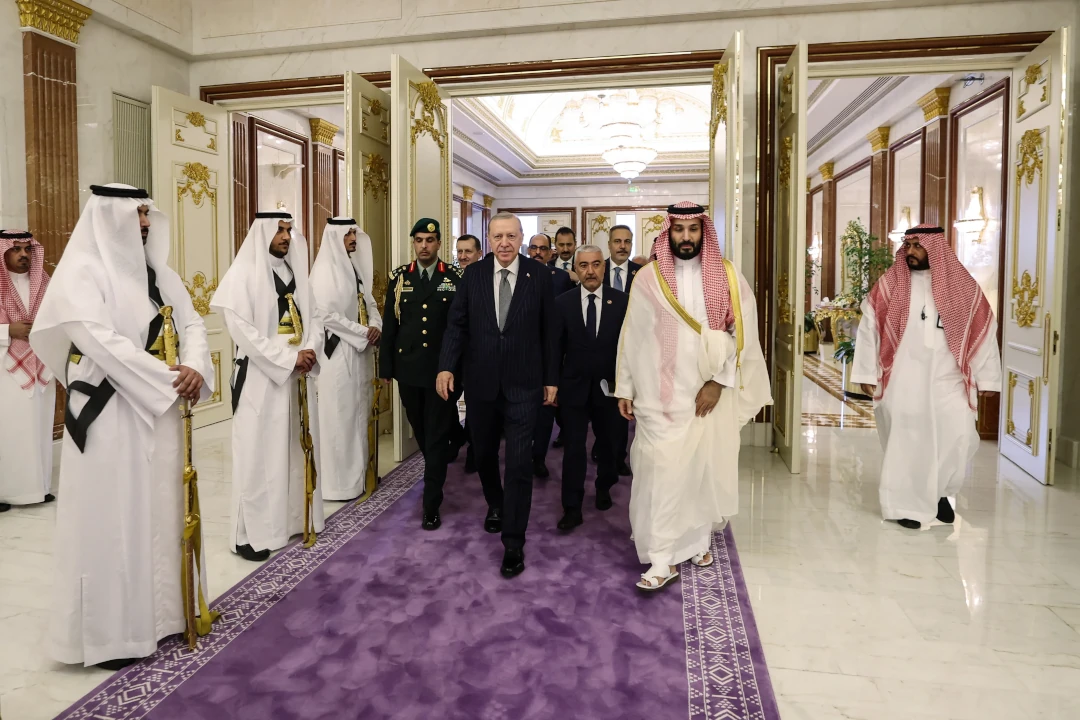
Saudi Arabia's Crown Prince Mohammed bin Salman walks alongside Turkish President Recep Tayyip Erdogan during their meeting in Mecca on August 7 [Handout via AFP]
Locked Out of Mecca: How a New Muslim NATO Rose While Trump Watched
On Friday, a Turkish president, a Saudi crown prince, and a Pakistani prime minister — one of them commanding a nuclear arsenal — signed a mutual-defense pact in Islam’s holiest city. The United States was not consulted. It was not warned. And it has never looked more irrelevant.
The photograph tells you almost everything you need to know. Turkish President Recep Tayyip Erdoğan, Saudi Crown Prince Mohammed bin Salman, and Pakistani Prime Minister Shehbaz Sharif, side by side in ornate Saudi robes and business suits, walking a purple carpet in Mecca. Behind them: their foreign and defense ministers. In front of them: a pen, a table, and a document that redraws the security architecture of the Muslim world. What is not in the photograph, and what is the point of the photograph, is any American. There is no U.S. envoy in the frame. There is no notification cable that went to the State Department beforehand. There is only a message, delivered from the holiest city in Islam to a president in Washington whose entire foreign policy has been built on the assumption that the Gulf could not live without him.
The document they signed is called the Makkah Joint Defense Agreement. Its operative clause states that “an armed attack against any of the three would be regarded as an attack against them all” — language deliberately, unmistakably lifted from Article 5 of the North Atlantic Treaty. It welds together the world’s second-largest NATO military (Türkiye), the world’s largest oil exporter (Saudi Arabia), and the only Muslim-majority state with nuclear weapons (Pakistan). It is, as Al Jazeera’s Osama Bin Javaid put it from Doha, the beginning of a “different security architecture” in the region — one that does not run through Washington.
How did we get here? How did a Republican administration that came to office promising to be the strongest friend the Gulf ever had preside, in six months, over the single greatest realignment against American influence in the Middle East since the fall of the Shah? The answer is not complicated. It is written across every headline of 2026. And it points, inescapably, at the man in the Oval Office.
I. What Was Signed in Mecca
The Makkah Joint Defense Agreement did not appear out of nowhere. It is the capstone of a year of quiet diplomacy that began, tellingly, without American involvement. In September 2025, days after Israeli warplanes struck Hamas negotiators inside Doha — a strike Gulf leaders viewed as a stunning breach of the security guarantees they believed Washington was underwriting — Crown Prince Mohammed bin Salman flew to Riyadh and signed a bilateral Strategic Mutual Defence Agreement with Pakistan. The Saudis, according to reporting in TIME, did not inform their American partners until the deal was inked.
Friday’s trilateral is that same deal, on steroids. Türkiye — a NATO member — has now formally bound itself to the defense of two non-NATO states. Pakistani officials have been openly reminding Iran of the pact’s terms since March. The Saudi statement insisted the arrangement “does not represent any orientation toward building a military axis,” but every serious analyst has read the signal. Foreign Policy magazine called it a “Sunni NATO.” The Atlantic Council labeled it “an inflection point in the emerging multipolar order.” Even the hawkish Foundation for Defense of Democracies conceded, through senior fellow Jonathan Ruhe, that “the Trump administration certainly should have done better coalition-building before the Iran war.”
That last sentence deserves to be read twice. It comes not from MSNBC, not from a Democratic senator, not from this editorial board — but from a defense hawk at an institution that has spent two decades arguing for tougher American posture against Tehran. And even he can see what the president cannot: the coalition America needed was allowed to walk away, and it walked toward Mecca.
The Signatories
Türkiye brings NATO’s second-largest military and a large defense-industrial base. Saudi Arabia brings the wealth of the world’s largest oil exporter. Pakistan brings roughly 170 nuclear warheads.
The Trigger
Negotiations accelerated after Israel’s September 2025 airstrike on Doha, Qatar — the first Israeli attack on a Gulf country — which Arab leaders viewed as an unpunished violation of American security guarantees.
The Notification
Per multiple published accounts, the Saudi–Pakistan bilateral was not disclosed to the United States until after signing. The Mecca trilateral followed months of quiet talks Washington did not lead.
II. A War of Choice, and Its Bill
To understand why the Gulf is now insuring itself against American failure, you have to remember what American failure looks like. On February 28, 2026, President Donald Trump joined Prime Minister Benjamin Netanyahu in launching Operation Epic Fury — a joint U.S.–Israeli air campaign against Iran that killed Supreme Leader Ali Khamenei and struck Iranian nuclear and military infrastructure. Within seventy-two hours, Iranian missiles and drones were falling on U.S. bases and Saudi oil facilities. Within a week, the Strait of Hormuz — the narrow channel through which roughly a fifth of the world’s oil moves — was effectively closed.
The president promised a swift, decisive victory. What Americans got was six months of grinding escalation, threats issued and withdrawn on Truth Social, deadlines set and extended, and a June memorandum of understanding that the president himself has since declared functionally broken. As Britannica now records, “Iran sought to assert hegemonic control over the strait and eventually collect fees on ships passing through” — charging tolls of over $1 million per vessel. The waterway that Trump inherited as a free-transit artery of the global economy is, today, effectively an Iranian tollbooth. And this president, who campaigned on projecting American strength, has been unable to force it back open.
“No President in control of his senses would publicly promise to eradicate an entire civilization.”
— Sen. Chris Murphy (D-Conn.), April 7, 2026
The senator was responding to a Truth Social post in which the president wrote that “a whole civilization will die tonight, never to be brought back again” — a statement so extreme that it drew calls for the 25th Amendment not only from Democrats like Sen. Ed Markey, Rep. Ro Khanna, and Rep. Ilhan Omar, but from figures on the president’s own political flank. As CNN reported, former congresswoman Marjorie Taylor Greene, Trump’s onetime ally, posted “25TH AMENDMENT!!!” within an hour, calling the statement “evil and madness.” Anthony Scaramucci, once his White House communications director, joined the call. So did podcaster Candace Owens.
When Marjorie Taylor Greene and Chris Murphy agree that a sitting president has crossed a line, something has happened to the presidency itself. That something is what our Gulf allies have been watching. And it is why they signed a treaty in Mecca that does not have America’s name on it.
III. The Nuclear Question Nobody Wanted to Ask
Here is what makes the Mecca pact different from every previous regional arrangement: it welds together states with active, unresolved conflicts against parties the United States relies on. Turkey has spent the last twenty months waging a slow, grinding campaign against the Kurdish-led Syrian Democratic Forces — America’s principal partners in the fight against ISIS. Turkish-backed forces seized Manbij in December 2024; Turkish-aligned Damascus forces launched a major offensive across northeastern Syria in January 2026, forcing SDF fighters west of the Euphrates. American Kurdish partners have been abandoned, and the state that abandoned them is now bound by treaty to Saudi Arabia and nuclear-armed Pakistan.
Pakistan, meanwhile, entered a shooting war with India in the spring of 2025 — a conflict between two nuclear powers that came closer to catastrophe than most Americans understood at the time. India’s Ministry of External Affairs, upon learning of the Saudi–Pakistan bilateral, announced it would “study the implications” for its national security. Translation: New Delhi is now recalculating its own nuclear posture in light of the fact that any Indian action against Pakistan can, in principle, be treated as an act of war against Saudi Arabia — and now Türkiye. This is not deterrence. This is a chain of trip wires laid across the world’s most dangerous fault lines.
Get Involved Today
Contribute to our mission and turn your concerns into action.
IV. The Strait, the Pump, the Grocery Bill
For the American whose paycheck disappears into groceries and gasoline every month, the Mecca pact may sound abstract. It is not. The line runs from Riyadh directly to the pump in Beacon, in Bakersfield, in Bay City. When the Strait of Hormuz closed in March, the national average price of gasoline crossed $4 a gallon. West Texas Intermediate crude hit $118 a barrel. According to the Centre for Economic Policy Research, the war is expected to add 0.6 percentage points to U.S. headline inflation in 2026 — an invisible tax on every American household to pay for a war their president chose to start and cannot end.
Even now, six months after the strikes, the pain is not gone. PBS reports that higher prices for gas, groceries, and flights will outlast the war itself. Shipping, footwear, fertilizer, and food supply chains that ran through the Strait remain disrupted. CNBC reported in late July that “from President Donald Trump’s perspective, having kicked off a return to direct conflict with Iran, there is now little he can do to shield Americans from the economic fallout.”
This is what a failed foreign policy actually feels like at the kitchen table. It feels like a family in the Hudson Valley deciding not to drive to see relatives this month because the tank costs eighty dollars to fill. It feels like a working parent moving cheaper cuts of meat and store-brand cereal into the cart. It feels like a country paying, again and again, for the vanity of a president who promised swift victory and delivered a permanent tollbooth in the Persian Gulf.
“These three countries have almost zero shared ability or interest to meaningfully contain Iran. The Trump administration certainly should have done better coalition-building before the Iran war.”
— Jonathan Ruhe, Foundation for Defense of Democracies
V. The Israel Problem, and the Trap It Sets
Any honest accounting of the Mecca pact must also reckon with Israel — because the Netanyahu government’s expansive campaign since October 7, 2023, has stretched from Gaza to Lebanon to Syria to Qatar to Iran, and every one of those strikes has narrowed the political room for Gulf leaders to be seen aligning with Washington. The Doha strike in September 2025 was the breaking point. The Wikipedia record of the Saudi-Pakistan bilateral notes that “the spillover of Israel’s war in Gaza in the wider Middle East is widely seen as a defining factor” in the pact. Erdoğan has spent the last two years denouncing Israeli conduct in the strongest possible terms. Even the Saudis, longtime quiet interlocutors of Israel, have concluded that hedging is now safer than alignment.
The trap for the United States is that the Trump administration has yoked American power to Israeli decision-making more tightly than any prior administration. The president has repeatedly said he would let Netanyahu “finish the job.” He struck Iran on Israel’s timetable. He has offered no meaningful public pressure to constrain Israeli operations, whether in Gaza, in Lebanon, or in the Gulf. The result is that when Israel escalates, America is now assumed — by adversary and ally alike — to be in the room. And when the region wants insurance against Israel, it is now insuring itself against America too. This is the strategic price of subcontracting your Middle East policy to a foreign prime minister who is on trial in his own country. The bill has come due in Mecca.
The 25th Amendment Exists Precisely Because the Framers Feared This
Section 4 of the Twenty-Fifth Amendment, ratified in 1967 in the wake of the Kennedy assassination, permits the Vice President and a majority of the Cabinet — or a body designated by Congress — to declare in writing that a president “is unable to discharge the powers and duties of his office.” Upon such a declaration, the Vice President immediately assumes those powers as Acting President. The mechanism was designed for physical incapacity, but its language is deliberately broader: unable to discharge. The Framers of the amendment understood that unfitness can take many forms.
The Calls Already on the Record
More than 85 members of Congress publicly urged either impeachment or invocation of the 25th Amendment following the president’s April 7 “civilization will die” post. Sen. Chris Murphy, Sen. Ed Markey, Rep. Ro Khanna, Rep. Ilhan Omar, Rep. Raja Krishnamoorthi, and Rep. Mike Quigley issued formal statements. Rep. Jamie Raskin’s office subsequently unveiled legislation to establish a congressional commission to assess presidential capacity — the body the amendment itself contemplates. Illinois Gov. J.B. Pritzker joined the call. So did figures on the right, from Marjorie Taylor Greene to Anthony Scaramucci. This is not a partisan margin. It is a bipartisan warning.
The Constitutional Argument
The case is not that this president holds policies with which the editorial board disagrees. The case is narrower and graver: a chief executive who publicly threatens the extinction of an entire civilization on social media, who sets and abandons wartime deadlines by tweet, who admits — as the president did to Norway’s prime minister in January — that his Greenland policy is retaliation for a Nobel Peace Prize he did not win, and who has now allowed the most consequential regional realignment against American power in a generation to occur without American participation, is a president unable to discharge the duties of the office as the Constitution understands them. Executive judgment is not a preference. It is a job requirement.
The Practical Barriers, Honestly Stated
We will not pretend the path is easy. Section 4 requires Vice President JD Vance and a majority of a Cabinet the president himself selected to declare him unfit. That is politically almost inconceivable in the short term. Congress could designate an alternative body, but Republicans control both chambers, and the president would veto any such statute. Impeachment faces the same math. These are real, structural barriers, and they are the reason removal has never been accomplished by this route.
Why the Argument Still Must Be Made
Constitutional mechanisms do not lose their moral force because they are politically inconvenient to invoke. The 25th Amendment exists in the Constitution not merely to be used, but to be visible — to establish, in black and white, that even the highest office in the land is bounded by capacity and duty. Every senator, every representative, every Cabinet secretary who has taken the oath is on notice. History will record who saw what was happening. And history is watching in Mecca right now.
VII. What This Says About Priorities
Every president reveals himself in the space between what he promised and what he delivers. This president promised strength; he has delivered a Gulf that no longer trusts him. He promised low prices; he has delivered $4 gasoline and a permanent premium on the American family budget. He promised deals; he has delivered a war whose ceasefire he has already declared broken. He promised America First; he has delivered a Muslim collective defense pact whose founding document was drafted in a language other than English, in a room from which the United States was excluded.
The priorities are visible in the outcomes. What the Middle East watched, over these last eighteen months, was an American president who cared more about being seen alongside Netanyahu than about the coalition Ruhe of the FDD says he should have built. Who cared more about threatening total destruction than about producing durable arrangements. Who cared, above all, about the projection of himself — and who mistook that for the projection of American power.
The Mecca signatories were not fooled. They have made their arrangements. The question now is whether the American constitutional system — the Cabinet, the Congress, the courts, the voters — will make theirs.
Editorial Conclusion
The Makkah Joint Defense Agreement is not just a foreign policy story. It is a verdict, delivered by three sovereign governments, on the fitness of the American presidency to keep its word.
The Gulf did not abandon Washington. Washington abandoned the Gulf, and the Gulf drew the necessary conclusion. Every gallon of gasoline that costs an American family a dollar more is a bill for that abandonment. Every future war between nuclear powers that this pact makes more likely is a bill for it too.
The Constitution provides a mechanism for a presidency that cannot discharge its duties. That mechanism may not succeed. But the record must show it was demanded — clearly, on the record, by name — and demanded now. Not because the politics are ripe, but because the office is not being executed. The Republic is older than any presidency. It will outlast this one. What is requiris that its guardians act like they know it.
Sources & References
- Al JazeeraTurkiye, Saudi Arabia, Pakistan sign joint defence agreement: What’s in it?
- Al JazeeraSaudi Arabia, Pakistan and Turkiye sign defence deal amid regional turmoil
- CBS NewsSaudi Arabia, Turkey and Pakistan sign key defense agreement
- The Washington PostSaudi Arabia, Turkey, and Pakistan have signed a defense agreement
- Foreign PolicyPakistan, Saudi Arabia, Turkey Sign a Mutual Defense Pact
- Atlantic CouncilWhy Saudi Arabia, Pakistan, and Turkey just signed a defense pact
- Jewish InsiderNew defense pact concerns U.S. national security experts
- TIMEThe Saudis Are Sending Trump a Warning
- CFR Global Conflict TrackerIran’s War With Israel and the United States
- Britannica2026 Iran War
- NBC NewsDozens of Democrats call for Trump’s removal after Iran threats
- CNN25th Amendment: Democrats and right-wing voices call for removal
- AxiosHouse Democrats file 25th Amendment bill targeting Trump
- TIMECan the 25th Amendment Be Used to Remove Trump From Office?
- USA TodayGas prices reach highest point in years amid Iran war
- CNBCIran war energy shock hits the U.S. economy
- PBS NewsHourHigher prices for gas, groceries and flights will outlast Iran war
- CEPRQuantifying the impact of the Iran war on U.S. inflation
Related News