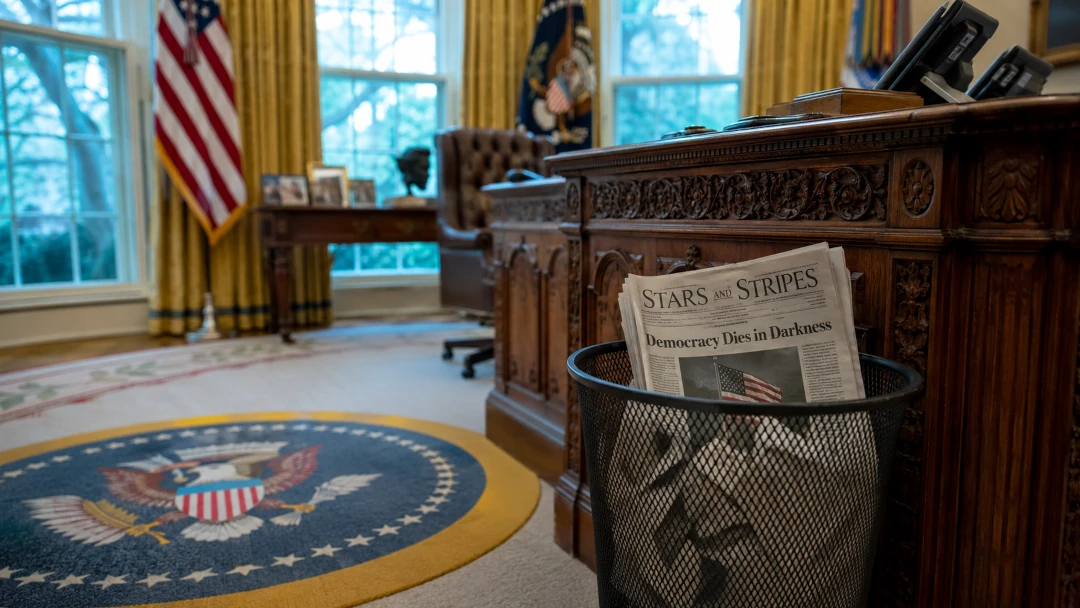
Silencing the Sentinels: The Pentagon’s War on the Troops’ Own Newspaper
The Trump administration fired the editor, publisher, and top Middle East reporter of Stars and Stripes for defending the paper’s 165-year tradition of editorial independence. What Pete Hegseth is trying to hide — and what the firings reveal about a commander in chief unraveling in real time.
On the evening of Friday, August 21, three separation notices went out from the Pentagon to the leadership of a newspaper that has served American troops in every major conflict since the Civil War. Erik Slavin, the editor-in-chief of Stars and Stripes, was fired. Max Lederer Jr., its publisher of more than three decades, was fired. Lara Korte, the paper’s Middle East reporter — who had spent months documenting a mental-health crisis aboard the USS Abraham Lincoln — was fired. The stated reason, according to the Pentagon, was “insubordination.” The actual reason is now impossible to disguise: they refused to say they would submit to censorship.
The offense, as Slavin himself described it to CNN, was appearing on a “CBS Sunday Morning” segment and stating that any effort to censor the news that reaches American service members would be a personal “red line.” He did not disobey an order. He did not refuse a directive. He simply affirmed, on camera, the exact principle that federal law and Defense Department regulations already require Stars and Stripes to uphold. For that, he was terminated.
What is unfolding at Stars and Stripes is not a personnel dispute. It is the culmination of a systematic, months-long effort by Defense Secretary Pete Hegseth to convert a congressionally protected news organization into a propaganda arm of a Pentagon that has something urgent to hide — a botched war with Iran, a Navy in crisis, an eroding force, and a president whose behavior has produced formal calls in Congress to invoke the 25th Amendment. This editorial is about what connects those things.
I. The Firings — and What Preceded Them
The Pentagon’s war on Stars and Stripes did not begin last Friday. It began in January, when Pentagon spokesman Sean Parnell announced the department would be “returning Stars & Stripes to its original mission” and stripping out what he dismissed as “woke distractions.” In March, a sweeping “modernization” memo barred the paper from carrying Associated Press wire copy and required that all content conform to a standard borrowed from military justice — “good order and discipline.” In April, the Pentagon fired Jacqueline Smith, the paper’s ombudsman, whose job — created by Congress — was specifically to protect editorial independence from political interference. In June, two members of the paper’s advisory board sued the government, calling the modernization memo “illegal censorship.”
Then, in mid-August, the Pentagon installed Navy Capt. William Urban — an active-duty public-affairs officer with more than two decades of communications work for the Defense Department — as deputy to the publisher, reportedly without consultation. Lederer announced his retirement days later, telling staff he had come to disagree in “fundamental ways” with the direction of Pentagon leadership. Then the firings came.
II. What They Weren’t Allowed to Cover
The context around Korte’s dismissal is impossible to ignore. Stars and Stripes had produced, over the summer, some of the most consequential military reporting of the Trump administration’s second term: a series of stories on the USS Abraham Lincoln, an aircraft carrier that has spent more than 250 consecutive days at sea, roughly 40 of them in sustained combat operations off Iran. The paper documented interviews with active-duty sailors and family members describing exhaustion, declining morale, suicidal ideation, and at least one instance in which a crew member was prevented from jumping overboard.
In one particularly devastating report, a spouse tearfully told Acting Navy Secretary Hung Cao during a town hall that she had received a message from her husband that same day saying “he hopes he doesn’t wake up tomorrow.” That was published in Stars and Stripes. On August 3, a sailor did in fact go overboard from the Lincoln in what U.S. officials confirmed to CNN was a mental-health episode. The Navy publicly denied any increase in suicidal ideation aboard the ship; Stars and Stripes and Navy Times reported the accounts of families who said otherwise.
“I am working for Stars and Stripes. Not for the Pentagon. Not for any administration. Not for any policymaker.”
— Lara Korte, fired Stars and Stripes Middle East reporter, CBS “Sunday Morning”
The Trump administration dismissed the reporting as “dishonest” and “overblown.” U.S. Central Command, according to Responsible Statecraft, placed a graphic on official channels declaring that “multiple media outlets have reported several false claims” about the Lincoln. Now the reporter who covered it has been fired.
What was being covered up is not complicated. It is the human cost of a war the administration insists is a triumph.
III. Hegseth’s Iran Failure
To understand why the Pentagon needed the reporter silenced, one has to understand what the Pentagon does not want the American public to see. Pete Hegseth entered the Defense Department in January 2025 promising, in his own words, warfighting, lethality, and readiness. Eighteen months later, by the assessment of members of Congress from both parties, he has delivered none of them.
At a July 22 Senate Appropriations hearing, Defense Secretary Hegseth was forced to disclose that the Iran war has now cost at least $37.5 billion — up from a $25 billion estimate given in April, and, according to NBC News reporting, still likely undercounted. The Pentagon has asked Congress to redirect north of $4 billion from troop training and critical weapons purchases to cover Iran-war operational costs, a move that even sympathetic conservative defense analysts have described as raiding readiness to pay for a war that was supposed to be brief. Sen. Gary Peters (D-Mich.), during that hearing, delivered one of the sharpest rebukes of a sitting defense secretary in recent memory:
“You, sir, are the failure. Not the men and women who are on that front line.”
— Sen. Gary Peters (D-Mich.), to Defense Secretary Pete Hegseth, July 22, 2026
Hegseth called the characterization “reckless.” The record does not. Two weeks after that hearing, The Washington Post reported that President Trump himself had erupted at Hegseth during a Camp David summit, demanding answers on why he had apparently been misled about “extreme munitions shortages” that now threaten to limit U.S. military options against Iran. The Strait of Hormuz, closed since the beginning of the war, remains closed. Global energy prices remain elevated. American service members remain in harm’s way. Hegseth has, since the outset of the conflict, refused to hold a Pentagon briefing on the war for stretches of months at a time, and has purged nearly the entire professional press corps from the building.
Even the conservative journal Foreign Policy, in a July analysis titled “How ‘On the Psychology of Military Incompetence’ Predicted Hegseth’s Iran Debacle,” located Hegseth within a long tradition of failed commanders whose defining traits were an inability to tolerate criticism and a habit of picking subordinates for loyalty rather than competence. That is not a partisan indictment. That is a mainstream military-affairs assessment.
IV. The Toll on Troops, Readiness, and National Security
Every one of these failures has a downstream cost, and it is paid by the troops. When the Pentagon diverts billions from training to cover the operational overrun of a war the president said would be short and decisive, units go into the field less prepared. When aircraft carriers are held on station for 250-plus days because there is no coherent exit strategy, sailors reach the breaking point that a spouse described in that Navy town hall in San Diego. When the press is banished from most of the Pentagon and the paper that speaks directly to service members is muzzled, families lose the mechanism through which their concerns become public — and therefore actionable.
Mick Mulroy, a former Defense Department official and senior fellow at the Harvard Kennedy School’s Belfer Center, warned last fall that Hegseth’s press restrictions would degrade the public’s ability to understand what its military is doing and why. Mark Thompson of the Project On Government Oversight, a decades-long chronicler of Pentagon dysfunction, put it more bluntly: the restrictions are “an abuse of power” designed to give the American public a “sanitized view” of what is being done in its name. When the sanitized view breaks — when a sailor goes over the side of a carrier and the paper of the American military tries to explain why — the response of this Pentagon is to fire the paper.
The national-security consequences are not theoretical. As the Hill’s editorial page argued in July, Hegseth’s mismanagement has produced a Pentagon that is “almost broke” after wasting billions on the Iran quagmire, with morale collapsing among rank-and-file troops, senior officers, and civilian workers alike. The department’s chief response, notoriously, has been to focus on testosterone testing, beard grooming, and Hegseth’s own social-media fitness content. Adversaries are watching. So are allies.
Get Involved Today
Contribute to our mission and turn your concerns into action.
V. What Congress Is Doing — and What It Isn’t
Within hours of the firings, Sens. Richard Blumenthal (D-Conn.), Elizabeth Warren (D-Mass.), and Jeanne Shaheen (D-N.H.) — senior members of the Senate Armed Services Committee — demanded answers from Hegseth on the placement of an active-duty public-affairs officer atop the Stars and Stripes chain of command. Blumenthal, speaking to NOTUS, described the firings as “political interference and intimidation” and pledged to press for a Senate Armed Services Committee hearing.
The First Amendment picture is stark. Will Creeley, legal director of the Foundation for Individual Rights and Expression (FIRE), told Newsweek that Stars and Stripes has been governed by First Amendment principles under congressional mandate since 1991. The Pentagon does not have the authority to make it a house organ. A federal judge has already ruled — in a permanent injunction — that Hegseth’s broader press access restrictions violated the First and Fifth Amendments. The Pentagon has responded not by complying but by inventing new workarounds, most recently shuttering the historic Correspondents’ Corridor inside the building itself.
What Congress has not yet done is exercise the constitutional oversight authority its own institutions require. With Republican majorities in both chambers and party discipline holding, subpoenas are not being issued, hearings are not being scheduled, and appropriations riders that could protect Stars and Stripes’ independence have not been advanced. This is where the deeper constitutional question begins.
The 25th Amendment Case No Congress Wants to Make
The mechanism. Section 4 of the 25th Amendment permits the Vice President and a majority of Cabinet officers — or an alternative “body” that Congress may designate by statute — to declare that the President is “unable to discharge the powers and duties of his office,” at which point the Vice President immediately becomes Acting President. If the President contests the declaration, Congress must decide the matter by a two-thirds vote in each chamber within a defined window.
Who is calling for it. On April 14, 2026, House Judiciary ranking member Rep. Jamie Raskin (D-Md.), joined by 50 co-sponsors, formally introduced legislation to create the alternative “body” the amendment contemplates — a 17-member bipartisan commission of physicians and former high-ranking officials empowered to conduct a medical examination of the President. On April 30, Sens. Sheldon Whitehouse and Jack Reed (D-R.I.) entered into the Congressional Record a statement by 36 physicians — neurologists, psychiatrists, and cognitive-disorder specialists from Harvard, Tufts, Columbia, and George Washington University — warning of the President’s “rapidly worsening, reality-untethered, increasingly dangerous decline” and calling for his removal “with the greatest urgency.”
The constitutional argument grounded in Stars and Stripes. The Framers understood that a commander in chief unable to distinguish between honest information and flattery is a commander in chief unable to discharge the duties of the office. The 25th Amendment was drafted, and later ratified, precisely because prior generations recognized that the presidency contains no safety mechanism if the person occupying it cannot receive bad news, tolerate honest reporting, or process contradiction. A president who orders the firing of an editor for refusing to promise censorship — while the same administration diverts billions from training to cover a war it cannot end — is exhibiting the exact category of impairment the amendment was written to address. This is not about political disagreement. It is about a documented pattern of retaliatory conduct against those who would deliver unwelcome facts.
The Barriers — Honestly Named
Section 4 requires either a mutinous Vice President and Cabinet — which will not happen while J.D. Vance and Trump appointees serve at the President’s pleasure — or a two-thirds override in a Republican-controlled Congress that has demonstrated no appetite for it. The Raskin commission bill will not become law over a Trump veto. As the Brennan Center noted years ago, the amendment functions only in cases of near-unanimity about the President’s condition.
Why the Barriers Do Not Negate the Case
The purpose of naming the 25th Amendment case is not to predict its success. It is to place on the record what an honest constitutional analysis of this Presidency requires. The 36 physicians who signed the Whitehouse-Reed statement did not do so believing a Republican Senate would act. They did so because history will ask whether anyone said, when it mattered, that the emperor was not merely wearing no clothes but had stopped being able to hear the people describing his condition. The firings at Stars and Stripes are the latest, and among the clearest, exhibits in that record.
VI. What This Does to Recruiting and Retention
Hegseth has spent much of 2026 boasting about recruiting numbers — a “30-year record,” he told the House Armed Services Committee in April, that he attributed to renewed patriotism under the Trump administration. Those numbers are real. The story he tells about them is not.
ABC News reporting from August, based on interviews with recruiters and defense analysts, established that the recruiting rebound predated the 2024 election — every service met its FY2024 goals more than a month before Election Day. The historically strongest predictor of a recruiting boom, as recruiting officers have said in on-the-record interviews, is a weak civilian economy. That is what is happening now. Hegseth’s claim of a partisan mandate is a narrative laid over data with a different cause.
More important is what military-affairs experts warn is coming. When culture-war rhetoric is folded into recruitment; when standards are used as a political proxy rather than a professional one; when the press that documents service-member welfare is fired for doing so — the pipeline that produces a diverse, capable, and stable all-volunteer force begins to contract. Retention, not accession, is the metric that will break first. Sailors on 250-day deployments who cannot get honest reporting about their own service, and who watch their leaders punish the journalists who tried, do not re-enlist at the rates the Pentagon projects. Neither do their spouses agree to another tour.
Defense-community publications sympathetic to the administration have quietly noted the same concern. A growing question, one former Air Force official told ABC News, is whether Hegseth’s partisan rhetoric is beginning to shrink the military’s appeal beyond the Beltway. The USS Lincoln coverage was, in effect, an early stress test of that question. The Pentagon’s response — fire the reporter — is its own answer.
VII. What This Says About Trump’s Priorities
Stand back from the individual episodes and a pattern becomes visible. The President who tried, in his first term, to shut down Stars and Stripes entirely — and was talked out of it — has, in his second term, delegated the task to a Defense Secretary whose principal qualification was cable television. The administration’s response to reporting on sailor mental health was to attack the reporting. Its response to congressional questioning on the Iran war was to accuse the questioner of smearing the troops. Its response to a federal court ruling against its press restrictions was to invent new ones. Its response to physicians raising concerns about the President’s cognition was silence and mockery.
This is not the profile of a Presidency that is confident in its record. It is the profile of a Presidency that has understood, correctly, that its record cannot survive independent scrutiny — and has therefore made the elimination of independent scrutiny the operational priority of the executive branch. The firings at Stars and Stripes are the tell.
Editorial Conclusion
The freedom of American service members to read honest reporting about their own service is not a courtesy the Pentagon extends. It is a right Congress codified in 1991 and the First Amendment guaranteed in 1791. When a Defense Secretary fires the editor of the troops’ own newspaper for refusing to promise censorship, the question is no longer whether this administration respects the Constitution. It is whether the Congress sworn to defend it will act.
Erik Slavin, Max Lederer, and Lara Korte defended the paper. The Framers wrote the rest. What remains is for the rest of us — voters, veterans, service families, and the lawmakers who represent them — to make it cost something when a President tries to blind his own troops. Stars and Stripes has covered every American war since 1861. It has never before been the story. That it is now is not the paper’s failure. It is the country’s warning.
Sources & References
- Washington Post · Pentagon fires Stars and Stripes leaders who criticized DOD’s interference (Aug. 21, 2026)
- NBC News / AP · Pentagon dismisses Stars and Stripes leadership after editor, reporter oppose military interference
- CNN Business · Pentagon fires Stars and Stripes leaders amid Hegseth pressure campaign
- Al Jazeera · Editor of US newspaper Stars and Stripes reportedly fired under Trump
- Salon · Hegseth fires Stars and Stripes journalists, deepens Pentagon press crackdown
- Common Dreams · “Ugly, Un-American Attack on Our Free Press”: Stars & Stripes journalists fired
- NOTUS · Pentagon purges leaders at military newspaper Stars & Stripes
- Sen. Blumenthal (D-CT) · Blumenthal, Warren, and Shaheen demand answers from Hegseth
- Newsweek · Pentagon firing “Stars and Stripes” newspaper editor raises First Amendment question
- Editor & Publisher · Stars and Stripes remains under fire from Pentagon
- Stars and Stripes · USS Abraham Lincoln families press Navy leaders over sailors’ mental health
- CNN · Sailor went overboard from the USS Abraham Lincoln as conditions prompt lawmakers’ demand for answers
- Responsible Statecraft · Officials say “America-hating” media to blame for USS Lincoln outrage
- NBC News · Pete Hegseth puts Iran war estimate at $37.5 billion as Pentagon seeks more money
- PBS NewsHour · “You, sir, are the failure,” Sen. Peters tells Hegseth over Iran war
- Washington Post · Trump, Hegseth clashed at Camp David over Iran missile depletion concerns
- The Hill · Pete Hegseth is a dangerous failure
- Foreign Policy · How “On the Psychology of Military Incompetence” predicted Hegseth’s Iran debacle
- Mediaite · House Democrats file bill to form 25th Amendment commission to assess Trump’s mental fitness
- The Hill (Opinion) · Concerns grow over Trump’s mental fitness for presidency
- POGO · Pentagon press restrictions — experts weigh in
- TIME · Pentagon accused of “intimidation” with new restrictions for journalists
- ABC News · New recruits are joining the military in big numbers, but not for the reason Hegseth says
Related News