Eagle Claw II: A Ground Invasion on Standby and a War Timed to the Ballot Box
The Pentagon has drawn up plans to send thousands of American troops into Iran to dig out buried uranium, a mission its own commanders rate at extreme risk. Meanwhile, the president turns down a ceasefire, tells aides the bombs can wait until after November 3, and ignores a Congress that has told him to stop.
In April 1980, eight American servicemen died in the Iranian desert at a place called Desert One. The rescue mission they were part of, Operation Eagle Claw, never reached Tehran. It became the defining image of an overreaching plan meeting unforgiving terrain. Forty-six years later, the Pentagon has built a plan that commentators across the spectrum keep comparing to that disaster. This one would send far more troops, far deeper into Iran, to do something no military has ever tried in wartime: recover roughly half a ton of near-weapons-grade uranium from sealed and mined tunnels under a mountain.
A note on the name: “Operation Eagle Claw 2” is not an official Pentagon codename. It is shorthand critics and commentators use for the reported plan, because of its obvious parallels to the 1980 raid. No official name for the mission has been publicly confirmed.
The plan is real. It has been briefed to the president, rehearsed by elite units, and paused at least once when the risks became too plain to ignore. It has never been taken off the table. It now sits alongside a second, more immediate danger. According to reporting first published by the Wall Street Journal, President Trump has rejected Iran’s latest ceasefire offer and told aides he expects to resume bombing after the November midterm elections.
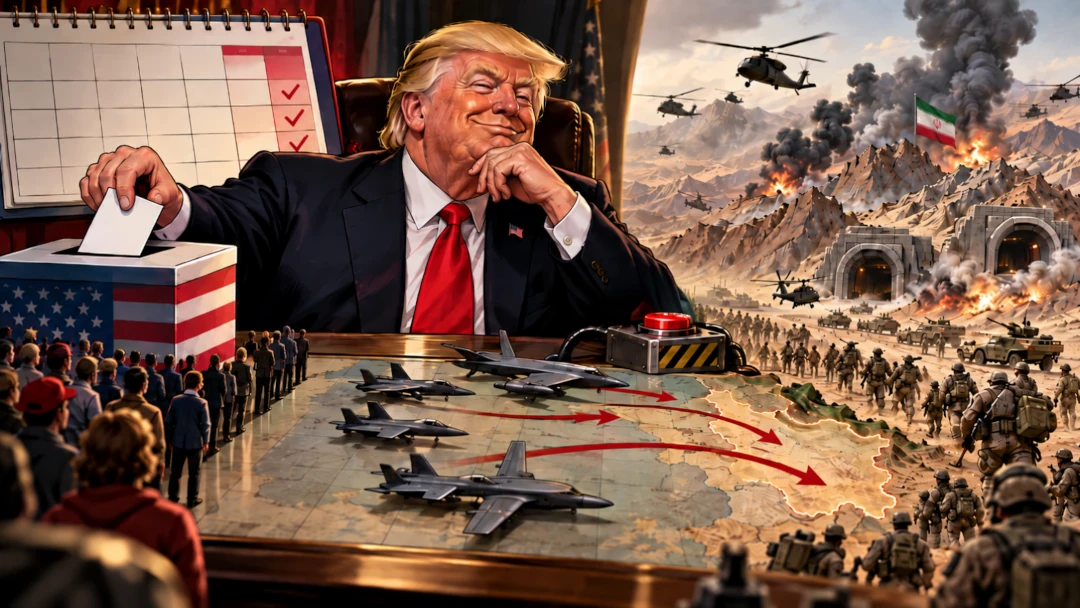
Read those two facts together and a pattern appears. The escalation is not being scheduled around military conditions, diplomatic deadlines, or the safety of American troops. It is being scheduled around an election.
I. What the Plan Is, and Who Is Building It
The uranium-seizure option first surfaced in the war’s opening weeks. In early March, CNN reported that capturing the stockpile would require a large ground force, not a small commando team. Planners discussed using elite Joint Special Operations Command units, possibly alongside Israeli commandos, to enter the tunnels and secure or destroy the material. By April 1, the Washington Post reported that the military had delivered a plan to the president at his own request. It involved flying in excavation equipment and building a runway so cargo planes could carry the radioactive material out.
The planning reached the top of the chain of command. CNN later revealed that Gen. Dan Caine, Chairman of the Joint Chiefs of Staff, cut short a NATO meeting in Brussels on May 19 to fly to U.S. Central Command in Tampa for in-person briefings on the ground mission. Commanders rated the operation “High to Extreme” on the special-operations risk scale, meaning significant American casualties even if the mission succeeded. Trump paused it after being warned it would likely provoke severe Iranian retaliation.
The option did not go away. In July, the independent defense publication The High Side reported that a JSOC task force had already spent more than three months on standby in the Middle East. Then, on July 25, the New York Post published the most detailed account yet, as summarized by Army Recognition and Ynet News.
The Force
Thousands of troops to seize and hold the sites, plus construction crews and a large blocking force. A smaller special-operations team would do the actual retrieval. Reported units include SEAL Team 6’s Silver Squadron, the 2nd Ranger Battalion, and the 21st Ordnance Company. Source
The Targets
Fordow, Isfahan, and possibly “Pickaxe Mountain” near Natanz. Each is heavily fortified and was damaged in earlier strikes. The mission would require clearing mines and reopening collapsed tunnel entrances. Source
The Material
About 440.9 kg of uranium enriched to 60 percent, plus 184.1 kg at 20 percent. The IAEA has done almost no verification inside Iran since February 28. Source
The Obstacle
U.S. intelligence says Iran deliberately collapsed tunnels and booby-trapped the entrances with explosive mines once it learned a raid was being considered. Source
The cast of people behind the planning is large. The Pentagon under Defense Secretary Pete Hegseth has refused throughout the war to rule out ground forces. In June, Hegseth argued that Washington gains an advantage by keeping Tehran guessing about how American troops might arrive. Secretary of State Marco Rubio reportedly told a congressional briefing that to secure the uranium, “people are going to have to go and get it.” Israel has lobbied too. Axios reported that the Israeli government wants Trump to order the special-forces mission, and that Trump has hesitated because of the risk.
The best record of the plan’s evolution is its own chronology.
- February 28, 2026U.S. and Israeli strikes launch the war. Congress never authorized it. Iran responds by militarizing the Strait of Hormuz.
- Early MarchGround and commando options surface in reporting by CNN and Bloomberg. Sen. Richard Blumenthal warns that securing the uranium cannot be done without a physical presence in Iran.
- Late MarchAbout 2,000 soldiers from the 82nd Airborne are ordered to the region, a division trained to seize airfields and secure weapons of mass destruction.
- April 1The Washington Post reports that a plan requested by Trump would involve bulldozers, a purpose-built runway, and potentially weeks on the ground.
- May 19Gen. Caine rushes from Brussels to Tampa for urgent in-person briefings on the ground mission.
- JuneTrump pauses the operation over casualty and retaliation risks. A June memorandum of understanding briefly holds out hope for a negotiated handover of the uranium, then collapses.
- July 25The New York Post reports a revived plan requiring thousands of troops. A CSIS analyst calls it potentially “the most sophisticated operation in military history.”
- September 25The Wall Street Journal reports that Trump expects to resume bombing after the midterms. The ground option remains open.
II. Will It Happen? Could It Work?
Nobody outside the Situation Room can give a certain answer. The public record does, however, support a sober assessment. It suggests that the next five weeks and the weeks after November 3 are two very different risk periods.
That last point deserves emphasis. Skepticism about this mission is not limited to the left. It comes from the Joint Staff’s own risk ratings, from Republican senators like Rick Scott, who told the Associated Press that no one had briefed him on how to secure the uranium without boots on the ground, and from a conservative commentator writing on the president’s favorite network. The question is not whether the operation is dangerous. Everyone agrees it is. The question is who will be held accountable for ordering it.
III. The Midterm Clock
The president has not been shy about his timetable. At the Republican midterm convention in Dallas this month, Trump told the crowd the war would end shortly after the election. He claimed Iran was holding out in hopes of dealing with “dumb, weak Democrats.” TIME noted that he conceded gas prices would take longer than the midterms to come down. He repeated the line to world leaders at the United Nations on September 22.
“They’re waiting to see how I do in the midterm election.”
— President Donald Trump · UN General Assembly, September 22, 2026 · via NBC News
In that same address, the president said he faced a choice between a deal and whether to “annihilate the Islamic Republic, and do it quickly.” Three days later came the Journal’s report that he had rejected Iran’s seven-day ceasefire plan and expected bombing to resume after the midterms. Publicly, he denies that the election is shaping his decisions. Privately, according to his own officials, he has set the calendar by it.
Why does the timing matter? There are three reasons.
First, it shields his party from the consequences. Casualties, spiking fuel prices, and images of American troops in Iranian tunnels would land squarely on Republican candidates if they arrived in October. Deferring escalation until after November 3 means voters make their choice without seeing what the administration intends to do. Gas already averaged $4.48 a gallon on the day of the latest Senate vote, with diesel at $6.51.
Second, it exploits the gap between the election and the new Congress. Whatever voters decide on November 3, the new Congress is not sworn in until January 2027. A bombing campaign launched in November or December would unfold under the current Republican-controlled Senate, the same chamber that has blocked a dozen war powers resolutions. This is our analysis, not a stated White House plan. But it is the practical effect of the timetable the president has chosen.
Third, it reveals what he treats as the real constraint. The constraint is not the Constitution, not a Congress that has formally told him to stop, and not commanders’ casualty estimates. It is the polling calendar. A commander in chief who holds a war’s next phase for a campaign is telling the country that the campaign comes first.
Get Involved Today
Contribute to our mission and turn your concerns into action.
IV. Congress Has Spoken. The President Isn’t Listening.
Congress has not stayed silent. On June 3, the House passed a war powers resolution 215 to 208, with four Republicans joining Democrats. That same month, the Senate adopted the House measure 50 to 48. Rep. Gregory Meeks, the top Democrat on the House Foreign Affairs Committee, called the conflict “this war of choice.” He argued that under the War Powers Resolution the measure binds the president to cease hostilities. According to Democracy Now!, the White House simply ignored it, claiming it infringed on the president’s powers as commander in chief.
The House has since acted twice more. In July it passed a second resolution 214 to 208. On September 15 it passed a third, sponsored by Rep. Seth Moulton, 220 to 204. This time a record seven Republicans broke ranks: Thomas Massie, Brian Fitzpatrick, Warren Davidson, Tom Barrett, Mariannette Miller-Meeks, Zach Nunn, and Nancy Mace. Massie has also filed articles of impeachment against Hegseth, GlobalSecurity.org’s war log notes.
On September 24 the Senate fell one vote short, 49 to 50. Republican Sens. Susan Collins, Lisa Murkowski, Rand Paul, and Thom Tillis voted with Democrats. Tillis voted to advance the measure for the first time, citing the 60 days that had passed since the administration told Congress in July that military action had restarted. Sen. John Fetterman was the only Democrat to vote no. The Washington Post’s roll call shows how thin the margin has become.
“The president right now is in violation of the Constitution.”
— Sen. Tim Kaine (D-Va.) · Senate floor, September 24, 2026 · via CNBC
Kaine, who has led the Senate effort since the first vote, made the case plainly on the floor, as CNBC reported. He argued that the president is violating the War Powers Act and the concurrent resolution Congress had already passed. Senate Democratic Leader Chuck Schumer called the war “one of the biggest catastrophes in American history.”
The bill for that catastrophe is coming due. The nonpartisan Congressional Budget Office, in a report requested by Rep. Brendan Boyle, estimates the war cost $38.1 billion through August 1, an average of $246 million a day. It adds $2 to $3 billion for every month it continues. The war has consumed up to two-thirds of the nation’s missile-defense interceptors, which CBO says will take at least five years to rebuild. Sen. Elizabeth Warren has called it a betrayal of the American people. Nineteen U.S. service members have died.
V. The Diplomatic Door Is Open. He Keeps Closing It.
This is not a war without an exit. There was a deal. In June, Washington and Tehran signed a memorandum of understanding that provided for gradual sanctions relief and the reopening of the Strait of Hormuz while the two sides negotiated remaining issues. It collapsed amid renewed fighting and disputes over shipping. Iranian President Masoud Pezeshkian, speaking to Fox News, blamed Washington for its failure and said Tehran still wants to return to that framework.
Diplomacy is still happening, just barely. On September 22, envoys Steve Witkoff and Jared Kushner held roughly three hours of mediated talks with an Iranian delegation led by Foreign Minister Abbas Araghchi on the sidelines of the UN General Assembly. Witkoff described the round as “constructive and promising.” According to Al Jazeera, Iranian state media said Tehran’s conditions for reopening the strait include lifting the U.S. naval blockade, releasing frozen assets, and ending the war on all fronts.
Iran then put a concrete offer on the table. Araghchi described a seven-day roadmap, discussed in talks in Qatar according to Raw Story’s account of the WSJ report. Under it, the Strait of Hormuz would reopen by the end of the seventh day and nuclear talks would restart, in exchange for an end to the blockade, oil-sanction waivers, and a ceasefire extending to Lebanon. Araghchi said it would be better to reach a deal before the midterms. Trump rejected it. On Saturday he told reporters that Iran wants the strait reopened “because they’re dying.”
We do not defend the Islamic Republic. Its conditions serve its own interests, and it has often failed to keep its word. But a responsible president tests an offer to reopen the world’s most important oil chokepoint. He does not dismiss it while privately planning the next bombing campaign for a date chosen by the political calendar.
The White House and its defenders make arguments that deserve a fair hearing. They say a nuclear-armed Iran is an intolerable threat, and that roughly half a ton of 60-percent uranium outside international inspection is exactly that danger. House Speaker Mike Johnson has argued that “Iran declared war on us 47 years ago” and that the president is protecting the country. Senate Republicans have maintained that he is acting within his Article II authority. Some independent analysts, including CSIS’s Joseph Rodgers, believe that if negotiations fail, military action may be the most realistic way to remove the stockpile. Defenders also note that Iranian leaders themselves have been divided over talks, which makes any promise from Tehran harder to trust.
These arguments explain why the uranium matters. They do not explain why Congress’s direction can be ignored, why a concrete ceasefire offer can be dismissed without testing it, or why the next phase of the war should wait for an election.
VI. A Pattern of Unfitness
Individually, each of these decisions could be defended as hard-nosed strategy. Together they describe a presidency that has lost the thread. Consider the record:
A war predicted to last four or five weeks is in its seventh month. A ground plan rated “High to Extreme” risk has been requested, paused, revived, and left hanging over thousands of service members. In April and again at the UN, the president threatened to annihilate an entire nation of more than 90 million people. He has ignored a concurrent resolution passed by both chambers. He has dismissed a concrete offer to reopen the Strait of Hormuz. And he has told aides that the timing of new violence will be set after his party’s election. None of this reflects a strategy. It reflects impulse, grievance, and political self-interest overriding the duties of the office.
When a President Cannot Be Trusted With the Power to Start a War
1 · How the mechanism works
Section 4 of the 25th Amendment lets the vice president and a majority of the Cabinet declare in writing that the president is “unable to discharge the powers and duties of his office.” The vice president then becomes acting president at once. If the president contests the declaration, Congress decides, and it takes a two-thirds vote of both chambers to keep him sidelined, as Axios has explained. The amendment is not a punishment for bad policy. It exists for a president whose judgment has become a danger in itself.
2 · Who has called for it
After the president’s April threat to wipe out Iranian civilization, more than 85 House Democrats called for impeachment or removal under the 25th Amendment. They included Rep. Alexandria Ocasio-Cortez and former Speaker Nancy Pelosi. Reps. Shri Thanedar and Jasmine Crockett sent letters directly to Vice President Vance and the Cabinet. Rep. Yassamin Ansari called for invoking the amendment. Sen. Ed Markey, writing that he would support any avenue to remove the president, warned: “We cannot leave this man in charge of America’s nuclear weapons.” Rep. Madeleine Dean called on Vance and the Cabinet to act, and Rep. Chrissy Houlahan said an order to annihilate Iran would be the epitome of an illegal order. Rep. John Larson filed articles of impeachment. Even former Rep. Marjorie Taylor Greene called for the 25th.
3 · The constitutional argument
The case does not rest on disagreement with the war. It rests on capacity: whether the president can reliably separate the nation’s security from his own political fortunes. A president who repeatedly threatens annihilation, openly schedules military escalation around an election, ignores a direct instruction from Congress under the War Powers Resolution, and keeps a high-casualty ground invasion on standby without a coherent end state is showing the kind of impaired judgment the amendment’s framers had in mind. Its drafters, writing after the Kennedy assassination, understood that inability can be a matter of judgment as well as physical incapacity.
4 · The honest barriers
Invocation is extraordinarily unlikely. It requires Vice President Vance and a majority of a Cabinet the president appointed to act against him, and TIME noted in April that they are highly unlikely to do so. A contested declaration would then need two-thirds of both chambers, a threshold far beyond today’s narrow war powers votes. Section 4 has never been used.
5 · Why the barriers do not settle the question
A remedy being hard to use does not make it the wrong remedy. The 25th Amendment gives the people closest to the president a legal duty to act when he can no longer safely exercise his powers, and pressure on that duty matters. Every public call on the record raises the cost of silence for Cabinet members who know what they are watching. If Americans are asked to accept a ground invasion scheduled for after an election, those officials owe the country an answer: do they believe this man is fit to give that order?
Editorial Conclusion
A president who waits until the ballots are counted to decide whether American troops will dig through minefields under an Iranian mountain is not guarding the country’s security. He is guarding his party’s majority.
Congress has told him to stop. Iran has offered a path to reopen the strait. His own commanders have warned him about the cost in American lives. What is required now is not another symbolic vote. Congress must use every lever it holds, including the power of the purse, to forbid an unauthorized ground invasion of Iran. Voters must treat November 3 as a referendum on whether a president may time a war to an election. And the officials sworn to the Constitution must answer the question the 25th Amendment puts to them. The Republic cannot afford to learn the lesson of Desert One twice.
Sources & References
- Bloomberg · Trump rejects Iran’s ceasefire offer, expects bombing after midterms (citing WSJ)
- Times of Israel · Trump rejects Iran ceasefire proposal, expects to renew strikes after midterms
- Business Standard / ANI · Trump rejects Iran’s 7-day ceasefire plan, prepares for military escalation
- The Hill · Trump rejects Iran’s 7-day plan to end war, expects bombing to resume post-midterms
- NBC News · Trump tells U.N. he could “annihilate” Iran but expects a deal after the midterms
- NBC News · Trump says Iran war will end after Election Day
- TIME · Trump promises end to Iran war after midterms
- CNN · US military rushed to prepare ground mission to capture Iran’s uranium, but Trump paused it
- CNN · Iran sealed uranium cache and placed mines amid fears of US operation
- CNN · Capturing Iran’s highly enriched uranium would require a large US ground force
- The Washington Post · Risky commando plan to seize Iran’s uranium came at Trump’s request
- The High Side · Iran WMD raid: Inside JSOC’s most challenging mission yet
- Army Recognition · U.S. considered special forces operation to secure Iran’s uranium (on the NY Post report)
- Ynet News · Report: US mulls sending special forces into Iran to seize or destroy nuclear material
- The Yeshiva World · U.S. weighs massive special forces operation to seize Iran’s enriched uranium
- Kyiv Post · Pentagon reviews ground raid to extract Iran’s uranium stockpiles
- Fox News (Opinion) · Robert Maginnis: The Pentagon’s plan to seize Iran’s uranium isn’t a raid. It’s an invasion
- The War Zone · Possibility of operation to retrieve Iran’s enriched uranium appears to rise
- Vision Times · How the United States would seize Iran’s enriched uranium
- Fortune / Bloomberg · U.S. considers idea of special operation to seize Iran’s uranium
- Fortune / AP · Trump seems to have put himself in a position where the only Iran solution is troops on the ground
- Times-Georgian / AP · Hegseth says ground war still an option
- The Tribune (India) / ANI · US military’s plan for ground operation to seize Iran’s uranium was paused by Trump
- GlobalSecurity.org · Iran War 2026: Day 209 update
- CBS News · Iran war powers measure falls short in Senate, despite new GOP support
- CNBC · Senate narrowly votes down resolution calling for end to Iran war
- NBC News · Senate rejects resolution calling to end the Iran war
- The Washington Post · How every senator voted on the Iran war powers resolution
- HNGN · Senate blocks Iran war powers resolution in 49-50 vote
- MS NOW · GOP senators say they want to end the Iran war. They keep refusing to rein in Trump.
- The Hill · House passes war powers resolution to limit military action in Iran
- NPR · House passes war powers resolution directing Trump to end hostilities with Iran
- House Foreign Affairs Committee Democrats · Meeks statement on Senate passage of his Iran War Powers Resolution
- Political.org · House passes war powers resolution 220-204, with seven Republicans breaking ranks
- Democracy Now! · Headlines for September 25, 2026
- CNBC · Iran war has cost on average $246 million per day, CBO finds
- iHeart · CBO: Iran war costs U.S. $246 million daily
- Times of Israel · US and Iranian negotiators hold talks at UN that Trump says “went very well”
- Al Jazeera · US, Iran hold mediated UNGA talks on ending war, opening Strait of Hormuz
- The National · Iran presents US with road map for regionwide ceasefire and Hormuz reopening
- Raw Story · Trump preparing for fresh bombing offensive on Iran after the midterms: WSJ
- RT · Trump prepares to bomb Iran after midterms (on the June MOU and WSJ report)
- Axios · Trump removal chatter erupts among Dems over Iran post
- Axios · Iran ceasefire fails to quash Dem calls for Trump’s removal
- TIME · Democrats demand GOP leaders end recess to stop Trump’s Iran war
- WHYY · Pa., Del., N.J. lawmakers consider 25th Amendment for Trump
- Office of Rep. John Larson · Trump’s rhetoric on Iran war sparks wave of calls for his removal
- Airborne & Special Operations Museum · Operation Eagle Claw (1980)
Related News