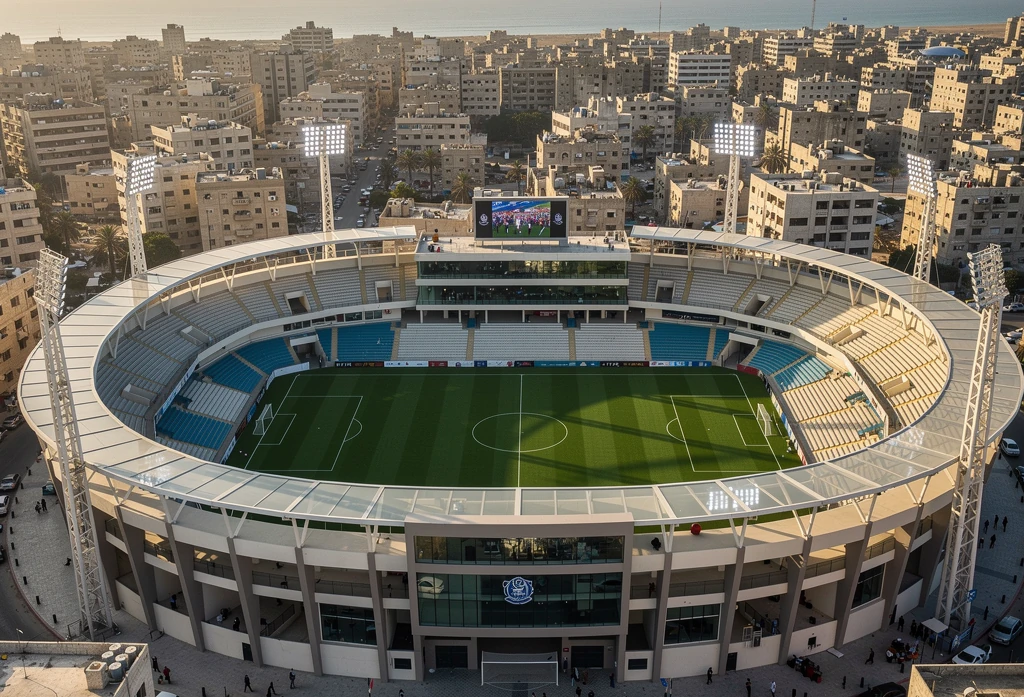
While nearly four out of five Gazans face acute hunger, the Trump administration is planning a 350-acre military base and celebrating a deal to build a soccer stadium. The dissonance of this presidency has never been more stark — and Congress is beginning to name it.
On February 19, 2026, President Donald Trump convened the inaugural meeting of his self-styled “Board of Peace” in Washington, D.C., a body he had announced at the World Economic Forum in Davos a month earlier and which he chairs personally. The gathering was meant to signal American leadership on one of the world’s most intractable crises: the rebuilding of Gaza after more than two years of devastating warfare. What it signaled instead was something far more troubling — a presidency substituting pageantry for policy, spectacle for strategy, and cosmetic reconstruction for the urgent restoration of human life.
In the weeks that followed, two announcements captured the essential character of the Trump Gaza plan. The first: contracting records reviewed by The Guardian revealed the administration was advancing plans for a 350-acre, 5,000-person military base in southern Gaza, part of what would be a $500 million installation intended for the as-yet-undeployed International Stabilization Force. The second: Trump himself announced that FIFA, the global soccer governing body, would raise $75 million for soccer-related projects in Gaza — including a 20,000-seat national stadium, a FIFA Academy, five full-size pitches, and 50 mini-pitches near schools and residences. FIFA President Gianni Infantino, a man with his own history of autocratic adjacency, stood alongside the president to celebrate the deal.
Meanwhile, the World Food Programme continued to classify Gaza as facing an acute food emergency, with approximately 77 percent of the population confronting serious food insecurity. Hospitals remained under-supplied. Rubble removal — which the BBC has reported could take up to 21 years — has barely begun. And the Board of Peace itself, as Reuters reported, had received less than $1 billion of the $17 billion pledged at its inaugural meeting.
1. The Architecture of the Board of Peace
Trump unveiled his “Board of Peace” not through a congressional authorization or diplomatic treaty, but through a presentation at the World Economic Forum in Davos — a gathering of the world’s financial elite. His son-in-law Jared Kushner, whose private equity firm Affinity Partners manages billions in Gulf state capital, presented a glossy “master plan” for Gaza: glass towers rising along the coast, industrial zones replacing ruins, and a coastal tourism district featuring 180 skyscrapers. Chatham House described the plan as treating Gaza “as vacant beachfront real estate rather than as part of a Palestinian state,” formulated without meaningful Palestinian consultation.
The Board’s structure drew immediate criticism from constitutional scholars and foreign policy analysts alike. It is chaired by Trump himself, with authority exercised through the Gaza Executive Board — a body that includes neither Palestinian nor Israeli members. The Carnegie Endowment for International Peace warned that the structure amounts to “a wholly Trump-controlled body meant to rival the United Nations with complete discretion over how to spend the billions of dollars of donor contributions,” adding that it is “untethered to international law or standard financial oversight and accountability mechanisms.”
Senator Ed Markey of Massachusetts wrote directly to Secretary of State Marco Rubio — a member of the Board’s Executive committee — to express alarm at “the concentration of authorities in the hands of the chairman and his power to wield binding authority over budgets.” The Board, in short, is Trump’s foreign policy operation in miniature: personal, unaccountable, and organized around the performance of power rather than its responsible exercise.
2. A Military Base for a Peacekeeping Force That Doesn’t Exist
The plans for a 350-acre military installation in southern Gaza, detailed in contracting records obtained by The Guardian, are notable not for their ambition but for their unreality. The base is designed to house the International Stabilization Force — the multinational peacekeeping body that was supposed to deploy immediately to Gaza under the terms of Trump’s 20-point plan. That plan was announced on September 29, 2025, and a ceasefire followed on October 10. But as of this spring, the ISF has yet to deploy. Only a handful of countries have pledged troops, and none of them have committed to security roles. Washington has maintained, meanwhile, that American troops will not deploy to Gaza.
“Trump ran successfully on ending the forever wars in the Middle East. A large new American military footprint near Gaza stands in stark contrast to everything he promised.”
— Annelle Sheline, Quincy Institute for Responsible Statecraft
The irony is not subtle. The president who campaigned as the great ender of foreign wars — who decried the sacrifice of “sons and daughters” in the post-9/11 era — is now planning a half-billion dollar military campus in one of the most contested territories on earth, to house a peacekeeping force that no one has agreed to staff. The Civil-Military Coordination Centre in Kiryat Gat, which was itself a cornerstone of the Trump plan, is simultaneously being shuttered by the administration according to multiple sources familiar with the matter — its diplomatic momentum having “faded” as Israeli attacks continued and Hamas reasserted governance in parts of the territory.
Defense Priorities analyst Daniel DePetris wrote bluntly of the Board’s second phase: “Not in over 75 years and 15 U.S. presidents has a resolution to the Palestine-Israel conflict been found.” The Board, he concluded, lacks the political temperament to contribute meaningfully to legitimate Palestinian governance.
3. Soccer Fields and Spectacle
The FIFA partnership announced at the Board of Peace’s inaugural meeting is, on its surface, not without appeal. Sport carries genuine rehabilitative value, and FIFA’s commitment to build 1,000 mini-pitches globally by 2030 is a real initiative with real impact in communities across the developing world. But the specific context in which this $75 million pledge was made — announced by the president of the United States alongside a deal that has received less than six cents on every pledged dollar — reveals the partnership for what it functionally is: a press release dressed as a peace plan.
FIFA pledged $50 million toward a new 20,000-seat national stadium and $15 million for a FIFA Academy, plus 55 additional soccer fields, as part of the Board of Peace’s inaugural meeting package. Washington Today, Feb. 26, 2026
The World Food Programme classifies approximately 77% of Gaza’s population as facing acute food insecurity as of 2026. Diseases including hepatitis and meningitis are spreading in displaced persons camps. Carnegie Endowment, March 2026
The Board of Peace’s Gaza Reconstruction and Development fund has received less than $1 billion of the $17 billion pledged at its inaugural meeting — a collection rate below six percent. Prism Reports, April 2026
The BBC has reported that clearing the more than 50 million tonnes of debris in Gaza — including vast quantities of unexploded ordnance — could take up to 21 years under current conditions. No significant clearing operations have begun. Wikipedia / BBC sourcing
Get Involved Today
Contribute to our mission and turn your concerns into action.
Gazans themselves have been direct about what the stadium pledge represents. Writing for Truthout, Gaza-based correspondent Asmaa Elkhaldi recounted asking her friend Lama about the announcement. Lama’s response: “Do they believe that building stadiums will give the world the impression that Gaza has been rebuilt and is now living in peace?” Another resident, a college student named Ahed who was near graduation, said flatly: “Instead of building stadiums, focus on securing students in schools and universities — and provide them with transportation first.”
“How can more than 50 football fields be planned while no real effort is made to establish peace first? How can sports projects be discussed in a place still under daily bombardment?”
— Asmaa Elkhaldi, writing from Gaza for Truthout, May 2026
The question answers itself. Soccer fields cannot be built in a rubble-filled, active conflict zone without first securing clean water, functional hospitals, restored power grids, and physical safety. The FIFA plan acknowledges this obliquely, noting that “implementation will proceed in line with ongoing monitoring of safety and security conditions.” In other words: the stadium will wait. The announcement, however, will not.
4. What the Priorities Reveal
The conjunction of these two announcements — a military base for a peacekeeping force that hasn’t been staffed, and a stadium for a population that cannot find clean eggs — reveals the organizing principle of the Trump Gaza plan: optics over outcomes, monuments over medicine. The Kushner master plan, as the Arab Center Washington described it, portrays the Board of Peace as a “controlling international authority in Gaza” that “lacks the experience, the funding, or the political temperament to contribute significantly to the establishment of effective, representative, and legitimate Palestinian governance.”
Of the Board’s 20 advisory members, Freedom House and the Economist Intelligence Unit classify 16 as authoritarian or only “partly free.” The plan itself, Chatham House noted, “treats Palestinian statehood as a conditional prospect” — achievable only after Gaza is fully demilitarized, a process High Representative Nickolay Mladenov has said will require “all factions in Gaza, not just Hamas” to disarm, making any realistic timeline extend years beyond the Board’s mandate, which sunsets in December 2027.
What the plan does not treat as conditional is Trump’s authority over the process. He chairs the board. He controls its budget. He announced the FIFA deal. He unveiled the Kushner renderings. When Defense News reported in May 2026 that the United States’ flagship Gaza coordination mission was being shuttered, the White House referred all inquiries to — the Board of Peace, the organization Trump chairs. It is a foreign policy apparatus in which the president is simultaneously the architect, the executive, and the sole spokesman.
5. A Pattern Beyond Gaza
The incoherence of the Gaza plan does not exist in isolation. It is one chapter in a presidency defined by impulsive unilateralism. On February 28, 2026 — just nine days after the inaugural Board of Peace meeting — Trump launched military strikes against Iran without a clearly articulated rationale, against the warnings of senior officials, and without notifying key congressional allies. The strikes triggered Iranian retaliation and an escalating crisis in the Strait of Hormuz, the chokepoint through which a substantial portion of the world’s oil passes. Trump then posted on Truth Social that “Tuesday will be Power Plant Day, and Bridge Day, all wrapped up in one, in Iran” — threatening to destroy civilian infrastructure across a nation of 90 million people.
More than 70 Democratic lawmakers — and, notably, a number of conservative commentators including Tucker Carlson, former Representative Marjorie Taylor Greene, and Alex Jones — publicly called for the invocation of the 25th Amendment or Trump’s removal from office. Representative Yassamin Ansari of Arizona stated plainly: “The 25th Amendment exists for a reason. The President of the United States is a deranged lunatic, and a national security threat to our country and the rest of the world.” Representative Melanie Stansbury of New Mexico called on Congress and the Cabinet to act. Representative Sydney Kamlager-Dove of California said: “He’s risking the safety of every American. Invoke the 25th.”
The Case for Presidential Incapacity — and Why Barriers Don’t Negate the Argument
The Twenty-Fifth Amendment was ratified in 1967, in the aftermath of President Kennedy’s assassination, to address a gap the founders never anticipated: what happens when a president is neither dead nor resigned, but genuinely unable to discharge the duties of the office? Section 4 provides the answer. If the Vice President and a majority of the Cabinet — or of such other body as Congress may by law provide — transmit a written declaration that the president “is unable to discharge the powers and duties of his office,” the Vice President shall immediately assume those powers as Acting President.
The practical barriers are real and must be named honestly. Twelve of the 23 members of Trump’s Cabinet would need to agree to remove him, including Vice President J.D. Vance — a man who has shown no public inclination toward such action. Even if the Cabinet acted, Trump could simply declare himself fit, triggering a congressional vote in which two-thirds of both chambers would need to sustain the removal. In a Republican-dominated Congress, that threshold is currently unreachable.
These barriers explain why Representative Jamie Raskin of Maryland, joined by 50 Democratic co-sponsors, introduced legislation in April 2026 to create a 17-member Commission on Presidential Capacity — the “other body” the amendment explicitly contemplates Congress having the power to establish. Composed of physicians, psychiatrists, and former senior officials from both parties, the commission would be empowered to carry out a medical examination of the president to determine whether he is “mentally or physically unable to discharge the powers and duties of the office.” Raskin said: “We have a solemn duty to play our defined role under the 25th Amendment by setting up this body to act alongside the Vice President and the Cabinet.”
The Gaza pattern is directly relevant to this constitutional argument. Section 4 does not require a diagnosis of clinical illness — it requires a finding of incapacity to discharge the duties of the office. A president who announces a $7 billion reconstruction plan for a war-ravaged territory, collects less than six cents on every pledged dollar, shutters his own coordination infrastructure, plans a military base for a peacekeeping force no nation will staff, and celebrates a soccer stadium deal while nearly four in five Gazans go hungry — that is not a governance failure alone. It is evidence of a president who cannot distinguish between the announcement of policy and its execution; between the performance of leadership and its substance.
The constitutional case for at minimum establishing the commission Raskin proposes is sound. The political barriers are real. But the existence of barriers does not extinguish the moral and constitutional obligation to document, argue, and press the case — so that when the historical record is written, it reflects that the warning was sounded clearly, and on time.
6. The Democratic Stakes
The United States has, in recent memory, built its foreign policy reputation on a claim of moral seriousness — the idea that American engagement, however imperfect, is ultimately oriented toward human welfare, democratic governance, and the rule of law. The Gaza plan, in the form Trump has given it, is the explicit repudiation of that claim. It is a plan shaped by real estate aesthetics, managed by his son-in-law, announced to billionaires in Davos, populated by authoritarian governments, and designed to give Trump personal control over billions in reconstruction funds without meaningful oversight or accountability. It is not a peace plan. It is a brand extension.
The people who will pay the price for this brand extension are the 2.3 million residents of Gaza, of whom more than 70,000 have been killed since the start of the war — a figure the United Nations has characterized as genocidal. The Board of Peace has, as Jacobin’s E.A. Halevi wrote, “done little to nothing to rebuild Gaza” while it waits for Hamas to disarm. The rubble sits. The diseases spread. The stadium renderings circulate on social media. And the president of the United States accepts the applause.
Editorial Conclusion
A president who cannot distinguish between the spectacle of a peace plan and the substance of one — who builds military bases for phantom peacekeepers, celebrates soccer stadiums for starving populations, and controls billions in unaccountable reconstruction funds while his own coordination infrastructure collapses — has demonstrated an incapacity of judgment that goes beyond ordinary policy failure. The Twenty-Fifth Amendment was not written for moments of mere disagreement. It was written for precisely this: when the performance of the presidency so thoroughly eclipses its duties that the nation itself is placed at risk. Congress must establish the Commission on Presidential Capacity. The Cabinet must be made to answer, on the record, whether it believes the man currently running American foreign policy is fit to continue doing so. The democratic stakes of remaining silent are higher than the political costs of speaking.
Sources & References
- The Times of Israel — Trump Administration Said Planning to Build 350-Acre Military Base in Gaza (Feb. 19, 2026)
- The Guardian / Haaretz — Trump Officials Reportedly Planning 5,000-Person Military Base in Gaza (Feb. 19, 2026)
- Responsible Statecraft — U.S. to Build Major New Base Near Gaza: Contradictions With Campaign Promises (Nov. 14, 2025)
- Defense News / Reuters — U.S. to Close Its Flagship Gaza Mission as Trump Plan Stalls (May 1, 2026)
- FIFA / Inside FIFA — FIFA and the Board of Peace Announce Strategic Partnership (Feb. 19, 2026)
- Jerusalem Post — FIFA, Trump’s Board of Peace Work Together to Support Gaza Reconstruction Through Soccer (Feb. 20, 2026)
- Washington Today / National Today — FIFA Pledges $50M for New Soccer Stadium in War-Torn Gaza (Feb. 26, 2026)
- Truthout — FIFA-Backed “Board of Peace” Plan for Gaza Stadium Ignores Needs of Palestinians (May 2026)
- Chatham House — The Risks of Trump’s Peace Plan: Two Gazas and an Annexed West Bank (Feb. 19, 2026)
- Carnegie Endowment for International Peace — The Board of Peace and Funding for Gaza Reconstruction: On Whose Account? (March 2026)
- Arab Center Washington DC — Trump’s Board of Peace: Rebuilding Gaza, or Remaking the World? (Feb. 23, 2026)
- Defense Priorities — Why the Second Phase of Donald Trump’s Gaza Peace Plan Is Failing (March 31, 2026)
- Prism Reports — Map of Future Gaza Proposed by Trump’s Board of Peace Fails Palestinians (April 27, 2026)
- Jacobin — Donald Trump’s “Board of Peace” Is a Board of Naked Power (May 2026)
- TIME Magazine — What to Know About the 25th Amendment as Lawmakers Call for Trump’s Removal (April 2026)
- Deseret News — Democrats Want a Medical Check on Trump’s Fitness for Office — Rep. Raskin Introduces Commission Bill (April 14, 2026)
- NBC Washington — What Is the 25th Amendment? What to Know as Calls Grow to Remove Trump (April 2026)
- Fox News — Rep. Jamie Raskin Introduces Bill to Assess Trump’s Fitness for Office (April 14, 2026)
Related News