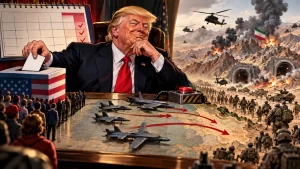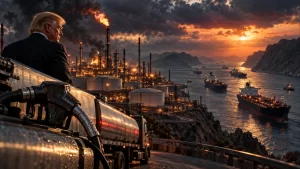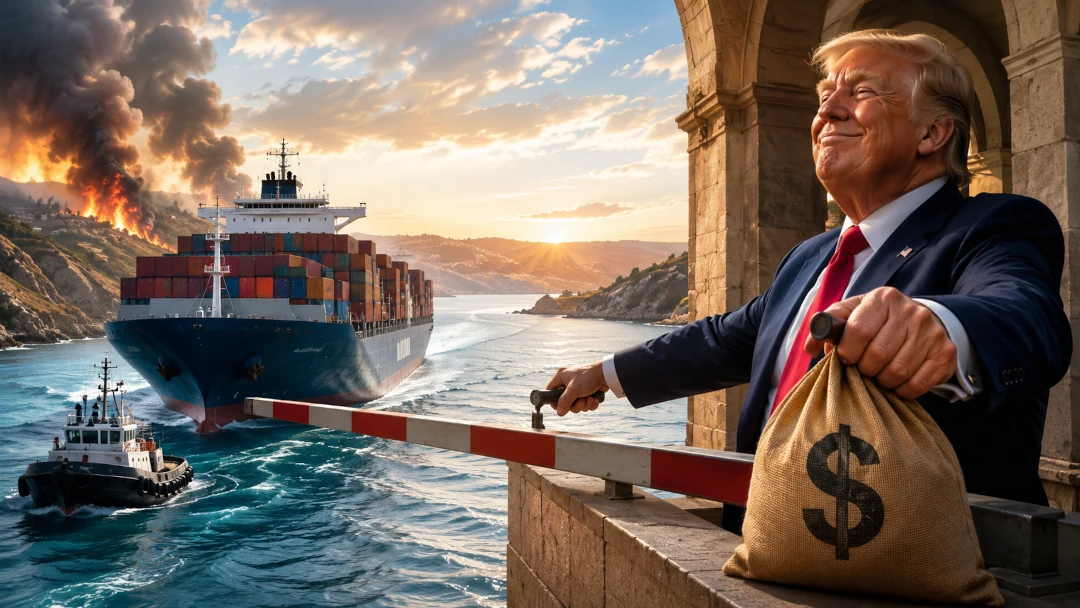
Donald Trump lit the Strait of Hormuz on fire in February. This week he declared himself its guardian — and told the world it must now pay him twenty percent of every ton it ships. It is protection money, dressed in a flag, and Americans are the ones who will pay the bill.
On a Monday morning in July, from the safety of Truth Social, the President of the United States announced that he had appointed himself the toll collector of one of the world’s most consequential waterways. In the post — preserved here in full — Trump declared the Strait of Hormuz “OPEN, and will remain OPEN, with or without Iran,” reinstated what he called “THE IRANIAN BLOCKADE,” and christened the United States “THE GUARDIAN OF THE HORMUZ STRAIT.” Then came the price tag. The country he leads, he said, would “be reimbursed, at the rate of 20% on all cargo shipped, for any and all costs necessary to do the job of providing safety and security to this very volatile section of the World.” The process, he added, “will begin immediately.”
Strip away the capital letters and what remains is unambiguous. The President is claiming the authority to impose a twenty-percent surcharge on roughly a fifth of the world’s seaborne oil trade, in a strait he does not own, over which he has no sovereignty, and whose current instability is a direct consequence of a war he chose to start on February 28. The International Maritime Organization, the United Nations agency that governs global shipping, responded within hours: “There is no legal basis through which to introduce mandatory tolls simply to transit through a strait.” James Kraska, a professor of international maritime law at the U.S. Naval War College, was blunter still. Iran had floated similar fees earlier this year; the United States correctly denounced them as illegal. Now Washington proposes to charge ten times what Iran once demanded.
“The U.S.A. will be, from this point forward, known as ‘THE GUARDIAN OF THE HORMUZ STRAIT,’ but as such, and as a matter of FAIRNESS, will be reimbursed, at the rate of 20% on all cargo shipped.”
— President Donald J. Trump · Truth Social · July 13, 2026
I. The Fire, Then the Toll
To understand the moral bankruptcy of the announcement, one must remember who broke the strait in the first place. Before February 28, when the United States and Israel launched their joint war on Iran, commercial traffic through Hormuz flowed as it had for decades. Since the war began, maritime traffic has collapsed by roughly seventy percent, according to reporting compiled from Pentagon and industry sources. The waterway that carries about twenty million barrels of oil each day — about one in five barrels burned anywhere on Earth — has become a shooting gallery. Iranian attacks on tankers, U.S. and Israeli strikes on Iranian ports, exchanges of missiles and drones across Bahrain, Kuwait, Oman and Jordan: this is the “volatile section of the World” the President now proposes to charge admission to.
The June 17 interim agreement was supposed to end this. Trump himself declared the ceasefire “over” last week and, on July 7, ordered a new round of strikes on Iranian air-defense systems, coastal radar, and port infrastructure — an escalation he reported to Congress on July 10 in compliance with the War Powers Resolution. Congress, it should be noted, had already voted in June to direct the end of hostilities. The vote was symbolic; the President ignored it. He is now attempting to monetize the very chaos he refuses to end.
This is not “guardianship.” It is the oldest business model in the world, dressed in the language of national security. Set the neighborhood on fire, then charge the neighbors for the water.
II. A Timeline of How We Got Here
III. The Bill Americans Have Already Paid
Before we get to the twenty percent, consider what this war has already cost — and who has been paying. The public Pentagon estimate is $29 billion as of mid-May, of which roughly $24 billion is the cost of repairing or replacing spent munitions, downed drones, and damaged aircraft. That figure was delivered to lawmakers by acting comptroller Jules Hurst, who explicitly refused to include the cost of rebuilding U.S. installations, saying only, “we don’t know what our future posture is going to be.”
Others do know, roughly. Three sources familiar with the internal accounting told CNN the real figure is closer to $40 to $50 billion once base damage is included. Rep. Ro Khanna, a Democrat on the House Armed Services Committee, called the Pentagon’s $25 billion accounting “totally off” during an April hearing. An NBC News investigation published in June, drawing on a forthcoming CSIS analysis, put the plausible total near $100 billion once you count munitions at replacement cost, base repairs, deployment surges, and the more than fifty thousand American troops now stationed in the region. Harvard economist Linda Bilmes — whose landmark work priced the true long-term cost of the Iraq and Afghanistan wars — has projected that the Iran war will eventually cost the United States at least $1 trillion once veterans’ medical care, disability benefits, and decades of aftereffects are counted.
Now consider the pump. On February 27, the day before the first strikes, the national average price of regular gasoline was $2.98. By early April it had reached $4.14. JPMorgan’s energy team warned that a sustained closure of the strait could push it past $5 per gallon — enough, the bank’s economists estimated, to “consume much or all of the larger tax refunds many Americans were expecting” from the 2025 tax law. In April, U.S. headline inflation hit 3.8% year-over-year, the highest reading in nearly three years, with the energy sub-index up 17.87% and gasoline alone up 18.9%. The Center for Economic Policy Research at CEPR calculated that even a one-quarter closure would add 0.6 percentage points to U.S. headline inflation in 2026. Bloomberg reported that Wall Street analysts and U.S. officials are now openly modeling a scenario in which oil moves to $200 a barrel — a stagflationary shock that would, in their words, “shift everything from the path ahead for central banks to the outcome of the U.S. midterm elections.”
Get Involved Today
Contribute to our mission and turn your concerns into action.
IV. What “Twenty Percent on All Cargo” Actually Means
Trump’s post is deliberately vague about how the twenty percent would be calculated. Is it twenty percent of the value of the cargo? Twenty percent of the U.S. Navy’s cost of escort, divided among transiting vessels? Twenty percent of the freight rate? John McCown, a senior fellow at the Center for Maritime Strategy, told CNN Business that shippers have no way to evaluate whether they’d even use such a “service” without knowing which of these is meant. On any reading, the numbers are staggering. Twenty million barrels a day at recent prices around $100 per barrel is roughly $2 billion of oil flowing through Hormuz every twenty-four hours — nearly three-quarters of a trillion dollars a year in crude alone, before adding LNG, refined products, containers, and dry cargo. A twenty percent surcharge, applied literally, is a multi-hundred-billion-dollar tax on the world’s energy trade.
Every dollar of that surcharge would be paid, in the end, by consumers. Refineries do not absorb tolls; they price them in. American drivers, American truckers, American farmers running diesel tractors, and American families heating their homes would fund the tribute the President wants to collect. The Republican-passed 2025 tax cut, already narrower than advertised, would be functionally erased at the pump. This is not “reimbursement,” as the post claims. It is the largest new consumption tax in modern American history, imposed by fiat, on Americans, laundered through foreign shippers.
And it does not stop at the wallet. Iran’s foreign minister, Abbas Araghchi, seized on the announcement almost gleefully, writing on social media that “whoever provides secure and safe passage of commercial vessels through the Strait of Hormuz should be compensated for this service” — and that Iran, which “has always been the GUARDIAN of the Strait,” would simply be “fair” about it. In one Truth Social post, the President has handed Tehran the moral and legal cover to charge its own tolls, undone the entire premise of the June ceasefire memorandum, and validated the argument that international straits are protection rackets to be auctioned rather than global commons to be defended. Herbjorn Hansson, CEO of Nordic American Tankers, told CNBC the proposal is “unrealistic” and warned that “Iran is suffering, America is suffering, 192 countries outside the Hormuz Strait are suffering.” The suffering, in his framing, is what the White House now proposes to bill for.
“These are the ravings of a dangerous and mentally unbalanced individual. Congress has got to act NOW. End this war.”
— Sen. Bernie Sanders (I-Vt.) · April 5, 2026
V. The Damage to America Itself
For eighty years, the U.S. Navy has policed the world’s sea lanes on the theory that stable, freely navigable oceans are a public good the American economy depends on more than anyone else’s. That bargain — American power in service of a rules-based order — is what has made the dollar the world’s reserve currency, kept American ports full, and given Washington leverage even in rooms where it was outnumbered. Trump has now offered to sell that bargain by the ton.
Allies noticed. Every Gulf state whose oil transits Hormuz was told, in effect, that the United States will only guard their tankers for a twenty-percent cut. European refiners, Japanese and South Korean utilities, Indian shippers, and Chinese state oil buyers were all told the same thing. They will draw the appropriate conclusion, and they will draw it quickly: that American security guarantees are now transactional, negotiable, and — most damaging of all — subject to a single man’s Truth Social account. The dollar’s reserve status, the appeal of U.S. Treasuries, the willingness of allies to host American bases: all of it rests on the perception that the United States is a serious country. That perception is a resource. It has been squandered.
Tourism and commerce feel it before diplomacy does. Every dollar added to the global cost of oil is a dollar not spent on the American vacation, the American restaurant meal, the American car. When European and Asian consumers see their fuel bills rise because Washington is charging tolls, they will not distinguish between “the U.S. government” and “American exporters” and “American brands.” The costs of Trump’s protection racket will land on Iowa soybean farmers, on Boeing, on Ford, on every small business whose margins depend on freight rates staying inside a predictable band. And the political costs will land on American diplomats trying to build coalitions for anything else the country needs to accomplish over the next generation.
The 25th Amendment Was Written for Exactly This
Section 4 of the Twenty-Fifth Amendment allows the Vice President and a majority of the Cabinet to declare in writing that the President is “unable to discharge the powers and duties of his office.” Upon that declaration, the Vice President becomes Acting President. The mechanism was designed for precisely the situation the country now confronts: a Commander-in-Chief whose public conduct — his all-caps midnight posts, his profane threats to erase “a whole civilization,” his impulse to invent new taxes on international waterways over breakfast — raises reasonable, non-partisan questions about capacity to govern.
The record is not the invention of Democratic operatives. It is the President’s own Truth Social account. On April 5, on Easter morning, he wrote: “Tuesday will be Power Plant Day, and Bridge Day, all wrapped up in one, in Iran. There will be nothing like it!!! Open the Fuckin’ Strait, you crazy bastards, or you’ll be living in Hell — JUST WATCH! Praise be to Allah.” On April 7, he threatened that “a whole civilization will die tonight, never to be brought back again” if his eight-o’clock deadline lapsed. Pope Leo XIV called the threats “truly unacceptable”. Today’s Hormuz announcement — reinventing a strait as an American tollbooth — is not a departure. It is continuity.
Rep. Jamie Raskin, ranking member of the House Judiciary Committee, wrote formally to the White House physician on April 10, asking for a cognitive evaluation and stating that “the American people must be able to trust that the Commander-in-Chief has the mental capacity to discharge the essential duties of his office.” Sen. Chris Murphy of Connecticut said publicly that if he sat in the Cabinet he would “spend Easter calling constitutional lawyers about the 25th Amendment.” Sen. Bernie Sanders called the Easter posts “the ravings of a dangerous and mentally unbalanced individual.” Sen. Chuck Schumer, Rep. Maxine Dexter of Oregon, and Rep. Yassamin Ansari of Arizona joined. By the end of April, more than seventy congressional Democrats were on record supporting invocation, impeachment, or both.
The practical barriers are real and should be named honestly. Section 4 requires the Vice President and a majority of a Cabinet handpicked for loyalty; Vice President JD Vance has given no indication he would act. Sen. Sheldon Whitehouse has publicly acknowledged the effort is “not realistic” in the near term. That political reality does not dissolve the constitutional case; it indicts the officeholders who refuse to act on it. A Cabinet that chooses partisan solidarity over its Section 4 duty is not a rebuttal of the amendment. It is the failure the amendment was written to shame.
Whether or not the votes exist today, the record must be made and preserved. Every unhinged Truth Social post, every profane midnight threat, every fresh invention like the Guardian of the Strait, is evidence. History will ask whether a functioning constitutional order looked at this and did nothing. It should not be able to say yes.
VI. Revenge, Dressed as Patriotism
Peel back the rhetoric of “guardianship” and the strategic logic dissolves. There is no strategy. There is a grievance — that other countries have, in the President’s telling, been getting American security “for free” for fifty years — and there is a punishment. The Hormuz toll is the same instinct that produced the abandoned June ceasefire, the abrupt escalation on July 7, the rambling Fox News phone call earlier Monday in which he mused about calling the Navy the “Guardian Angel” of the strait. It is grievance policy. It is revenge on allies for the sin of having relied on us.
Americans should understand what is being done in their name and with their money. The Trump administration proposes to charge the world for security the American taxpayer will actually be paying to provide — through the $29 billion (and climbing) already spent, through the $200 billion supplemental for munitions, through the trillion-dollar Bilmes projection of long-term costs, through the $100 billion Moody’s estimates has already been extracted from household budgets at the pump. Then, on top of that, the surcharge itself will pass through global freight rates and land back on American consumers as higher prices for everything from gasoline to imported electronics. It is the rare policy that manages to be extortion abroad and a regressive tax at home in the same sentence.
What this reveals about priorities is uglier than any single post. A President whose energy is spent inventing tolls is not a President spending energy on ending a war. A President auditioning as the world’s tollkeeper is not a President working on the health of American manufacturing, the affordability of American housing, the solvency of American entitlements. The Guardian-of-the-Strait announcement is not, strictly speaking, a foreign policy. It is a distraction, a grievance, and a shakedown, delivered with the volume knob at eleven and the constitutional oversight knob at zero.
Editorial Conclusion
A President who breaks a strait and then charges rent on it has abandoned the pretense of statesmanship. This is protection money. Americans will pay it — at the pump, at the grocery store, in the erosion of the alliances that have kept this country safe and prosperous for eighty years. Congress has a War Powers Resolution to enforce and an oversight duty to discharge. The Cabinet has a Section 4 duty it is presently refusing to see. History will not care which excuses looked reasonable in the moment. It will ask whether the institutions built to restrain exactly this kind of Presidency did their job. The record now demands they do.
Sources & References
- Truth Social — “THE GUARDIAN OF THE HORMUZ STRAIT” — full text of the July 13, 2026 post
- CBS News — Trump says U.S. will be “guardian of the Hormuz Strait” and is reinstating Iranian blockade
- Al Jazeera — Trump says US will become ‘guardian’ of Strait of Hormuz and collect tolls
- CNBC — Trump proposes 20% toll on cargo through Strait of Hormuz; restarts Iran blockade
- CNN Business — Trump offers US protection in the Strait of Hormuz for a 20% fee. How would that work?
- CNBC — UN maritime agency opposes Hormuz transit fees after Trump demands protection money
- Euronews — Trump reimposes US blockade and demands 20% Hormuz shipping fee
- The Hill — Trump reimposes blockade on Strait of Hormuz, declares 20 percent US toll on shipping
- CBS Live Updates — Trump tells Congress fighting with Iran has resumed, vows to “keep” Strait and charge fees
- Breaking Defense — Price tag for Iran war ticks up to $29B, not including base damage
- CNN Politics — Repairing damaged US military bases will add billions to Iran war cost, sources say
- CSIS — Iran War Cost Estimate Update: $11.3B at Day 6, $16.5B at Day 12
- NBC / MS.now — The Pentagon says the Iran war cost $29 billion. Experts say it’s far more.
- Christian Science Monitor — What is the Iran war costing Americans? Here’s a breakdown.
- Bloomberg — Iran War: How High Could Oil Prices Get with Strait of Hormuz Closure?
- CEPR / VoxEU — Quantifying the impact of the Iran war on US inflation
- CBS News (via AOL) — Gas prices could top $5 if Strait of Hormuz stays shut, J.P. Morgan says
- House Judiciary Democrats — Rep. Raskin’s April 10, 2026 letter requesting a cognitive test of the President (PDF)
- CNN Politics — Raskin calls for Trump to take cognitive test in wake of Iran threats
- NBC News — Dozens of Democrats call for Trump’s removal after his Iran threats
- Al Jazeera — Democrats blast Trump for Iran ‘war crimes’ threat; Republicans supportive
- EIA — EIA: Drop in global oil demand will limit price increases from Hormuz disruptions
Related News