The Bunker Presidency: When the People’s House Becomes a Fortress
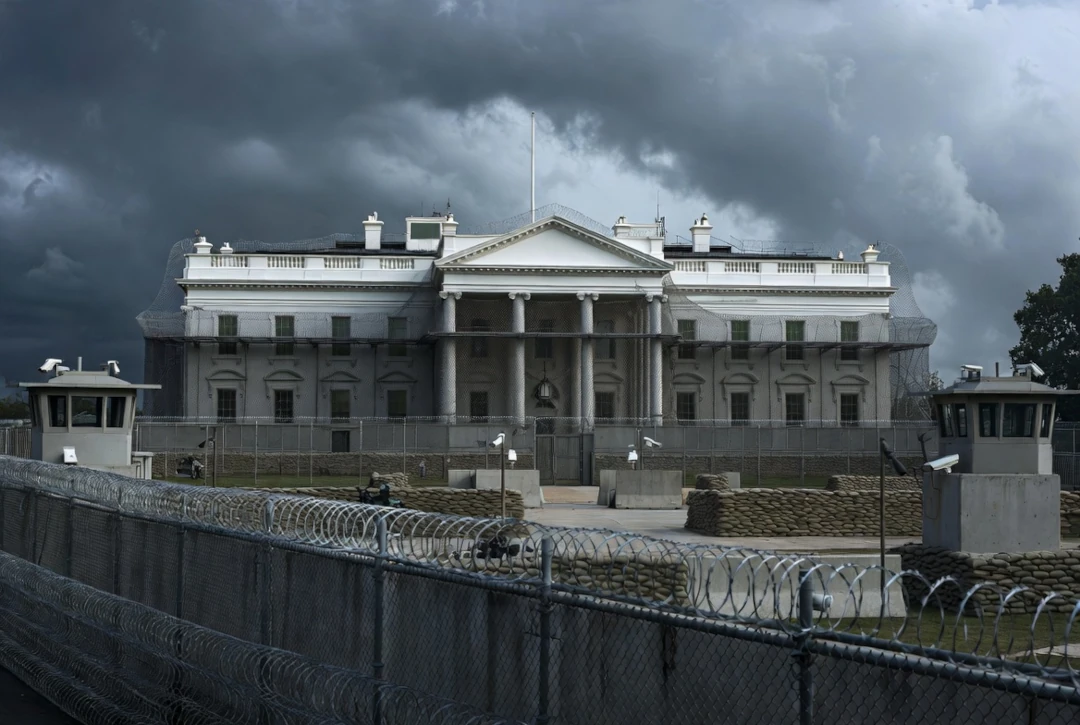
Permanent fencing on Pennsylvania Avenue. A drone port on the roof. A “massive complex” being built beneath a $600 million ballroom. Add it up, and the question is no longer whether Donald Trump is fortifying the White House — but what a president this afraid of his own country cannot see, decide, or lead through.
Something changed at the White House this year, and it is not just the paint on the columns. Beginning July 10, the Trump administration confirmed it is seeking to permanently fence Lafayette Square and the block of Pennsylvania Avenue that has, for generations, belonged to the American public. That announcement did not arrive in isolation. It landed on top of a demolished East Wing, a $600 million ballroom rising from that pit, a rebuilt underground military complex, a proposed rooftop “drone port,” bulletproof glass, “bio-defense,” bomb shelters, a hospital, and a park across the street that has been ringed with construction fencing since January. Taken together, this is no ordinary security upgrade. It is the physical construction, in stone and steel and taxpayer money, of a bunker mentality — and it is being paid for, at least in part, by the same Americans now being fenced out.
The White House has always had layers of protection. What is new is the scale, the secrecy, and the president’s own words about what he is building and why. And what is newer still is the willingness of a growing chorus of lawmakers, physicians, and constitutional scholars to name the pattern for what it is: a president whose behavior, decisions, and fixations have crossed from ordinary security concern into a question the drafters of the 25th Amendment left deliberately open — whether the man in the office is unable to discharge its powers and duties.
I. The Fortress Rises
The permanent-fencing proposal, first reported by CBS News and The Washington Post, would give the Secret Service the ability to seal off Pennsylvania Avenue between 15th and 17th Streets and to close Lafayette Square — the seven-acre park where citizens have gathered to protest, celebrate, and glimpse their president for the better part of two centuries. Previous administrations weighed and rejected the idea, largely on the grounds that a fortified capital sends the wrong signal about American democracy. This administration is not weighing it. It is building it.
Michael McGill, a former General Services Administration official who also served on the National Capital Planning Commission, warned The Washington Post that under Trump’s plan, “residents and tourists alike would be unable to see the White House from any reasonable distance, especially if Trump plants more trees in the park” — a reference to the president’s separate proposal to plant 47 trees in Lafayette Square to commemorate his being the 47th president. Juliette Kayyem, a former Department of Homeland Security official under President Obama, put the tension plainly: “We’ve had this park that has served as a place for citizens to congregate,” she said, “and to encounter their leader.”
The fencing is only the outer ring. Behind it, the East Wing has been demolished and replaced by an active construction site for a 90,000-square-foot ballroom the president initially claimed would be built with private money at a cost of $200 million. That estimate rose to $300 million, then $400 million, then — according to a Clark Construction project summary obtained by The Washington Post — $600 million, of which roughly half is now expected to come from taxpayer-funded departments including the Secret Service, the White House Military Office, and the Executive Residence. In March, standing in the Oval Office, Trump told reporters, “We have no taxpayer putting up 10 cents.” The internal Clark Construction cost estimate, prepared for the White House, had been finalized days earlier. It was not true when he said it.
II. What Trump Told Us Himself
The most important evidence for what this project is really about does not come from opponents. It comes from the president. Speaking to reporters aboard Air Force One in late March, Trump volunteered that “the military is building a massive complex under the ballroom,” describing the ballroom above as “essentially a shed for what’s being built under.” He said the roof would be “droneproof,” that the glass would be “high-grade bulletproof,” and that the below-ground facility would be shielded “from drones and any other thing.”
“The ballroom essentially becomes a shed for what’s being built under… On top of the roof, we’re going to have the greatest drone empire that you’ve ever seen.”
— President Donald Trump, March–May 2026, aboard Air Force One and at the East Wing site
By May, at a press tour of the site reported by Military Times, Trump was reading from a handwritten list: “The roof is droneproof. We have secure air-handling systems. We have bio-defense all over. We have secure telecommunications and communications all over. We have bomb shelters that we’re building. We have a hospital and very major medical facilities that we’re building.” He described a rooftop “DronePort” that would accommodate an “unlimited number of drones,” calling it “perhaps the most sophisticated anywhere in the World.” Renderings he posted to Truth Social showed military drones flanked by snipers on the White House roof.
This is not the rhetoric of a president managing a legitimate threat environment. It is the rhetoric of a man building a stronghold and inviting the country to admire it. Security professionals do not, as a rule, boast on social media about the specifications of their commander-in-chief’s bomb shelter. Historian Garrett Graff, a national-security author, told PBS NewsHour that the entire point of a presidential emergency facility is that adversaries do not know where the president is. Trump has spent months telling them.
III. Timeline: The Bunkering of the People’s House
Administration announces plan for a 90,000-square-foot ballroom attached to the White House. Estimated cost: $200 million. Trump says private donors will pay for all of it.
Demolition of the entire East Wing begins. The Presidential Emergency Operations Center — a bunker in continuous use since Franklin D. Roosevelt — is torn out with it.
Lafayette Square is fenced off for a months-long “renovation.” CNN reports on plans to rebuild the “top-secret” bunker beneath the demolished East Wing.
Trump confirms on Air Force One that “the military is building a massive complex under the ballroom” and that the structure above is “essentially a shed” for what is beneath.
A gunman opens fire at the White House Correspondents’ Dinner. Trump subsequently requests $1 billion from Congress to “harden” the ballroom. The Senate refuses.
Another shooting near a White House checkpoint on 17th Street and Pennsylvania Avenue. A suspect is killed by Secret Service agents.
Leaked Clark Construction records show the ballroom-and-bunker project’s true cost is $600 million, with roughly half funded by taxpayers.
Administration formally advances plan for permanent fencing on Pennsylvania Avenue and around Lafayette Square, closing off historic public space.
IV. The Fortress, Itemized
What is being built and proposed at 1600 Pennsylvania Avenue is not one project. It is a portfolio. Each element is defensible on its own; taken together, they describe a presidency that has retreated behind concrete.
Perimeter Fencing
Permanent fencing on Pennsylvania Avenue and around Lafayette Square, closing off a park used by tourists and protesters alike.
Underground Military Complex
A rebuilt Presidential Emergency Operations Center beneath the demolished East Wing. Trump: “the military wanted it more than anybody.”
Rooftop “DronePort”
A rooftop drone facility Trump described as capable of holding an “unlimited number” of drones — “the greatest drone empire that you’ve ever seen.”
$600M Ballroom
A 90,000-square-foot event hall, roughly half of it now funded by taxpayers, functioning as an above-ground shell for the bunker below.
Hardened Envelope
“High-grade bulletproof glass,” droneproof roof, secure air handling, bio-defense, bomb shelters, and a hospital — Trump’s own itemization.
The Wider Grounds
Brick walkways in Lafayette Square to be replaced with granite so protesters cannot pick up bricks. Fountains, sod, curbs — all behind fencing.
There is a rational core here. Trump has been the target of at least two attempted assassinations in the past two years, along with an armed man at the Correspondents’ Dinner and a shooting outside a White House checkpoint. Any president in his position would harden the facility. But hardening does not require the demolition of a historic wing, the fencing-off of a public square, a $600 million monument to himself half-paid by the public, a rooftop drone armada, or a $1 billion supplemental appropriation request the Senate refused. These are choices — and they are choices that reveal a set of priorities.
V. What the World Sees
A country’s power is not measured only in the size of its bunkers. It is measured in the credibility of its word. And on that measure, the American ledger has been badly damaged.
At the NATO summit in Ankara this month, Italian Prime Minister Giorgia Meloni — once one of Trump’s most reliable European allies — said publicly, “I don’t know why the president of the United States behaves this way toward his own allies.” Retired Lt. Gen. Mark Hertling told MSNBC that “most of the alliance headquarters, they don’t trust Trump, they don’t trust [Defense Secretary Pete] Hegseth.” In a February op-ed in The New York Times, Sens. Jeanne Shaheen (D-N.H.) and Lisa Murkowski (R-Alaska) — a bipartisan pair — warned that Trump’s threats against Greenland and NATO members “do not project strength. They signal unpredictability, weaken deterrence and hand our adversaries exactly what they want.”
Russian Foreign Minister Sergey Lavrov, quoted by PBS NewsHour, called the transatlantic rift “a major upheaval for Europe, and we are watching it.” Sophia Besch of Carnegie Europe wrote that Trump’s threats against Greenland “crossed a line that cannot be uncrossed” — that even without force, “that breach weakens the alliance in a lasting way.” A president who cannot be trusted to defend allies, and who now needs to be shielded behind droneproof glass to face the country he leads, is a president whose signal to the world is one of retreat dressed up as strength.
Adversaries read this correctly. A leader building visible fortifications while insulting allies and threatening “to extinguish a civilization” on social media — as Trump did on Easter weekend, prompting Pope Leo XIV to call the threat “truly unacceptable” — projects not confidence but volatility. Deterrence rests on the belief that a leader is composed, credible, and constrained. None of those adjectives describe this administration.
Get Involved Today
Contribute to our mission and turn your concerns into action.
VI. What It Costs Americans
While hundreds of millions in Secret Service and Military Office funds are diverted to the ballroom-bunker, the underlying economy Trump inherited has been actively worsened by his own hand. Mark Zandi, chief economist at Moody’s Analytics, wrote in May that “the data are definitive; the tariffs have done significant damage to the economy.” The Tax Foundation calculates that the Trump tariffs represent the largest U.S. tax increase as a share of GDP since 1993, costing the average American household roughly $1,500 in 2026. Stanford’s Institute for Economic Policy Research estimates that pass-through of these tariffs to consumers now exceeds 50 percent — a real tax on real families, on top of manufacturing job losses.
The priorities are on display. A president who cannot secure $1 billion from Congress to further fortify his ballroom can nonetheless redirect $155 million from the Secret Service and $149 million from the White House Military Office toward it. A president who tells cameras “I’m not privy to provide any more details” about the bunker at his residence is happy to give reporters an itemized inventory of its features. A president who claims his tariff regime is making Americans richer is presiding over an economy where, as Peterson Institute and Federal Reserve analysts have documented, inflation would likely be more than a point lower without his trade and warmaking decisions.
Ordinary Americans have been priced out of homes, groceries, and borrowing. The People’s House is being priced out of their view.
“Public trust in Donald Trump’s ability to meet the duties of his office has dropped to unprecedented lows. We are at a dangerous precipice, and it is now a matter of national security for Congress to fulfill its responsibilities under the 25th Amendment.”
— Rep. Jamie Raskin (D-Md.), April 14, 2026
VII. The Constitutional Question
“Unable to discharge the powers and duties of his office.”
The Twenty-Fifth Amendment gives the Vice President and either a majority of the Cabinet or “such other body as Congress may by law provide” the authority to declare a sitting president unable to discharge the powers and duties of the office. It does not define “unable.” That silence was intentional.
The framers’ choice
Yale Law School’s Rule of Law Clinic, whose Reader’s Guide to the amendment was praised by primary drafter Sen. Birch Bayh himself, concludes that “while the amendment’s framers generally contemplated Section 4’s employment in the case of the President’s mental or physical incapacitation, they also expressly disclaimed any intent to define ‘inability.’ They purposefully set forth a flexible standard intentionally designed to apply to a wide variety of unforeseen emergencies.” Rep. Emanuel Celler, one of the House architects of the amendment, told his colleagues in 1965 that the president “may be as nutty as a fruitcake. He may be utterly insane.” The drafters left the door open on purpose.
What lawmakers are saying now
On April 14, 2026, Rep. Jamie Raskin (D-Md.), joined by 50 Democratic co-sponsors, formally introduced legislation to create a bipartisan Commission on Presidential Capacity — the “other body” that Section 4 explicitly permits Congress to establish. Two weeks later, Sens. Sheldon Whitehouse (D-R.I.) and Jack Reed (D-R.I.) entered into the Congressional Record a statement signed by 36 physicians — neurologists, psychiatrists, and specialists from Harvard, Tufts, Columbia, and George Washington University — warning of Trump’s “rapidly worsening, reality-untethered, increasingly dangerous decline.” They called him “mentally unfit” and urged the invocation of the 25th Amendment “with the greatest urgency.”
The connection to what is being built
A leader’s judgment is not something one reads only in speeches. It is something one reads in choices. The choice to demolish a wing of the White House to build a personal monument and a private fortress. The choice to insist on record while records show the opposite. The choice to broadcast the specifications of a classified bunker to the world. The choice to alienate the allies whose intelligence and airspace keep this country safe, then fence oneself off from the citizens whose consent one governs by. Under the standard the drafters deliberately left open — the “totality of the circumstances” test that Yale’s guide calls the correct reading of Section 4 — these choices bear directly on capacity, not merely on politics.
The path is hard. Section 4 requires the Vice President and a majority of the Cabinet — Trump’s own hand-picked people — to act. That will not happen absent extraordinary circumstances. Raskin’s Commission bill will die in a Republican-controlled Congress. Yet the constitutional argument does not depend on the immediate political prospects of its remedy. It depends on the honest description of the record. The framers built Section 4 because they knew there would be moments when the country needed to name a truth even if it could not immediately act on it. The naming matters. The record matters. History does not grade only outcomes; it grades who saw clearly, and when.
VIII. The Fear on Display
What is a president afraid of when he builds like this? The honest answer, from the president’s own words and the record of his conduct, is: nearly everything he cannot control. He is afraid of protesters — hence the granite walkways and the fenced park. He is afraid of drones — hence the rooftop empire and the droneproof glass. He is afraid of losing the news cycle — hence the daily social-media itemization of his fortress. He is afraid of a country that keeps refusing to worship him — hence the 47 trees, the arch, the ballroom bearing his imprint that will outlast his term. And he is afraid, above all, of accountability. Fences do not just keep people out. They keep the president from having to look at them.
Courage in a president is not a matter of temperament alone. It is a matter of the ability to make hard decisions in full view of the people who will bear their consequences. A leader who builds a bunker to hide from his own citizens has already ceded something essential about the office. The founders did not envision an executive walled off from the republic. They envisioned a First Citizen. Trump has, in stone and steel and public money, chosen otherwise.
Editorial Conclusion
A president who fences himself off from the country he governs, who broadcasts the specifications of his bunker while insulting the allies who protect his airspace, who diverts hundreds of millions from public agencies to build a monument to himself while ordinary Americans absorb the cost of his tariffs, is not projecting strength. He is projecting fear — and the fear is not of foreign adversaries. It is of his own people.
The Twenty-Fifth Amendment does not require unanimity to matter. It requires that Congress and the country be honest about the record. That record now includes a demolished East Wing, a $600 million fortress half-funded by the public, a rooftop drone armada, a fenced-off public square, an allied consensus that America can no longer be trusted at its word, and 36 physicians on the Congressional Record calling for the amendment to be invoked.
The remedy is difficult. The description is not. What is being built at 1600 Pennsylvania Avenue is not the People’s House. It is a bunker. And a bunker presidency is not the presidency the Constitution contemplates.
Sources & References
- CBS News — White House considering plan to add permanent fencing on Pennsylvania Ave. to bolster security (July 10, 2026)
- The Washington Post — Trump plan would fence public areas by White House as security measure (July 10, 2026)
- The Daily Beast — Trump Unveils Plan to Completely Fence Off People’s House (July 10, 2026)
- The Washington Post — Records reveal $600M estimate for Trump’s ballroom project, with half from taxpayers (June 16, 2026)
- HuffPost — Trump Ballroom Costs Balloon To $600 Million, Taxpayers To Foot Half Bill (June 2026)
- The Hill — White House ballroom costs may rise to $600M, with half coming from taxpayers
- NBC News — Trump says White House ballroom plans include ‘massive’ underground military complex
- NPR — Trump’s ballroom fight sheds new light on an underground White House bunker (April 3, 2026)
- TIME — What We Know About the ‘Massive’ Military Complex Being Built Beneath the White House
- PBS NewsHour — A brief history of the underground White House bunker at the heart of Trump’s ballroom legal case
- Military Times — Trump invokes national security in push for White House ballroom ‘drone port’ (June 1, 2026)
- NPR — The many ways Trump wants to change D.C., from buildings to statues to parks
- CNN Politics — ‘The thing I do best in life is build’: How Trump has made construction his second job as president
- MSNBC / MS NOW — Trump attends NATO summit, antagonizing allies and increasingly isolating U.S. (July 2026)
- PBS NewsHour — NATO’s credibility as a unified force under U.S. leadership has taken a hit under Trump
- Carnegie Endowment — Ahead of the Ankara Summit, NATO’s Mood Has Changed
- Fortune / Moody’s Analytics — Trump’s tariffs have done ‘significant damage’ to the U.S. economy, says Moody’s chief economist
- Tax Foundation — Tracking the Impact of the Trump Tariffs & Trade War
- Stanford SIEPR — The U.S. economy in 2026: What to watch for
- MS NOW / NBC News — Raskin offers bill setting up 25th Amendment process to remove Trump from office
- The Hill (Opinion) — Concerns Grow Over Trump’s Mental Fitness for Presidency
- Yale Law School Rule of Law Clinic — Rule of Law Clinic Releases “Reader’s Guide” for the 25th Amendment
- Congress.gov (CRS) — Presidential Disability Under the Twenty-Fifth Amendment: Constitutional Provisions and Perspectives for Congress
Related News