On May 4, 2026, more than forty world leaders gathered in Armenia to reaffirm multilateralism, the rule of law, and collective security — pointedly without the United States. The same week, Donald Trump blindsided NATO allies with an impulsive troop withdrawal from Germany and threatened to deepen it further, while over 70 lawmakers at home demanded a reckoning with his fitness to serve. The question the Yerevan summit posed to America is one the Constitution already has an answer for.
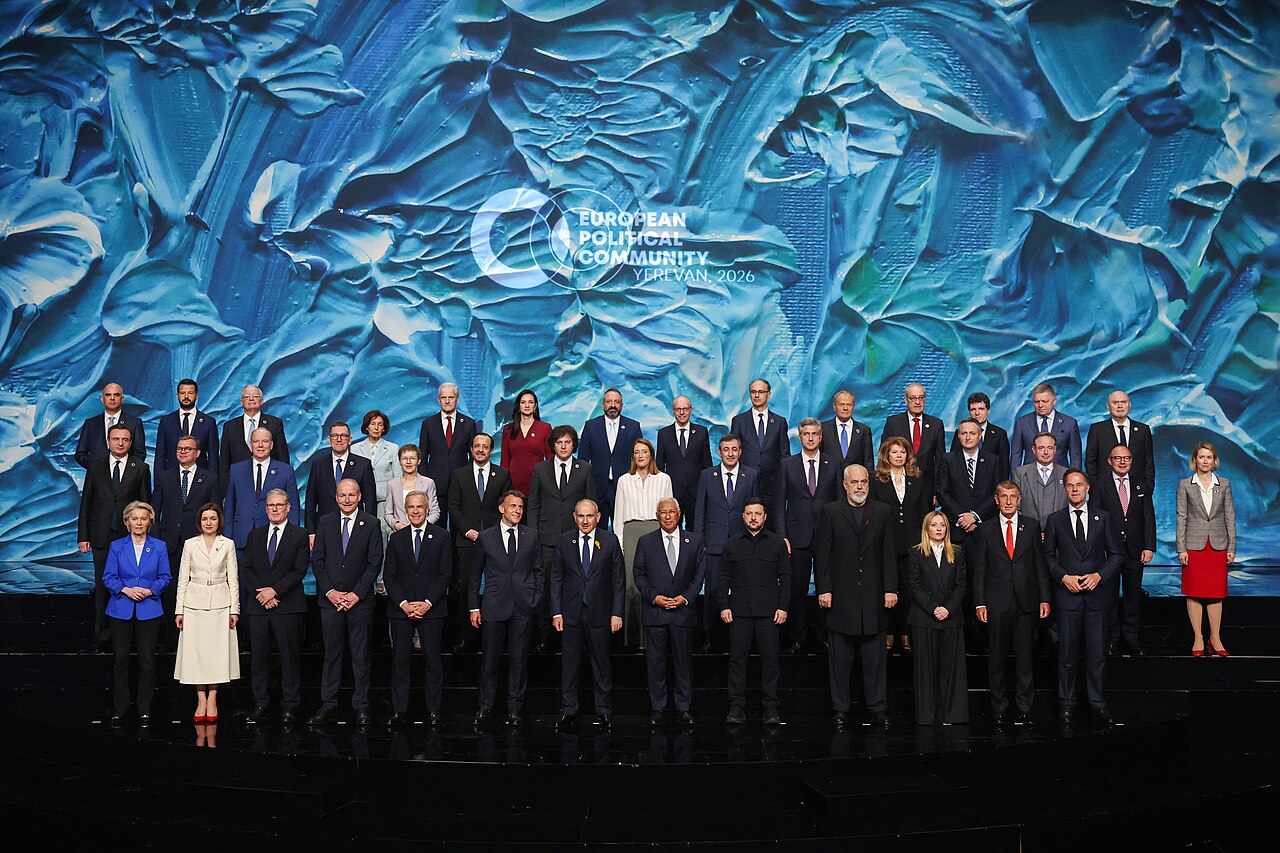
The Armenian capital of Yerevan is not a city that often finds itself at the center of the world’s geopolitical attention. But on May 4, 2026, it became exactly that — host to the 8th summit of the European Political Community, the largest international gathering Armenia had witnessed since its independence. Forty-eight heads of state and government descended on Yerevan to do something increasingly rare in the Trump era: sit at the same table, speak in the same language of international law, and commit — together — to a multilateral future. The United States was not among them. It was not an oversight. It was a verdict.
The European Political Community is not a formal treaty body requiring American membership. But its 2026 convening — attended by European Council President António Costa, European Commission President Ursula von der Leyen, NATO Secretary General Mark Rutte, Ukrainian President Volodymyr Zelensky, British Prime Minister Keir Starmer, French President Emmanuel Macron, and Canadian Prime Minister Mark Carney — was self-consciously constructed as a demonstration of values America under Trump has abandoned. Costa said it plainly upon arrival: “Europe must be at the forefront of the defence of the rules-based international order, anchored in the UN Charter as the main pillar of multilateralism.”
That sentence was not a pleasantry. It was, in context, an indictment — of an administration that has spent eighteen months systematically dismantling precisely that order. Trump did not show up in Yerevan because Trump was not invited. And Trump was not invited because America, under his leadership, no longer speaks the same diplomatic language as the rest of the democratic world.
1. The Summit America Missed — And What Was Said There
The 8th EPC summit was historic for reasons beyond its geographic novelty. It was the first time the community had convened in the South Caucasus, and it arrived alongside a landmark first-ever bilateral EU-Armenia summit, signaling Yerevan’s determined pivot away from Moscow’s orbit and toward European integration. The EU pledged €2.5 billion in investment in Armenia under its Global Gateway strategy, and just two weeks prior, the European Council had voted to establish a civilian EU Partnership Mission in Armenia — a formal security commitment to a nation that had spent decades under Russian influence.
Canadian Prime Minister Mark Carney attended as the first-ever non-European leader formally invited to an EPC gathering — a distinction that itself carried meaning. Carney did not merely attend; he made clear why. The international order, he declared, “will be rebuilt out of Europe.” This was not a taunt directed at Washington. It was an assessment. A strategic conclusion drawn from watching a United States president withdraw from 66 international organizations, call NATO a “paper tiger,” and announce troop withdrawals designed not to advance American security but to punish a German chancellor for criticizing his war strategy.
“In a world of growing chaos, that vision must be guided by one clear, overarching principle: Europe must be at the forefront of the defence of the rules-based international order, anchored in the UN Charter.”
— António Costa, President of the European Council, Yerevan, May 4, 2026
NATO Secretary General Mark Rutte also attended — and his presence underscored a profound institutional tension. Rutte is nominally America’s partner at the helm of the Western alliance. But the alliance he now leads is one whose American pillar has been crumbling in real time, as Trump treats NATO commitments as bargaining chips and bilateral troop deployments as personal retribution tools. Rutte met with Zelensky in Yerevan, reaffirming “NATO’s unwavering support for Ukraine” — a position that grows more strained with every passing Trump announcement.
2. The Troop Withdrawal That Blindsided an Alliance
Days before the Yerevan summit opened, the Trump administration dropped a different kind of announcement — one that illustrated, with remarkable clarity, exactly why America was not in the room in Armenia. Without advance consultation with NATO command, without strategic rationale, and without any formal coordination process, the Pentagon announced it would withdraw approximately 5,000 active-duty troops from Germany within six to twelve months. Trump then told reporters the reduction would go “a lot further” — adding that he planned on “cutting a lot further” — without specifying when, how, or to what end.
According to reporting by Euronews, senior NATO officials were not warned before the Pentagon’s announcement. One American source told the outlet that the figure of 5,000 was “a top-line number that Trump took out of the sky because he wanted to do something demonstrative as part of his confrontation with Merz.” It was not strategy. It was spite.
The confrontation with German Chancellor Friedrich Merz had begun when Merz publicly criticized Trump’s handling of the Iran war, saying the US was being “humiliated” by the prolonged conflict. Trump responded with a social media post instructing Merz to worry about ending the war in Ukraine instead of commenting on American policy. Within hours, the Pentagon had announced a troop withdrawal that its own officials could not explain in detail. The Council on Foreign Relations, in an analysis published May 4, noted that the Tomahawk missile deployment to Germany — scheduled for 2027 — may also be canceled, a development with far graver implications for NATO deterrence than the troop numbers themselves.
Senior NATO command was given no advance warning before the Pentagon announced 5,000 troops would leave Germany — a move sources described as lacking any coherent strategy. Euronews, May 3, 2026
Republican Senators Roger Wicker (MS) and Rep. Mike Rogers (AL) warned the withdrawal risked “undermining deterrence and sending the wrong signal to Vladimir Putin.” Fortune, May 2, 2026
The Council on Foreign Relations warned that the possible cancellation of Tomahawk cruise missile deployments to Germany poses a graver threat to NATO deterrence than the troop numbers. CFR, May 4, 2026
In January 2026, Trump signed a presidential memorandum withdrawing the US from 66 international organizations, including UNFCCC, IPCC, UNESCO, and the WHO — the core of the multilateral system. Union of Concerned Scientists, Jan. 2026
3. A Pattern of Strategic Abdication
The Yerevan moment did not materialize in a vacuum. It is the logical endpoint of a systematic campaign to dismantle American engagement with the democratic world — conducted not by adversaries, but by the American president himself. Since taking office in January 2025, Trump’s administration has, according to a Brookings Institution analysis, “taken a meat cleaver to several elements of the multilateral order.” The imposition of sweeping, poorly structured tariffs disrupted the WTO-based trading system. A new National Security Strategy advanced arguments about American resource extraction in the Western Hemisphere that contradict the foundational prohibition in the UN Charter against territorial acquisition.
Foreign Policy, in a February 2026 analysis, identified the result: the United States is now functioning as “a global spoiler” — bending norms against the use of force, threatening the essence of NATO through its designs on Greenland, and scuttling consensus on global agreements. While the Trump administration has exited, defunded, or hollowed out multilateral bodies, the rest of the world has not stood still. It has begun building without Washington.
The Yerevan summit’s structure captured this dynamic precisely. Canada — not an EPC member — was invited as a symbolic guest to affirm democratic solidarity, in a signal that the democratic West is reconfiguring itself around European leadership. EU foreign policy chief Kaja Kallas said upon arrival that even discussing the American troop withdrawal timing felt surreal: “I can’t understand what’s going on in President Trump’s head.” That statement, from a senior Western official, deserves to be read not as a rhetorical flourish but as a diagnosis.
Get Involved Today
Contribute to our mission and turn your concerns into action.
4. A Chronology of Retreat
Trump signs presidential memorandum withdrawing the United States from 66 international organizations, including the UNFCCC, IPCC, UNESCO, and WHO — the broadest single act of multilateral disengagement in American history.
Trump launches military strikes against Iran without a congressional declaration of war, over internal warnings of retaliation, beginning a conflict that chooses off the Strait of Hormuz and sends energy prices soaring globally.
Trump posts on Truth Social on Easter Sunday threatening to make “Power Plant Day and Bridge Day” in Iran — threatening strikes on civilian infrastructure — triggering bipartisan alarm and the first wave of 25th Amendment calls.
Rep. Jamie Raskin (D-MD), Ranking Member of the House Judiciary Committee, writes to the White House Physician demanding a comprehensive cognitive and neurological evaluation of the president, citing “incoherent, volatile, and alarming” public statements.
Raskin formally introduces a bill with 50 Democratic co-sponsors to create a Commission on Presidential Capacity under the 25th Amendment. More than 70 Democratic lawmakers have now called for Trump’s removal.
Trump announces withdrawal of 5,000 troops from Germany — blindsiding NATO command — then vows to cut “a lot further,” with no strategic detail and no allied consultation. Republican lawmakers call it dangerous and potentially emboldening to Putin.
The 8th EPC Summit opens in Yerevan with 48 heads of state and government. The United States is absent. The world’s democratic nations reaffirm the rules-based international order — and begin organizing around European leadership in America’s place.
he Mechanism the Framers Built for This Moment
The 25th Amendment was ratified in 1967, in the aftermath of President John F. Kennedy’s assassination, to formalize procedures for addressing presidential incapacity. Section Four — its most consequential and least-used provision — establishes that whenever the Vice President and a majority of Cabinet officers transmit to Congress a written declaration that the president “is unable to discharge the powers and duties of his office,” the Vice President immediately assumes those powers as Acting President.
Section Four does not require proof of physical illness. The constitutional language is deliberately broad: “unable to discharge the powers and duties of his office.” Legal scholars have long argued that profound cognitive impairment, strategic incoherence, and unmanageable erratic behavior qualify — particularly when a Commander-in-Chief is directing active military operations. Rep. Jamie Raskin (D-MD), citing language in the amendment that allows “such other body as Congress may by law provide” to participate in the declaration process, has argued that Congress itself can create a mechanism to force the question of presidential capacity.
Raskin’s bill, introduced April 14 with 50 co-sponsors, would create a bipartisan Commission on Presidential Capacity — a panel of physicians and former senior officials — empowered to assess whether the president meets the constitutional threshold for incapacity. Rep. Yassamin Ansari (D-AZ) called Trump “a national security threat to our country and the rest of the world.” Rep. Melanie Stansbury (D-NM) said flatly: “Time for the 25th Amendment. Congress and the Cabinet must act.” Over 70 Democratic lawmakers have now joined some form of removal or incapacity proceeding.
The practical barriers are formidable. Republicans control both chambers of Congress. Vice President JD Vance has given no public indication he would participate in any Section Four declaration. Even if a declaration were transmitted, Congress would need a two-thirds majority in both chambers to make it permanent. The political path is almost certainly blocked — for now.
But the constitutional argument is not nullified by political obstruction. The 25th Amendment was written because the Framers understood that a president’s incapacity could itself become the greatest threat to constitutional order. A commander-in-chief who threatens to destroy another nation’s civilian power grid on a holiday Sunday. Who impulsively withdraws troops from a NATO ally to punish a chancellor for a press conference. Who has presided over the dismantling of 66 international bodies while America’s democratic partners build a world order in its absence. The constitutional standard does not require a diagnosis. It requires a judgment. And the evidence for that judgment is accumulating — in every abandoned treaty, every blindsided NATO command, and every empty chair at a summit in Yerevan.
5. What the World Is Saying — And Building — Without Us
The most consequential message from Yerevan was not delivered in a press conference. It was delivered by the list of attendees. Forty-eight nations. NATO’s Secretary General. The heads of state of Britain, France, Canada, Norway, Italy, Ukraine, Georgia, Albania, Iceland, Kosovo, Moldova, and dozens more. The European Commission. The European Parliament. The European Council. All of them, in the same room, speaking the same language of collective security, democratic resilience, and rules-based engagement.
The summit’s final communiqué from the concurrent EU-Armenia bilateral meeting committed to cooperation on energy, digital infrastructure, artificial intelligence aligned with the EU AI Act, cybersecurity, and the fight against foreign information manipulation — a comprehensive architecture of democratic governance. Armenia itself, once firmly in Russia’s orbit, is now oriented toward Europe: applying for association with EU institutions, beginning a visa liberalization dialogue, and formally partnering with the EU’s Common Security and Defence Policy.
“Today’s summit shows that Europe’s way of doing things — diplomacy, multilateralism, and respect for international law — yields results. It yields peace.”
— António Costa, European Council President, closing press statement, Yerevan, May 4, 2026
British Prime Minister Keir Starmer said simply that “there needs to be a stronger European element in NATO.” Norwegian Prime Minister Jonas Gahr Støre called for the troop withdrawal to be handled “in a harmonious way inside the framework of NATO” — a statement that, in its deliberate mildness, contained a pointed rebuke: harmony is precisely what the Trump administration has been abandoning.
What happened in Yerevan on May 4 was not just a summit. It was a proof of concept — a demonstration that the democratic world can organize, convene, invest, commit, and lead without America at the table. The Brookings Institution observed in February that the United States under Trump “now appears to eschew both the baseline argument for relative self-restraint in world affairs, and the case for basic decency in its relations with longtime and would-be allies.” The world has taken note. And it has begun to act accordingly.
Editorial Conclusion
Forty-eight democratic nations gathered in Yerevan and, by their very presence together, issued a verdict on American leadership under Donald Trump: the United States is no longer a reliable partner in the construction of a peaceful, rules-based world. That conclusion was not reached by adversaries. It was reached by allies — by the leaders of Britain, France, Canada, Norway, Ukraine, and dozens of others who once looked to Washington as democracy’s anchor.
The same week those leaders met, Trump blindsided NATO by withdrawing thousands of troops from Germany on impulse, in retaliation for a German chancellor’s press conference. He has withdrawn the United States from 66 international institutions. He has threatened to obliterate Iranian civilian infrastructure from his phone on Easter morning. And more than 70 members of Congress — including Republicans on the Armed Services Committees — have either called for his removal or warned that his decisions are emboldening Vladimir Putin.
The 25th Amendment exists not as a political weapon but as a constitutional safeguard — the framers’ answer to the question of what happens when the person holding the most consequential office in the democratic world loses the capacity to discharge its duties with the coherence, predictability, and restraint those duties demand. What the Yerevan summit made visible — to the entire world — is that America is failing that test in real time, in front of every democratic nation on earth. The Constitution provides a remedy. What is required now is the political will — and the moral courage — to use it.
Sources & References
- European Council — Meeting of the European Political Community, May 4, 2026
- European Council — First EU-Armenia Summit Announced, March 26, 2026
- Wikipedia — 8th European Political Community Summit, Yerevan
- France 24 — European and Canadian Leaders Hold Security Talks in Yerevan, May 4, 2026
- NATO — Secretary General Rutte Attends EPC Summit in Armenia, May 4, 2026
- Northwest Arkansas Democrat-Gazette — Leaders Meet at Armenia Summit, May 5, 2026
- Euronews — “No Strategy” Behind Trump’s Withdrawal of NATO Troops, May 3, 2026
- Fortune — Trump Vows to Reduce Troops “a Lot Further” Than 5,000, May 2, 2026
- Time — The U.S. Military Drawdown in Europe Has Only Just Begun, May 3, 2026
- Council on Foreign Relations — Trump Pulling Troops From Germany; Missiles a Bigger Problem, May 4, 2026
- House Judiciary Dems — Raskin Demands Cognitive Evaluation of Trump, April 10, 2026
- Great America News Desk — House Democrats File 25th Amendment Commission Bill, April 2026
- Axios — Raskin Demands Trump Cognitive Test in 25th Amendment Push, April 10, 2026
- Time — What to Know About the 25th Amendment as Lawmakers Call for Trump’s Removal, April 6, 2026
- Union of Concerned Scientists — Trump Withdraws US From 66 International Organizations, January 2026
- Foreign Policy — Trump’s Rejection of Multilateralism Is Bad for the U.S. and the World, January 2026
- Brookings Institution — Trump’s “Board of Peace” and the Multilateral Order, February 2026
- Council of the EU — EU-Armenia Summit Joint Statement (Document ST-8799-2026), May 4, 2026
Related News