Green Water, Red Flags: What a Failing Reflecting Pool tells us about a Failing Presidency
A $14 million vanity project — peeling, algae-choked, and steered to a Mar-a-Lago neighbor without a competitive bid — has become the most honest mirror of Donald Trump’s second term that the National Mall has ever produced. The pool reflects what we should already see.
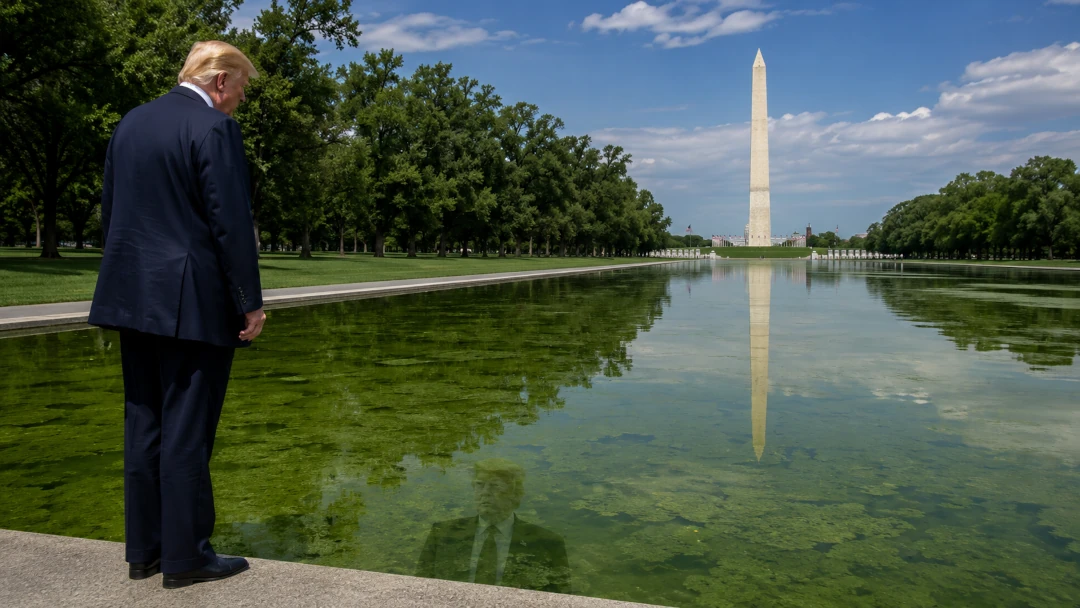
The reflecting pool was supposed to mirror something. That, after all, is what reflecting pools do — they hold the sky and the monuments steady, returning to us a clearer picture of the country built around them. What the Lincoln Memorial Reflecting Pool reflects this June is not the Washington Monument. It is a presidency. And the image is not flattering.
For nearly a century, the basin between the Lincoln Memorial and the Washington Monument has served as a stage for the American conscience. Marian Anderson sang at its edge in 1939 after being barred from Constitution Hall because she was Black. Martin Luther King Jr. delivered “I Have a Dream” to a quarter of a million people gathered along its banks in 1963. One hundred thousand Americans assembled there in 1967 to march on the Pentagon against the Vietnam War. The pool’s quiet, dark, achromatic surface was, in the literal language of the National Park Service’s 1999 Cultural Landscape Report, a “character-defining feature” — a void deliberately engineered to deepen reflection, both optical and civic.
Now it is bright blue, breaking apart, and overrun with algae. The contract to install its water-treatment system was steered, without competitive bidding, to a company called Greenwater Services that is owned by a $300,000 Trump donor with a 2002 federal conviction for conspiring to bribe a sitting member of Congress. The president is blaming, without evidence, anonymous vandals. The cost has multiplied roughly sevenfold past the figure he first announced. And he wants it finished, regardless of the result, in time for a photo opportunity.
This is not a story about a paint job. This is the story of the second term, told in miniature.
1. A $14 Million Mirror
Begin with what we know. In April, President Trump announced he was going to fix what he called the “absolutely filthy” Reflecting Pool by painting its bottom what he termed “American flag blue,” in time for the country’s 250th anniversary celebrations. He told reporters in the Oval Office the project would cost roughly $2 million and take a week or two. Neither claim turned out to be remotely true.
According to federal contracting records reviewed by The New York Times and CBS News, the National Park Service paid Virginia-based Atlantic Industrial Coatings $14.7 million — without competitive bidding — to apply the blue waterproofing. A separate no-bid contract for $1.7 million went to Greenwater Services for the water-treatment system. The total is roughly seven times Trump’s stated estimate. To finance this and other “beautification” projects, the Washington Post reported that the administration has diverted at least $90 million from national-park entrance fees — money that would otherwise pay for trail maintenance and ranger salaries — into Trump’s July Fourth pageantry.
Within 24 hours of refilling, the pool turned green. By Thursday of last week, sheets of the new blue waterproofing were peeling off the concrete and drifting to the surface, where they joined the algae blooms now requiring federal workers to wade into the basin with hoses and bottles of hydrogen peroxide. By June 19, an aerial photograph published by CNN showed water that resembled a stagnant ditch more than a reflecting plane. The president responded by claiming on Truth Social that the damage was the work of vandals who had been arrested. Multiple outlets have noted that there is no evidence to support this claim.
2. The Donor’s Cut
The procurement story is where the metaphor sharpens into something legally serious. The $1.7 million water-purification contract was awarded — without a competitive bidding process — to a company called Greenwater Services of Brookfield, Ohio. Its ultimate owner, according to federal contracting records first reported by The New York Times, is the J.J. Cafaro Investment Trust. The trust is headed by John J. Cafaro, a longtime Republican donor who owns a Palm Beach mansion less than a mile from Trump’s Mar-a-Lago club and whom Trump has publicly called “a fantastic man.”
Cafaro is not a stranger to federal scrutiny. In 2002, he pled guilty to conspiracy to bribe former Democratic Representative Jim Traficant of Ohio. Cafaro has donated more than $300,000 to Trump-linked political committees since 2016. His wife chaired a Red Cross gala at Mar-a-Lago. Federal contracting databases show his company had received exactly one other federal contract in its history — a $1 million study on Tijuana River sewage — before walking into a sole-source deal for a National Mall landmark.
The Times also reported that David Schutzenhofer — the general manager of Trump’s golf club in Bedminster, New Jersey — personally advised the National Park Service on the project and was in contact with Greenwater Services. The administration’s justification for skipping competitive bidding is “urgency.” Jessica Tillipman, a government contracting law professor at George Washington University, told the Times that the urgency exception “is not meant for cases where the government is merely behind schedule,” and that “the government cannot create its own urgency.”
“You can’t make this up: after railing about waste, fraud, and abuse, the Trump administration spent $14 million on a reflecting pool reno that’s now peeling and chock full of algae. I’m pressing to get answers for this embarrassing waste of resources.”
— Sen. Jeff Merkley (D-Ore.), June 2026
3. The Pattern, in Miniature
Why does this matter beyond Washington’s most famous puddle? Because every element of this episode — the obsessive personal fixation, the no-bid steering of millions to a personal acquaintance, the bypassing of legally required review, the disregard for institutional expertise, the inflated estimates, the broken result, the reflex accusation of sabotage, the photo-op above all else — is the operating logic of the entire second administration in concentrated form.
Consider the legal bypass. On May 11, the Cultural Landscape Foundation (TCLF) filed suit in federal court arguing that the administration violated Section 106 of the National Historic Preservation Act of 1966 by altering a property listed on the National Register of Historic Places without the required consultation. The administration also bypassed review by the U.S. Commission of Fine Arts, the independent body established under 40 U.S.C. § 9101 to oversee design changes to federal monuments. Charles Birnbaum, the TCLF president who spent fifteen years at the Park Service and authored the federal standards governing this exact review process, called the dark basin “the design” — not a coincidence to be papered over.
Judge Carl Nichols, a Trump appointee, heard arguments on the foundation’s request for an emergency injunction. The administration declared the work complete before he ruled — a move legal observers noted as a deliberate effort to render the case moot. This is what we mean by “bypassing review.” It is not bureaucratic shortcut. It is a method.
4. A Timeline of Fixation
Get Involved Today
Contribute to our mission and turn your concerns into action.
5. The Question Beneath the Surface
No reasonable observer believes a green pool is, by itself, a constitutional crisis. A failed paint job is not impeachable. A no-bid contract to a donor is — and should be — the work of the Office of Inspector General, congressional oversight committees, and, eventually, a court. These are scandals; they are not, in isolation, evidence of incapacity.
But the reflecting pool is not in isolation. It is part of a pattern that has, since April, prompted a serving member of Congress and the ranking Democrat on the House Judiciary Committee to formally invoke the constitutional mechanism the framers of the 25th Amendment built for precisely this kind of moment.
Section 4 of the Twenty-Fifth Amendment, and Why It Exists
Ratified in 1967 in the wake of the Kennedy assassination, the 25th Amendment establishes the procedure by which a president unable to discharge the powers of the office may be removed from those powers — temporarily, by the vice president and a majority of the cabinet, with a permanent body that Congress may establish by law as an alternative to the cabinet. Section 4 was specifically designed for situations in which the president is incapable of acknowledging his own incapacity.
What lawmakers have actually proposed
On April 14, 2026, Rep. Jamie Raskin (D-Md.), the ranking member of the House Judiciary Committee, introduced legislation to establish the Commission on Presidential Capacity to Discharge the Powers and Duties of Office — the body the 25th Amendment authorizes Congress to create but never has. Fifty House Democrats co-sponsored. Rep. Yassamin Ansari (D-Ariz.) and Rep. Alexandria Ocasio-Cortez (D-N.Y.) have publicly called for invocation. The catalyst was Trump’s social-media threat that “a whole civilization will die tonight” amid the Iran conflict, but the underlying argument is broader: a sustained, documented pattern of erratic judgment.
The constitutional argument
Raskin’s case is not that any single act crosses a threshold. It is that the framers anticipated cumulative, observable incapacity — judgment so impaired that the officeholder cannot recognize it in himself — and built Section 4 to address it. A president who fixates for weeks on a pool’s color, inflates a $2 million estimate to $14 million in service of a self-image, steers contracts to a personally connected donor with a federal bribery conviction, posts AI-generated swimsuit images of himself in the pool, and then accuses imagined vandals of sabotage when the project visibly fails — is exhibiting, in the language of Raskin’s letter to the White House physician, behavior “plainly out of the realm of normal politics.”
The honest barriers
The political barriers are real and we will not pretend otherwise. Section 4 requires the vice president to act; Vice President JD Vance will not. It requires either a majority of the cabinet or the commission Congress has not yet established; the cabinet was chosen for loyalty, and the Republican-controlled Congress will not advance Raskin’s bill. Even if both somehow concurred, Congress would have to ratify the removal by a two-thirds vote in each chamber. The path is, at this moment, effectively closed.
Why the barriers do not negate the case
A constitutional argument is not silenced because the political path is hard. The 25th Amendment exists in our charter regardless of whether the current Congress chooses to honor it. Raskin’s legislation, even if it dies in committee, establishes for the historical record what reasonable observers — including, as he noted, “several of the President’s longtime allies and supporters” — see plainly: that a person exhibiting this pattern of conduct is not fit to hold the office he occupies. The reflecting pool is not the cause. It is the evidence anyone walking the Mall this summer can see for themselves.
6. What the Pool Reflects
The Lincoln Memorial Reflecting Pool was designed by Henry Bacon in 1924 to disappear. Its genius was self-effacement. Its dark, neutral basin held the Washington Monument and the sky perfectly still so that the country could see itself. Trump’s redesign inverts the entire premise: it foregrounds the basin, dyes it the color of a swimming pool, and breaks the optical effect. As TCLF attorney Alexander Kristofcak put it in court filings, the new pool now resembles “a large swimming pool rather than the reflective civic landscape it was designed to be.”
That is the metaphor. A monumental civic instrument, built to make the country visible to itself, repurposed at vast public cost into a personal swimming-pool fantasy of the man in office — broken, leaking, algae-choked, awarded to a friend, defended with lies, paid for by raiding the parks. The pool reflects what we should already see. The question is whether we will look.
Editorial Conclusion
The Lincoln Memorial Reflecting Pool is not the most important failure of the second Trump term. It is the most legible one. A president fit for the office does not divert ninety million dollars from the park system to repaint a landmark in time for a parade. A president fit for the office does not hand sole-source millions to a Mar-a-Lago neighbor convicted of bribing a congressman. A president fit for the office does not invent vandals when the work he ordered begins to peel.
The constitutional remedy exists. The political path to it is, today, blocked. That fact does not change what is true. Rep. Raskin’s legislation deserves a floor vote, the no-bid contracts deserve a full inspector-general investigation, and the country deserves a Congress willing to do what the Constitution permits it to do. Until then, the pool will keep on reflecting. We are obliged to look at what it shows.
Sources & References
- CNN PoliticsTrump claims multiple people arrested for vandalizing Reflecting Pool (June 20, 2026)
- NPRReflecting Pool refills after Trump’s repaint (June 5, 2026)
- CBS NewsCompany owned by Trump donor won $1.7 million no-bid Reflecting Pool contract (June 2026)
- The Daily BeastTrump’s Reflecting Pool Fiasco Gets Even More Embarrassing With Cafaro Contract Revelation
- NewsweekWho Is John Cafaro? Trump Donor Scrutinized Amid Reflecting Pool Debacle
- MediaiteOwner of Reflecting Pool Renovation Company Pleaded Guilty to Bribing a Congressman
- Raw StoryAstonishing irony as no-bid contractor behind algae-ridden pool named
- Cultural Landscape FoundationTCLF Sues Department of the Interior Over the Painting of the Reflecting Pool (May 11, 2026)
- Architect MagazineAmerica’s Most Sacred Reflecting Pool Just Turned Blue (May 12, 2026)
- NPRNonprofit sues federal government over plans to paint Reflecting Pool blue
- PBS NewsHourDesign plan for Trump’s proposed Washington arch approved
- House Judiciary Committee DemocratsRaskin Introduces Legislation Establishing Independent Commission on Presidential Capacity (April 14, 2026)
- House Judiciary Committee DemocratsRaskin Demands White House Physician Evaluate Trump’s Cognitive Fitness (April 10, 2026)
- The HillRaskin introduces bill to assess president’s fitness under 25th Amendment
- Spectrum NewsDozens of House Democrats launch 25th Amendment commission effort
- Straight Arrow NewsTrump says reflecting pool ‘all fixed’ as water makes a splash again
- AlternetTrump’s Mar-a-Lago neighbor owns company behind Reflecting Pool humiliation
- WikipediaLincoln Memorial Reflecting Pool — History and 2026 Renovation
Related News