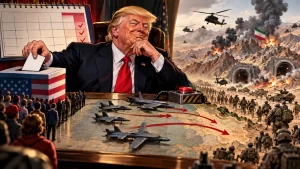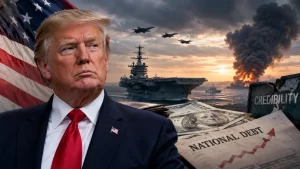
A war the president started without Congress, ended with a memorandum the president cannot enforce, after 109 days that killed thousands, drained one hundred billion dollars from American households, and produced a nuclear arrangement weaker than the one he tore up eight years ago. The deal is signed today. The bill is now permanent.
On a stage in Geneva today, the United States and the Islamic Republic of Iran formally signed a fourteen-point memorandum of understanding that ends, for now, a war the American president started one hundred and nine days ago — without an authorization from Congress, without a coherent justification to the public, and without a strategic plan for the morning after. According to the Center for Strategic and International Studies, the framework runs barely two pages and opens a sixty-day negotiating window on Iran’s nuclear program, the lifting of sanctions, and the eventual permanent reopening of the Strait of Hormuz. The American naval blockade comes down. Roughly twenty-four billion dollars in frozen Iranian assets begin moving back to Tehran. And the president who once called the Joint Comprehensive Plan of Action the worst deal in American history now hails a far thinner instrument as the greatest.
The arithmetic is unforgiving. Fifteen American service members are dead. More than five hundred are wounded. Tens of thousands of Iranians, Lebanese, and Gulf-state civilians lie buried in the rubble of a regional war that was never necessary. The Pentagon’s direct cost has climbed past thirty-four billion dollars; the indirect cost passed on to American households — through gasoline, diesel, jet fuel, fertilizer, freight, and inflation — has now surpassed one hundred billion dollars by Moody’s calculation. And what did the country buy with that money and those lives? A two-page paper that promises, in essence, sixty days of negotiation toward the same outcome Barack Obama achieved in 2015, only with weaker inspection language, a smaller coalition, and no guarantee Iran’s now-larger uranium stockpile will ever leave Iranian soil.
This is not analysis from the partisan margins. Ernest Moniz, the former Energy Secretary who helped negotiate the JCPOA, told CNBC that any agreement reached today must contend with technological advances Iran made after the original deal collapsed — advances that exist only because the United States walked away from the verification regime that was already working. Kelsey Davenport of the Arms Control Association noted to Al Jazeera that the 2026 framework is in no meaningful sense comparable to the JCPOA: the original was a 159-page document with five technical annexes, negotiated for twenty months across six world powers. The new MOU is two pages, bilateral, and includes no specific Iranian commitments beyond a promise to talk.
1. What We Got, And What We Gave
Begin with the ledger. The MOU formally signed in Geneva today does four things. It declares an immediate and permanent end to military operations on all fronts, including Lebanon. It opens a sixty-day window in which Iran’s nuclear file, the disposition of its highly enriched uranium, and the lifting of American sanctions will be negotiated. It commits the United States to lifting its naval blockade within thirty days and to ceasing interference in Iran’s internal affairs. And it begins the release of roughly twenty-four billion dollars in Iranian assets frozen across foreign banks, with about half flowing before the technical negotiations begin.
In exchange, Iran has agreed to the principle of negotiating limits on enrichment and to allowing the International Atomic Energy Agency to participate in the eventual down-blending of the four hundred and forty kilograms of near-bomb-grade uranium Tehran accumulated after Donald Trump unilaterally walked away from the JCPOA in 2018. As Vice President JD Vance has acknowledged, the entire negotiating sequence Obama’s team completed across roughly twenty months must now be accomplished in sixty days, against a backdrop of mutual distrust so deep that Iranian Foreign Minister Abbas Araghchi has publicly cited Washington’s history of broken promises as the reason Iran will spend the entire sixty-day window watching to see whether the United States honors what it has now signed.
This is the bargain. Three months of bombing campaigns, thirty-four billion dollars in direct military cost, fifteen American dead, and somewhere between two and eight thousand Iranian military personnel killed — to arrive at a piece of paper that promises only that the two sides will continue talking. A senior American official told Axios this week that Iranian characterizations of guaranteed asset releases were merely “spin.” Tehran insists it is owed the money. Both governments leave Geneva claiming victory; neither, in private, behaves as if it believes its own claim.
“A whole civilization will die tonight, never to be brought back again.”
— President Donald J. Trump, Truth Social, April 7, 2026, hours before the first ceasefire announcement
2. The Obama Comparison Trump Cannot Win
The president has spent eight years describing the JCPOA as a disgrace. He withdrew the United States from it in 2018 over the unanimous objections of the international monitors who certified Iran’s compliance, the unanimous objections of America’s European allies, and the warning of his own Secretary of Defense at the time. In a public statement in 2018, President Obama explained the consequences plainly: that Iran had already destroyed the core of its plutonium reactor, removed two-thirds of its centrifuges, and eliminated ninety-seven percent of its enriched uranium stockpile under the deal’s monitoring regime, and that walking away would mean walking away from the most far-reaching inspection regime ever negotiated in an arms-control agreement. That is precisely what happened. Iran resumed enrichment. The international coalition fractured. And the path that led to a 28 February 2026 bombing campaign began on the day the JCPOA died.
Set the two agreements side by side, and the comparison is brutal.
The president can call this a better deal. He cannot make it one. The most authoritative voice on this point is the man who built the original. President Obama, in a recent public statement reported by CNN, predicted that whatever Trump eventually signs will not look meaningfully different from what he tore up in 2018 — only it will arrive with a much higher body count, a degraded international coalition, and a Tehran with two more years of nuclear know-how than it had before.
3. The Human Cost: A Region Burned to Sign a Document
The Twelve-Day War of June 2025 killed roughly twelve hundred people in Iran alone, according to the U.S.-based Human Rights Activists in Iran organization. The wider war that began on 28 February 2026 — branded by the Pentagon “Operation Epic Fury” — was significantly larger and significantly bloodier. The Center for American Progress documents that by early April, more than three hundred Iranian medical and emergency-care facilities had been damaged, an in vitro fertilization clinic at Gandhi Hospital was struck on the war’s second day, and pregnant women across affected provinces were giving birth in unsafe conditions.
Get Involved Today
Contribute to our mission and turn your concerns into action.
The casualty tracking is, by design, imprecise. Independent compilations place Iranian military deaths in a range between roughly eighteen hundred and seventy-six hundred, with both governments incentivized to lie in opposite directions. What is not in dispute: more than three thousand seven hundred Lebanese were killed. At least seventeen Gulf-state nationals died from missile debris and counter-fire across Bahrain, Iraq, Kuwait, Jordan, and the U.A.E. American service members died at Al Udeid Air Base, in Kuwait, in friendly-fire incidents involving F-15Es and a Chinook helicopter. None of them needed to die. None of them died defending the United States from an imminent threat, because no imminent threat existed.
4. The Bill at Home
A century from now, the Iran War of 2026 will be remembered for what it did to the American household budget at least as much as for what it did to the Persian Gulf. The Institute on Taxation and Economic Policy has tracked the per-household cost of the conflict in real time. As of mid-June, the average American family had paid roughly $397 more in motor-fuel costs alone since 28 February. That number is projected to climb past $712 by the end of summer if prices hold. In aggregate, Americans have paid more than fifty-three billion dollars in additional fuel costs alone — more, according to the Senate Joint Economic Committee, than the direct cost of the war itself.
The pain is not evenly distributed. California Governor Gavin Newsom’s office noted that Utah, Ohio, Michigan, Illinois, Kentucky, and Idaho — every one of them red states that voted for the president — have been hit with gasoline price increases between forty-eight and fifty-nine percent. The president of the United States started a war that has effectively imposed the largest regressive tax in a generation on the working-class voters who put him in office. CBS News reports that consumer prices rose 0.6 percent in April and 0.9 percent in March, producing the biggest annual inflation jump since May 2023. Mark Zandi, chief economist at Moody’s Analytics, told Fortune that as of mid-May, the larger tax refunds Americans received this year no longer cover the higher costs of gasoline, diesel, and jet fuel caused by the war.
“From Day One, this has been an unauthorized war of choice based on a demonstrably false premise of an imminent Iranian threat — and as of today, 60 days in, there is still no congressional authorization for President Trump’s war.”
— Reps. Gregory Meeks, Adam Smith, and Jim Himes (ranking Democrats on the Foreign Affairs, Armed Services, and Intelligence Committees), Joint Statement, May 2, 2026
This is the part the president does not advertise on Truth Social. The deal he is signing today does not refund a single penny of the gas, groceries, freight, or fertilizer that ordinary Americans have already paid for. It does not return the savings that families on the bottom half of the income distribution drained to cover the gap. As Goldman Sachs noted in April, the rise in gasoline prices represented roughly $140 billion in annualized headwind to household incomes. That money is gone. It went to oil-industry margins, to defense contractors, and to the wreckage in Lebanon and Iran. None of it is coming back.
5. Israel: The Junior Partner Who Refuses to Sit Down
Any honest account of how the United States arrived at Geneva must reckon with the role of the Israeli government — and specifically with Prime Minister Benjamin Netanyahu, who launched the 28 February assault on Iran in coordination with Trump, who has refused to withdraw Israeli forces from southern Lebanon as part of the peace, and whose far-right coalition partners openly demand that the war continue. Channel 13 reported this week that Netanyahu was asked, during a tense phone call with Vice President Vance, to scale back the Israel Defense Forces’ presence in Lebanon. He refused. National Security Minister Itamar Ben Gvir declared this week that “all of Lebanon must burn,” after four IDF soldiers were killed in a Hezbollah attack — language Iranian Foreign Minister Abbas Araghchi forwarded directly to Trump and Vance, accusing the Israeli government of seeking permanent war.
The diplomatic reality is straightforward and embarrassing for the American president. The MOU he is signing today commits Iran and the United States to ending hostilities on all fronts, “including in Lebanon.” But Israel — formally a sovereign actor, in practice the recipient of the American weapons that won the war — has refused to subordinate its operations in Lebanon to the American peace. NPR’s Carrie Kahn reports from Tel Aviv that Netanyahu’s coalition is hammering him for accepting even the limited concessions in the framework, and that the prime minister, facing elections this fall, is now publicly at odds with the American president on the central condition of his own peace agreement.
This is the structural problem that Geneva does not solve. The American president went to war in part to deliver a victory to a foreign government whose interests no longer align with his own. He cannot enforce the central peace condition without breaking the alliance he just spent thirty-four billion dollars and fifteen American lives to defend. Even the initial April ceasefire was nearly derailed when Israeli strikes on Beirut produced the deadliest day Lebanon had seen since the war began, three hundred dead in a single day, and Iran threatened to retaliate against the United States for an action the United States had not ordered and could not stop.
6. What This Says About the President — and What the Constitution Says Back
The pattern is what matters. A president who started a war without congressional authorization. Who publicly threatened to annihilate an entire civilization. Who issued ultimatums for nuclear talks on Easter weekend in language his own administration’s lawyers refused to defend on the record. Who, when the War Powers Act’s sixty-day clock expired on May 1, simply wrote Congress that “hostilities have terminated” — while his own Pentagon maintained a naval blockade, and his own Defense Secretary, Pete Hegseth, told the House Armed Services Committee that the sixty-day clock “pauses or stops” during a ceasefire, a legal theory that even Republican Senator Thom Tillis questioned on the floor.
This is a presidency operating by tweet, by impulse, and by the iron conviction that no rule binds it. The four most senior Democrats on the House national-security committees — Reps. Gregory Meeks, Adam Smith, and Jim Himes — issued a joint statement on May 2 declaring that “from Day One, this has been an unauthorized war of choice based on a demonstrably false premise of an imminent Iranian threat.” Sen. Andy Kim of New Jersey told Fox News, on the record, that the president is unfit for office and that the 25th Amendment is the appropriate remedy. Sen. Ed Markey of Massachusetts called for Congress to return from recess and pursue both impeachment and the amendment, writing that Trump “must be removed from office before he causes incalculable and unfathomable harm.” Rep. Mike Quigley of Illinois filed his own call on April 7. Rep. Shri Thanedar of Michigan wrote directly to every Cabinet member, citing Trump’s threats to annihilate Iran as evidence of unfitness. Rep. John Larson of Connecticut filed articles of impeachment.
“Unable to Discharge the Powers and Duties of His Office”
Section 4 of the Twenty-fifth Amendment is the most consequential sentence in modern American constitutional law that has never been used. It permits the Vice President and a majority of the Cabinet — or “such other body as Congress may by law provide” — to declare in writing to the leaders of the Senate and House that the president is “unable to discharge the powers and duties of his office.” Power immediately transfers to the Vice President as Acting President. The president may dispute the declaration; if so, Congress decides, and removal requires a two-thirds vote of both chambers.
The drafters did this on purpose. When Senator Birch Bayh and the Senate Judiciary Committee shaped the amendment in 1965, they considered and rejected language that would have limited “inability” to physical incapacity or formal medical diagnosis. The historical record is explicit: they wanted the word to cover any condition — physical, mental, or behavioral — that prevented a president from carrying out his office competently and constitutionally. They feared that an overly precise definition would tie the hands of the very people who would, in a crisis, have to make the judgment in real time. The text was written so that the Cabinet and Vice President could act on what they knew, when they knew it.
The mechanism’s elasticity is the point. A president who, by Truth Social post, threatens to extinguish “a whole civilization” hours before a deadline. A president who launches a one-hundred-and-nine-day war without consulting Congress, claims it is over while maintaining a naval blockade, and then declares that the War Powers Act is “unconstitutional” — language that constitutional scholars uniformly reject. A president whose own Republican colleagues in the Senate, on the floor, openly question the legal theories his administration is offering. A president who in a single conflict has produced one hundred billion dollars in household economic damage, fifteen American military deaths, and an Iran-policy outcome demonstrably worse than the one he tore up. These are not partisan complaints; they are observable facts. Whether they amount to “inability” is exactly the judgment the Twenty-fifth Amendment was designed to permit.
Named lawmakers calling for invocation now include Sens. Andy Kim (D-NJ), Ed Markey (D-MA), Chris Murphy (D-CT), and Richard Blumenthal (D-CT); Reps. Ro Khanna (D-CA), Ayanna Pressley (D-MA), Seth Moulton (D-MA), Mike Quigley (D-IL), Shri Thanedar (D-MI), Summer Lee (D-PA), Andrea Salinas (D-OR), Bonnie Watson Coleman (D-NJ), and John Larson (D-CT); and Gov. J.B. Pritzker (D-IL). CNN noted in April that even conspiracy broadcaster Alex Jones publicly asked, “How do we 25th Amendment his ass?” — an indication of how broadly Trump’s Iran rhetoric ruptured his own coalition.
The practical barriers are real and should be named honestly. Section 4 requires the Vice President and a majority of the Cabinet to act, and Vice President Vance and the current Cabinet are unlikely to do so. Trump’s Cabinet was selected for loyalty in precisely the way Section 4 was designed to overcome. The amendment’s most realistic path therefore runs through Congress’s authority — in the same constitutional text — to designate “such other body” to make the inability determination. That body has never been created. It could be. Senator Jamie Raskin (D-MD) introduced legislation in Trump’s first term to establish a commission of former presidents, former cabinet officers, and physicians; that legislation could be reintroduced now, with the Iran war as its causus.
The barriers do not negate the constitutional case. Difficulty of remedy is not absence of grounds. The framers of the Twenty-fifth Amendment did not require that invocation be easy. They required only that it be possible — and that the words “unable” and “inability” be capacious enough to cover what a future generation might recognize as unfitness in forms they themselves could not predict. We are now that future generation. The behavior is on the record. The body count is on the record. The economic damage is on the record. And the amendment’s text, by deliberate design, leaves room for the judgment that the conduct described above is precisely the conduct it was written to address.
7. The Ceasefire That Cannot Hold
The serious question now is whether the framework signed today survives sixty days. The structural pressures arguing against it are considerable. Iran’s Foreign Minister has publicly stated that his government does not trust the United States and will spend the entire window watching for breach. The Israeli government is at open odds with the American government over Lebanon. Hezbollah and the Israel Defense Forces exchanged fire again this week, with forty-seven Lebanese reported killed in retaliatory strikes. The Iranian succession crisis following the death of Supreme Leader Khamenei remains unresolved, with internal pressures inside Tehran unknown to Western observers. And the American president has personally demonstrated, twice in the past year, that he is willing to declare a war over while continuing military operations.
There is one structural pressure arguing for the deal’s survival, and it is the same pressure that produced it: oil. The Strait of Hormuz carries roughly twenty percent of the world’s traded petroleum. With it closed, no participant in the Middle East economy can afford a renewed war. Pakistan, Qatar, the Gulf states, the European Union, and even Saudi Arabia have aligned around continuation of the framework precisely because the alternative is the same gas-price catastrophe that has already cost the American household more than four hundred dollars per year. The peace will hold for as long as no one with the power to break it can afford to. That is not a foundation. It is a hostage situation.
8. What This Means for the Average American
Strip away every diplomatic and constitutional consideration. The American family living near Buffalo, New York, or Provo, Utah, or Cincinnati, Ohio, paid more for gas this spring than they have paid since 2022. They paid more for groceries, because diesel went up. They paid more for airline tickets, because jet fuel went up. They paid more for everything that moves on a truck, which is everything. The savings rate is at near-historic lows. Mark Zandi’s analysis at Moody’s finds that lower-income families have already begun to ration discretionary spending, and that consumer caution will likely persist for the remainder of 2026 regardless of whether the peace holds.
This is what the war meant for the average American. Not victory. Not security. A regressive tax of approximately four hundred dollars per household, paid to oil companies and defense contractors, in exchange for a piece of paper that may or may not hold. Senator Chris Van Hollen of Maryland summarized the cost on March 30 — at the time, two billion dollars per day, fifteen American dead, thousands of civilians killed. He asked then, on a public stage in Aberdeen, Maryland: end this war now. That call took another eleven weeks to be answered. The bill arrived months ago, and continues to arrive, and will continue to arrive long after the signing ceremony in Geneva is finished.
The leadership question, then, is not whether the deal is a victory. It is whether a president who would launch this war, conduct it in this way, escape congressional accountability through this kind of legal sophistry, and emerge holding a two-page MOU as the trophy of his statesmanship — whether that president is the person Americans want carrying the nuclear codes for two and a half more years. That is not a question for foreign-policy specialists. It is a question for the Cabinet, for the Vice President, for the Congress, and — ultimately — for the American voter.
Editorial Conclusion
One hundred and nine days of war. Fifteen American service members in flag-draped coffins. More than five hundred wounded. Three thousand seven hundred Lebanese dead. Somewhere between two and eight thousand Iranian military personnel killed. One hundred billion dollars drained from American households. Thirty-four billion dollars spent at the Pentagon. The international coalition Obama built shattered. The verification regime Obama achieved destroyed. The diplomatic standing the United States held in 2017 squandered.
And the price for all of it: a two-page memorandum committing both governments to negotiate, for sixty days, a deal that may resemble — if everything breaks right — a weaker version of the one Donald Trump tore up in 2018.
This is not statesmanship. This is not strength. This is not “the art of the deal.” This is a president substituting his impulses for the Constitution, his vanity for strategy, and his ego for the lives of American service members and the wages of American families. The Twenty-fifth Amendment exists for moments precisely like this one. The drafters left the word “unable” undefined so that a future Cabinet, a future Vice President, or — if necessary — a future Congress acting under Section 4’s “such other body” provision could make the judgment when the moment arrived.
The moment has arrived. The Constitution provided the language. What is required now is the moral and political will to use it. Anything less is acquiescence to the proposition that no American president can ever be removed for unfitness — and the framers wrote the Twenty-fifth Amendment specifically to reject that proposition.
Sources & References
- CSIS · “The United States and Iran Announce a Deal to End the War” — Center for Strategic and International Studies, June 15, 2026.
- NPR · “U.S. and Iran Reach Initial Deal to End War, Reopen Strait of Hormuz” — National Public Radio, June 15, 2026.
- CNN · “Analysis: Trump Promises a Better Iran Deal Than Obama’s. Here’s What We Know.”
- Al Jazeera · “How Does Trump’s MOU With Iran Compare With Obama’s Nuclear Pact?”
- Al Majalla · “Trump’s 2026 Iran Deal Differs From Obama’s 2015 JCPOA.”
- CNBC · “Inside the Obama-Era Iran Nuclear Deal That Trump Withdrew From.”
- Axios · “Obama Statement on Trump’s Iran Deal Withdrawal” (2018 archive).
- Iran International · “Iran Media Publish Purported Details of Iran–US Draft Agreement.”
- Iran International · “US Rejects Iranian Claims on Frozen Funds Under Deal.”
- Military Spend · “Iran War Casualties 2026: U.S., Iran & Civilian Death Toll Tracker.”
- WarCosts · “Iran War (2026) — Cost, Casualties & Analysis.”
- NPR · “Casualties and Cost of the War in Iran 2 Weeks Into the Conflict.”
- Center for American Progress · “The Human and Environmental Costs of the War in Iran.”
- Center for American Progress · “State-by-State Increases in Gas Prices Since Trump’s War on Iran.”
- ITEP · “Iran War Fuel Costs” — Institute on Taxation and Economic Policy.
- U.S. Senate JEC · “Americans Have Paid $25 Billion More for Gas Since Start of Iran War.”
- Fortune · “Iran War Has Cost U.S. Families $100 Billion, Finds Moody’s.”
- CBS News · “In 8 Weeks, the Iran War Has Dented the U.S. Economy.”
- Government of California · “Trump’s Iran War Drives National Gas Prices to a Four-Year High.”
- PBS NewsHour · “Trump Says Deadline for Congress to Approve Iran War Doesn’t Apply.”
- NBC News · “Trump Says He Doesn’t Need Congressional Authorization for Iran Operations.”
- CNN · “The 60-Day Limit on Unauthorized Wars. The U.S. Is Blowing Past It in Iran.”
- NPR · “House Passes War Powers Resolution Directing Trump to End Hostilities With Iran.”
- Time · “House Votes to Restrain Trump’s Iran War Powers in Bipartisan Rebuke.”
- CNN · “An Eclectic, Bipartisan Group Suddenly Calls for Removing Trump Using the 25th Amendment.”
- Time · “What to Know About the 25th Amendment as Lawmakers Call for Trump’s Removal.”
- NBC News · “Dozens of Democrats Call for Trump’s Removal After His Iran Threats.”
- The Hill · “Democrats Say Trump’s Iran Threat Cause for 25th Amendment Removal.”
- U.S. House (Quigley) · “Quigley Calls for Trump’s Removal Under 25th Amendment.”
- U.S. House (Thanedar) · “Congressman Thanedar Calls on Cabinet to Remove Trump From Office.”
- U.S. House (Larson) · “Trump’s Rhetoric on Iran War Sparks Wave of Calls for His Removal.”
- U.S. Senate (Van Hollen) · “End This War, NOW!” — Aberdeen, MD, March 30, 2026.
- Times of Israel · “Israel–Lebanon Talks Said Close to Yielding Lasting Ceasefire Deal.”
- Times of Israel · “Israel and Hezbollah Renew Ceasefire After Flare-Up, But IDF to Stay in Southern Lebanon.”
- NPR · “Israel’s Stance on Lebanon Ceasefire Complicates U.S.–Iran Deal.”
- CBS News · “Iran and U.S. Reach Deal as Israeli Strikes in Lebanon Threaten Agreement.”
- Al Jazeera · “Will a US–Iran Deal Unlock $300bn in Investment Fund for Tehran?”
Related News