A Strait He Cannot Hold
The Trump administration pushed commercial ships through a Strait of Hormuz corridor Iran was never consulted on. Two vessels have been hit in 48 hours. The peace deal is bleeding, Americans are paying at the pump, and a constitutional question that began in April has not gone away.
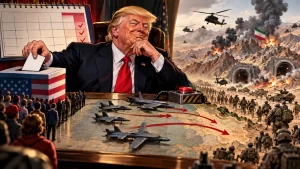
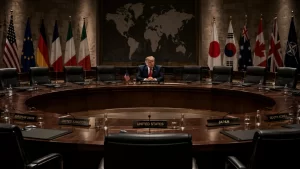
Ten days ago, a president who once threatened to extinguish a “whole civilization” stood at the Palace of Versailles and signed his name to a memorandum of understanding with Iran. Mariners stranded in the Persian Gulf for nearly four months — more than eleven thousand of them, by the United Nations’ count — finally had reason to believe the war might be ending. By Thursday, an Iranian drone had blown a hole in the bridge of a Singapore-flagged container ship called the Ever Lovely off the coast of Oman. By Friday, U.S. warplanes were striking Iranian radar and missile storage in retaliation. By Saturday morning, a second tanker had been hit and Iranian drones were inbound on Bahrain. The administration is calling Iran’s attacks a “foolish violation” of the ceasefire. What the administration is not calling foolish is its own decision to route those ships through waters Tehran had publicly warned, in writing, were not authorized.
This is the heart of the failure. The U.S.-Iran memorandum, signed June 17 in the aftermath of the G7, established a 60-day window in which Iran was to make “best efforts” to allow toll-free safe passage through the strait — and committed Iran and Oman to “conduct dialogue” to define how the waterway would be administered going forward. Within a week, the Trump administration and Oman had announced a new southern transit corridor hugging the Omani coast — coordinated with the International Maritime Organization, not with Tehran. Iran’s Islamic Revolutionary Guard Corps responded almost immediately: only routes designated by Iran were authorized, and vessels using other passages would carry the consequences themselves. The administration kept directing traffic through the disputed corridor anyway. TIME magazine reported that analysts had warned the MoU’s language on strait management was deliberately ambiguous and left unresolved. The administration appears to have treated that ambiguity as license to act unilaterally. Commercial ships’ crews paid for that assumption.
1. What Actually Happened in the Strait
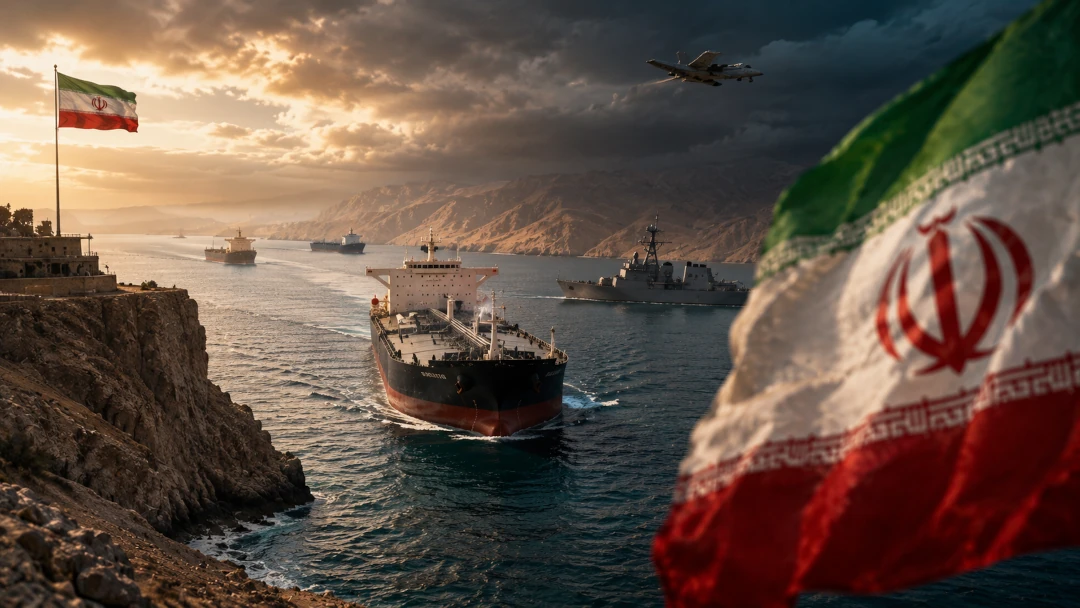
The sequence of events is not in dispute. On Wednesday, June 24, Oman — in coordination with the IMO but, according to the IRGC, without consulting Iran — announced a transit corridor along the Omani coast on the southern side of the strait. Maritime intelligence firm Kpler recorded 70 vessels transiting the strait that day, a 105 percent jump from the day before, with most ships hugging the Omani coast rather than using the northern route closer to Iran’s shore. The IRGC issued a formal warning: “The only authorised transit routes through the Strait of Hormuz are those designated by the Islamic Republic of Iran.” Iran’s newly created Persian Gulf Strait Authority added that passage outside its framework would not be covered by safe-passage guarantees and that consequences would rest with the owner, operator, and commander of the vessel. The warning could not have been clearer.
Hours later, the Ever Lovely was struck by an Iranian one-way attack drone roughly 7.5 nautical miles southeast of Oman’s port of Dahit, while transiting the Omani corridor. The bridge sustained damage; the crew, miraculously, was not injured, and the ship proceeded on its way. The IMO immediately paused its evacuation of the more than 11,000 mariners still trapped in the Gulf. On Friday afternoon, U.S. Central Command struck Iranian missile and drone storage facilities and coastal radar sites in retaliation. By Saturday morning, the U.K. Maritime Trade Operations Centre was reporting another tanker hit by a projectile, and Bahrain — which hosts the U.S. Navy’s Fifth Fleet — was under Iranian drone attack. The Joint Maritime Information Center raised the regional threat level back up to “substantial.”
“Donald Trump’s instability is more clear and dangerous than ever.”
— Rep. Nancy Pelosi (D-CA), April 2026, calling for invocation of the 25th Amendment
2. The MoU the President Pretends Was Clear
What does the memorandum of understanding actually say? It says Iran will make best efforts, for 60 days, to allow toll-free safe passage. It says Iran and Oman will conduct dialogue to define future administration and maritime services in the strait. It does not award the United States — or Oman, or the IMO — the unilateral right to designate transit routes. It does not name a corridor. It explicitly preserves the negotiation. Analysts at Eurasia Group, speaking to Al Jazeera, described the MoU as deliberately leaving the strait’s future status unresolved, with both sides expected to keep talking. Instead, the administration walked the ink dry, announced a route, and dared Iran to do something about it.
Iran’s deputy foreign minister Kazem Gharibabadi told reporters that safe passage through the strait cannot be guaranteed when arrangements are ambiguous and parallel routes are imposed from outside Iran’s considerations as the coastal state. That is the position of an authoritarian regime that is also, in this narrow legal sense, correct about what its own diplomats signed. International law protects the right of transit through international straits — Secretary of State Marco Rubio is right about that, and Vice President Vance is right that no country gets to charge tolls on global commerce. But the question of which corridor a ship should use through territorial waters during a fragile 60-day transition is a question the United States agreed to negotiate. It chose instead to assert.
Signed June 17, 2026 at Versailles. Iran committed to “best efforts” toll-free safe passage for 60 days. The text required Iran and Oman to “conduct dialogue” on strait administration — a future negotiation, not a settled question.
Announced June 24 by Oman in coordination with the IMO. Hugs the southern coast. The IRGC said it was not consulted. Within 24 hours, 70 ships used it. Within 48, one was on fire.
Issued before the Ever Lovely strike via VHF Channel 16: only Iran-designated routes were authorized; ships outside the corridor would carry their own consequences. The administration kept routing ships south anyway.
Vance claimed a U.S.-Iran military hotline had been established in Doha. The IRGC publicly denied it within hours. The deconfliction channel Vance described, in other words, does not exist.
3. What This Costs the American at the Pump
This crisis was supposed to be ending. After the MoU was signed, Brent crude fell to roughly $72 a barrel — its lowest level since before the war, though still above the pre-war benchmark of $66. AAA reported that the national average for regular gasoline had dropped below $4 a gallon for the first time since March, settling near $3.99 by mid-June. Drivers, for the first time in months, had reason to think the worst was behind them.
The worst is not behind them. A LendingTree analysis of AAA data found that gas prices were still up 28.8 percent year-over-year — nearly a dollar a gallon higher than a year earlier. In New Hampshire, the increase was 41.9 percent; in New York and Vermont, more than 39. California crossed $5.71 a gallon. The U.S. Energy Information Administration’s June outlook forecast a wholesale gasoline average of $2.98 a gallon for 2026 — almost a full dollar above what the EIA was projecting before the war began. Diesel and jet fuel are up more than 60 percent. Every renewed strike in the strait — every drone in the air, every retaliatory cruise missile, every threat to the corridor — feeds straight back into those numbers. The president has now ordered a federal investigation into why prices are not falling faster, which is an extraordinary thing to do when the answer is sitting on the front pages of every newspaper in the country: because his administration cannot stop picking fights in the waterway through which one-fifth of the world’s oil and twenty percent of its liquefied natural gas pass.
For an American family driving 12,000 miles a year in a car that gets 25 miles to the gallon, the added cost from the Iran war alone — pre-Ever-Lovely — already approached $400 annually. For diesel-dependent farmers, truckers, and small contractors, the hit is several multiples of that. Food prices, fertilizer prices, jet fuel surcharges, plastic feedstocks: all of these run through the Persian Gulf, and all of them remain elevated. The Congressional Research Service’s analysis of the conflict is unflinching about what a continued strait disruption costs the global and U.S. economy. The headline-grabbing risk is $200 oil — which Bloomberg has now reported Wall Street and U.S. officials are taking seriously. The quieter, grinding cost is simply that everything Americans buy costs more, for longer, because the president of the United States cannot or will not honor the negotiation he himself just signed.
4. The Timeline of a Self-Inflicted Wound
Get Involved Today
Contribute to our mission and turn your concerns into action.
5. Why It Looks Like Sabotage
Why would a president who just spent four months in a ruinous war — a war that killed Americans, blew up a fifth of global energy trade, sent gas above five dollars in seven California counties, and put a U.S. presidential threat of mass civilian destruction on the international record — risk that hard-won, fragile agreement within ten days of signing it? The official answer is freedom of navigation. The honest answer involves a president who has shown, repeatedly and on the record, that he treats every agreement he signs as a starting position for further leverage, not a binding commitment. The administration’s stated reason for refusing Iran’s role in strait administration — that no country can charge tolls or unilaterally control an international waterway — is legally correct and rhetorically useful. It is also a reason that has nothing to do with whether American-backed ships needed to push the disputed corridor on Day 7 of a 60-day negotiation.
There is no scenario in which Iran’s drone strike on a civilian cargo ship is justified. There is also no scenario in which a competent administration provokes that strike by ignoring a written warning from a regime it just spent four months at war with. The Senate already passed a war powers resolution rebuking the president’s conduct in this conflict — the first such successful resolution during the crisis, on the eighth attempt. Members of Congress have spent eleven weeks asking, with increasing volume, whether the man making these decisions is capable of making them.
“A whole civilization will die tonight, never to be brought back again.”
— Donald J. Trump, on his Truth Social account, April 7, 2026
The 25th Amendment Does Not Define “Unable” — and That Was the Point
The Twenty-Fifth Amendment to the United States Constitution, ratified in 1967 after the Kennedy assassination, contains a single, deliberately spare phrase at the heart of Section 4: a president may be removed when he is “unable to discharge the powers and duties of his office.” The amendment does not define “unable.” It does not define “inability.” The drafters, led by Senator Birch Bayh and constitutional scholar John Feerick, made that choice consciously. They wanted the standard to flex — to cover physical incapacitation, yes, but also mental impairment, psychological collapse, and what Feerick later called “any condition which prevents the President from carrying out his official responsibilities.”
The Cabinet and the Vice President may declare a President unable to discharge his duties — and the language was left open precisely because the framers could not anticipate every future form of unfitness.
In April, after Trump’s “whole civilization will die tonight” Truth Social post, more than 70 members of Congress publicly called for either impeachment or invocation of the 25th Amendment. Rep. Nancy Pelosi said the cabinet should “invoke the 25th Amendment and restore sanity.” Rep. Ro Khanna wrote that Section 4 needed to be invoked because “threatening war crimes is a blatant violation of our constitution and the Geneva Conventions.” Sen. Chris Murphy wrote that no president in control of his senses would publicly promise to eradicate an entire civilization. Reps. Alexandria Ocasio-Cortez, Ilhan Omar, Melanie Stansbury, Seth Moulton, and Sen. Ed Markey all joined the call. Rep. John Larson formally filed articles of impeachment. Even former Rep. Marjorie Taylor Greene, no progressive ally, posted simply: “25TH AMENDMENT!!!”
The argument is not partisan. The argument is that a president who threatens nuclear war on social media, signs a peace agreement at Versailles, undermines its terms within ten days, gets two civilian vessels shot at, claims a deconfliction hotline that does not exist, and orders a federal investigation into why gas prices are not falling faster is not exhibiting the steady judgment the office requires. That is — by the deliberately open language of the amendment — a question of “inability.”
The practical barriers are real and they are large. Section 4 requires the Vice President plus a majority of the Cabinet to act first. JD Vance has shown no inclination to do so; on the day dozens of lawmakers were calling for removal, Vance was on a stage in Budapest with Viktor Orbán. The Cabinet was hand-picked for loyalty. If the President contested the declaration, two-thirds of both chambers of a Republican-controlled Congress would have to ratify it. Section 4 has never, in fifty-nine years, been successfully invoked.
None of that negates the moral and constitutional case. The amendment exists because the framers understood that a president can be unfit in ways that do not announce themselves with a stroke or a fall. The political path is hard. The constitutional argument is not. The Constitution does not require that removal be easy. It requires that the option exist — and that the people who can invoke it understand they have a duty to consider it.
6. What It Says About Priorities
An ordinary American driving to work this Monday morning, paying $3.88 a gallon to fill a tank that cost $2.96 a year ago, deserves to ask a simple question: why is this still happening? The answer is not Iran’s drones, though Iran fired them. The answer is not the IRGC, though the IRGC pulled the trigger. The answer is that the president of the United States signed an agreement and immediately treated it as a suggestion. He has chosen to define his administration’s relationship with a 60-day peace negotiation as a contest of leverage rather than a foundation for ending a war. Every renewed strike, every reciprocal escalation, every disputed route is the cost the country is paying for that choice.
The MoU’s 60-day clock runs out in mid-August. If the strait is not stabilized by then, Iran has signaled it may resume charging fees or close the corridor entirely. The administration has signaled it would respond militarily. Markets are already pricing in another spike. The peace deal, which was the entire premise on which the administration justified its conduct of the war, is being held together by a paper-thin ceasefire that the United States itself is straining at the edges. None of this had to happen on this timeline. It is happening because the man at the top is conducting foreign policy the way he conducts everything else: as a series of dares and dominance displays, with the consequences pushed downstream to people who cannot afford them.
Editorial Conclusion
This is not a foreign policy problem. It is a leadership problem masquerading as a foreign policy problem. The Trump administration signed a memorandum it has been unable, or unwilling, to honor for two weeks. Civilian crews have been shot at. The peace deal is fraying. American families are still paying nearly a dollar a gallon more for fuel than they were a year ago. And the constitutional mechanism for addressing a president who cannot discharge his duties was written, deliberately, to cover circumstances exactly like these.
The framers of the 25th Amendment did not define “unable” because they trusted future Americans to recognize unfitness when they saw it. We are seeing it. The political path is hard. The duty is not optional. Congress must act — and the Cabinet must remember what oath it took.
Sources & References
- CBS News — Iran strikes commercial ship in Strait of Hormuz in challenge to U.S.-Iran deal
- TIME — Iran Strikes Vessel in Strait of Hormuz, Pausing Escort Operations
- Al Jazeera — IRGC warns against new Hormuz route for ships: What we know
- Al Jazeera — “Pick up the phone”: IRGC appears to rebuff US Strait of Hormuz hotline
- Al Jazeera — US strikes Iran in response to drone strike on commercial ship
- The Hill — US strikes Iran in response to Strait of Hormuz cargo ship attack
- Boston.com / AP — Iranian drones attack Bahrain, ship is struck in the Strait of Hormuz
- CBC News — 2nd ship struck in Strait of Hormuz as attacks between Iran and U.S. escalate
- Euronews — Cargo ship hit by projectile in Hormuz as Iran issues renewed passage warning
- NBC News — Dozens of Democrats call for Trump’s removal after his Iran threats
- CNN — An eclectic, bipartisan group suddenly calls for removing Trump using the 25th Amendment
- CBS News — Few Republicans condemn Trump’s Iran threat as Democrats call for his removal
- CNBC — Trump faces calls for removal over threats to wipe out “whole civilization” in Iran
- The Hill — Trump’s grave threats toward Iran stoke war crime debate
- U.S. EIA — June 2026 Short-Term Energy Outlook
- AAA Gas Prices — National Average Gasoline Price Updates
- LendingTree — US Gas Prices Soar Nearly 29% Nationwide
- Congressional Research Service — Iran Conflict and the Strait of Hormuz: Impacts on Oil, Gas, and Other Commodities
- Bloomberg — How High Could Oil Prices Get with Strait of Hormuz Closure?
- Larson House Office — Trump’s rhetoric on Iran war sparks wave of calls for his removal
Related News