Hush Money With a Federal Badge: Kash Patel’s Personal Slush Fund and What It Tells Us About the Trump FBI
A million taxpayer dollars allegedly funneled to a hand-picked unit of FBI loyalists — some on the director’s drinking-buddy security detail, some on a so-called “Payback Squad” hunting political enemies. The cash buys two things: loyalty, and silence. Both are now in the congressional record.
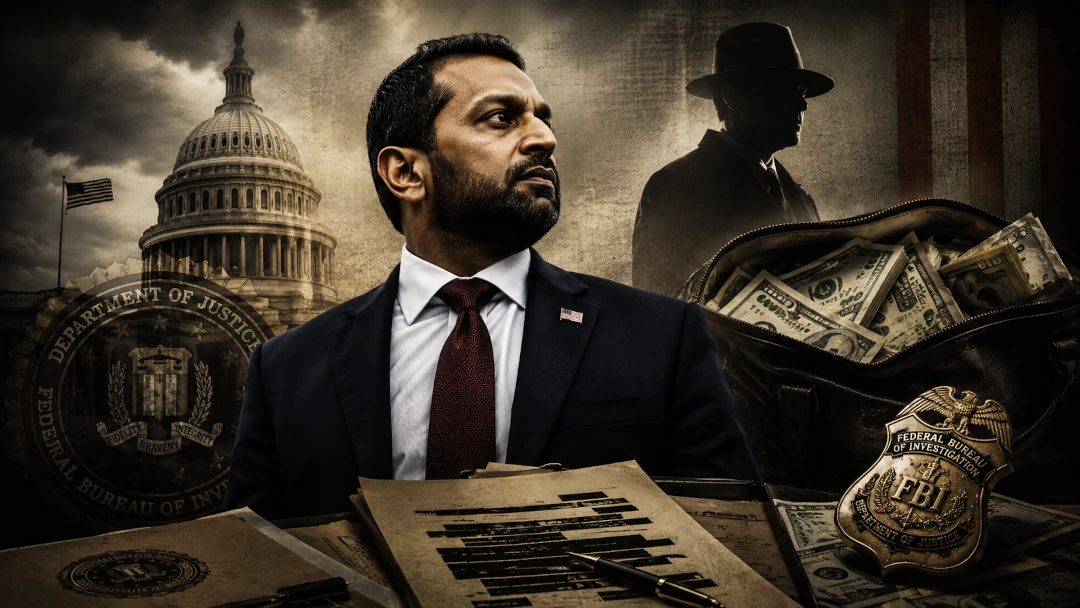
On June 16, Representative Jamie Raskin of Maryland — the ranking Democrat on the House Judiciary Committee — sent FBI Director Kash Patel a letter that should have ended his tenure. It accused Patel of converting part of the Federal Bureau of Investigation’s budget into what Raskin, in plain English, called a “personal slush fund”: more than $1 million in recurring cash bonuses allegedly paid to a hand-picked inner circle of FBI agents. Some of those agents are on the director’s personal security detail. Others are on a unit that internal sources have described to NOTUS as “the Payback Squad.”
The letter, obtained exclusively by MS NOW and then posted in full by the House Judiciary Democrats, describes what the committee says it has been told: numerous agents have received roughly $8,000 every two-week pay period for five consecutive periods — nearly $40,000 per agent — pushing some recipients past the federal salary cap and even bouncing payments against an FBI reserve account so depleted it ran dry. Raskin gave Patel until June 29 to produce the paperwork.
Patel is unlikely to comply. Democrats are in the minority and lack subpoena power. The Justice Department that would have to enforce any compliance order answers to Trump’s hand-picked Acting Attorney General, Todd Blanche, who has already publicly attacked the journalism that exposed Patel’s drinking and absenteeism. The Inspector General who could investigate sits in a chain of command that runs back to the same political appointees. This is, in the most literal sense, a closed loop.
But it is now a closed loop with a written record. That is what changed this week. The dollar amounts are public. The bar names are public. The legal theory is public. And the agents fired to make room for this scheme have lawyers and a federal courtroom of their own.
1. What the Letter Actually Alleges
Strip away the language about “slush funds” and what Raskin describes is a textbook abuse of incentive-pay authority. Under 5 U.S.C. § 5759 and related provisions of federal pay law, the FBI director can award retention bonuses — but only for narrowly defined reasons, after consultation with the Office of Personnel Management, capped at a fraction of basic pay, and subject to a hard aggregate limit on total annual compensation. The whole architecture exists to prevent exactly what Raskin says is happening: the director’s office turning a public payroll into a private patronage account.
According to the committee’s information, the main recipients are agents on Patel’s “Director’s Advisory Team” — the unit that NOTUS’s Jose Pagliery first revealed in May is colloquially known inside the bureau as the “payback squad” — and agents on Patel’s personal protective detail. The Raskin letter argues both groups have functional reasons for the payments that have nothing to do with merit: the Director’s Advisory Team carries out politically directed investigations against perceived enemies of the president, and the security detail witnesses what Raskin politely refers to as the director’s “indiscretions.”
“The FBI’s budget is not a slush fund to reward craven loyalty and ensure that your abuses of power and indiscretions remain hidden.”
— Rep. Jamie Raskin (D-Md.), letter to FBI Director Kash Patel, June 15, 2026
That second category is the one that should chill any reader who still believes the FBI is an apolitical institution. Raskin’s letter explicitly names the bars and venues — the Poodle Room, Ned’s, Rao’s, Lower Broadway, the Strip, and the Milano Cortina Olympics — where Patel’s security detail allegedly witnessed conduct that, in Raskin’s careful phrasing, the bonuses may be designed to keep hidden. That is not a budgetary scandal. That is the description of a payoff.
2. The Other Half of the Ledger: Who Got Fired
The slush fund story cannot be understood without its mirror image — the people Patel removed. The contrast is not subtle.
Acting Director, Decorated
Brian Driscoll — Medal of Valor recipient, former Hostage Rescue Team commander, briefly acting FBI Director — was fired in August 2025 and is now suing Patel for wrongful termination. CNN
Counterterrorism, Purged
Steven Jensen, who had led the FBI’s law-enforcement response to the January 6 Capitol attack, was elevated to run the Washington Field Office — then fired. He is a co-plaintiff in the lawsuit. NPR
The Bonus Recipients
Multiple agents on the “Director’s Advisory Team” allegedly received five consecutive $8,000 bonus payments — close to $40,000 each — in some cases pushing them past federal pay limits. House Judiciary
The Reserve, Drained
Raskin’s letter says Patel directed roughly $1 million in award payments to his inner circle so quickly that some payments “bounced back” from depleted FBI accounts. New Republic
The firings are not allegations. They are on the record in a federal lawsuit, Driscoll, Jensen and Evans v. Patel, filed in U.S. District Court in Washington in September 2025. According to that complaint and to Driscoll’s own televised account on CNN, Patel told him in person that the White House had directed the firings of any agents who had touched the Trump investigations — and that Patel’s own job depended on carrying those orders out. Christopher O’Leary, a former senior FBI counterterrorism executive, has called the bureau’s use of an elite SWAT team to chauffeur Patel’s girlfriend’s friends home from Nashville nights out “a long way from” what FBI agents swear an oath to do.
On one side of Patel’s ledger are the agents who arrested terrorists, rescued kidnapped children, and worked the case files of January 6 and the Mar-a-Lago classified documents investigation. They are unemployed and litigating. On the other side are the agents who, according to Raskin’s information, have been pulled away from real cases to dig through internal files in search of prosecutions against names supplied by the White House — and who are being paid extra for the trouble. There is no neutral way to describe that contrast. It is the privatization of federal law enforcement, line by line and bonus by bonus.
3. The Legal Exposure — Real, and Real-World Constrained
If even the broad outlines of Raskin’s allegations are correct, the legal exposure for Patel and the officials who approved these payments is substantial. The conduct described implicates, at minimum, federal statutes prohibiting payments in excess of statutory caps; the criminal provisions covering theft of government funds at 18 U.S.C. § 641; potential wire fraud exposure for the use of federal payroll systems to make payments the law does not authorize; and — if the payments are tied to silence about the director’s conduct — the federal witness-tampering and obstruction statutes.
It also implicates a quieter but more permanent body of law: federal personnel rules under which an agency head cannot fire career civil servants in retaliation for their participation in lawful investigations. That is the heart of Driscoll v. Patel, and it is why the case will outlast the headlines.
The realistic political constraint is this: the people empowered to bring those charges work for the people implicated in them. The Justice Department reports to Acting Attorney General Todd Blanche, who has spent the spring publicly disparaging the journalism that revealed Patel’s drinking. The FBI’s leadership is the target. The inspector general is independent in title only; the president can fire one with thirty days’ notice. The body that could compel documents — the House Judiciary Committee — is in the hands of a Republican majority that has shown no appetite for oversight of this administration. Raskin’s June 29 deadline is, in a practical sense, a deadline imposed on a respondent who controls whether anyone with subpoena power ever calls his name.
This is precisely why Raskin’s letter matters even though Patel will almost certainly stiff-arm it. The factual record is now public, congressionally documented, and admissible. The next House — and forecasters increasingly expect a Democratic one after November — will inherit not only subpoena power but a paper trail already constructed.
Get Involved Today
Contribute to our mission and turn your concerns into action.
4. What This Costs the Average American
It is tempting, when reading about $8,000 bonus checks and Olympic locker-room celebrations, to file this scandal under “Beltway corruption” and move on. That would be a mistake. There are direct, measurable costs to people who will never set foot in the J. Edgar Hoover Building.
5. What This Says About Patel’s Fitness — and the President’s
It is impossible to read the totality of the public record on Kash Patel — the Atlantic’s reporting on his drinking and unreachability, the New York Times reporting on SWAT teams escorting his girlfriend, the lawsuit by Driscoll and Jensen describing firings carried out under presidential instruction, and now Raskin’s allegations of a million-dollar loyalty fund — and conclude that this is an FBI director performing his constitutional duties.
The FBI Director’s role is statutorily defined: lead the nation’s principal federal investigative agency, faithfully execute the laws, protect the public from threats foreign and domestic. None of that is consistent with what is documented. What is documented is a director who, by the account of his own former acting deputy, told a subordinate that “the FBI tried to put the president in jail and he hasn’t forgotten it” — and then ran the bureau accordingly.
Patel filed a $250 million defamation suit against The Atlantic, which has said it stands by every word of its reporting. He told reporters: “Print it, all false.” He has not yet publicly responded to Raskin. Patel has every legal right to defend himself in court. He does not have a right to do so on the taxpayer’s dime, with a security detail flying him from venue to venue and a bonus pool to keep the witnesses quiet.
“The FBI tried to put the president in jail and he hasn’t forgotten it.”
— FBI Director Kash Patel to former Acting Director Brian Driscoll, as alleged in Driscoll v. Patel
And that is the point at which an FBI scandal becomes a presidential one. Patel did not appoint himself. He was nominated, confirmed 51–49 with every Democrat and Senators Collins and Murkowski opposed, and is kept in his job at the president’s pleasure. The conduct described above is occurring with the president’s continued backing, in pursuit of cases — like the prosecution of former CIA Director John Brennan that NOTUS reports the Director’s Advisory Team is now building — that the president has publicly demanded.
When Inability to Discharge Is Visible at the Cabinet Level
The Twenty-Fifth Amendment, ratified in 1967, establishes the constitutional mechanism for transferring presidential power when a president is “unable to discharge the powers and duties of his office.” Section 4 — the most consequential — allows the Vice President and a majority of the Cabinet to make that declaration, with Congress as the final arbiter if the president contests it. The amendment is, in its plain text, a tool for moments when the country needs a functioning chief executive and does not have one.
The legal-political case being made here is not that the slush fund itself triggers Section 4. It does not. The Amendment is about the president’s capacity, not a cabinet officer’s conduct. What the cabinet officer’s conduct does is illuminate the president’s. The Patel scandal is, in the end, a presidential scandal. The decision to keep an FBI director in place who is publicly described by twenty-plus inside sources as unreachable from alcohol-fueled nights, who has allegedly drained federal accounts to pay hush money, and who has — per Driscoll’s sworn account — carried out White House-directed political purges, is the president’s decision. Trump has the authority to dismiss the FBI director at any moment. He has chosen not to.
Named legislators who have invoked the 25th
Representative Jamie Raskin — author of the leading academic and political treatments of the 25th Amendment, including his book Unthinkable — has been the most persistent voice in Congress arguing that the amendment’s framers intended it to cover not only medical incapacity but also a sustained inability to discharge the duties of the office in any form. Senator Tammy Duckworth and Representative Jamie Raskin previously co-introduced legislation to establish a standing body of medical and other experts to assist any future Section 4 process. Representative Jasmine Crockett and others have repeatedly raised the question in public hearings.
The argument from the Patel record
The constitutional argument is this: a president whose appointed FBI director is allegedly paying agents to suppress witness accounts of the director’s misconduct, while purging decorated career agents who worked on lawful investigations of the president himself, is a president who is no longer exercising the office in good faith but as a personal protective racket. The FBI is not the president’s law firm. When it begins behaving as if it were, with presidential sanction, the question of fitness is not metaphorical — it is structural.
The honest assessment of barriers
The practical barriers are real. Section 4 requires Vice President JD Vance and a majority of a Cabinet appointed for loyalty to act against the president who appointed them. That is, in the current political configuration, vanishingly unlikely. The Republican Congress is not pursuing impeachment, the only other constitutional removal mechanism. The Justice Department will not investigate. None of that changes the fact that the constitutional case has now been documented, and documented in a form that future Congresses, future inspectors general, and future historians will be able to read.
Why the barriers don’t negate the case
The 25th Amendment was written by people who had just watched a president shot in Dallas and another suffer a debilitating stroke in office. Its drafters did not assume the cabinet would always act. They wrote it down anyway, because constitutional norms survive on the record of having been asserted. To name a president’s unfitness — clearly, factually, with the misconduct of his own appointees as evidence — is not a political stunt. It is the work the framers of the Amendment expected each generation to do when the moment arrived. This is one of those moments.
6. What Comes Next
Patel’s June 29 deadline will likely pass without compliance. The FBI did not respond to MS NOW’s request for comment. The Justice Department’s response, to the extent there is one, will likely echo Todd Blanche’s earlier line: anonymous sources, partisan attacks, bring it on. The Director’s Advisory Team will keep building cases against the president’s enemies. The bar tab will keep growing.
But this scandal has now joined a list that is no longer manageable through denial. The Atlantic’s reporting on Patel’s drinking. The MS NOW reporting on the SWAT detail for Alexis Wilkins. The CNN reporting on the firing of Brian Driscoll. The NOTUS reporting on the Payback Squad. The Hill’s reporting on the FBI jet. The Daily Beast’s accounting of twelve personal trips on the bureau plane in a single year. And now, on House Judiciary letterhead, the allegation of a million-dollar slush fund.
The accounting will come. The only open question is who is in the room when it does, and whether the people receiving the bonuses are still wearing the badges when the receipts get pulled.
Editorial Conclusion
An FBI director who allegedly pays loyalists out of a depleted public account to investigate the president’s enemies and to keep quiet about the director’s own conduct is not running a federal law enforcement agency. He is running a protection racket with a federal seal on it.
This is what state capture looks like in a constitutional republic: not coups, but bonus pools. Not jackboots, but biweekly direct deposits. The slush fund is the receipt.
The constitutional question is not whether Kash Patel should be removed — it is whether the president who appointed him, defended him, and continues to direct the conduct described in Raskin’s letter is exercising the office of the presidency, or something else. The record now answers that question. What remains is whether anyone with constitutional authority is willing to act on the answer.
Sources & References
- MS NOW — “Kash Patel may have a ‘personal slush fund’ of taxpayer dollars to pay loyalist agents, says Raskin” (June 16, 2026). ms.now
- U.S. House Judiciary Committee Democrats — Official press release: “Ranking Member Raskin Launches Investigation Into Kash Patel’s Misuse of FBI Funds” (June 16, 2026). judiciary.house.gov
- Raskin Letter to Patel (PDF) — Full text of the June 15, 2026 letter from Ranking Member Raskin to Director Patel. judiciary.house.gov (PDF)
- NOTUS — Jose Pagliery, “FBI Created ‘Payback Squad’ to Handle Political Cases” (May 12, 2026). notus.org
- CNN — “Fired former acting FBI chief says Patel tied job security to purging agents linked to Trump probes” (May 12, 2026). cnn.com
- NPR — “Fired FBI agents allege retribution, incompetence at top security agency” (Sept. 11, 2025). npr.org
- PBS NewsHour — “FBI reportedly investigates journalist who wrote about Kash Patel’s heavy drinking” (May 2026). pbs.org
- The Atlantic — Sarah Fitzpatrick, “The FBI Director Is MIA” (April 17, 2026). theatlantic.com
- The Hill — “House Judiciary Democrats demand Kash Patel take alcohol disorders test following Atlantic report” (April 22, 2026). thehill.com
- Al Jazeera — “FBI Director Kash Patel sues Atlantic for ‘false’ reporting on drinking” (April 20, 2026). aljazeera.com
- MS NOW — “Kash Patel ordered FBI detail to give girlfriend’s pal a lift home” (Dec. 5, 2025). ms.now
- The Daily Beast — “Keystone Kash’s Jaw-Dropping FBI Perks for Girlfriend Exposed” (March 1, 2026). thedailybeast.com
- The Daily Beast — “Kash Patel Hit With Claim of Secret FBI ‘Slush Fund'” (June 16, 2026). thedailybeast.com
- The New Republic — “Even Kash Patel Seems to Have His Own Secret Personal Slush Fund” (June 16, 2026). newrepublic.com
- Democracy Docket — “Senior FBI Agents Allege White House-led Political Purge of Bureau in New Lawsuit” (Sept. 10, 2025). democracydocket.com
- Raw Story — “‘Troubling reports’ point to Kash Patel having ‘personal slush fund'” (June 16, 2026). rawstory.com
- The Washington Times — “Kash Patel accused of giving bonuses to FBI loyalists” (June 20, 2026). washingtontimes.com
- Cornell Legal Information Institute — 5 U.S.C. § 5759 (FBI retention and relocation bonuses; statutory caps and authority). law.cornell.edu
- U.S. Office of Personnel Management — Fact Sheet: Aggregate Limitation on Pay (federal compensation caps). opm.gov
Related News