A Band-Aid on a Flesh Wound: Trump’s $8 Billion Promise to the Farmers He Broke
Diesel has nearly doubled, fertilizer spiked, export markets cratered and farm bankruptcies hit a six-year high. Two weeks before the midterms, the president announced another bailout from a campaign stage — one whose payment rates won’t even be set until after the votes are counted. The question for rural America is not whether the money sounds big. It’s whether it ever arrives, and whether anyone in Washington will fix what made it necessary.
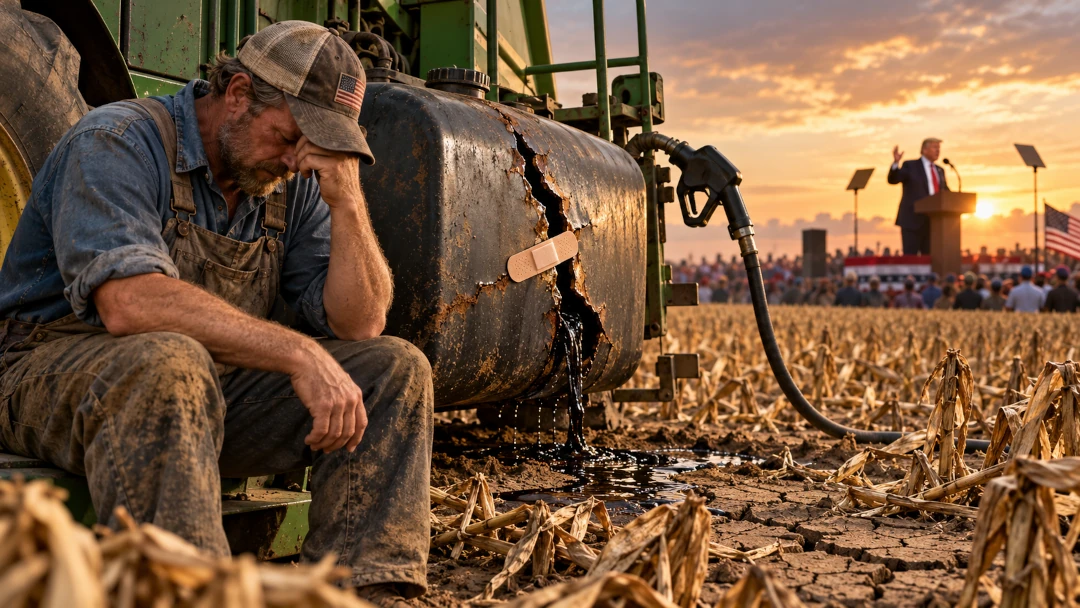
On Monday night in Park City, Kansas, standing beside an embattled Republican senator, Donald Trump told a rally crowd that the Department of Agriculture would launch a “Harvest Fuel Relief” program worth $8 billion to help farmers cover this season’s diesel bills. He credited Sen. Roger Marshall, who is locked in a tight race with Democrat Adam Hamilton, for making it happen. He asked the audience, as HuffPost reported, to “pretend please that I’m on the ballot.”
He is. And so is the record of what his policies have done to the people who grow America’s food. Within hours, an economics segment on MS NOW summed up the program in a phrase that has stuck: a “Band-Aid on a flesh wound.” The segment, hosted by Stephanie Ruhle, featured the Cato Institute’s Scott Lincicome and The Economist’s Charlotte Howard — hardly a pair of left-wing firebrands. That a libertarian think tank and a free-market magazine are the ones sounding the alarm tells you how far the damage has spread.
I. The Wound: A Farm Economy in Free Fall
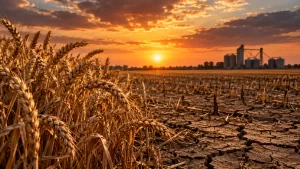
Start with the numbers that farm families live inside. The American Farm Bureau Federation reports that Chapter 12 family-farm bankruptcies rose for the second straight year in 2025, to 315 filings — a 46% jump over 2024. Then 2026 got worse. Court data compiled by Epiq AACER showed 62 Chapter 12 filings in April alone, up 130% from a year earlier and the highest monthly total since early 2020, with at least 158 cases filed in just the first four months of the year.
Those figures understate the crisis. Farm Bureau economists note that most farms don’t even qualify for Chapter 12, because so many families depend on off-farm jobs to stay afloat — meaning that when the debt becomes unbearable, many simply close. USDA’s own count shows the nation lost another 15,000 farms in 2025, leaving 1.865 million, with losses in every sales class except the largest operations. A POLITICO analysis of USDA data found the country has shed almost 150,000 farms in five years, with farm numbers falling three times faster than farmland — the signature of small family operations being swallowed by bigger ones.
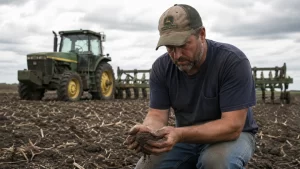
Ohio State agricultural law specialist Robert Moore put it bluntly: after years of losses, high diesel and fertilizer prices have “made 2026 the breaking point.” NPR reported in September that producers of every major row crop are projected to lose money in 2026 for the fourth consecutive year, with Farm Bureau economist Faith Parum observing that growers are paying far more to raise a crop and “not making near enough for it.”
Bankruptcies
Chapter 12 filings in April 2026 — a 130% year-over-year jump and the highest monthly count since February 2020. AGDAILY / Epiq AACER
Record Debt
USDA’s projected total farm debt for 2026, with interest costs expected to hit a record $33 billion. AFBF via Georgia Farm Bureau
Diesel
Farm diesel per gallon, up from an average $3.01 since September 2025, per the Farm Bureau. Retail diesel sits near $6.32. Civil Eats
Fertilizer
Bushels of corn needed to buy one ton of urea after the war began, up from 75 bushels in December 2025. CSIS via Food Ingredients First
Lost Market
U.S. soybean exports to China in 2025, down from a peak near $18 billion in 2022 after Beijing retaliated against Trump’s tariffs. Fortune
II. The Self-Inflicted Injuries: Tariffs and a War of Choice
None of this was an act of God. The first blow was the trade war. Beginning in February 2025, the president imposed sweeping tariffs under the International Emergency Economic Powers Act. China answered by effectively boycotting American soybeans — and the Trump administration, in a move that enraged growers, announced a $20 billion bailout for Argentina, the very country China turned to for its beans. Metals tariffs, meanwhile, drove up the cost of tractors, combines, parts and farm buildings.
The inputs got hit too. A North Dakota State University study cited by the Nebraska Farm Bureau found the IEEPA tariffs pushed the average tariff rate on farm inputs from under 1% to 12%. When the Supreme Court struck those tariffs down 6–3 in February, the president didn’t change course; he immediately invoked a never-before-used statute, Section 122 of the Trade Act of 1974, to impose a global tariff — first at 10%, then raised to the 15% legal maximum the following day.
Then, on February 28, 2026, came the second blow: U.S.–Israeli airstrikes on Iran and the closure of the Strait of Hormuz. Yahoo News, in describing the program announced Monday, put the causation plainly — diesel has soared since Trump’s decision to start a war with Iran, rising from roughly $3.70 a gallon before the war to about $6.23 at the peak of harvest. The International Energy Agency warned last week that U.S. pump diesel topped $6 for the first time in September, about 70% above prewar levels, and that the global diesel shortage will persist well into 2027.
Fertilizer was hit harder and faster. Roughly a third of the world’s seaborne fertilizer trade moves through Hormuz; within weeks, Oxford Economics estimated urea prices had surged about 50% since the war began. According to the Center for Strategic and International Studies, urea at the New Orleans hub jumped from $516 to $683 a metric ton in a single week — at the start of spring planting, when farmers buy the most. Even with crude flows through the strait recovering, CNN reported this month that diesel remains near all-time highs because the passage is still dangerous and expensive.
The president, for his part, told farmers at a White House event this year that “we’re doing really well in Iran,” according to wire coverage of the event. On Monday in Kansas, as MS NOW’s MaddowBlog noted, he did not mention that farmers’ fuel costs are high because of the war he launched — calling the string of bailouts “effectively admissions of guilt.”
III. The Band-Aid: What the $8 Billion Actually Is
Strip away the rally-stage theatrics and here is what USDA has actually committed to. The Harvest Fuel Relief program will make one-time payments using “a uniform formula to cover a portion of modeled losses” for the 2026 crop year, administered by the Farm Service Agency. The money comes through the Commodity Credit Corporation Charter Act — not a fresh appropriation from Congress — and crop-insurance enrollment is not required, according to Newsweek’s review of the USDA release. Farmers are told to set up Login.gov accounts and wait for pre-filled applications.
What USDA has not committed to is a date. Payment rates for major row crops won’t be released until November — that is, after the November 3 election. The application period hasn’t been announced. Specialty-crop growers and fishermen have been invited to email in their fuel-cost data, with methodology “to follow.” Nexstar’s reporting concluded that payments likely won’t go out until after the current harvest season — meaning “harvest fuel relief” will not arrive during harvest.
“When Republicans win, we will pass even more funding for our farmers.”
— President Donald Trump, Park City, Kansas, Oct. 19, 2026 · via CBS News
Why push the details past Election Day? The administration hasn’t said. But the sequencing speaks for itself: the announcement came at a campaign rally for a vulnerable senator, two weeks before voters go to the polls, while the dollar figures that would let a farmer actually calculate his check land only once the votes are in. The president’s own words made the transaction explicit — more money when Republicans win. It is the same pattern as his promise, reported by Newsweek via Yahoo, of $5,000 “dividend” checks to millions of Americans if the GOP holds Congress. Relief is being offered not as a duty of government but as a reward for a vote.
Will the money come? History suggests some of it will — late, partial, and lopsided. The December $12 billion bridge package was promised by the end of February and did reach more than 560,000 farmers in one-time payments. But the White House’s June request for another $11.1 billion still sits with Congress, even as Farm Bureau President Zippy Duvall acknowledged that farmers’ losses far exceed that amount. And USDA itself projects that net farm income will fall 2.6% this year as production expenses rise 4.5%, with fuel and oil costs up nearly 30%. An $8 billion one-time check, spread across every commodity, does not change that math.
National Farmers Union President Rob Larew said the losses being covered were ones anyone could have seen coming and warned that repeated emergency aid shows “the farm safety net is failing family farmers.” Sam Kieffer of the National Association of Wheat Growers called the relief welcome while warning that input costs continue to threaten the viability of family farms. These are not partisan outfits. They are the people who will be standing in the FSA office in January, waiting for a formula.
IV. Congress: A Farm Bill Left to Expire
The single most important thing Washington can do for farmers is pass a farm bill — the five-year law that governs crop insurance, commodity supports, conservation programs and food assistance. It hasn’t. The House passed the Farm, Food, and National Security Act of 2026 on April 30 by a narrow 224–200. The Senate Agriculture Committee’s version failed in August, then passed in September on a strict party-line 12–11 vote. Sen. Peter Welch (D-Vt.), a committee member, said flatly, “This is not a good Farm Bill,” as Democrats objected that it fails to address deep cuts to food assistance.
On September 30, the latest extension of the 2018 farm bill expired with no replacement, leaving USDA to stretch programs administratively through year’s end. The full Senate isn’t expected to vote until Congress returns after the midterm elections. Republicans control both chambers and the White House. The delay is theirs to own.
V. What Democrats Are Proposing
Democrats have spent much of 2026 attacking the cost side of the ledger — the part a one-time check can’t touch. Senate Democratic Leader Chuck Schumer and Senate Agriculture Ranking Member Amy Klobuchar introduced the Strategic Fertilizer Reserve Act, directing USDA to study creating the nation’s first fertilizer reserve to blunt exactly the kind of price shock the Iran war caused. Their release cited New York Farm Bureau figures showing fertilizer rising from about $400 to $580 a ton, with anhydrous ammonia above $1,000.
Klobuchar, who described farmers facing a “perfect storm of ugly,” also wrote two bipartisan bills: the Fertilizer Transparency Act with Senate Majority Leader John Thune, creating mandatory price reporting in a market where a handful of companies dominate, and the Homegrown Fertilizer Act with — notably — Sen. Marshall, to finance domestic fertilizer production and storage. Neither has become law. Democrats also introduced legislation to end the president’s replacement global tariffs, and pressed for year-round E15 sales to cut fuel prices.
On the campaign trail, Democratic Senate candidates are running on farm policy in places Democrats rarely compete. MS NOW reported that Michigan’s Abdul El-Sayed unveiled a small-farm plan built with the Michigan Farmers Union, while Iowa’s Josh Turek has made the farm bill a centerpiece — proposing a rule barring Congress from recess if a farm bill lapses — and backs a “right to repair” for farm equipment alongside a pledge to undo the trade damage done to farm exports.
Get Involved Today
Contribute to our mission and turn your concerns into action.
VI. Beyond the Check: What Trump Is — and Isn’t — Doing
On fuel, the president signed an order letting highway vehicles burn tax-exempt red-dyed diesel through year’s end. But NPR found states warning drivers they may owe the taxes later, and South Dakota’s Republican governor told people not to do it. Trump has refused calls from some in his own party to pause diesel exports. The one lever that would truly lower diesel — ending the conflict and securing the strait — remains unpulled eight months on.
On markets, the administration touts a deal for China to buy 25 million tons of U.S. soybeans a year, but purchases have lagged; Bloomberg reported in June that buying had resumed but risked falling short of the pledges. The White House also floated a plan, attributed to Jared Kushner, to require Iran to buy American food as part of a peace deal — an idea NPR reported remains largely unclear. Rebuilding export markets the trade war destroyed will take years; tariffs remain in place.
On disease and disaster, credit where it’s due: USDA has mounted a serious response to the New World screwworm, which reappeared in Texas cattle in June for the first time since 1976, including a $750 million sterile-fly facility slated for mid-2027. But the threat arrives when the national cattle herd is already at its lowest level since 1951, and drought has triggered disaster designations from Virginia to Washington state. Fortune warned this summer that a looming Super El Niño raises the risk of a “mini-Dust Bowl.”
And the agency farmers rely on to deliver disaster aid has been hollowed out. USDA lost about 24,000 workers under this administration; Kansas alone lost roughly a quarter of its Farm Service Agency staff. Farmers Advance reported the FSA entered 2026 down 24% and APHIS — the agency fighting screwworm — down 25%. In Polk County, Iowa, the local FSA office has reportedly been closed four days out of five. Those are the offices that will process the $8 billion — if it comes.
Who Holds the Purse — and Who Pays for the War?
The power to tax and tariff
Article I, Section 8 gives Congress, not the president, the power to “lay and collect Taxes, Duties, Imposts and Excises.” The Supreme Court enforced that line in February when it held 6–3 that the 1977 International Emergency Economic Powers Act does not authorize the president to impose tariffs. The administration’s answer — a global tariff under Section 122 of the Trade Act of 1974 — rests on a provision that caps such tariffs at 15% and limits them to 150 days without congressional approval. It was designed for balance-of-payments emergencies, not to sustain a permanent trade war at the expense of farm exports.
The power of the purse
Article I, Section 9 requires that no money be drawn from the Treasury but “in Consequence of Appropriations made by Law.” The $8 billion Harvest Fuel Relief program runs through the Commodity Credit Corporation’s borrowing authority, the same channel used for previous bailouts. That is lawful, but it means a president can announce billions from a campaign podium without a single vote in Congress — while the long-term farm bill that Congress must pass sits expired. Ad hoc executive payments are no substitute for a durable, legislated safety net.
The power to make war
Article I, Section 8 also vests in Congress the power to declare war. The costs of the conflict with Iran — record diesel, a fertilizer shock, a global fuel shortage the IEA expects to last into 2027 — are being paid in the farm belt. When the branch that started a war also controls, at its discretion and on its timetable, the compensation for that war’s damage, accountability runs backward. Congress should reassert all three powers: over tariffs, over spending, and over war.
VII. What It Says About Priorities
Taken together, the pattern is unmistakable. Since January 2025, ad hoc support for farmers reached $42 billion by the Farm Bureau’s count even before the latest $8 billion — and still the bankruptcies climb. Each payment is announced with fanfare; each is too small, too slow and too temporary to reverse the damage of policies that remain in force. The tariffs stay. The war continues. The farm bill lapses. The USDA field offices empty out. The checks arrive, if they arrive, on a political schedule.
Agriculture Secretary Brooke Rollins called Trump “the most pro-farmer president of my lifetime.” But a president who truly put farmers first would not have spent two years raising their costs, closing their markets and gutting the agency that serves them — only to offer back a fraction of the losses in exchange for loyalty at the ballot box. Leadership means preventing the wound, not selling the bandage.
VIII. What You Can Do
The $8 billion is real money for families on the edge, and farmers who qualify should claim every dollar owed to them. But no single check fixes a structural crisis. Here are the practical steps available right now:
- Farmers: prepare to applyCreate a Login.gov account now, as USDA recommends, so a pre-filled Harvest Fuel Relief application can reach you. Keep fuel receipts and acreage reports organized, and contact your county FSA office — call ahead, since many are short-staffed.
- Specialty growers & fishermen: submit your dataUSDA has asked non-row-crop producers to email documentation of increased fuel costs before it sets payment methods. If you don’t submit, your sector risks being left out of the formula.
- Check before you fill up with red dieselThe federal waiver does not settle state taxes. Check your state revenue department’s guidance before using dyed diesel in highway vehicles to avoid a surprise bill.
- Call your senators about the farm bill and fertilizerWhen Congress returns in November, ask your senators to pass a farm bill that protects both producers and food assistance, and to move the Strategic Fertilizer Reserve, Fertilizer Transparency and Homegrown Fertilizer acts. The Capitol switchboard is (202) 224-3121.
- Vote — and help your neighbors voteEarly voting is underway in many states ahead of November 3. Ask every candidate on your ballot a simple question: what will you do about tariffs, the war’s fuel costs and the expired farm bill — not just about the next check?
Editorial Conclusion
America’s farmers did not wander into this crisis. They were marched into it — by tariffs Congress never voted on and the Supreme Court struck down, by a war of choice that sent diesel and fertilizer soaring, and by an administration that emptied the very offices meant to help them. An $8 billion promise made at a campaign rally, with payment rates timed to arrive after the ballots are counted, is not relief. It is a receipt for damage done.
What farm country requires is not another bandage but a cure: a real farm bill, an end to tariff policy by decree, a Congress that reclaims its powers over trade, spending and war, and a government that treats help for struggling families as an obligation of the republic — never as a reward for a vote.
Sources & References
- MS NOW (YouTube) — ‘Band-Aid on a flesh wound’: Economics expert on Trump’s $8B promise to farmers
- CBS News — Trump pledges $8 billion in relief for farmers struggling with soaring diesel prices
- Yahoo News — Trump announces ‘more goodies’: $8 billion to offset fuel costs for farmers
- Newsweek — Trump Announces $8B Harvest Fuel Relief Program for Farmers: What We Know
- Nexstar / WGNO — Farmers to get one-time payments from $8 billion program: What to know
- HuffPost — As Election Day Nears, Trump Promises Additional $8 Billion To Farmers
- Civil Eats — USDA Will Pay Farmers $8 Billion to Make Up for High Diesel Prices
- MS NOW / MaddowBlog — White House approves yet another bailout for farmers hurt by Trump’s agenda
- Georgia Farm Bureau / AFBF Market Intel — Farm Chapter 12 bankruptcies up 46%
- AGDAILY — Farm bankruptcies climb to highest level in more than 6 years
- NPR — American farmers are hurting, and worried about their futures
- USDA NASS — Farms and Land in Farms 2025 Summary
- E&E News / POLITICO — US losing farms faster than farmland
- Fortune — Rural America’s farms face the risk of a ‘mini-Dust Bowl’
- CNBC — Fertilizer prices surge amid Iran war, sparking food security warnings
- The National — Diesel shortage to persist into 2027 as Iran war disrupts supply, IEA warns
- Nebraska Farm Bureau — Supreme Court Strikes Down Trump Tariffs
- Farm Policy News (U. of Illinois) — Farm Bill Expires Again as Lawmakers Continue Negotiations
- Senate Democrats — Schumer unveils Strategic Fertilizer Reserve Act
- Farm Progress — Trump calls on Congress to deliver $11.1B farmer assistance
Related News