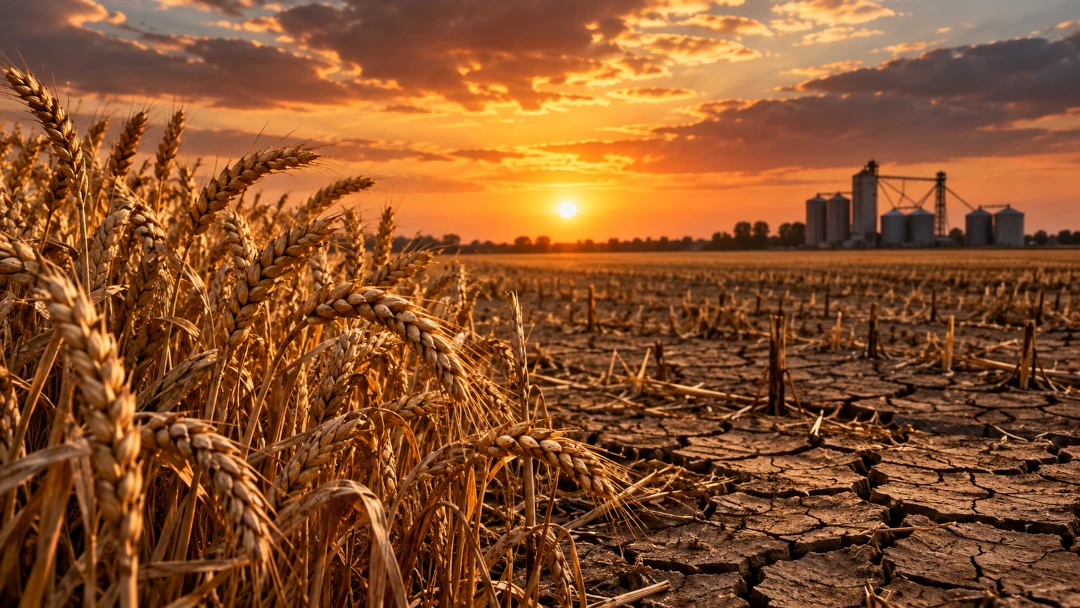
For half a century American agriculture ran a trade surplus the rest of the economy envied. Now the country imports more food than it exports, family farms are filing for bankruptcy at a pace not seen since before the pandemic, and the White House is spending its energy on everything but the people who feed the nation.
The numbers tell a story most Americans have never heard. In June 2025 the U.S. Department of Agriculture projected that the country would close fiscal year 2025 with an agricultural trade deficit of $49.5 billion, with roughly $220 billion in imports against $170.5 billion in exports. The final tally came in lower, between $42.9 billion and $43.7 billion depending on the revision, but it still shattered the previous record of $31.8 billion set just a year earlier. As researchers summarized in the University of Illinois’ Farm Policy News, the shift reverses five decades in which U.S. farm trade ran large surpluses and even served as a Cold War foreign-policy tool.
The administration now celebrates a smaller gap. USDA’s August outlook forecasts a fiscal 2026 deficit of about $25 billion, and Under Secretary Luke Lindberg has called the improvement tremendous progress. Read the fine print, though. When USDA cut its forecast in February, Agri-Pulse reported that the entire year-over-year improvement came from Americans importing less, not from farmers selling more, and projected exports still fell short of fiscal 2024. A deficit that shrinks because tariffs make groceries more expensive is not a farm recovery. It is a household squeeze with a better press release.
I. How the Breadbasket Went Into the Red
The deficit has several causes, and only some of them are scandals. American Farm Bureau Federation economist Faith Parum has documented that horticultural products, including fruits, vegetables, nuts, wine and spirits, make up roughly half of U.S. agricultural imports by value. Avocados, bananas, coffee, cocoa and winter tomatoes are high-value products that either cannot be grown here or cannot be grown here in January. U.S. exports, meanwhile, remain dominated by lower-value bulk commodities like corn and soybeans. The Farm Bureau’s economists also point to a strong dollar and high domestic labor costs, which make American goods more expensive to foreign buyers, and to retaliatory tariffs that cut off markets in China and the European Union while buyers turned to Brazil and Argentina.
Trade inside industries plays a role too. American food companies import ingredients, process them, and sell finished products at home and abroad. And former USDA chief economist Joe Glauber, writing for the American Enterprise Institute, found that most of the change in the deficit since 2022 reflects shifting prices rather than shifts in the volume of food moving across borders. That is a fair caution against panic. It is not a reason for complacency. Agriculture Secretary Brooke Rollins herself called the projected deficit “devastating to our American farmers and ranchers,” as Glauber’s report notes. The question is what her boss has done about it.
Geography sharpens the picture. Mexico and Canada are the largest suppliers of fruits, vegetables and processed food to American shelves, and USDA’s latest outlook shows a $24.1 billion deficit with our two North American neighbors, nearly the entire national gap, offset by a surplus with Asia. These are the same partners the president has spent two years threatening with tariffs.
- FY 2022
Last surplus. U.S. farm exports hit a record of about $196 billion and the ledger stays in the black. - FY 2023 – FY 2024
Deficits arrive at $17.3 billion, then nearly double to about $32 billion. - April 2025
“Reciprocal” tariffs announced. China retaliates against U.S. soybeans and other goods; importers front-load purchases. - October 2025
$20 billion Argentina rescue. The Treasury backs Argentina while Argentine farmers sell soybeans to China in place of U.S. growers. - December 2025
$12 billion farm bailout announced, paid from tariff revenue, after months of delay. - Spring 2026
Strait of Hormuz closure sends diesel and fertilizer soaring; record drought spreads across the Plains and Southeast. - April 2026
Farm bankruptcies hit a six-year monthly high with 62 Chapter 12 filings. - September 30, 2026
Farm bill expires with no successor law, after Republicans built theirs around nutrition cuts Democrats would not accept.
II. The Squeeze: Fuel, Fertilizer, Seed and Freight
Farmers do not experience the trade deficit as a line in a USDA spreadsheet. They experience it as a margin that has nearly vanished. Trade-war tariffs raised the cost of imported fertilizer, chemicals and equipment parts in 2025. The administration rolled back fertilizer tariffs in November, but North Dakota State University researchers found that while wholesale prices fell quickly, retail prices stayed sticky, leaving farmers paying tariff-era premiums into 2026. Their analysis estimated that price pass-through during the tariff period exceeded 100 percent, meaning farmers paid more than the tariff itself.
Then came the war. The closure of the Strait of Hormuz disrupted the global fuel and fertilizer trade. Cal Poly agricultural economist Richard Volpe told Fortune that farmers faced a “one-two punch” of higher energy and fertilizer costs, and USDA raised its 2026 food-price inflation forecast to 3.6 percent. As harvest began last month, diesel reached record highs, and Purdue economist Michael Langemeier noted that equipment and fertilizer prices had also climbed under the tariffs. Higher fuel is also higher freight: Iowa Corn Growers Association president Steve Kuiper described farmers rethinking where and when they can afford to haul grain.
Fertilizer affordability
Worst on record
Fertilizer prices reached their highest level since 2022 while grain prices stayed well below 2022 levels, leaving wheat fertilizer affordability at its worst recorded level entering 2026, per StoneX.
Farm debt
$624.7B
USDA forecasts record farm-sector debt in 2026, up 5.2 percent, as lenders report farmers borrowing more and taking longer to repay, per AFBF analysis.
Family farm bankruptcies
+46%
Chapter 12 filings rose to 315 in 2025, and April 2026 brought 62 filings, the most in any month since February 2020, per Law360 data reported by Farm Policy News.
The Delta
“Hand to mouth”
Mississippi farmer Sledge Taylor told NPR he now buys diesel in small batches, as Delta growers who rely on diesel irrigation pumps absorb both lost export markets and war-driven costs.
Honesty requires a caveat. Bankruptcy filings remain well below the 599 recorded in 2019, as Capital Press has reported. But those figures understate the damage. Farms that earn most of their income off the farm, which describes most small family operations today, do not qualify for Chapter 12 at all. When they fail, they simply close, and no court records the loss.
“Family farmers have been bankrupted by Trump’s ill-conceived trade wars.”
— Rep. Angie Craig (D-Minn.), Ranking Member, House Agriculture Committee
III. Drought, Wind and a Warming Farm Belt
Climate change has turned every one of these pressures into a multiplier. By early May, the Union of Concerned Scientists reported that about 61 percent of the continental United States was in drought, including nearly all of the Southeast, where Georgia and the Carolinas logged their driest stretch since record-keeping began in 1895. UCS calculated that 70 percent of the winter wheat crop, 98 percent of cotton and 61 percent of cattle sat in drought-stricken areas. USDA’s own crop data indicated roughly a third of winter wheat acreage would go unharvested, a level of abandonment not seen since the Dust Bowl era. Spring heat records, wind and hail outbreaks across the Midwest, and a cattle herd already at a 75-year low compounded the losses.
An administration serious about farmers would treat this as a national emergency requiring investment in conservation, water infrastructure, crop insurance reform and climate research. Instead, as the Union of Concerned Scientists warned, Congress and the administration have yet to act at the scale the 2026 drought demands, leaving farmers to absorb the weather and the war alike.
Get Involved Today
Contribute to our mission and turn your concerns into action.
IV. Middlemen and the Corporate Takeover of the Farm
Even in good years, the farmer’s slice keeps shrinking. USDA’s Economic Research Service reports that farms received just 11.8 cents of every dollar Americans spent on domestically produced food in 2024. The other 88.2 cents went to processing, transportation, packaging, retail and food service. Part of that reflects Americans eating out more. Much of it reflects market power.
Consider beef. Four meatpackers, JBS, Cargill, Tyson and Marfrig-owned National Beef, control roughly 85 percent of U.S. beef processing, up from about a quarter in the early 1970s. Ranchers have complained for decades about a widening gap between what they are paid for cattle and what shoppers pay at the counter. The president did order a Justice Department investigation into the packers last November, and it has since expanded to major grocery chains. That deserves acknowledgment. It also deserves skepticism: Investigate Midwest reported that the Justice Department quietly closed a similar probe from Trump’s first term, and an investigation is not a policy.
The concentration downstream mirrors consolidation on the land itself. The 2022 Census of Agriculture found the number of U.S. farms fell 10 percent in a decade, to about 1.9 million, while farms with $1 million or more in revenue grew by 32 percent. Small and mid-sized farms are disappearing; the giants are growing. Civil Eats reported that large farms now control 42 percent of U.S. farmland. When a family farm sells out under debt pressure, the buyer is rarely the neighbor’s kid. It is an investor, an integrator, or a larger operation with better access to credit and subsidy. Every bankruptcy filed this year accelerates that transfer.
V. What It Means at the Kitchen Table
For the average American, the farm crisis arrives through the grocery receipt. Tariffs raise the price of imported produce, coffee and cocoa. Drought and a shrunken cattle herd drive beef to record prices. Diesel costs flow into every truckload. And a nation that relies on two neighbors for much of its fresh produce, while picking fights with both of them, has made its food supply more fragile, not more independent. The long-term outlook from analysts is sobering: continued tight margins, record debt, rising interest costs, and lenders who expect financial stress to persist. If the family farm continues to vanish, the country will be left with fewer, larger producers and less competition to hold food prices in check.
VI. Congress Acts, the White House Deflects
Democrats have offered a plan. In January, House Agriculture Committee Ranking Member Angie Craig and Rep. Jahana Hayes introduced the Farm and Family Relief Act, which would send a supplemental payment to farmers, delay the shift of SNAP costs onto states, and require congressional approval before new tariffs take effect. That last provision goes to the heart of the problem: farmers cannot plan around a trade policy that changes by social media post.
In the Senate, Ranking Member Amy Klobuchar has pressed to finish a bipartisan farm bill, but Democrats on the Agriculture Committee refused to advance a Republican draft that left most of last year’s SNAP cuts in place. As the Spokesman-Review reported, Democrats want a two-year delay on the cost shift to states rather than the one year Republicans offered. Republicans chose to fund farm programs through last year’s reconciliation bill while cutting nutrition aid, breaking the coalition that has passed every farm bill for decades. The old law lapsed at midnight last night. (September 30, 2026)
The president’s record is defined by what he has chosen to prioritize. In October 2025, as soybean farmers watched China buy Argentine beans instead of theirs, the administration extended a $20 billion lifeline to Argentina and floated importing more Argentine beef. Asked why, Trump told reporters, as quoted by Al Jazeera:
“Argentina is fighting for its life.”
— President Donald Trump, October 19, 2025, on aiding Argentina over U.S. soybean growers
American farmers got their aid two months later: a $12 billion package paid from tariff revenue, meaning money collected from American importers and consumers was recycled to partially compensate farmers for damage the same tariffs caused. Sen. Elizabeth Warren and other Democrats introduced legislation to block the Argentina rescue. Beyond one-time checks and a meatpacker probe, the White House has put forward nothing comparable in scale for drought, war-driven fuel costs, or rebuilding the export markets its trade war shattered.
When Erratic Leadership Reaches the Dinner Table
The mechanism. Section 4 of the 25th Amendment allows the Vice President and a majority of the Cabinet, or another body Congress creates by law, to declare in writing that the president is unable to discharge the powers and duties of the office. If the president contests the finding, Congress decides, and a two-thirds vote in both chambers is required to keep the Vice President in charge. Section 4 has never been invoked.
Who has called for it. After the president warned in April that “a whole civilization” in Iran could die, more than 70 members of Congress called for impeachment, the 25th Amendment, or both. Sen. Chris Murphy said no president “in control of his senses” would make such a threat. Reps. Raja Krishnamoorthi, Mike Quigley, Ro Khanna and Melanie Stansbury joined the call, as did Sen. Ed Markey and Reps. Eric Swalwell, Sydney Kamlager-Dove and Yassamin Ansari earlier in the year. House Judiciary Ranking Member Jamie Raskin introduced a bill, with 50 Democratic co-sponsors, to create a 17-member commission under Section 4.
The argument. Bad policy is not, by itself, constitutional incapacity, and we do not claim otherwise. The case its advocates make rests on a pattern: what Rep. Krishnamoorthi called reckless escalation and erratic decision-making. The farm crisis fits that pattern. A president who launches tariffs, reverses them, bails out a foreign competitor while domestic growers go under, and then pays farmers with revenue from the tariffs that hurt them is not pursuing a strategy. He is lurching. When a president’s impulses close export markets, raise the cost of feeding a family, and leave a farm bill to expire, the question of capacity to discharge the duties of the office is not abstract.
The barriers. The obstacles are real. Vice President JD Vance and the Cabinet have shown no willingness to act. Republicans control both chambers, the president could veto Raskin’s commission bill, and a contested Section 4 finding needs two-thirds of both houses. By any practical measure, removal this way is a long shot.
Why the case still matters. The framers of the 25th Amendment wrote it so the country would not have to wait for a crisis to become a catastrophe. A remedy being politically difficult does not make the underlying question illegitimate. Putting the evidence on the record, including the slow-motion damage to the country’s food system, is how Congress fulfills its constitutional role and how voters can judge it in November.
Editorial Conclusion
America did not lose its farm trade surplus overnight, and not every cause is Donald Trump’s doing. But a president’s job is to meet a crisis, and this one has deepened it: tariffs that raised costs and closed markets, a rescue for Argentina before America’s own growers, silence on drought, and a farm bill allowed to lapse. Congress must pass a farm bill that protects both farmers and families, reclaim its authority over tariffs, enforce antitrust law against the packers and processors taking the farmer’s share, and invest in a food system built to withstand a hotter climate. The country that feeds the world should be able to feed itself, and it deserves a president fit to protect that capacity.
Sources & References
- FarmWeek · Projected ag trade deficit climbs to $49.5 billion
- Farm Policy News (Univ. of Illinois) · USDA projects ag trade deficit will fall to $41.5 billion in 2026
- Agri-Pulse · USDA cuts ag trade deficit forecast on even lower imports
- Ag Bull Trading · USDA sees U.S. ag trade deficit narrowing to $25 billion in FY 2026
- Texas Farm Bureau / AFBF · U.S. ag trade deficit widens, headed to record levels
- American Enterprise Institute · Is a negative US agricultural trade balance a cause for concern?
- NDSU via AgEcon Search · January 2026 Agricultural Trade Monitor: fertilizer tariffs and price pass-through
- Fortune · Tariffs, war and historic drought converge into a “perfect storm” for farmers
- WGLT / Harvest Public Media · Record-high diesel costs are squeezing farmers as harvest begins
- StoneX · Input cost surge leaves farm margins exposed in 2026
- NPR · Rising fertilizer and fuel costs push some farmers to the brink
- Georgia Farm Bureau / AFBF · Farm Chapter 12 bankruptcies up 46%
- Farm Policy News (Univ. of Illinois) · Farm bankruptcies hit six-year high in April
- Capital Press · Farm bankruptcies surge, but remain below peak levels
- Union of Concerned Scientists · Widespread record U.S. drought threatens rural livelihoods and food affordability
- USDA Economic Research Service · Farms received 11.8 cents per food dollar in 2024
- USDA Economic Research Service · 2022 Census of Agriculture: number of farms down 10 percent
- Civil Eats · What the latest farm census says about the changing ag landscape
- Investigate Midwest · Fact-checking Trump’s call for an investigation into meatpackers
- The Fence Post (via Rep. Craig) · Craig unveils Farm and Family Relief Act
- The Spokesman-Review · Farmers want relief from Congress. Here’s the holdup
- Al Jazeera · Why U.S. soybean farmers are upset with Trump’s $20bn Argentina bailout
- ABC News · Trump says $12 billion farmer bailout will come from tariff revenue
- NBC News · Dozens of Democrats call for Trump’s removal after Iran threats
- Axios · Democrats file long-shot 25th Amendment commission bill
Related News