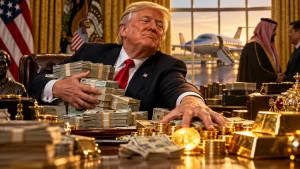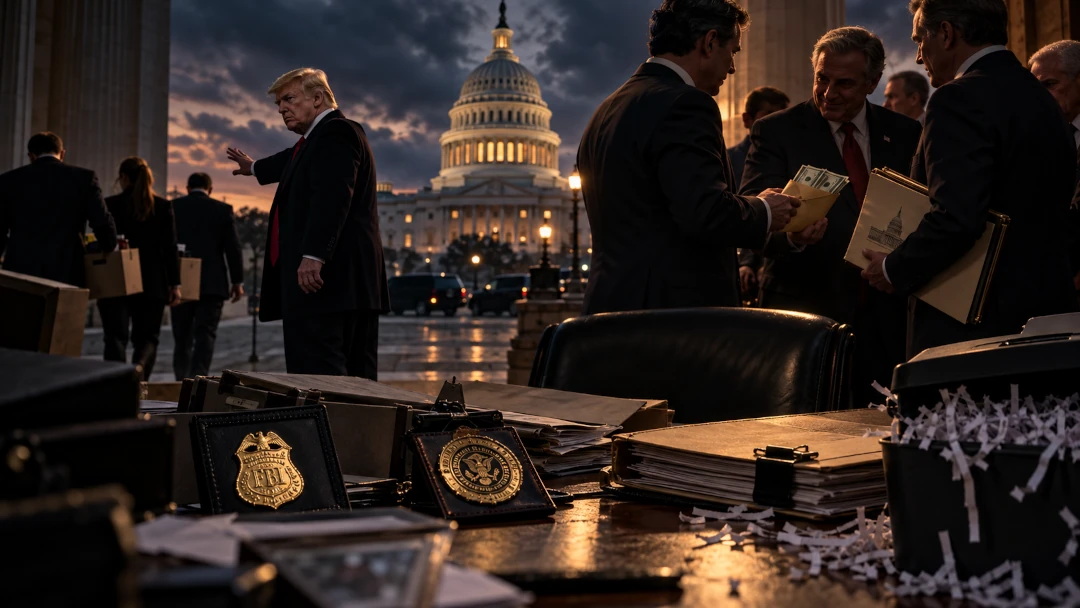
A convicted defense contractor told the FBI he bought federal money from some of the most powerful people in Congress — Republicans and Democrats alike. Agents were building the case when Donald Trump returned to office and dismantled the very teams that investigate bribery. The probes are dead, the contracts kept flowing, and the president who promised to clean up Washington has spent his second term getting richer than ever.
For a guest list of two defense executives and a lobbyist, the price of admission was $40,000 in campaign pledges, and the meeting was capped at 45 minutes. That is how ProPublica opens its new investigation, published yesterday, into a March 2020 steakhouse dinner in Washington between the late Sen. Lindsey Graham and the leadership of Navatek, a Hawaiian naval research contractor. According to what Navatek’s former CEO, Martin Kao, later told FBI agents, Graham agreed at that dinner to steer a roughly $10 million Navy contract to the company in South Carolina — and asked for $100,000 in campaign support in return.
Kao’s account did not stop with Graham. He told agents the same arrangement — campaign cash for budget language that would funnel money to his firm — was struck with South Carolina’s most powerful Democrat, Rep. James Clyburn, and with Republican Rep. Joe Wilson, a senior member of the House Armed Services Committee. Last month, ProPublica reported a parallel thread: Kao told the FBI that a $150,000 contribution to a super PAC backing Maine Sen. Susan Collins was a bribe for her help securing more Navy funding.
Every one of those lawmakers, or their offices, denies wrongdoing. Kao is a convicted fraudster serving a seven-year sentence who cooperated in hopes of reducing it. Those facts matter, and we will return to them. But the reason no court or jury will ever weigh his story against the documents is not that agents found it baseless. It is that the investigation was killed — and the people who killed it work for the president who told voters he would drain the swamp.
I. The Method: How Influence Gets Bought
Read together, ProPublica’s two reports describe something more instructive than a single bribe. They describe a business model. Kao, who called his approach “the method,” would open an office in a powerful appropriator’s home state, partner with a local university to lend the proposal credibility, and then seek a meeting with the lawmaker. Funding would be written into the defense budget in language that never named Navatek but described its planned work so precisely that no other bidder made sense. After the bill passed, congressional staff would nudge the Navy toward the “right” contractor — even though those awards were supposed to be competitive.
The company, Kao explained to agents, deliberately targeted appropriators from small states, who control enormous sums but answer to fewer constituents. The paper trail backs up pieces of the story. ProPublica found that budget language describing a Navatek project appeared in a House Appropriations report days after a Clyburn staffer previewed it to the company, and that a near-identical paragraph sat in a Navatek executive’s spreadsheet two months before it surfaced in the Senate’s report. Within days of Congress passing that funding, the donations began.
The product taxpayers received for all this was, by the accounts of Navatek’s own former leaders, close to worthless. A former executive told ProPublica the company had essentially no staff capable of the cutting-edge shipboard power research it sold to Congress. The $9.5 million contract Graham’s office helped direct to the company was awarded in July 2020; after Navatek collapsed, its successor firm, Integer Technologies, picked up that same work and is now projecting hundreds of millions in contracts.
“[It’s] corruption at its best. But I am the only one rotting in prison.”
— Martin Kao, former Navatek CEO, writing to ProPublica from federal detention
II. The Evidence on the Record
Here is what the reporting documents — and what each side says about it.
The Graham Dinner
Required in contributions for a 45-minute private dinner, per emails ProPublica reviewed. Graham’s office called pay-for-play claims false and said fundraising minimums are routine. ProPublica
The Clyburn Meeting
In donations from Kao and family days after a scheduled meeting, plus a $10,000 gift to Clyburn’s alma mater. His office says donations never changed his support for South Carolina universities. ProPublica
The Collins Super PAC
Sent through a shell company to a pro-Collins super PAC after a meeting with its chief. Collins’ office calls Kao’s bribery claims outlandish and says it cooperated fully with the FBI. Defense One / ProPublica
The Promised Payoff
In naval contracts Kao told his executives Collins had committed to, according to an internal company email. Her office says she backed Navatek’s Maine work before any donation arrived. NEWS CENTER Maine
The FBI’s Own Conclusion
An FBI agent’s memo found a lengthy history of contractor donations tied to contracts, named two ex-Navatek executives as subjects, and flagged the lawmakers as possible future subjects. ProPublica
The Official Denial
The FBI told reporters it found nothing implicating Collins or her campaign. ProPublica counters that its documents show the broader probe ended only after Trump’s cuts. WBUR · ProPublica
We want to be precise. Lindsey Graham died earlier this year and can no longer answer for himself; his sister, Darline Graham, now holds his seat and kept much of his staff. Clyburn, Wilson and Collins have never been charged. The lobbyist who arranged the Graham dinner confirmed many details of Kao’s account — the envelope of checks, the brief appearance — but flatly denied that any explicit deal was struck. Corruption cases are also harder to win than ever, after a string of Supreme Court decisions that Fix the Court has catalogued as narrowing federal bribery law.
But “unproven” is not the same as “disproven.” The point of an investigation is to find out. This one was never allowed to.
III. How the Investigation Went Dark
The demolition of federal anti-corruption enforcement did not happen in one stroke. It happened in a sequence, and the sequence is the story.
The Associated Press reported in May 2025 that the bureau was dissolving a Washington squad dedicated to fraud and corruption allegations against members of Congress and other federal officials. A month later, a Reuters special report found the Justice Department’s Public Integrity Section — created after Watergate to prosecute exactly this kind of misconduct — had been stripped of its power to file new cases. Fordham constitutional law professor Andrew Kent told Reuters the moves were “utterly unprecedented” and dangerous for a democracy.
By this spring, NPR reported, the section that once had around 40 prosecutors was down to two. John Keller, who resigned as the section’s acting chief rather than drop the Adams case, put the consequence bluntly to NPR: “Because public integrity no longer exists, those cases aren’t being done.”
IV. Why Would Trump Kill Corruption Cases?
The administration’s stated answer is reallocation and reform. The AP reported that the FBI under Director Kash Patel was shifting resources toward immigration, drug trafficking and violent crime. The Justice Department frames its overhaul as ending “weaponization.” And an FBI spokesperson told ProPublica that agents are removed only for unethical conduct or misusing law enforcement, while dismissing Kao’s claims as unreliable.
The record points to three more convincing explanations.
First, retaliation. The Washington squad that was dismantled had, as the AP noted, worked on investigations into efforts by Trump and his allies to overturn the 2020 election. ProPublica describes the purge of the D.C. field office’s anti-corruption agents as revenge against people who had once investigated the president. The Navatek case was not the target. It was collateral damage — which is precisely what makes it so revealing.
Second, leverage. A Justice Department that cannot independently investigate members of Congress is a Justice Department that cannot threaten a president’s allies — and that can be selectively pointed at his enemies. Reuters found that longstanding rules requiring Public Integrity review before charging public officials were scrapped, removing a guardrail designed to stop politically motivated prosecutions. Note that the dead case reached both a Republican committee chair and the Democrats’ most influential elder statesman. An administration that controls whether such files ever move holds something valuable over everyone named in them.
Third, impunity as policy. The purge does not stand alone. A Reuters analysis published this month counted at least 85 public officials charged with or convicted of corruption-related crimes who received clemency from Trump across his two terms — the large majority of them Republicans or open supporters.
“President Trump is trying to end accountability for public officials.”
— Phillip Halpern, retired federal prosecutor, to Reuters
Senator Susan Collins has pointed out that she wrote then-Attorney General Pam Bondi in early 2025 urging her not to cut FBI agents — a fair point her campaign raises in her defense, as ABC News 4 reported. It also demonstrates the trap: when enforcement depends on the goodwill of political appointees rather than on independent investigators, no one — the accused included — can ever be cleared by an honest process.
Get Involved Today
Contribute to our mission and turn your concerns into action.
V. What This Means for You
It is tempting to treat Capitol Hill bribery as an insiders’ scandal. It is not. When a contractor can, as Kao alleged, buy its way into the defense budget, the losses land on ordinary people in at least three ways.
You pay for it. Every dollar steered to a company that, by its own former executives’ account, could not do the work is a dollar not spent on a sailor’s equipment, a veteran’s care, or a tax cut for a working family. Navatek won more than $40 million in new government contracts in 2020 alone.
It weakens the country’s defense. Navy research money exists to keep the fleet ahead of adversaries. When it is allocated by fundraiser rather than by merit, readiness suffers — quietly, invisibly, until it matters.
It corrodes the idea that the law applies to everyone. Martin Kao is in prison. Nobody who allegedly took his money has faced a grand jury. Without enforcement, Keller warned NPR, public officials start serving themselves first and the public second. Trust is already near the floor: a House resolution introduced this May by Rep. Jason Crow notes that just 17 percent of Americans trust Washington to do the right thing most of the time.
The Law Still Says Bribery Is a Crime. Enforcement Is the Missing Piece.
- 18 U.S.C. § 201 — Federal Bribery
- It is a felony for a public official to corruptly seek or accept anything of value in exchange for being influenced in an official act. Campaign contributions can qualify, but prosecutors must prove an explicit quid pro quo — which is why undercover work and documentary evidence, both lost when the case died, are so important.
- 52 U.S.C. § 30119 — Federal Contractor Contributions
- Companies holding federal contracts are barred from making contributions to federal candidates or committees. Kao’s use of a shell company to route money to a super PAC is the conduct to which he pleaded guilty.
- Article II, § 3 — The Take Care Clause
- The president must “take Care that the Laws be faithfully executed.” Abolishing the capacity to enforce anti-corruption statutes while they remain on the books turns that duty on its head.
- Article I, § 9, cl. 8 — Foreign Emoluments Clause
- No federal officeholder may accept any present or payment from a foreign state without Congress’s consent. Democrats argue the president’s acceptance of a Qatari 747 and foreign-linked investments in family ventures violate this clause; the administration says the government, not Trump, received the plane.
- Article II, § 4 — Impeachment
- The Framers named “Bribery” explicitly as grounds for removal. The Constitution treats corruption at the top not as a political inconvenience but as a threat to the republic itself.
VI. What Congress Is Doing — and Not Doing
The response so far comes almost entirely from Democrats, and almost none of it can pass a Republican-controlled Congress. That is worth stating plainly.
In August 2025, Sen. Elizabeth Warren and Rep. Jerrold Nadler, joined by dozens of colleagues, opened an inquiry into the gutting of the FBI and DOJ public-corruption teams, warning that the administration was “giving the green light to would-be lawbreakers,” and demanding a list of corruption cases still open.
In July, Senate Democratic Leader Chuck Schumer introduced the Anti-Corruption Bureau Creation Act (S. 5183), co-sponsored by Sens. Jeff Merkley, Alex Padilla and Andy Kim. It would create an independent bureau shielded from presidential interference and let Americans and state attorneys general sue to recover money obtained through presidential corruption. In March, Warren and Sen. Dick Durbin led 14 Democrats in introducing the FCPA Reinforcement Act, doubling the statute of limitations for foreign bribery so today’s offenses can still be prosecuted by a future administration.
In the House, more than 180 Democrats reintroduced the DISCLOSE Act to expose the anonymous money that flows through super PACs. And just yesterday, Rep. Eugene Vindman introduced two bills to tighten ethics screening for appointees and extend the window for prosecuting false statements to Congress.
Meanwhile, the Senate Ethics Committee — the one body that could examine the Navatek allegations against a sitting senator right now — has so far said nothing publicly in response to the complaint filed by Maine attorney Valerie Adams. With Republicans in the majority, few expect it to act. Silence from both parties on the Clyburn allegations would be equally damning. An anti-corruption movement that protects its own is not an anti-corruption movement.
VII. The President Who Profits
Here is the part of the story that should end any debate about priorities. While the machinery for investigating corruption was being taken apart, the president’s own family was building the most lucrative business of its life on the back of his office.
Trump’s 2025 financial disclosure, released by the Office of Government Ethics this summer, showed roughly $1.2 billion in income from family cryptocurrency activities in his first year back in office, including nearly $550 million tied to World Liberty Financial, the venture his sons co-founded, AFP reported. Forbes estimates his personal fortune nearly tripled between 2024 and 2026. Bloomberg found the family made about $1.55 billion from World Liberty token sales once previously undisclosed transactions were counted. And according to Wall Street Journal reporting summarized by Benzinga, lieutenants of a senior Emirati royal bought 49 percent of World Liberty for $500 million this January — money from a foreign government’s inner circle flowing to a sitting president’s family business.
Then there is the $400 million Boeing 747 from the government of Qatar, which Trump called “stupid” to refuse. Schumer placed holds on Justice Department nominees over it, noting that the attorney general who blessed the arrangement had previously worked as a lobbyist for Qatar. Even some Republican senators voiced security and legal concerns.
The White House insists, through spokesperson Anna Kelly, that neither the president nor his family has ever had a conflict of interest. Set that claim beside the record: a president who paused enforcement of the nation’s foreign-bribery law, gutted its domestic counterpart, pardoned dozens of convicted officials, and banked a billion dollars from ventures foreign governments can buy into. Each act might be defended in isolation. Together, they describe a government reorganized so that corruption is not investigated — and is, for those closest to power, extraordinarily profitable.
Trump won his first term promising to drain the swamp. In his second, the inspectors were fired, the referees went home, and the swamp’s most valuable real estate turned out to belong to him.
VIII. What You Can Do
An honest assessment: there is no quick fix. The Justice Department answers to the president, the Senate Ethics Committee answers to the majority, and most reform bills will not move this Congress. But public pressure decides which stories die quietly and which become the issue of an election. Here is where it counts.
- Vote — and make corruption the question
Midterm Election Day is Tuesday, November 3, 2026. Ask every candidate for Senate and House, by name, whether they will co-sponsor the Anti-Corruption Bureau Creation Act and support restoring the Public Integrity Section. Make them answer on the record, regardless of party.
Call your senators about S. 5183 and the FCPA Reinforcement Act
Reach any office through the Capitol switchboard at (202) 224-3121. A two-minute call asking whether the senator supports an independent anti-corruption bureau is tallied by staff and does more than an email.
Demand the Ethics Committees act
Write to the Senate Select Committee on Ethics and the House Committee on Ethics asking them to review the Navatek allegations against every sitting member named — Republican and Democrat alike. Bipartisan pressure is the only kind that works.
Follow the money yourself
Look up who funds your own representatives at the Federal Election Commission’s free database (fec.gov). Bring what you find to a town hall and ask about it out loud.
Protect the people who expose this
This story exists because investigative reporters and career agents did their jobs. Support independent, nonprofit journalism, and if you have firsthand knowledge of public corruption, take it to a reputable newsroom or your state attorney general — offices that do not answer to the White House.
Editorial Conclusion
A convicted contractor handed federal agents a map of how money buys power in Washington. Rather than follow it, this administration fired the people holding the map, emptied the office that was supposed to prosecute what it showed, and pardoned officials already caught. Whether every one of Martin Kao’s claims is true is precisely what Americans were denied the chance to learn.
A republic does not survive on the honesty of its officials alone; it survives on the certainty that dishonesty will be investigated, whoever commits it and whichever party they belong to. That certainty is gone. Restoring an independent, protected anti-corruption force is not a partisan demand — it is the minimum condition of self-government. Congress must build it, voters must require it, and no president who profits from its absence should be trusted to decide otherwise.
Sources & References
- ProPublica — How Trump’s FBI Purge Saved Lindsey Graham and James Clyburn From a Bribery Investigation (Oct. 20, 2026)
- ProPublica — The FBI Anti-Corruption Squad Was Circling Susan Collins — Until Trump Got in the Way (Sept. 2026)
- ProPublica — Susan Collins Bribery Allegations, Explained
- ProPublica — Debunking the Collins Campaign’s Claims About the FBI’s Navatek Investigation
- Defense One — FBI Defense Bribery Investigation (ProPublica republication)
- WBUR — Democrats Accuse Susan Collins of ‘Corruption’ Following Report on Alleged Pay-to-Play Scheme
- ABC News 4 — ‘Nothing Wrong’: Collins’ Campaign Denies Bribery Claims in ProPublica Report
- Portland Press Herald — Democrat Files Ethics Complaint Against Susan Collins Over Alleged Pay-to-Play Scheme
- NEWS CENTER Maine — Maine Attorney Urges Ethics Probe Into Collins ‘Pay-to-Play’ Allegations
- Associated Press via OPB — The FBI Is Disbanding One of Its Washington-Based Public Corruption Squads
- Reuters — How Trump Defanged the Justice Department’s Political Corruption Watchdogs
- Fordham Law News — Prof. Andrew Kent Comments on Overhaul of the Justice Department
- NPR via LAist — How the Trump Administration Has Undermined the Fight Against Public Corruption
- Reuters via Devdiscourse — Special Report: In Trump’s Pardons for Public Officials, Republicans Win Most of the Mercy
- Arnold & Porter — President Trump Presses Pause on FCPA Enforcement
- Fix the Court — Recent Supreme Court Cases That License Corruption
- Office of Sen. Elizabeth Warren — Warren, Nadler Open Investigation Into Retreat From Enforcement of Corruption Laws
- Senate Democrats — Schumer Pushes First-Ever Anti-Corruption Bureau
- Congress.gov — S. 5183, Anti-Corruption Bureau Creation Act
- Freshfields — The FCPA Reinforcement Act: Senate Democrats Push for Longer Lookback
- Office of Rep. John Larson — House Democrats Reintroduce the DISCLOSE Act
- Office of Rep. Eugene Vindman — Vindman Introduces Two Bills to Crack Down on Corruption
- Congress.gov — H. Res. 1326, Denouncing Corruption in All Its Forms
- AFP via Khaleej Times — Trump Earned Over $1 Billion From Crypto Ventures in 2025
- Bloomberg Law — Quiet Token Sales Boosted Trump Crypto Wealth by $660 Million
- Benzinga (summarizing WSJ) — World Liberty Financial Generated $1.4 Billion in 16 Months
- Yahoo News — Schumer Blocks Trump DOJ Appointees Over $400 Million Plane Gift From Qatar
Related News