They Wanted a Voting Machine Hacked in Secret — While They Gutted the Guardians of Our Elections
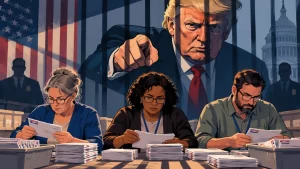
New reporting from ProPublica reveals that Trump’s political appointees at Homeland Security asked the nation’s election-security agency to quietly buy a voting machine, break into it, keep the vendor in the dark, and hand the results to the White House. The request went nowhere — partly because the experts who could have done it had already been fired. Fifteen days before the midterms, that is the whole story in miniature: an administration that wants ammunition against elections, not protection for them.
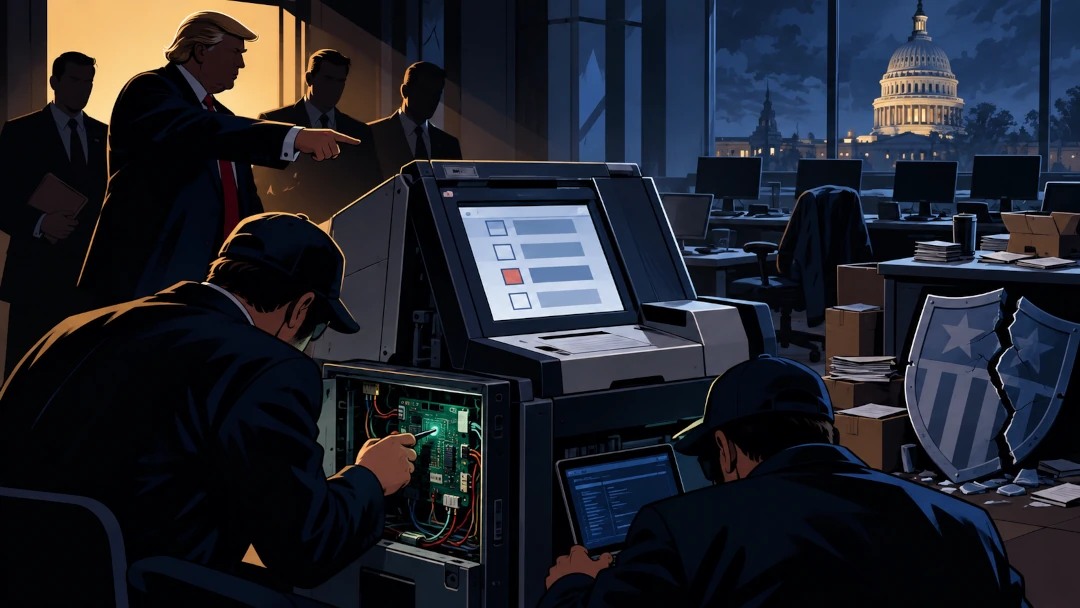
A few months into Donald Trump’s second term, political appointees at the Department of Homeland Security went to the Cybersecurity and Infrastructure Security Agency — the federal body whose job, since 2017, has been to help states defend their voting systems — with a request that career staff found almost impossible to believe. According to an investigation published this morning by ProPublica reporters Andy Mannix and Doug Bock Clark, the appointees wanted CISA to procure a voting machine without telling anyone, examine it for weaknesses, and report its findings so they could be passed to the White House. Two former administration officials described the request.
There was a second instruction that made the first one sinister. CISA was told not to notify the machine’s manufacturer about any flaws it found — the opposite of how responsible vulnerability research works, and the opposite of CISA’s own standard practice. A defender finds a hole so it can be patched. Someone who finds a hole and deliberately keeps it secret is building a file.
One of the former officials put the staff’s fear plainly: the worry was that the findings would be held in reserve and used to throw out any election results the administration didn’t like. That official’s verdict on the whole proposal was blunt: “This goes against everything CISA represents.”
The operation never happened. CISA employees repeatedly told the appointees it couldn’t be done — in part, ProPublica reports, because the agency personnel capable of such work had just been laid off by Elon Musk’s DOGE initiative. Eventually the appointees stopped asking. That should not comfort anyone. It means the only thing standing between the White House and a secret dossier on voting-machine weaknesses was that the administration had already fired too many of its own experts to produce one.
I. What the Reporting Shows
The hacking request is the headline, but ProPublica’s larger finding is about what has happened to the agency itself. CISA was created by a law Trump himself signed in 2018, and it spent years building a fragile partnership with state election officials — one founded on a promise that the sensitive information states shared about their systems would stay confidential. Derek Tisler, election-security counsel at the Brennan Center for Justice, told ProPublica that trust took years of patient relationship-building to establish.
In Trump’s second term, that partnership has been dismantled piece by piece. The evidence is specific:
The Secret Hack Request
DHS political appointees asked CISA to acquire and probe a voting machine, report to the White House, and withhold any flaws from the vendor. Staff refused it as unworkable. ProPublica
A Third of the Workforce Gone
More than 1,000 CISA employees laid off or pushed out; the 2027 budget proposal seeks another $700 million in cuts, which could mean 900 more layoffs. ProPublica
$39.6 Million Withheld
Congress directed DHS in April to keep funding election-security programs, including the EI-ISAC threat-sharing center. Months later, none of the money had reached it. The Hill
States’ Confidential Data Exposed
To back the president’s 2020 claims, the administration declassified records that included raw information states had shared with CISA in confidence, such as an Election Day 2020 monitoring log. ProPublica via AlterNet
A Partisan at the Helm
Acting CISA Director Nick Andersen is a Republican Party district representative in Virginia who gave a March speech to a local GOP chapter on fighting Democratic redistricting. ProPublica
A Plan Delivered as Voting Began
CISA’s 13-page 2026 security plan arrived September 24 — after the window when the agency historically finished its state preparations, and as early voting got under way. CISA
Election officials across the political map described the same reality to ProPublica. Ryan Macias, an election-technology expert who has consulted for CISA, said the agency wasn’t merely deprioritized through 2025 and most of 2026 — it was effectively absent. Arizona Secretary of State Adrian Fontes said the administration had cut states off and left them to fend for themselves. Maine Secretary of State Shenna Bellows said CISA’s sudden autumn offer of help came far too late to matter. David Becker of the nonpartisan Center for Election Innovation and Research said the administration had torn down, within its first months, what Trump’s own first term had built. Caitlin Durkovich, a former DHS assistant secretary for infrastructure protection, said she did not know how the broken trust could be rebuilt.
Officials in one large jurisdiction went further: they have met privately with their voting-machine vendors to plan for the possibility that the federal government seizes their equipment or declares it unusable. That local election officials now plan for federal sabotage the way they once planned for hurricanes should alarm every American, regardless of party.
“DHS is actively sabotaging elections by not funding these programs.”
— Arizona Secretary of State Adrian Fontes, via NPR
In fairness, the administration disputes this account. White House spokesperson Lauren Bis told ProPublica that no president has done more than Trump to ensure free and fair elections, and denied that releasing state-shared records broke any agreement. DHS and CISA did not answer ProPublica’s questions. Andersen, in an August call with state officials, attributed lapses to the fall 2025 government shutdown. And the agency’s new plan says it has recommitted to its statutory mission. Readers should weigh those claims against the record laid out here — a record of firings, frozen funds, and a request to hack the very equipment the agency exists to protect.
II. Not an Isolated Request: A Pattern
The secret-hack proposal fits a long campaign to treat voting equipment as evidence for a predetermined conclusion. ProPublica notes that in fall 2025 a Justice Department official, Andrew McCoy Warner, called Missouri county clerks seeking access to voting machines, and that then–Director of National Intelligence Tulsi Gabbard led an operation to seize election machines in Puerto Rico. When the private contractor hired to examine those machines found nothing supporting claims about 2020, its federal work ended. (ODNI says the contract was simply completed.)
The July 16 speech deserves particular attention because it shows the method. ABC News reported that across a 20-minute address, the president provided no specific evidence that any vote in 2020 had been changed, despite again calling that election stolen. CNN found that the newly declassified documents mostly described vulnerabilities known for years — ones election officials have long worked to address. Trump nonetheless told the country that voting machines were “extremely exposed to attack.” And an Associated Press review, cited by Newsweek, found the documents did not show China or any foreign actor had manipulated votes or changed results.
Put the pieces side by side and the logic becomes clear. Warn loudly that machines are vulnerable. Fire the people who make them less vulnerable. Withhold the money Congress approved to help. Then ask what’s left of the agency to find flaws — and keep them secret. That is not a security strategy. It is a pretext strategy.
III. What This Means for the Midterms
Here is the reassuring part, and it matters: state and local officials say they will run a secure election without Washington’s help. Elections in America are administered by thousands of county clerks and state officials, with paper records, canvasses, and audits. ProPublica reports that state leaders have used their own budgets to replace some of what CISA abandoned, such as sensors that flag unusual activity on election networks. Nothing in this reporting suggests the machines you’ll use in November have been compromised.
The danger is different, and in some ways worse. Some services can’t be replaced by states — above all, federal intelligence about what foreign adversaries are doing. A state cannot run its own spy agency. And with the information-sharing relationship broken, threats one state detects may no longer travel quickly to its neighbors. The country’s early-warning system has been switched off at the moment it’s most needed.
The other danger is narrative. Officials and cybersecurity experts told ProPublica they fear Trump will claim the election was hacked if Republicans lose in November. A secret file of machine vulnerabilities — withheld from the vendor so it could never be fixed — is precisely the kind of material that could be waved around after the polls close to cast doubt on legitimate results. The request failed. The intent behind it did not disappear.
IV. What It Means for the Average American
For most voters, the practical effect will be invisible until something goes wrong. If a ransomware gang hits a county’s systems, if a foreign influence campaign floods your social feeds with fake polling-place changes, or if election-office phones are swamped with bomb threats, the federal backstop that once coordinated the response is thinner than at any point since 2016. Your county election office is more on its own.
There is also a quieter cost. Every claim that elections are rigged — repeated without evidence from the most powerful office in the country — wears down the public’s willingness to accept outcomes. That corrosion does not stay partisan. A democracy where losers believe they were cheated, and winners can’t prove they weren’t, is a democracy that stops resolving disputes peacefully. Protecting the integrity of the count and protecting public confidence in the count are the same job. This administration is failing at both.
Get Involved Today
Contribute to our mission and turn your concerns into action.
V. What Congress and Democrats Are Doing
Democrats have not been silent, though they hold neither chamber’s gavel. In June, House Homeland Security Committee Ranking Member Bennie Thompson of Mississippi led committee Democrats in demanding answers from DHS Secretary Markwayne Mullin on how the department would spend its election-security budget, restore relationships with states, and preserve the EI-ISAC and the regional election-security advisers.
“Congress rejected the Trump Administration’s attempt to abdicate the Federal government’s election security obligations.”
— House Homeland Security Committee Democrats, led by Rep. Bennie Thompson, via committee letter
In September, Sen. Alex Padilla of California and Rep. Joseph Morelle of New York — the top Democrats on the congressional committees overseeing federal elections — pressed Mullin and acting CISA Director Andersen to explain why the $39.6 million had not been delivered, noting that Congress had given DHS “clear, bipartisan instructions” back in April. They also warned that CISA was only beginning to rehire critical election staff, months too late. Earlier, in March, Rep. Dan Goldman of New York led 47 Democrats in urging appropriators to bar any DHS funds from being used to seize, collect, or analyze voting machines and voter records — a response to the Fulton County raid and to Trump’s January statement that he regretted not ordering DHS and the Pentagon to seize machines after 2020. In light of today’s report, ProPublica notes that Democrats are also calling for an investigation into whether CISA can still do its job.
That is oversight, and it is necessary. But letters are not enforcement. Until Democrats hold subpoena power or the purse, the administration can — and so far has — ignored them. That is part of what is on the ballot on November 3.
Meanwhile, the courts have done much of the defending. The Justice Department has lost fifteen straight lawsuits seeking states’ full, sensitive voter rolls — several before judges Trump himself appointed. And on September 14, the Supreme Court left in place an order blocking the Postal Service’s mail-ballot rule for this year’s elections. Colorado Attorney General Phil Weiser summed up the message as telling the president and the Postal Service to “stay the hell away from our elections.”
Who Actually Runs American Elections — and What the Law Requires of the President
The Elections Clause — Article I, Section 4
The Constitution assigns the “times, places and manner” of congressional elections to state legislatures, with Congress — not the president — empowered to alter those rules. There is no presidential elections power. That is why courts have repeatedly rebuffed this administration: Chief U.S. District Judge Lance Walker, a Trump appointee, ruled in May that responsibility for managing elections lies with the states, as the AP reported. Maine’s Bellows responded that if the administration keeps trying to interfere, “We will not let them.”
The Power of the Purse — Article I, Section 9, and the Impoundment Control Act
Money appropriated by Congress is not a suggestion. The Constitution gives Congress control of spending, and the Impoundment Control Act of 1974 sharply limits an executive branch’s ability to sit on funds Congress has directed it to spend. Congress told DHS in April to continue fiscal 2024 election-security activities, including the EI-ISAC and regional advisers. Withholding that $39.6 million through the heart of election preparation raises serious questions under both.
CISA’s Statutory Mission — The CISA Act of 2018
The law Trump signed charges CISA with protecting critical infrastructure — which, since January 2017, has formally included election systems. Asking the agency to find voting-machine flaws while ordering it to hide them from the manufacturer inverts that mission: it turns a defender’s tools toward building leverage rather than closing holes.
The Civil Rights Act of 1960 Is Not a Voter-Data Dragnet
The Justice Department has leaned on a civil-rights-era records law to demand states’ full voter files, including partial Social Security numbers. Judges across the ideological spectrum — including U.S. District Judge James Pederson in Wisconsin — have held that a state’s voter registration list simply isn’t a record that law reaches. A statute written to protect Black voters’ access to the ballot is being misused as a federal surveillance tool.
Presidential Executive Orders Cannot Rewrite Election Law
On the mail-voting order, Danielle Lang of the Campaign Legal Center told Votebeat: “The president has no power to direct the creation of any of these lists.”
VI. Priorities and Leadership: What This Says About the President
Every president is judged by what he protects. Faced with real, documented threats to American elections — foreign intelligence services, ransomware crews, influence operations — this president has chosen to shrink the agency that defends against them, withhold money Congress approved to fight them, expose confidential data states shared in good faith, and install a partisan operative atop the agency responsible for neutrality. At the same time, his appointees sought a secret inventory of how voting machines could be broken.
Those are not the choices of a leader worried that elections might be insecure. They are the choices of a leader preparing to say they were. A president genuinely concerned about vulnerabilities would fund the people who fix them, tell vendors what needs patching, and stand beside secretaries of state of both parties on election night. Instead, Trump continues to relitigate an election he lost six years ago, attack mail voting that millions of Americans — including, in the past, Trump himself — rely on, and treat the machinery of democracy as a personal grievance file.
The deeper lesson is about loyalty. The government’s protective agencies exist to serve the public and the Constitution. This administration has repeatedly tried to repurpose them to serve one man’s political fortunes. That CISA’s career staff said no is a credit to them. That they had to is an indictment of the people who asked.
VII. What You Can Do
You cannot rehire CISA’s fired analysts or force DHS to release its funds by yourself. But elections are run locally, and they are defended locally — by voters, poll workers, and volunteers. The most effective counter to a strategy built on doubt is overwhelming, documented, orderly participation. Here are five concrete steps:
- Verify, Plan, and Vote EarlyCheck your registration today — tools like TurboVote and Vote411, compiled by the Union of Concerned Scientists, help you confirm status, find your polling place, and look up ID rules. If you vote by mail, request and return your ballot as early as possible and use your state’s ballot-tracking tool. Early votes leave more time to fix problems.
- Save 866-OUR-VOTE in Your PhoneThe nonpartisan Election Protection hotline, led by the Lawyers’ Committee for Civil Rights Under Law, connects voters with trained legal volunteers. Call or text 866-687-8683 if you’re turned away, intimidated, or see something wrong. Share the number with family and neighbors — especially first-time and elderly voters.
- Become a Poll Worker or Poll MonitorCommon Cause is recruiting more than 10,000 volunteers nationwide to monitor polling places and staff hotlines, with short training sessions. Your county election office may still need paid poll workers. Trained citizens at the polls are the best defense against both chaos and false claims of chaos.
- Trust Official Sources — and Starve DisinformationWith federal disinformation monitoring dismantled, rumors will spread faster. Get polling-place and deadline information only from your county election office or secretary of state. Don’t share unverified “fraud” videos or claims of last-minute rule changes. And be patient on election night: complete, accurate counts take time, and delay is not evidence of fraud.
- Make Congress Act on the RecordCall your senators and representative (Capitol switchboard: 202-224-3121). Ask whether they support releasing the $39.6 million for election security, adopting Rep. Goldman’s proposed ban on using DHS funds to seize voting equipment, and investigating the secret hack request. Get their answers on the record before November 3.
Editorial Conclusion
An administration that wanted to protect American elections would have funded CISA, kept faith with the states, and told voting-machine makers about any flaw it found. This one fired the defenders, froze the money, exposed the states’ secrets, and asked for a hidden map of weaknesses to deliver to the White House.
That is not negligence. It is a choice — and it reveals a president who views the machinery of democracy not as a public trust to be guarded, but as a weapon to be held in reserve.
The Constitution puts elections in the hands of the states and the people, not the president. On November 3, the people must vote in numbers so large, and watch the count so carefully, that no secret file and no rehearsed lie can overturn their verdict. Congress must then use every power it has to restore the agency charged with protecting the vote — and to hold to account those who tried to turn it against us.
Sources & References
- ProPublica — This Cybersecurity Agency Is Supposed to Protect U.S. Elections. Officials Fear It’s Been Compromised by Trump. (Mannix & Clark, Oct. 19, 2026)
- AlterNet — Panic sparked as Trump admin orders cyber agents to hack voting machines (republication of ProPublica)
- CISA — 2026 Election Infrastructure Security Plan (PDF)
- NPR — Democrats demand Homeland Security officials fund election security ahead of midterms
- The Hill — Democrats press DHS on election security funding
- House Homeland Security Democrats — Committee Dems Demand Answers on Dismantling of Election Security Programs
- Rep. Dan Goldman — Goldman Leads 47 Democrats in Push to Ban Use of DHS Funding to Seize Election Infrastructure
- ABC News — Trump says documents show voting vulnerabilities, China meddling and fraud
- CNN — Trump delivers primetime speech, claims declassified documents show election vulnerabilities
- CBS News — Trump gives primetime speech on elections as White House alleges Chinese access to voter data
- Newsweek — Justice Department investigating ‘thousands’ of noncitizen voters
- KUOW / NPR — The FBI seizure of Georgia 2020 election ballots relies on debunked claims
- Reuters via Yahoo News — Trump vows to end use of mail-in ballots ahead of 2026 midterm election
- Votebeat — Trump issues second executive order on elections, giving USPS unprecedented control over mail voting
- New Jersey Monitor / States Newsroom — US Supreme Court blocks Trump rule limiting mail voting, sides with Dem states
- Democracy Docket — DOJ is 0-15 after GOP-appointed judges toss voter roll lawsuits
- Associated Press via WTOP — Judges in Maine and Wisconsin dismiss DOJ attempts to force turnover of voter rolls
- Lawyers’ Committee for Civil Rights Under Law — 866-OUR-VOTE Election Protection Hotline
- NC Newsline — Common Cause launches nationwide election protection effort for 2026
- Union of Concerned Scientists — Protect the Vote 2026: Voter Resources
Related News