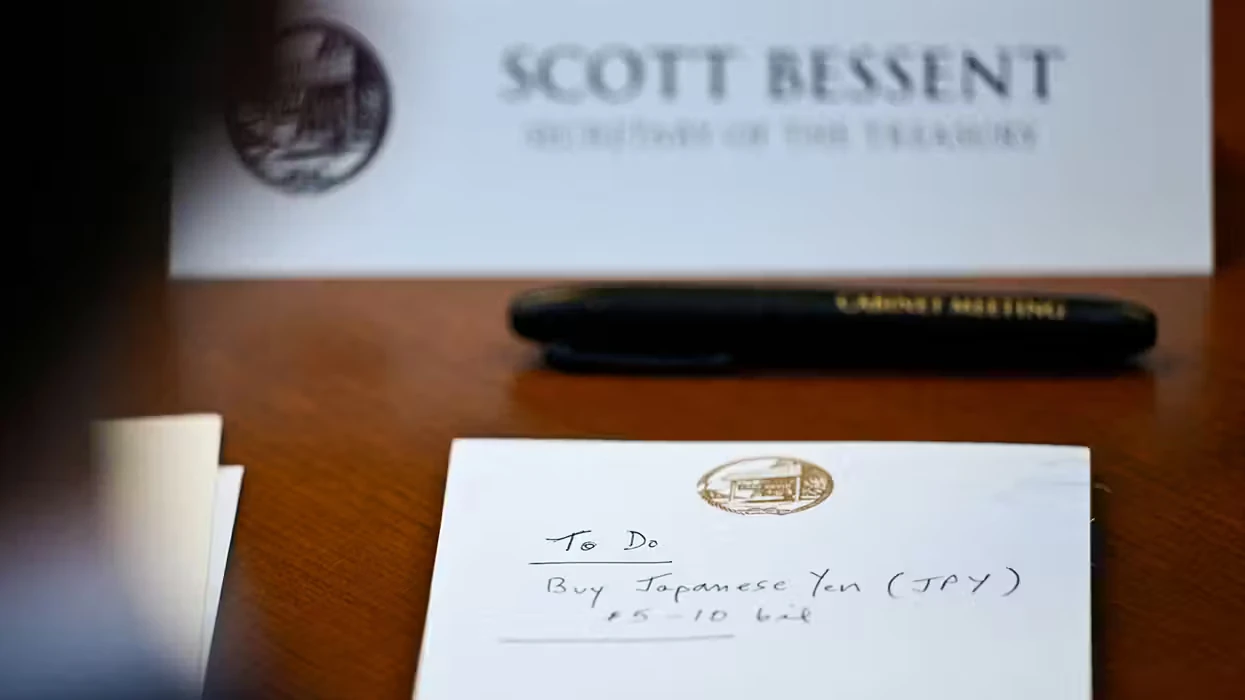
A notepad in front of U.S. Secretary of the Treasury Scott Bessent reads “To Do Buy Japanese Yen $5-10 bil” as he participates in a cabinet meeting at Camp David, Maryland, U.S., July 31, 2026.
The Note on the Table: Bessent’s Quiet Panic and a Presidency Without a Compass
A Reuters photographer at Camp David caught Treasury Secretary Scott Bessent’s ballpoint scrawl: “Buy Japanese Yen $5–10 bil.” Hours later, the New York Fed dumped euros for yen. Behind the scramble is a crisis the White House refuses to name — and a leadership vacuum the Constitution was written to address.
The photograph was almost too on-the-nose to be real. Sitting at a Camp David cabinet meeting on Friday, July 31, Treasury Secretary Scott Bessent left his legal pad open in full view of the press pool. Beneath the underlined words “To Do,” in his own hand, was a single line: Buy Japanese Yen (JPY) $5–10 bil. A Reuters lens caught it at 11:33 a.m. Eastern. Within hours, the Federal Reserve Bank of New York was reportedly executing exactly that trade — selling euros for yen through Goldman Sachs and Morgan Stanley on Treasury’s behalf. It was Washington’s first yen-buying intervention in more than a decade, and the man tasked with defending the U.S. dollar had, quite literally, written the plan down on a piece of paper and left it face-up in a room full of cameras.
To progressives who have watched this administration lurch from one improvised emergency to the next, the tableau was clarifying. The Treasury Secretary of the wealthiest nation on earth was jotting billion-dollar currency operations on a legal pad the way a harried assistant manager notes bank runs. And he did it during a cabinet meeting — which is to say, in the room where actual economic strategy is supposed to originate. The note is not the scandal. The note is the symptom. The scandal is that there is no coherent economic policy for Bessent to be executing, only a series of reactive maneuvers meant to keep a decaying financial architecture from collapsing before the next news cycle.
I. What Bessent Actually Did
The mechanics of Friday’s intervention are worth understanding, because they explain why it matters. According to Financial Times reporting relayed by CNBC and Reuters, the New York Fed sold portions of the U.S. Treasury’s euro reserves and used the proceeds to purchase Japanese yen through two of Wall Street’s largest primary dealers. The Treasury declined to disclose the size of the operation. Bessent’s own notepad suggested a range of five to ten billion dollars. It was the first U.S. intervention in support of the yen since the coordinated G7 response to Japan’s 2011 earthquake and tsunami, and the first without a natural-disaster pretext since 1998.
The intervention was coordinated with Japanese Finance Minister Satsuki Katayama, whose ministry had already spent enormous sums earlier in the week trying to arrest the yen’s slide toward 40-year lows against the dollar. Bloomberg reported that Japanese authorities also intervened during New York trading Friday afternoon, and that the New York Fed contacted major American banks to check rates on the yen against the euro. The two governments are expected to unveil a broader joint policy this week aimed at deterring speculative bets against the Japanese currency.
The Note, Verbatim
“To Do — Buy Japanese Yen (JPY) $5–10 bil.”
— Scott Bessent, U.S. Treasury Secretary, notepad photographed at Camp David, July 31, 2026
II. Why Bessent Cared: The $1.19 Trillion Reason
The public will be told this was about being a good ally to Japan. It was not.
Bessent’s motive is written in the ledger of the U.S. Treasury itself. Japan is the single largest foreign holder of American government debt — roughly $1.19 trillion as of the most recent Treasury data, or about thirteen percent of all foreign-held U.S. Treasuries. When Japan intervenes to defend its own currency, it needs dollars. To get dollars quickly and at scale, the most direct option is to sell U.S. Treasury bonds. Every yen Japan buys with a dumped Treasury bond pushes U.S. yields higher, because prices and yields move inversely.
That is precisely what analysts believe happened this spring. Bloomberg reported that Federal Reserve custody holdings of Treasuries for foreign accounts fell by $8.7 billion in a single week in May, at the same time Japan’s Ministry of Finance was estimated to have spent about $54.7 billion defending the yen. The Japan Times reported in June that Tokyo’s foreign securities holdings had dropped by more than $75 billion in a single month — the largest such decline on record — during and after a record ¥11.73 trillion currency intervention. The math is not subtle. Japan has been funding its yen defense by selling America’s debt.
By pre-emptively buying yen for Japan, Bessent was not doing Katayama a favor. He was trying to remove Japan’s incentive to keep dumping U.S. bonds. As one industry analysis noted this weekend, if stabilizing the yen reduces Japan’s need to liquidate Treasuries, it also relieves upward pressure on U.S. long-term rates — and by extension on mortgages, auto loans, and the federal government’s own interest bill.
III. A Timeline of the Slow-Motion Crisis
Japan’s holdings of U.S. Treasury securities reach $1.19 trillion, cementing its position as the largest foreign creditor to the United States, according to Congressional Research Service data.
The yen sinks toward 40-year lows. Japan’s Ministry of Finance spends an estimated $54.7 billion in a single week defending the currency, with Bloomberg tracking a matching drop in the Fed’s foreign custody holdings.
Japan Times reports Tokyo’s foreign securities holdings fell by $75.6 billion in May — the largest monthly drop on record — as Japan liquidated part of its Treasury book to fund intervention.
The 30-year U.S. Treasury yield hits 5.28%, its highest level in 19 years, per Trading Economics. The 10-year yield closes near 4.75%.
A Reuters photographer captures Scott Bessent’s notepad during a Camp David cabinet meeting. The words “Buy Japanese Yen (JPY) $5–10 bil” are visible over his shoulder in an on-the-record portion of the meeting.
The Financial Times confirms the New York Fed sold euros for yen through Goldman Sachs and Morgan Stanley on the Treasury’s behalf. It is the first U.S. yen-buying intervention since 2011.
IV. What This Costs the American Household
The chain from a currency intervention in Tokyo to a mortgage application in Beacon, Buffalo, or Bakersfield is not intuitive, but it is direct. Long-term U.S. interest rates track the ten-year Treasury yield. Thirty-year mortgage rates track the ten-year Treasury yield. When Japan sells Treasuries in bulk, U.S. yields rise. When U.S. yields rise, mortgages get more expensive. Auto loans get more expensive. Credit card interest rates get more expensive. And the federal government’s own annual interest bill — already the fastest-growing line item in the budget — balloons further.
That is the world families are already living in. CNN Business reported in July that the average 30-year fixed mortgage was stuck near 6.5%, with Zillow projecting only a modest drift down by year end. Median new home prices reached an all-time high of $440,600, according to the Harvard Joint Center for Housing Studies’ 2026 State of the Nation’s Housing report. The same Harvard analysis found that the number of homes for sale that were affordable to households earning $75,000 or less had collapsed by roughly 60 percent since March 2019.
The Housing Wage
A full-time worker now needs to earn $34.73 an hour to afford a modest two-bedroom rental at fair-market rent, according to the National Low Income Housing Coalition’s Out of Reach 2026 report. The average renter earns $24.84.
Jobs Freeze
The U.S. added only 116,000 jobs in 2025, the weakest non-recession year since 2002, per Bureau of Labor Statistics data cited by the Harvard housing report. Young adults are delaying household formation as a result.
Bond Yields at 19-Year Highs
The 30-year Treasury yield reached 5.28% on July 30 — the highest since 2007. Each basis point higher adds billions to future federal interest costs and consumer borrowing rates.
62% Say Buying Is Unrealistic
A 2026 national survey cited by the Economic Security Project found nearly two in three Americans now believe homeownership is out of reach — a middle-class ladder folded up while the White House chases foreign-currency emergencies.
Get Involved Today
Contribute to our mission and turn your concerns into action.
This is the affordability crisis Democrats have been trying to name for two years, and it is precisely the crisis the yen intervention was designed to keep from getting worse. Framing it that way, however, requires the administration to admit that the crisis exists at all — that mortgage rates are pinned near 6.5% not because the Federal Reserve is being stubborn but because the entire foundation of cheap American borrowing depends on foreign creditors continuing to buy U.S. debt, and those creditors are getting jittery. The White House has spent months insisting the economy is strong. Bessent’s notepad tells a different story.
V. Priorities: Bailouts Abroad, Silence at Home
The yen intervention did not happen in a vacuum. It happened alongside a pattern of extraordinary Treasury interventions to prop up foreign governments and foreign markets. Last October, Bessent authorized a $20 billion currency swap with Argentina drawn from the same Exchange Stabilization Fund now being used for yen operations. Forty-seven Democratic lawmakers, led by Senator Elizabeth Warren, wrote to Bessent objecting that American family farmers were being treated as a lower priority than a foreign government facing political trouble. Warren introduced the No Argentina Bailout Act to prohibit the maneuver. The administration proceeded anyway.
The pattern matters because the same Treasury Secretary who found ten billion dollars for a currency operation over a weekend has spent the past year telling American workers there is no fiscal room to expand rental assistance, child care subsidies, or targeted housing support. Warren confronted Bessent directly at a February Senate hearing on his affordability record, telling him that American families were not fooled by administration talking points. Representative Gregory Meeks reportedly told Bessent, at a separate House Financial Services hearing, to stop functioning as a cover for the president.
What these confrontations share is a diagnosis: the Treasury Department is being used to stabilize the balance sheets of the wealthy and the strategic interests of foreign governments, while the balance sheets of American households continue to deteriorate. When Bessent scribbles “Buy Japanese Yen” on a notepad, he is not choosing to help Japan over Americans. He is doing what he has to do because the underlying policy — massive deficits, trade war tariffs, a bond market losing patience — has left him no other choice. That is the real story. It is a story about a president who has created the crisis Bessent is now trying to manage on the fly.
VI. The Constitutional Question
The 25th Amendment is not a policy tool. It is not a mechanism for reversing an election a party did not like. It exists for one purpose: to give the country a lawful way to remove a president who is no longer capable of discharging the duties of office. And the question Americans need to ask, calmly and directly, is whether the pattern of leadership on display — a trade policy that spooked bond markets, a Middle East war launched without congressional consent, a Treasury Secretary reduced to writing emergency instructions on a legal pad — is consistent with a functioning presidency.
The Mechanism, the Movement, and the Bar
What Section 4 actually does. Section 4 of the 25th Amendment allows the Vice President and a majority of the Cabinet — or “such other body as Congress may by law provide” — to declare in writing to Congress that the president is unable to discharge the powers and duties of the office. Upon that declaration, the Vice President assumes the powers of the presidency as Acting President. It has never been successfully invoked. It was written with exactly this contingency in mind.
The specific legislative push. On April 14, 2026, Representative Jamie Raskin of Maryland, ranking Democrat on the House Judiciary Committee, introduced legislation with 50 Democratic co-sponsors to establish a Commission on Presidential Capacity — the very body the 25th Amendment contemplates. Raskin had already demanded a full cognitive evaluation from the White House physician, Captain Sean Barbabella. On April 30, Senators Sheldon Whitehouse and Jack Reed entered into the Congressional Record a statement from 36 physicians — neurologists, psychiatrists, and cognitive specialists from Harvard, Tufts, Columbia, and George Washington University — describing what they called a rapidly worsening decline and calling for the amendment’s use.
The economic case, plainly stated. The Bessent intervention is not, on its own, grounds for invocation. But it is evidence. A functioning presidency does not force its Treasury Secretary to run reactive multibillion-dollar operations off a legal pad because there is no coherent economic policy at the top. A functioning presidency does not push bond markets to 19-year highs by threatening allies, threatening the Federal Reserve’s independence, and launching wars without congressional authorization. The affordability crisis, the mortgage crisis, and the fiscal crisis are, at root, a leadership crisis.
The practical barrier. Honesty requires naming it: Section 4 requires the Vice President and the Cabinet to act, and neither is going to. Republicans hold 53 Senate seats. Raskin’s commission bill will not pass this Congress. Anyone claiming the 25th Amendment is a next-week fix is selling something.
Why the case is worth making anyway. Because the point of the amendment is not only removal. The point is the standard. When lawmakers, physicians, and now the Treasury’s own operational conduct converge on a single conclusion — that the president is not capable of steady economic leadership — the country deserves to hear that argument made in full, on the record, in the terms the Constitution provides. Documenting the case matters even when the votes are not there. It is how democracies remember what they are.
VII. What Comes Next
The Kyodo News reported over the weekend that Washington and Tokyo intend to unveil a broader joint policy on the yen as early as this coming week. Whether that policy holds, or whether Bessent has to keep improvising, will depend on factors no cabinet meeting can control: whether the Middle East conflict quiets, whether oil prices retreat, whether the Federal Reserve holds firm on independence under mounting pressure, whether Japan judges another round of Treasury sales less costly than another round of yen defense. What is certain is that the U.S. economy — the mortgages, the jobs, the household budgets, the federal interest bill — is now demonstrably hostage to those choices. That is a status the world’s largest economy should never have accepted.
Americans deserve better than a Treasury Secretary running emergency operations off a legal pad. They deserve better than a president whose policies have made those emergencies inevitable. They deserve leadership that names the affordability crisis, addresses the housing crisis, and stops treating the bond market as a political prop. The photograph from Camp David will fade from the news cycle within days. The economic conditions it exposed will not.
Editorial Conclusion
A note left face-up on a cabinet-room table is not the crisis. The crisis is what the note reveals: an administration governing by improvisation, a Treasury reduced to triage, and an American household stretched thin by the very policies the White House refuses to name. The Constitution provides a mechanism for a presidency that cannot steady itself. Whether or not that mechanism is invoked, the case for it must be made in full — in daylight, on the record, and in the terms the founders provided.
Sources & References
- Nikkei Asia / Reuters — U.S. Treasury intervenes to support the yen after Japan steps in
- CNBC — U.S. Treasury intervenes to support yen after Japan steps in, FT reports
- Fortune — Bessent joins Japan to help reverse months of yen losses
- Bloomberg — Yen gains on intervention, reports of buying by both U.S. and Japan
- Raw Story — Bessent’s carelessly exposed ‘To Do’ list reveals multibillion-dollar scheme
- 24/7 Wall St. — The $1.2 Trillion Reason Scott Bessent Just Bought Japanese Yen
- Bloomberg — Fed data suggest Japan sold U.S. debt amid intervention
- The Japan Times — Japan likely sold Treasurys to fund yen intervention
- Congressional Research Service — Foreign Holdings of Federal Debt
- LegalClarity — Japan’s U.S. Treasury Holdings: Size, Impact, and Risks
- Trading Economics — U.S. 10-Year Treasury Note Yield
- CNN Business — Mortgage rates are stuck near 6.5%: A new housing law may make buying easier — eventually
- Harvard JCHS / The MortgagePoint — Harvard’s 2026 State of the Nation’s Housing report
- National Low Income Housing Coalition — Out of Reach 2026: The High Cost of Housing
- Economic Security Project — Building Affordability: The Policy Agenda for America’s Housing Crisis
- Fox Business — Warren accuses Bessent of prioritizing Argentina over U.S. farmers
- The Hill — Warren rips Bessent on affordability: ‘Families aren’t fooled by these lies’
- House Judiciary Democrats — Raskin demands cognitive evaluation of the President under 25th Amendment framework
- MS.NOW / NBC — Raskin offers bill setting up 25th Amendment process
- The Hill (Opinion) — Concerns grow over the president’s mental fitness
Related News