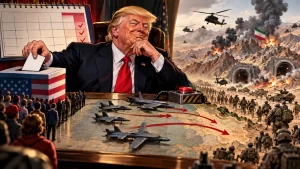
Please Send Ideas: The Pentagon Email That Confesses a War With No Plan
A senior officer at U.S. Central Command has resorted to crowdsourcing “creative and unconventional” ways to punish Iran — an admission, in one blunt email, that the commander in chief has run out of strategy, options, and time. This is what leadership collapse looks like in writing.
The most damning sentence in American foreign policy this year was not spoken from a podium, delivered in a State of the Union, or shouted on Truth Social. It arrived in an internal email. “We are looking for new creative and unconventional ways to pressure and punish Iran,” a senior officer in U.S. Central Command’s intelligence branch wrote last week to a broad group of military analysts, according to CNN’s exclusive reporting by Katie Bo Lillis and Zachary Cohen. The message went out to a broad group of military analysts. It was, in the words of the sources CNN spoke to, “unusual.” That is a polite way of saying it was a confession. Six months into the president’s war of choice, the command carrying out that war does not know what to do next — and has taken to asking the rank and file to help think of something.
This is not a story about a resourceful officer soliciting fresh perspectives, as CENTCOM’s spokesperson would have Americans believe. This is a story about a president who launched Operation Epic Fury with promises of a decisive, “swift” campaign, and a Secretary of Defense — Pete Hegseth, whose office Donald Trump renamed the “Department of War” — who has stood before Congress and repeatedly told lawmakers there is no quagmire, no failure, no reason for concern. And yet the internal email says the quiet part with painful clarity: the plans on the shelf are not working, and no one at the top has a better one.
I. The Email Itself
The CNN report, published Sunday night, describes a message sent Wednesday by an officer in CENTCOM’s intelligence branch. A second source confirmed that a senior U.S. military officer had circulated the request in the previous week. Military officials told CNN the email was unusual — the kind of communication that would normally be handled in a classified planning session, not a mass email described by sources as “crowdsourcing-style.”
CENTCOM’s public response was to insist the request was routine. “U.S. Central Command has a long history of thinking and working in innovative ways,” Capt. Timothy Hawkins, a CENTCOM spokesperson, said in a statement, adding that Admiral Cooper “reaches out to members of our great team, regardless of rank, to achieve the highest levels of operational performance possible.” But the reporting is unambiguous about what triggered the appeal: the president’s options are limited, and the ones on the table are “potentially unpalatable.” Trump has been weighing another round of intensified strikes on Iran’s remaining nuclear facilities — sites like Pickaxe Mountain, which are buried so deeply that even America’s most powerful conventional weapons cannot reliably destroy them.
To truly finish the job, sources told CNN, the United States would have to put ground troops on Iranian soil — a decision Trump has been unwilling to make and which would shatter one of the central promises of his 2024 campaign. According to CNN, Trump has instead been considering strikes akin to a “fireworks” display: symbolic bombings that would allow him to declare victory and exit the war without accomplishing what he said he started it for. This is not strategy. This is stagecraft.
“A command reduced to crowdsourcing ideas for how to punish an adversary is a command that has run out of them.”
— IBTimes UK analysis of the CNN report, August 3, 2026
II. A War Without a Strategy
The email did not appear in a vacuum. It landed at the end of a summer in which every serious observer of American national security — including inside the administration — has quietly concluded that the president’s approach to Iran is broken. Chairman of the Joint Chiefs of Staff Gen. Dan Caine told lawmakers last month that “air power has its limits.” Both the CIA and the Defense Intelligence Agency have assessed that the current bombing campaign is unlikely to shift Iran’s negotiating position, according to CNN’s earlier reporting. And Sen. Gary Peters of Michigan, in a devastating Senate Appropriations Committee exchange, said the quiet part out loud.
“You, sir, are the failure,” Peters told Defense Secretary Pete Hegseth in July, according to PBS NewsHour. “Not the men and women who are on that front line. Not the men and women who hold up their honor with distinction. But, if there’s a lack of a winning strategy, they’re in harm’s way, their leaders have failed them, and that’s what’s happening.” Peters noted that the administration has repeatedly shifted its stated objectives — from regime change, to destroying Iran’s nuclear capabilities, to seizing control of the Strait of Hormuz. This is exactly what strategic drift looks like, and it is why an officer inside CENTCOM’s intelligence branch is now sending emails asking for help.
Even Republicans are losing patience. The Hill reports that GOP senators say confidence in Hegseth’s leadership is eroding, with Sen. Susan Collins of Maine calling the departure of senior military officials from the Pentagon “deeply troubling” and warning that “questions remain” about the strategy and endgame. A second Republican senator who requested anonymity told The Hill there are “rumblings” about the Pentagon’s failure to anticipate the prolonged closure of the Strait of Hormuz and Iran’s ability to strike U.S. allies in Jordan, Kuwait, and Saudi Arabia.
III. What This Costs the Troops
Beneath the political theater, real Americans in uniform are paying the price of this improvised war. At least eighteen U.S. service members have been killed in the fighting so far, and CNN has separately reported serious questions about the administration’s transparency over the true casualty count. What does it say to a soldier stationed in the Gulf that the command running the war is emailing analysts to ask if anyone has “creative” ideas? What does it say to their families, watching gas prices climb and the deployment orders lengthen, that the president is toggling between symbolic “fireworks” strikes and threatening to send ground troops onto Iranian soil?
Sending troops to fight without a coherent theory of victory is not just a tactical failure. It is a moral one. It is the same trap Robert Pape, the University of Chicago political scientist and global security expert, described on PBS in March: the decapitation of Iran’s leadership failed to break the regime, and the failure has increased pressure for ever more force, including a full ground war. “Many will die,” Pape warned. He was right.
IV. What This Costs Diplomacy
Foreign policy runs on credibility. Adversaries and allies alike watch the United States for consistency, for signal, for the sense that the country’s stated intentions match its capabilities. When a CENTCOM intelligence officer emails a broad group asking for “unconventional” ways to punish an adversary — and that email leaks — every capital in the world reads it as the same thing: we are watching an administration bluff its way through a war it did not know how to fight.
Consider what Tehran learns from this. Iran’s negotiators, who have refused to reopen the Strait of Hormuz despite months of American bombing, now have documentary evidence that Washington’s options are exhausted. Consider what Riyadh learns. It was reportedly Saudi Arabia’s crown prince, according to CNN, who called Trump over the weekend and talked him out of another round of strikes. The United States is being managed by a foreign monarchy. Consider what Beijing and Moscow learn. They learn that the American commander in chief will threaten to “wipe out a whole civilization” on social media and then quietly call the operation off after a phone call. This is not deterrence. This is embarrassment.
The damage extends beyond the immediate war. Senate Democrats, including Sens. Adam Schiff, Tim Kaine, Andy Kim, Jeff Merkley, and Chris Van Hollen, have filed war powers resolutions attempting to force the president back to Congress for authorization. Trump has ignored them. As Sen. Kaine told reporters, “Congress has definitively said this war is illegal.” Yet the strikes continue, the strategy dissolves, and now the command carrying them out is soliciting fresh ideas by email.
“Trump’s rinse and repeat approach to the Iran war isn’t a strategy, it’s a recipe for utter disaster. We keep moving backward. Gas prices stay high, casualties increase, costs increase. It’s incredible what a fiasco this war is.”
— Sen. Chuck Schumer (D-N.Y.), Senate floor, July 2026
V. What This Costs Americans
The war that began with Operation Epic Fury on February 28, 2026, has never left the American kitchen table. It arrives every time a family fills the tank. According to the Institute on Taxation and Economic Policy, Americans have collectively paid nearly $67 billion in additional motor fuel costs since prices began to rise. Gasoline crossed $4 a gallon in March for the first time in over three years, and in some markets, like San Francisco, prices have climbed to $6.50 a gallon. Diesel has surged more than 40 percent, according to CNBC, with cascading effects on the price of every product in America that ships by truck.
These costs are not distributed evenly. As Goldman Sachs noted in a note to clients this spring, higher energy prices “erode” consumer spending power, hitting lower-income households hardest because food and energy make up a larger share of their budgets. UBS’s chief economist Paul Donovan warned in July that “economic gravity” will eventually catch up with American families who have coped so far only by cutting into savings. Mortgage rates have jumped from 5.9 percent to 6.41 percent since the U.S. attacked Iran, pricing more Americans out of homeownership. This is what a war of choice does to a working family.
The tragedy is that the president was warned. Rep. Raja Krishnamoorthi wrote to Trump in March urging him to tap the Strategic Petroleum Reserve to stabilize markets, calling the war “unauthorized” and citing spiking oil prices near $120 a barrel. Trump’s response, according to Krishnamoorthi’s public letter, was to describe the increase in gas prices as “a small price to pay.” Five months later, the price is still being paid — by the troops, by the taxpayer, by the trucker, by the parent trying to make grocery money last through the week — and the man who called it small is asking his intelligence officers to please, urgently, come up with something.
Get Involved Today
Contribute to our mission and turn your concerns into action.
VI. Timeline of a Crisis
VII. A Question of Command
The core question that this email raises is not tactical. It is constitutional. The Constitution vests the commander in chief with the responsibility to formulate and execute a coherent national defense. When that responsibility is failed — when the person in that office lacks the strategic clarity, the temperamental stability, or the basic competence to protect the country and the troops he commands — the Constitution provides remedies. And Americans, including several dozen sitting members of Congress, have already been talking about them.
When the President Cannot Do the Job
The 25th Amendment, ratified in 1967 after the assassination of John F. Kennedy, was written to answer a simple question that the Founders left ambiguous: what happens when the president is unable to discharge the powers and duties of his office? Its most famous provision, Section 4, allows the vice president and a majority of the Cabinet to declare the president unfit and transfer power to the vice president as acting president. Congress can be brought in to adjudicate. Section 4 has never been successfully invoked.
But it exists for exactly the situation this editorial board describes: a commander in chief whose military command is emailing junior analysts to help plan a war he started; who threatens to “kill a whole civilization” on social media and then cancels the strikes after a phone call from a foreign monarch; who has, according to the CIA and DIA, no plan capable of achieving the goals he publicly announced.
Who Has Called For It
In April, after Trump’s Easter Sunday post threatening to bomb Iran’s civilian power plants and bridges, more than 70 lawmakers publicly called for either invocation of the 25th Amendment or impeachment, according to NBC News. Sen. Ed Markey of Massachusetts wrote that “the cabinet and Vice President, with congressional concurrence, must invoke the 25th Amendment and remove Trump.” Sen. Chris Murphy of Connecticut said flatly: “No President in control of his senses would publicly promise to eradicate an entire civilization.” Rep. Ro Khanna of California, Rep. Yassamin Ansari of Arizona, Sen. Bernie Sanders, and Senate Minority Leader Chuck Schumer all echoed the call in some form. Even former Trump ally Marjorie Taylor Greene wrote, “25TH AMENDMENT!!! Not a single bomb has dropped on America. We cannot kill an entire civilization. This is evil and madness.”
The Constitutional Argument
The case for Section 4 is not partisan. It is that a president who has (1) launched an undeclared war Congress has ruled illegal, (2) presided over the deaths of at least 18 U.S. service members without a coherent theory of victory, (3) publicly threatened conduct that would constitute war crimes under the Geneva Conventions, and (4) whose own combatant command is now emailing analysts to invent a strategy from scratch, is demonstrably unable to discharge the office’s most fundamental duty: the defense of the United States and its people.
The Practical Barriers
Invocation requires Vice President J.D. Vance and a majority of Trump’s own Cabinet to act — the same Cabinet whose Defense Secretary, Pete Hegseth, has spent the summer telling Congress that the war is a “decisive campaign” going according to plan. It is politically almost impossible. Republican control of the House and Senate makes impeachment, the parallel remedy, no easier. This is why the previous 25th Amendment calls in April produced no institutional action.
Why the Barriers Do Not Negate the Case
None of that changes the constitutional reality. The 25th Amendment was written precisely for moments when the ordinary political process cannot function. Its purpose is not to be used often — its purpose is to establish the standard by which fitness for the presidency is measured so that officials, voters, and history can judge those who refuse to act. When a CENTCOM intelligence branch is reduced to sending mass emails asking for creative war ideas, that standard has been met, whether or not any Cabinet member has the courage to say so.
VIII. What This Says About the President’s Priorities
The final indictment is one of leadership itself. This war has continued because the president who launched it will not admit he cannot end it — and because the Cabinet around him will not tell the truth. The Secretary of Defense, Pete Hegseth, whose sole qualification for the role was hosting a weekend Fox News show, was described by columnists at The Hill as presiding over “a Pentagon almost broke” with “dismal” morale among rank-and-file troops, top brass, and civilian workers. He has responded to congressional oversight by accusing Democrats of “smearing the sacrifice” of U.S. troops. Sen. Peters replied, correctly, that it is the Secretary — not the troops — who is the failure.
A president who prioritized America’s national security would have accepted the interim ceasefire signed in June and used the pause to negotiate a durable settlement over the Strait of Hormuz. A president who prioritized American families would have released the Strategic Petroleum Reserve months ago. A president who prioritized the troops would not have shifted the war’s stated objectives three times, and would not have subjected them to the terror of a possible ground invasion in service of a “symbolic victory.” A president who prioritized the Constitution would have gone to Congress for authorization. Trump has done none of these things. He has done what his critics, from Chris Murphy to Marjorie Taylor Greene, have said for months he does: he has lashed out, backed down, and let others clean up. And now his own military command is emailing troops asking them to please, please help.
Editorial Conclusion
A war fought by mass email is not a war being led. It is a war being improvised, and the Americans dying in it — eighteen so far, with more surely to come — deserve better than a commander in chief whose only strategy is to ask his own troops for one.
The CENTCOM email is not a scandal because it is impolite. It is a scandal because it is honest. It admits, in writing, what every serious observer already knows: this administration launched a war it did not know how to fight, has spent six months unable to end it, and now has neither a plan for victory nor a plan for peace.
The remedy is not partisan. The remedy is the one the Constitution provides — congressional authorization, or its refusal; oversight with teeth; and, if a Cabinet with any conscience can be assembled, the 25th Amendment. What is required is not a better email. What is required is the end of the improvisation, the return of the war-making power to the Congress the Constitution assigns it to, and a president — this one or another — who is capable of the office. Anything less is failure. And America has had Enough.
Sources & References
- CNN via KVIAExclusive: US military asks troops for ‘creative and unconventional’ ideas to punish Iran (Aug. 2, 2026)
- MediaiteCENTCOM Asks Troops to Pitch ‘Creative and Unconventional’ Ideas on How to Punish Iran
- Jerusalem PostCENTCOM reportedly asked military analysts for strategies to punish Iran
- IBTimes UKCENTCOM Eyes ‘Creative and Unconventional’ Options Against Iran as Air Power Falls Short
- NBC NewsDozens of Democrats call for Trump’s removal after his Iran threats
- TIMEWhat to Know About the 25th Amendment as Lawmakers Call for Trump’s Removal
- MS NOWOver 50 Democrats push 25th Amendment as Trump threatens to kill ‘a whole civilization’
- The HillGOP senators warn confidence in Pete Hegseth eroding as Iran war drags on
- The Hill (Opinion)Pete Hegseth’s leadership leaves the Pentagon in financial and moral crisis
- PBS NewsHour‘You, sir, are the failure,’ Sen. Peters tells Hegseth over lack of U.S. strategy in Iran war
- CBS DetroitSen. Gary Peters tells Hegseth “You are the failure,” blaming him for lack of Iran war strategy
- TIMERepublican and Democrat Lawmakers Criticize Trump Over Resumption of Iran War
- The New RepublicDemocrats Outraged as Trump Tries to Reset the Clock on Iran War
- FortuneGas prices spiral over $4 as U.S.-Iran war heats up again
- CNBCIran war cost: Average U.S. household paying $450 more on gas and energy
- ITEPIran War Fuel Costs — Institute on Taxation and Economic Policy
- TIMEHow Much the War in Iran is Costing Americans
- PBS Amanpour and Company“Many Will Die”: Military Expert Robert Pape Warns of Iran Escalation Trap
- Rep. KrishnamoorthiLetter to President Trump on Iran War Gas Prices (March 10, 2026)
Related News