Japan just unloaded $66.7 billion in U.S. Treasuries in a single month — the largest single-country drop the Treasury has ever recorded. The president golfs. The Treasury Secretary insists there is nothing to see. The bond market disagrees, and the bill lands on every kitchen table in America.
The most important financial event of 2026 arrived without a press conference. On July 15, the Nikkei — reading the U.S. Treasury’s own Treasury International Capital data — reported that Japan’s holdings of American government debt fell from roughly $1.21 trillion at the end of April to $1.114 trillion at the end of May. A $66.7 billion drop in one month. It was the largest single-country monthly decline the Treasury has ever recorded, and it followed a $29.6 billion Japanese sell-off in the first quarter and a broader $138.4 billion foreign exodus from Treasuries in March alone. Japan is not fleeing the dollar. Japan is running out of options — its own currency in crisis, its own bond yields rising, its own institutions rediscovering that lending money to a government that insults its allies and threatens civilizations on social media is not, in fact, riskless.
The Trump administration’s response has been to insist the sale was merely a technical yen-defense operation. That is partly true and entirely beside the point. Japan sold Treasuries to buy yen because the yen was collapsing against the dollar; the yen was collapsing partly because Japanese institutions could no longer justify parking capital in an American bond market where the 30-year yield has been trading between 5.06% and 5.18% — the highest levels in nearly two decades. Yields do not rise this way when the world trusts you. They rise this way when the world starts asking for its money back and demanding a premium to lend more.
What follows in this analysis is not a partisan complaint. It is a straightforward reading of the numbers, the named officials responding to them, and the constitutional questions those numbers now raise about a president who no longer appears equipped to manage the consequences.
I. The Sell-Off, By the Numbers
Japan is the single largest foreign creditor of the United States government. That was true in 2020, when the yield curve was near zero. It was true in November 2025, when Japanese entities held roughly $1.2 trillion in U.S. Treasury securities. It is less true today, and that shift is not academic. When your largest customer stops showing up to the auction, someone else has to buy at a lower price — meaning a higher yield — or the auction fails. Every basis point of that adjustment gets passed through, mechanically, to mortgage rates, corporate borrowing, and the federal government’s own interest bill.
To understand why this matters, follow one specific number. The Congressional Budget Office projects that if current law holds, net interest will hit $2.1 trillion by 2036. That is not a distant abstraction. Interest on the debt is already larger than the entire federal budget for Medicaid, larger than defense, larger than every income-security program combined. When Japan and other foreign buyers step back, the rollover math gets uglier. Every note issued in the pandemic-era at coupons below 2% must be reissued at 4.5%, 5%, or higher. The Committee for a Responsible Federal Budget estimates that a sustained 55-basis-point rise above CBO’s baseline adds $2 trillion in interest costs over the decade — money that will not build a road, treat a veteran, or send a check to a Social Security recipient.
“Denmark’s investment in U.S. Treasury bonds, like Denmark itself, is irrelevant… I’m not concerned at all.”
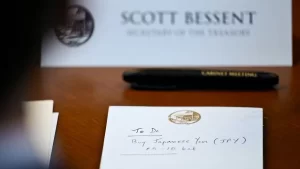
— Treasury Secretary Scott Bessent, Davos, January 2026
That was the Treasury Secretary of the United States, on the record, dismissing concerns about foreign investors selling American debt. Six months later, the largest foreign holder of that debt would sell $66.7 billion in a single month, and the man in charge of the market would have no plan beyond insisting the market was wrong. As Desmond Lachman wrote in Project Syndicate, “Far from warning Donald Trump against undermining foreign investors’ confidence in the U.S., his Treasury secretary is backing the president and downplaying the risks of a bond selloff. But markets are telling a different story.”
II. What This Costs You, Personally
Treasury yields are not a Wall Street abstraction. They are, as Bessent himself put it at the New York Fed’s Treasury Market Conference last November, “the global risk-free rate” that sets “the pricing for everything else: from bank loans and home mortgages to stocks and corporate bonds.” When that rate climbs, everything a working family finances gets more expensive. When the president’s own Treasury Secretary calls the 30-year yield the price a young family pays to buy a house, and then that yield hits a two-decade high on his watch, the consequences are exactly what he warned they would be.
A recent Fortune analysis, drawing on Council on Foreign Relations research, calculates that debt-driven yield increases since 2015 have added between $57,347 and $112,640 to the lifetime cost of a median American mortgage — between $1,912 and $3,755 per year. The CRFB’s math is starker: a 55-basis-point increase over CBO’s baseline adds nearly $200 to the monthly payment on a $500,000 mortgage and $64,000 over its life. That is not a Beltway number. That is a bedroom addition your family will not build, a college semester your kid will not attend, a retirement date that moves out another year.
Layer that on top of what is already crushing household budgets. The Tax Foundation calculates the president’s tariff regime is functionally a $900-per-household tax increase in 2026. A February New York Fed analysis found consumers and businesses are absorbing nearly 90% of tariff costs, with Fed researchers estimating that core inflation would have been 0.80 percentage points lower without the tariffs. Then add Brent crude trading above $100 a barrel for the first time in more than three and a half years as a direct consequence of the Iran war and the Strait of Hormuz shutdown. Then add utility bills that rose 2.5 times faster than inflation in 2025. Then add the fact that corporate profit margins have, according to Fed research, been “preserved” through tariff pass-through — a polite phrase for the reality that CEOs are using the president’s chaos as cover to raise prices they would never have gotten away with in a functional market.
This is what economists call a compound shock. It is what the rest of us call everything getting more expensive at the same time, for reasons the president cannot or will not fix.
III. The Compounding Crises
No single one of these problems would be catastrophic in isolation. The catastrophe is that they are stacking, and each one makes the next one worse.
Look at those events in sequence. A president who initiated a war without congressional authorization is now presiding over an oil shock, a bond shock, a currency shock, and a foreign-capital-flight shock — at the same time — and his answer to the American public is that the price of gasoline is a small price for peace, that affordability is a Democratic invention, and that Denmark is irrelevant.
“When the President of the United States threatens to extinguish a civilization on social media, rants about combat missions with children at the Easter Egg Roll, and drops profane tirades on Easter morning, we have indisputably entered the realm of profound medical difficulty and concern.”
— Rep. Jamie Raskin, House Judiciary Ranking Member, April 2026
IV. The Dominoes: BRICS and the Dollar
Japan is the loudest signal, but it is not the only one. According to the IMF’s own Currency Composition of Official Foreign Exchange Reserves data, the dollar’s share of global reserves fell below 57% in Q3 2025 for the first time since 1995, and continued declining through the first half of 2026. Central bank gold purchases have surged; the World Gold Council projects official-sector gold demand of 750–850 tonnes for 2026 alone. Gold’s share of global reserves has climbed from 13% in 2017 to approximately 30% in 2025.
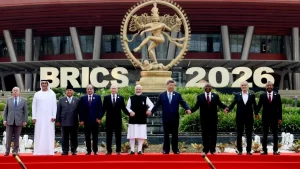
The BRICS bloc is not sitting still while this happens. As reported by Watcher Guru, BRICS Pay expansion has reduced U.S. dollar usage in intra-bloc trade by roughly two-thirds. India took the bloc’s presidency from Brazil this year and is hosting the 18th BRICS Summit in New Delhi. The “BRICS Unit” — a settlement instrument backed 40% by gold and 60% by member currencies — launched a pilot program on October 31, 2025. BRICS nations now settle approximately 67% of intra-bloc trade in local currencies, up from under 20% a decade ago.
The dollar is not going to collapse tomorrow. There is no serious alternative that could replace it whole. But that framing — either the dollar reigns supreme or it collapses — is precisely the wrong one, and it is the one Bessent keeps offering. The reality is a slow, corrosive erosion of dollar exclusivity, and the corrosion accelerates every time an American president threatens allies, weaponizes the dollar-clearing system as a foreign policy weapon, insults trading partners publicly, or presides over a foreign-capital-flight event of the kind we just witnessed. Every time this happens, the incentive for a Saudi crown prince or a Chinese central banker or an Indian finance minister to build a workaround grows. Jim O’Neill, the Goldman Sachs economist who coined the “BRIC” acronym in 2001, told reporters in July 2026 that technological advances have made alternatives to the dollar more realistic than they appeared only 18 months earlier.
Reserve currency status is what gives the United States its exorbitant privilege — the ability to run enormous deficits and finance them cheaply because the world has no choice but to hold dollars. Squander it, and the interest bill quoted above stops being a projection and starts being a compounding emergency.
Get Involved Today
Contribute to our mission and turn your concerns into action.
V. The Response: Denial, Distraction, Delay
Consider what the president and his Treasury Secretary have actually done in response to a $66.7 billion warning shot.
Bessent, according to Bloomberg, is “facing what may become his biggest financial-market test yet” with “few easy options.” He has argued for months that inflation will cool once the energy shock fades and that the Fed will “eventually” cut rates. The 30-year yield does not care about his patience. As TheStreet’s markets desk observed bluntly this month: “The long end of the yield curve is the one stretch of the market a Treasury secretary cannot reason with. Short-term rates follow the Fed, and the Fed can be lobbied. The 30-year bond is priced by people making a bet about what a dollar will be worth in the 2050s. No press conference changes that math.”
The president’s response has been to intensify the very behaviors driving foreign investors away. He has threatened tariffs on Japan, publicly. He has threatened tariffs on Europe, publicly. He has reinstated a naval blockade of Iran and demanded a 20% surcharge on all Hormuz cargo. He has told reporters that affordability is a Democratic invention. On social media, he has warned foreign leaders in language his own party’s constitutional lawyers describe as unstable. And he continually attacked Federal Reserve Chair Jerome Powell publicly, an act that a functioning bond market treats as a direct threat to central-bank independence and prices accordingly, in the form of higher yields.
Meanwhile, Republican leadership in Congress has done functionally nothing. The Joint Economic Committee’s own debt tracker shows the debt growing at $6.43 billion a day; the GOP-passed budget accelerates that trajectory rather than restraining it. Democrats — Sens. Sheldon Whitehouse and Jack Reed among them — have entered statements from 36 physicians, including neurologists and psychiatrists from Harvard, Tufts, Columbia, and George Washington, into the Congressional Record. Sen. Ed Markey has called for the 25th Amendment to be invoked. Reps. Eric Swalwell, Sydney Kamlager-Dove, and Yassamin Ansari have made the same call. And still nothing structural moves, because Republican leadership refuses to allow it to.
The 25th Amendment Was Written for This Exact Contingency
Section 4 of the 25th Amendment, ratified in 1967 in the wake of President Kennedy’s assassination, provides that the Vice President and a majority of the Cabinet — or another body designated by Congress — may declare in writing that the president “is unable to discharge the powers and duties of his office.” Upon that declaration, the Vice President becomes Acting President. The amendment does not require the president’s consent. It does not require his resignation. It exists because the Framers of the 20th-century Constitution understood that a president could, through injury, illness, or diminished capacity, become unfit to hold the nuclear codes — and that the country could not afford to wait for the next election.
The legislative record on the table
On April 14, 2026, Rep. Jamie Raskin (D-Md.), Ranking Member of the House Judiciary Committee, introduced legislation with 50 co-sponsors to create the “other body” the amendment explicitly contemplates: a 17-member bipartisan Oversight Commission on Presidential Capacity, empowered to conduct a medical examination within 72 hours of adoption and report to Congress. Sen. Ed Markey (D-Mass.), Reps. Eric Swalwell (D-Calif.), Sydney Kamlager-Dove (D-Calif.), and Yassamin Ansari (D-Ariz.) have explicitly called for the amendment to be invoked. Sens. Sheldon Whitehouse (D-R.I.) and Jack Reed (D-R.I.) have entered into the Congressional Record a statement signed by 36 physicians — neurologists, psychiatrists, and specialists in cognitive disorders from Harvard, Tufts, Columbia, and George Washington — calling for a formal evaluation.
The economic case, plainly stated
The Treasury market is the world’s largest, deepest, most consequential market. Its stability is the foundation of the American Dream, as Bessent himself acknowledged at the New York Fed last fall. A president who launches an undeclared war that spikes oil to $100, then insults the country’s largest creditor on Truth Social, then attacks the independence of the Federal Reserve, then reinstates a blockade that his own Treasury cannot forecast the consequences of, is not conducting foreign policy. He is materially degrading his own government’s ability to borrow at reasonable rates. That is not a policy disagreement. That is a demonstrable inability to discharge one of the enumerated duties of the office — protecting the full faith and credit of the United States.
The practical barriers, honestly acknowledged
Section 4 requires the Vice President and a majority of the president’s own Cabinet — or the alternative body Raskin’s bill would create — to make the finding. Vice President J.D. Vance has publicly defended the president’s Iran conduct. The Cabinet was hand-picked for loyalty. Republican majorities in both chambers, however narrow, mean Raskin’s commission bill will not pass in this Congress. The president would veto it, and Republican leadership has shown no appetite for override. These are real obstacles.
Why the barriers do not negate the constitutional case
The barriers are political. The case is constitutional. The purpose of the 25th Amendment is not merely to remove a president, but to create a permanent record — a formal marker — that the country’s elected representatives saw what was happening and named it. When historians look back at the summer of 2026 and ask how the world’s largest economy allowed its debt to be called into question, its currency to be quietly diversified out of, its allies to sell their bond holdings, and its president to escalate a war rather than answer the market, they will ask what Congress did. Raskin’s bill is the answer that the Democratic caucus has provided. It is on the record. Republican leadership’s refusal to advance it is also, permanently, on the record — and that, too, is what the Amendment was written to preserve.
VI. What Comes Next
There are three things the American public should watch between now and the fall. First, whether the September Fed meeting delivers a hold or a hike; a hike, at this point, would be an admission by Chair Warsh that inflation is not merely a Trump-tariff artifact but a structural problem the White House has stopped even pretending to address. Second, whether the 30-year yield retests 5.18%, or breaches it. That is the line at which mortgage rates and corporate borrowing costs begin to seize, and it is the level at which the CBO’s baseline debt projections start looking optimistic. Third — and this is the one Bessent cannot influence — whether the August TIC data shows another foreign-holder exodus. If Japan’s May sales prove to be the start of a trend rather than a one-off yen-defense operation, the price of financing the American government becomes a genuinely open question for the first time in a generation.
None of that is written yet. The path is contingent, and it can be corrected. But the correction requires leadership that stops treating the bond market as a partisan opponent to be talked down and starts treating it as what it is: a nervous, well-informed customer that has begun to price a risk premium into every dollar the United States borrows. That leadership is not currently being provided by the president, by his Treasury Secretary, or by the Republican leadership in Congress.
Editorial Conclusion
The world’s largest creditor of the United States government just sold $66.7 billion of our debt in a single month, and the president of the United States has neither the focus, the discipline, nor apparently the cognitive capacity to grasp what that means. His Treasury Secretary insists nothing is wrong. His party in Congress insists nothing is wrong. But the bond market, which does not vote, has already registered its verdict in the only language that ultimately matters: the price of borrowing our children’s future. The 25th Amendment was written for precisely this kind of moment — not as a partisan weapon, but as the constitutional acknowledgment that some presidents become unable to discharge the duties of the office they hold, and that when they do, the country cannot afford to pretend otherwise. Congress has a duty. History is watching to see whether they meet it, or whether the price of their silence will be paid, once again, by every American family with a mortgage, a job, and a savings account.
Sources & References
- BigGo Finance / Nikkei — Japan Sold $66.7 Billion in U.S. Treasuries in May to Fund Yen Defense Intervention (July 2026)
- Yahoo Finance / TheStreet — China, Japan, UAE, India Sell Billions in U.S. Treasuries (May 2026)
- Crypto Briefing — Japanese Investors Sell $29.6B in US Treasuries in Q1 2026 (May 2026)
- Bloomberg — Bessent Has Limited Options to Halt Climb in Treasury Yields (May 2026)
- Fortune — Scott Bessent Insists He’s ‘Not Concerned at All’ About Investors Selling America (January 2026)
- Project Syndicate — Scott Bessent Is in Denial – and the Bond Market Is Watching (Desmond Lachman, January 2026)
- Yahoo Finance / TheStreet — Bessent Just Ran Into a Problem He Cannot Talk Down (July 2026)
- U.S. Treasury Department — Remarks by Secretary Bessent before the Treasury Market Conference (November 2025)
- Peter G. Peterson Foundation — Interest Costs on the National Debt (Monthly Tracker, July 2026)
- Peter G. Peterson Foundation — What Is the National Debt Costing Us? (2026)
- Committee for a Responsible Federal Budget — Rising Interest Rates Are Exploding the Debt (May 2026)
- Fortune — The $38.9 Trillion National Debt Is Costing You Thousands on Your Mortgage (March 2026)
- Tax Foundation — Tracking the Impact of the Trump Tariffs & Trade War (July 2026)
- Fortune — Fed Researchers See a ‘Full Pass-Through’ of Trump’s Tariff Costs to Consumers (May 2026)
- Center for American Progress — A Year in Review: How Trump Economic Policies Made Life Less Affordable (February 2026)
- Informed Clearly / IMF COFER — De-Dollarization 2026: Dollar Reserve Share Below 57% for First Time Since 1995 (May 2026)
- Watcher Guru — BRICS De-Dollarization Agenda for 2026 Advances With Global Launch (January 2026)
- CNN Business — Oil Prices Soar Above $100 After Iran Says Strait of Hormuz Will Remain Shut (March 2026)
- CNBC — Brent Oil Jumps 9%, Biggest Daily Gain Since 2020, After Trump Reinstates Iran Blockade (July 2026)
- House Judiciary Democrats — Ranking Member Raskin Demands White House Physician Immediately Evaluate Trump’s Cognitive Fitness (April 10, 2026)
- Mediaite — House Democrats File Bill to Form 25th Amendment Commission to Assess Trump’s Mental Fitness (April 2026)
- The Hill — Concerns Grow Over Trump’s Mental Fitness for Presidency (June 2026)
- Office of Rep. Kamlager-Dove — U.S. Senator Markey and Others Call to Invoke the 25th Amendment (January 2026)
- Joint Economic Committee — Monthly Debt Update (2026)
Related News