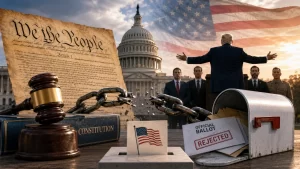
Warning: This President May Contain Inaccurate Information
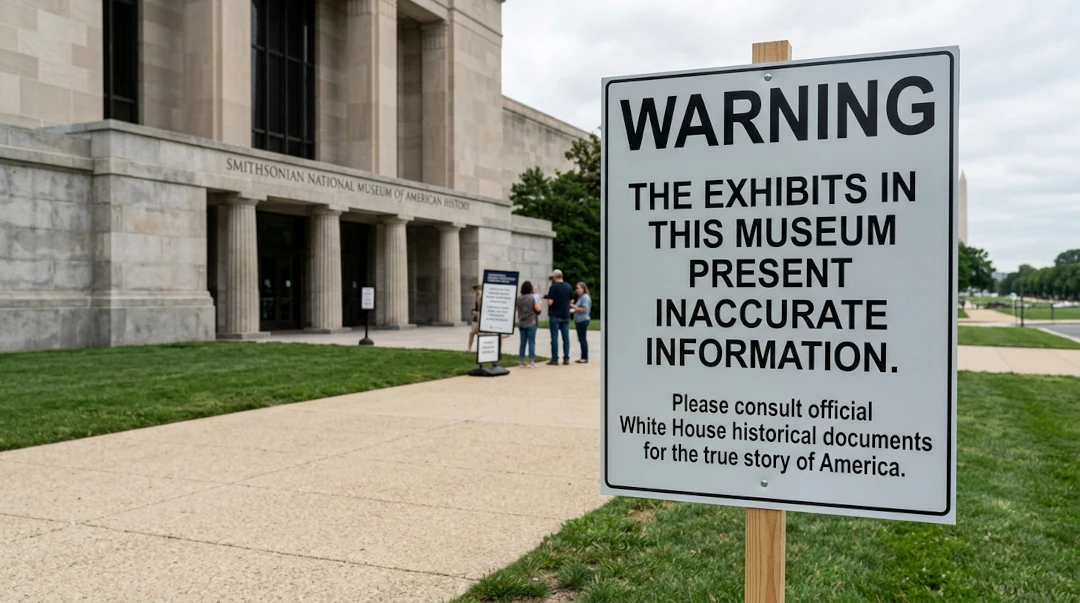
Donald Trump has ordered the National Park Service to plant warning signs outside the Smithsonian’s National Museum of American History, telling visitors the exhibits inside are unreliable. The order is legally dubious, constitutionally corrosive, and — with a country at war and a healthcare system in freefall — a chilling window into an administration’s priorities.
On the eve of the nation’s 250th anniversary, the President of the United States is not celebrating the American experiment. He is warning the country against remembering it honestly. On Friday, July 24, Donald Trump signed a new executive order directing Interior Secretary Doug Burgum and the National Park Service to install temporary “warning” signs on the sidewalks outside the Smithsonian’s National Museum of American History, telling the roughly four million people who visit each year that the exhibits inside present “inaccurate information” — and pointing them toward the White House’s own preferred version of the American story.
The order does not, and cannot, direct the museum itself to change anything. That is because the Smithsonian is not a Trump property. It is a 180-year-old trust instrumentality of the United States, governed by a Board of Regents that includes the Chief Justice of the United States and lawmakers from both chambers. The White House knows this. So it targeted the one asset it does control: the sidewalk. As the Associated Press bluntly noted, the president “lacks authority to quickly fire the Smithsonian leadership or to order changes to exhibits, so his executive order targets the sidewalks out front.”
Read that sentence again. The most powerful office in the world, occupied by a man who claims to represent the will of the people, has been reduced to editorializing on the concrete outside a museum he cannot control. This is not strength. It is a tantrum with letterhead.
I. What Is Actually Being “Corrected”
The July 24 order is the enforcement arm of a 162-page White House Domestic Policy Council report published, with unsubtle stagecraft, on July 4, 2026 — the 250th birthday of the republic. The report, titled “Saving America’s Story”, accuses the museum of “ideological capture” and demands, among other things, that the Smithsonian post a warning above every entrance reading: “Warning: the exhibits in this museum were prepared by people who don’t want you to love your country.”
So what, exactly, does the White House consider “inaccurate”? Reporting by Newsweek, CBS News, and the report itself make the answer plain. The offending content includes:
The pattern is not subtle. What the administration calls “inaccurate” is, overwhelmingly, what historians call “accurate.” The Organization of American Historians, in a statement joined by 36 allied scholarly organizations, called the effort a directive that “sanitizes to destroy truth” — one that “proposes to rewrite history to reflect a glorified narrative that downplays or disappears elements of America’s history — slavery, segregation, discrimination, division — while suppressing the voices of historically excluded groups.”
“Time to destroy the Smithsonian just like I did the Kennedy Center.”
— Sen. Jeff Merkley (D-Ore.), on X, responding to the executive order
II. The Legality: A President’s Fictional Authority
Here is the constitutional truth the White House would prefer no visitor read: the president has no lawful authority to command the Smithsonian to do anything. The institution was chartered by Congress in 1846 as a trust for “the increase and diffusion of knowledge.” It is governed by a 17-member Board of Regents that includes the Vice President, the Chief Justice of the United States, three senators, three representatives, and nine private citizens. The Congressional Research Service has stated the matter plainly: “The Smithsonian, due to its organizational structure outside the three branches, arguably is not subject to policy promulgated by executive order.”
Legal scholars have been even more direct. In a recent Yale Law Journal essay, “Fight at the Museum: Executive Overreach and the Future of the Smithsonian Institution,” a Yale Law scholar argues that Trump’s Smithsonian orders constitute plain executive overreach: “The Smithsonian is not an executive agency. Rather, it is a trust instrumentality serving a public function while operating largely independently of the federal government. The President’s attempts to usurp the museum’s leadership and to control the Smithsonian’s artistic direction encroach on that independence. Further, the Smithsonian Executive Order breaks nearly two centuries worth of precedent.”
Two centuries of precedent, discarded to install signs on a sidewalk. That is the measure of what is happening. And when the president cannot legally reach the exhibits, he does what he did at the Kennedy Center: he seizes the surrounding property, plants flags, and dares anyone to sue. It is not governance. It is graffiti with an executive seal.
Get Involved Today
Contribute to our mission and turn your concerns into action.
III. A Timeline of the Assault
This did not begin on Friday. The order is the culmination of a 16-month campaign to bring one of the world’s most respected cultural institutions to heel.
IV. A Country in Crisis, a President in a Museum
Consider, for a moment, the state of the country this executive order is meant to serve. American troops are engaged in an expanding war with Iran, one that House Budget Committee Democrats estimate is costing as much as $1 billion per day. Gasoline in parts of California has topped $6 a gallon. Nearly three million Americans have already lost ACA coverage after Republicans allowed the enhanced premium tax credits to expire. Sixteen million more are projected to lose Medicaid by 2034 under cuts already enacted. Health insurance premiums in Trump’s first year back in office doubled.
Trump himself, in April, told Americans directly: “We’re fighting wars. We can’t take care of daycare… It’s not possible for us to take care of daycare, Medicaid, Medicare.” The White House cannot afford daycare. It can afford to litigate the language on a sidewalk sign. Rep. Frank Pallone (D-N.J.) put it starkly: “Trump would rather spend taxpayer money bombing Iran rather than investing in Americans.” Now, apparently, he would rather spend it on museum warning labels.
This is not a president attending to crisis. It is a president fleeing from it into culture war, because culture war is the only front on which he still commands a base. There is no metric by which sidewalk signage outside a Washington museum ranks as a national priority in a country where families are choosing between insulin and rent. There is only the metric of grievance.
“Historians are appalled.”
— Samuel J. Redman, historian at UMass Amherst, quoted in The New York Times
V. The Children on the Field Trip
Every year, according to the Smithsonian’s own educational programming records, more than 6.5 million schoolchildren visit the Institution. They come from every state. They walk into the National Museum of American History with clipboards from their teachers, with worksheets, with the earnest belief that what they see is what happened. Millions of them are children of color, whose ancestors’ contributions and suffering are woven, honestly and painfully, through the exhibits the White House now brands “inaccurate.”
Consider the message a warning sign delivers to those children. It says: The government of the United States does not want you to believe what you are about to see. The government of the United States is telling you that the truth about slavery, about the Founders’ contradictions, about the workers and immigrants and women whose labor built this country, is a lie. A twelve-year-old on a field trip is not going to walk past that sign and think about the fine points of executive authority. She is going to think that maybe her family’s story does not count.
This is what censorship in a democracy actually looks like. It does not always come with book burnings. Sometimes it comes with a helpful little placard, taxpayer-funded, standing between a child and her country’s honest reflection. Rep. James Walkinshaw (D-Va.) noted at the July 22 House hearing that the same administration has already scrubbed Jackie Robinson, the Tuskegee Airmen, and the Navajo code talkers from Defense Department websites — some restored only after public outcry. The censorship is not theoretical. It is operational.
VI. Congress: A Study in Absence
What is Congress doing about it? The honest answer, reported by Roll Call just two weeks before the order dropped, is: as little as possible. House Republicans, who control the chamber, have held one show hearing but declined to pass legislation codifying Trump’s demands — because doing so would require them to defend those demands on the record. House Democrats, wary of “wading into a cultural fight” ahead of the midterms, have largely stuck to affordability messaging.
There are exceptions. Rep. Joe Morelle led the April 2025 letter to Vice President Vance defending the Smithsonian’s independence. Rep. Melanie Stansbury (D-N.M.) forcefully pushed back at the July 22 hearing. Sen. Jeff Merkley has warned openly of an ongoing effort to “destroy” the institution. But there is no coordinated legislative response — no bill to codify Smithsonian independence, no funding rider protecting its curators, no censure motion. The White House has correctly calculated that the political cost of this order is close to zero. That calculation is itself the crisis.
Meanwhile, the Smithsonian Board of Regents — which includes Chief Justice John Roberts and Vice President Vance — has been conspicuously silent. Roberts is the institution’s chancellor. He has the authority, and arguably the duty, to speak. He has not.
A Museum-Sign Presidency, and the Cost of Doing Nothing
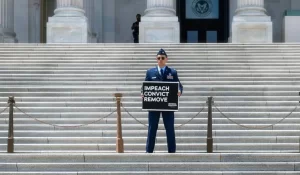
The 25th Amendment, ratified in 1967, provides in Section 4 that the Vice President and a majority of the Cabinet — or another body Congress establishes — may declare in writing that the President is “unable to discharge the powers and duties of his office.” The Vice President then assumes those duties as Acting President. Congress has never invoked Section 4. It was written for exactly the situation the country is being asked to accept: a president whose judgment, priorities, and grasp on reality have deteriorated to the point of national danger.
The invocation is not a partisan fantasy. On April 30, 2026, Sens. Sheldon Whitehouse (D-R.I.) and Jack Reed (D-R.I.) entered into the Congressional Record a statement signed by 36 physicians from Harvard, Tufts, Columbia, and George Washington University declaring the president “mentally unfit” and describing a “rapidly worsening, reality-untethered, increasingly dangerous decline.” On April 14, 2026, House Judiciary Ranking Member Rep. Jamie Raskin (D-Md.) introduced legislation to establish a bipartisan independent commission to activate the Section 4 process. Sen. Ed Markey (D-Mass.), Rep. Eric Swalwell (D-Calif.), and Rep. Yassamin Ansari (D-Ariz.) have all publicly called for the amendment’s invocation.
Ask what a rational chief executive would do this week. A war on two fronts. A collapsing insurance market. Grocery inflation that has driven bankruptcy filings to their highest levels in a generation. And this president’s use of a Friday afternoon — the traditional slot for burying inconvenient news — was to order signs on a sidewalk instructing children not to trust a museum. That is not a matter of policy disagreement. It is a matter of proportion, judgment, and capacity — the exact terrain Section 4 was drafted to police.
The Legal Argument
The case is not that the president holds unpopular views. The case is that his ordering of national priorities — museum signage over healthcare, sidewalk censorship over war finance, personal grievance over the operations of a nuclear-armed government — constitutes a failure to “discharge the powers and duties of his office” as the Framers of the Twenty-Fifth Amendment understood the phrase. The evidence is not one erratic Truth Social post. It is the sustained substitution of grievance for governance across an eighteen-month record.
The Practical Barriers
Invocation requires either the Vice President plus a Cabinet majority, or a body Congress creates. Vance is a loyalist. The Cabinet is stocked with loyalists. The Republican Congress will not create the alternative body Raskin’s bill proposes. As things stand, Section 4 has no path to activation. This is honest. It is also beside the point.
Why the Case Persists Anyway
The moral and constitutional argument is not extinguished by procedural impossibility. If invocation were easy, it would not require the moral seriousness the Framers built into it. The purpose of raising Section 4 is not to guarantee its immediate use. It is to enter into the national record — the way Sens. Whitehouse and Reed did with those 36 physicians — the truth that a functioning republic requires a functioning president, and that the country is not receiving one. History will not judge us by whether Section 4 was invoked. It will judge us by whether we told the truth about why it should have been.
VII. What This Says About Us
An administration that denies the documented truth about slavery is, unsurprisingly, the same administration that denies the documented truth about climate change, about vaccine science, about the outcome of a free election. There is a straight line from ordering signs against the historical record to ordering the Environmental Protection Agency to remove climate data from its websites, to gutting solar and wind investment credits, to reinstalling interpretive panels at Philadelphia’s Independence Hall that critics say whitewash the founding.
The through-line is not conservatism. Conservatism, at its best, honors the past honestly and calls the present to its standards. What this administration practices is not conservatism. It is eraseism — the systematic removal of any fact, figure, or narrative that complicates a preferred myth. It is a state ideology in the form of a warning label.
The average American should understand what is being negotiated on their behalf. It is not merely a museum exhibit. It is the question of whether the government of the United States retains the authority to instruct its citizens on what to believe about their own past. In every functioning democracy in the world, the answer to that question is no. In an American republic still nominally committed to the First Amendment, the answer must remain no. Otherwise, what remains of us? A nation that cannot bear to remember itself, that funds its wars but not its clinics, that argues over placards while its people go bankrupt — that is not a great country. That is a diminished one, presided over by a man who confuses vanity with vision.
Editorial Conclusion
A president who cannot pay for insulin but can pay for propaganda signs is not governing — he is performing. A government that censors museums instead of protecting patients has lost its moral compass. The Smithsonian belongs to the American people, not to the political vanity of one man. And a country that permits its history to be edited by executive order is a country preparing to lose everything else. The Twenty-Fifth Amendment exists for exactly this moment. That its invocation is politically unreachable does not mean the case for it is not made. The case is made. It is on the sidewalk.
Sources & References
- NBC NewsTrump orders signage warning visitors of ‘inaccurate information’ at Smithsonian
- CBS NewsTrump orders signs placed outside Smithsonian museum warning of “inaccurate” information
- CNN PoliticsTrump orders signs be installed outside Smithsonian museum warning of ‘inaccurate information’
- ABC News / APTrump orders new signs outside Smithsonian saying some exhibits are inaccurate
- Washington PostTrump orders warning signs near Smithsonian, escalating fight over history
- NewsweekTrump plans exhibits near Smithsonian to correct “inaccurate information”
- The White HouseExecutive Order: Restoring Trust in the Smithsonian Institution (July 24, 2026)
- The White House“Saving America’s Story” — Domestic Policy Council Report (July 4, 2026)
- Yale Law JournalFight at the Museum: Executive Overreach and the Future of the Smithsonian Institution
- Congressional Research ServiceSmithsonian Institution: Potential Effects of Executive Order 14253
- Roll CallAs Trump threatens the Smithsonian, Congress is on the sidelines
- Raw StoryTrump mocked after ‘dumbest’ order yet installs warnings outside Smithsonian
- Organization of American HistoriansStatement on Executive Order “Restoring Truth and Sanity to American History”
- First Amendment EncyclopediaControl of Smithsonian Institution Exhibits
- The HillConcerns Grow Over Trump’s Mental Fitness for Presidency
- House Judiciary DemocratsRep. Raskin Letter to White House Physician on 25th Amendment (April 10, 2026)
- House Budget Committee DemocratsTrump’s 2027 Budget Puts America Last
- Rep. Nancy PelosiWe Can Fix Health Care, But Trump Chooses Iran
- The ConversationTrump administration opens a new front in the history wars
- Encyclopedia of EducationSmithsonian Institution — Education Programs (6.5M schoolchildren annually)
Related News