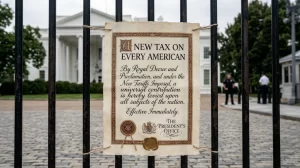
The Donald Dash: A Country Voting With Its Feet
For the first time since the Great Depression, more people are leaving the United States than moving in. It is not an accident of policy. It is the policy. And the president is calling it a victory even as the labor force, the treasury, and the birthright of a nation of immigrants drain away in real time.
There is a peculiar silence at the ports of entry. Not the silence of order, which is what the administration would have you believe, but the silence of a country that is being quietly abandoned by both those who wished to come and, more astonishingly, by those who were already here. In January, the Brookings Institution and the American Enterprise Institute — a center-left and a conservative shop, jointly — reported that net migration to the United States in 2025 was somewhere between negative 10,000 and negative 295,000 people. The last time this happened, Franklin Roosevelt was in his second term and Americans were leaving for work in the Soviet Union. The trend now has a nickname: the Donald Dash. It is a name earned.
The Wall Street Journal’s own investigation, subsequently amplified across every outlet from The Boston Globe to People, put the number of US citizens who emigrated in 2025 at roughly 180,000 — the largest outbound migration of Americans in decades. Gallup’s latest polling, taken just eight months ago, found that one in five Americans now say they want to leave the country permanently. A Harris poll pegged the “considered relocation” number at 42 percent of the entire adult population. This is not fringe. This is not celebrity theater. This is a mainstream American electorate looking at the exits.
The administration insists this is a triumph. A White House spokesman told the Journal that the country is “attracting countless ultra-high net worth foreigners” who are paying $1 million apiece for what the president calls a “Gold Card.” That is the theory of the case: America as gated community, its labor force replaced by hedge-fund heirs. The evidence, as we shall see, is that the community is emptying and the gate is closing on nothing but air.
I. What the Numbers Actually Show
The scale of the collapse in in-migration is easy to underestimate because the administration works to obscure it. Total immigration into the United States fell from nearly 6 million in 2023 to somewhere between 2.6 and 2.7 million in 2025 — a decline of more than half in two years. The Department of Homeland Security, in its own accounting, has claimed 675,000 formal deportations and 2.2 million “self-deportations” over the last year. Even accepting the administration’s figures at face value, the math is grim.
The Reversal
Brookings’ central estimate of US net migration in 2025 — the first negative year since at least the mid-1970s and possibly since 1935.
American Emigrants
US citizens who relocated abroad in 2025, per Pew and Wall Street Journal reporting — the largest outbound citizen wave in decades.
Foreign-Born Workers Lost
Decline in foreign-born workers since the March 2025 peak, per BLS data analyzed by the National Foundation for American Policy.
Renunciation Surge
Jump in citizenship renunciations recorded in the Federal Register in Q1 2025 vs. Q4 2024. Consulates now report month-long or longer backlogs.
The composition of the outflow is as telling as its size. Jen Barnett, founder of the relocation firm Expatsi, told the Journal that the profile has fundamentally changed. “Previously, the Americans leaving were super-adventurous and well-credentialed,” she said. “Now they’re ordinary people, like me.” Her company’s stated goal, she added, is “to move one million Americans.” Kelly McCoy, a Wall Street Journal expat interviewee who relocated to Albania from New York and now advises other Americans on the process, observes that a middle-class family can now live comfortably in her adopted country on roughly $1,000 a month. That is a comment on Albania. It is also a comment on America.
“Previously, the Americans leaving were super-adventurous and well-credentialed. Now they’re ordinary people, like me.”
— Jen Barnett, Founder, Expatsi (to the Wall Street Journal)
II. The Machinery Behind the Exodus
None of this is happenstance. The administration has built, over eighteen months, an interlocking set of policies whose direct and predictable effect is to shut off the labor pipeline that has powered American growth for a generation. The immigration attorneys at Solow, Hartnett and Galvan have compiled the sequence; the timeline below is drawn from their reporting and from the National Foundation for American Policy’s brief.
Get Involved Today
Contribute to our mission and turn your concerns into action.
Read as a whole, this is not enforcement. It is amputation. Every stage of the legal system that brings workers, spouses, students, and refugees into the United States has been either closed, capped, or priced out of reach. Stuart Anderson, writing at Forbes, put it bluntly: Fed Chair Jerome Powell has now stated publicly that the American labor market has seen no growth and no net private-sector job creation over the past several months. That is what the policy achieved. That is the “win.”
III. The Bill Comes Due
The economic architecture of the United States has, for four decades, depended on a simple demographic fact: American women are not having enough children to replace the American population, and the difference has been made up by immigration. The current fertility rate is roughly 1.6 births per reproductive-age woman, well below the 2.1 replacement level. Between 2019 and 2024, immigrant workers accounted for 84.7 percent of all US labor force growth. Remove that input, and the arithmetic of the economy inverts.
The joint Brookings–AEI analysis by economists Wendy Edelberg, Tara Watson, and Stan Veuger estimates that reduced migration will cut consumer spending by $60 billion to $110 billion across 2025 and 2026. Their more startling projection: the sustainable pace of monthly job growth in the United States has fallen to somewhere between 20,000 and 50,000 jobs a month — and could turn negative in 2026. Goldman Sachs, in a separate analysis, estimates net immigration will collapse from 500,000 in 2025 to 200,000 in 2026, a fraction of the roughly one million annual average of the 2010s.
The longer horizon is more sobering still. The National Foundation for American Policy — a nonpartisan research group focused on trade and immigration — projects that the current policy regime will reduce cumulative American GDP by $1.9 trillion through 2028 and $12.1 trillion by 2035. That is $34,369 per person over a decade. That is a tax, functionally, on every single American household, levied not by Congress but by executive fiat, and paid in slower wage growth, thinner services, and a shrinking tax base to fund Social Security and Medicare.
“The economy has, contrary to assurances from Vice President JD Vance and Deputy Chief of Staff Stephen Miller, produced neither the jobs boom nor the wage lift the administration promised. It has produced a labor market that, in the Fed Chair’s own words, is not growing at all.”
— The 2547NOW Authors
IV. What This Means at the Kitchen Table
It is easy to hear “GDP” and “labor force participation” and file the story away as an abstraction. It is not. Consider what the coming twelve months look like for an ordinary American household.
The industries hardest hit by the collapse of foreign-born labor are construction, agriculture, hospitality, elder care, and food processing — every one of them a driver of consumer prices. When 1 million foreign-born workers leave the labor force in a single year, the cost of framing a house, picking a tomato, staffing a nursing home, or serving a restaurant meal rises. That cost is passed to the consumer. It is showing up in the grocery bill and the rent already, and it will worsen. The administration has told American workers that removing immigrants will raise their wages. What it has, in fact, delivered — and this is documented — is a labor market with zero net private-sector job creation and a productivity outlook that Goldman now expects to remain suppressed through the decade.
Consider also the second-order effect. Social Security and Medicare are pay-as-you-go systems, funded by current workers to pay current retirees. Fewer workers, in an aging country, means the trust funds run down faster and the benefits shrink or the taxes rise. Every deported farmhand and every uninvited software engineer is a hole in the retirement of an American senior. That is not left-wing rhetoric; it is the plain accounting of the Congressional Budget Office. And it is why so many Americans are, quite rationally, calculating that their own retirement will be safer, and their children’s schools better funded, in Portugal, or Mexico, or Ireland — countries where American money still buys a middle-class life and a functioning healthcare system.
The Expatsi survey found that 56 percent of respondents named the sense that the United States has become “too divided” as a primary motivator for leaving; 53 percent cited political polarization; 41 percent named financial relief. Nearly half of Americans considering emigration to Portugal say they would consider renouncing their US citizenship outright. This is not a vacation. This is a severance.
V. Notable Points of Interest
A few features of the story deserve particular attention.
First, the outflow is bipartisan in its composition. As even the center-right analyst at the aviation blog Live and Let’s Fly conceded, “Trump’s re-election was a factor for many — although others voted for him.” The AllSides aggregation noted, correctly, that the phenomenon predates Trump’s second term. But every serious analyst also agrees that the trend has accelerated sharply since January 2025, and the WSJ’s own headline reflects this: the trend has been building; the Trump administration has poured accelerant on it.
Second, the demographic profile has shifted from adventurous singles to families and midcareer professionals — the very demographic on which the American middle class depends. This is not the loss of a rounding error. It is the loss of the country’s productive core.
Third, the administration’s own gauge of success — the “Gold Card” program in which the ultra-wealthy pay $1 million for expedited residency — is a policy of aristocratic replacement. It says, explicitly and unashamedly, that the American labor market is to be replenished not by hardworking immigrants who become citizens over decades, but by the global rich who purchase entry. That is not an immigration policy. It is a class policy in the shape of an immigration policy.
Fourth, the president has repeatedly framed the emigration of Americans as a positive — an unwanted population culling itself. That, more than any statistic, is what should give pause. Presidents do not, in normal times, celebrate the exodus of their own citizens.
VI. The Constitutional Question
Which brings us to the harder matter. A president who cannot articulate a plan to reverse a demographic collapse of his own making, who greets a historic outflow of American citizens with self-congratulation, and whose public statements have grown so erratic that members of his own party have begun asking whether he is fit to hold the office — is a president to whom the Constitution assigns a specific remedy.
When “The Powers and Duties of the Office” Are No Longer Being Discharged
The Twenty-Fifth Amendment, ratified in 1967 in the aftermath of the Kennedy assassination, provides in Section 4 for the involuntary transfer of presidential authority when the Vice President and a majority of the Cabinet — or “such other body as Congress may by law provide” — determine that the president is “unable to discharge the powers and duties of his office.” The framers of the amendment did not restrict its use to comas and strokes. Senator Birch Bayh, its principal author, wrote that it was intended to cover any incapacity, “whether from physical or mental disability,” that renders a president unable to make the deliberate decisions the office requires.
On April 14, 2026, Rep. Jamie Raskin (D-Md.), the ranking Democrat on the House Judiciary Committee, introduced legislation with 50 Democratic co-sponsors to establish precisely such an “other body”: a 17-member Commission on Presidential Capacity composed of physicians, psychiatrists, and former high-ranking officials, empowered to conduct a medical examination and report to Congress. Raskin’s letter to the White House Physician earlier that month observed that the president had “threatened to extinguish a civilization on social media, rant[ed] about combat missions with children at the Easter Egg Roll, and drop[ped] profane tirades on Easter morning” — conduct that placed the situation, in his words, “in the realm of profound medical difficulty and concern.”
He is not alone. Sen. Bernie Sanders (I-Vt.) has publicly described the president’s Iran-related social media output as “the ravings of a dangerous and mentally unbalanced individual.” Sen. Chris Murphy (D-Conn.) has said openly: “If I were in Trump’s Cabinet, I would spend Easter calling constitutional lawyers about the 25th Amendment.” Sen. Ed Markey (D-Mass.) has called for its invocation. Rep. Yassamin Ansari (D-Ariz.) has described the president as “extremely mentally ill.” Even Senate Majority Leader Chuck Schumer has publicly described presidential communications as those of “an unhinged madman.”
The economic policy under discussion here — the deliberate hollowing-out of the American labor force, the celebration of a citizen exodus, the boast that the country’s future rests on selling Gold Cards to foreign oligarchs — is a further data point in the same pattern. It is not a signature of a president who is weighing evidence, listening to economists, or acknowledging that the working-class Americans who elected him are now paying more for groceries and watching their children’s employment prospects narrow. It is a signature of a president who has decided that reality itself is negotiable, so long as he can rebrand the wreckage as a win.
The practical barriers are real. Section 4 requires the Vice President plus a Cabinet majority to move first, and this Vice President has staked his political future on defending the president’s every utterance. Raskin’s commission bill will not pass a Republican House. A two-thirds override in both chambers is a near-mathematical impossibility with the current partisan composition. All of this is true. None of it makes the constitutional argument wrong. The amendment exists precisely for moments when the person occupying the office is failing to discharge its duties; the fact that the current officeholder’s party will not act does not extinguish the fact that the duties are not being discharged.
The moral case does not require the political victory. Establishing on the record — through legislation, through the White House Physician’s evaluation Raskin has requested, through the plain public statements of ranking members of Congress — that the president is presently unfit is itself an act of constitutional maintenance. History will ask whether anyone said so out loud while it was happening. The answer, at least, will be yes.
Sources: Rep. Raskin’s April 10 letter to Capt. Sean Barbabella, White House Physician; H.R. legislation introduced April 14, 2026; public statements of Sens. Sanders, Murphy, Markey, Schumer and Reps. Dexter, Ansari and Kamlager-Dove.
VII. What This Says About Priorities
Every leader is a set of choices. The president has chosen to define the success of his administration by the number of people leaving the United States — whether at his direction or in flight from it. He has chosen to greet the collapse of net migration to the country he governs as a policy achievement, rather than as the demographic and economic emergency it plainly is. He has chosen to sell citizenship to the ultra-wealthy at a million dollars per head while telling native-born working Americans that immigrants were the problem. He has chosen to pursue an immigration regime that his own Federal Reserve chair has publicly identified as strangling job growth.
These are not the choices of a leader focused on the material welfare of ordinary Americans. They are the choices of a man who confuses the emptying of a country with its greatness, and who mistakes the applause of his rally crowds for the consent of the governed. The Americans quietly packing for Mexico City, Lisbon, Dublin, and Halifax are giving their own answer to the question of whether he is fit to lead the country they are leaving behind.
Editorial Conclusion
A country whose citizens are leaving in numbers unseen since the Great Depression is a country whose leadership has failed at the most fundamental task: making the place worth staying in. That the president celebrates the exodus does not make it a triumph. It makes him a witness to his own indictment.
The Twenty-Fifth Amendment was written for moments precisely like this one — when the person holding the office has ceased to discharge its duties, and when the pattern of that failure has become plain to lawmakers of both parties. The path to invoking it is politically narrow. The case for saying, plainly and on the record, that it applies is not narrow at all. It is required.
What is at stake is not one administration or one election. It is whether the American experiment — the two-and-a-half-century proposition that this is the country people come to — remains true. The answer, right now, is that it does not. And the responsibility for that answer, and for reversing it, is a responsibility Congress owes not to a party but to the Constitution it swore to defend.
Sources & References
- Brookings Institution — Immigration and the macroeconomy after 2024 (Edelberg, Watson, Veuger)
- Washington Post — Trump’s tougher policies led to net negative migration in 2025, estimate shows
- ABC News — US, for first time in 50 years, experienced negative net migration in 2025
- Fox News — Immigration to US turns negative in 2025, new Brookings report finds
- USA Today — US saw negative net migration in 2025, first time in decades
- American Enterprise Institute — Macroeconomic Implications of Immigration Flows in 2025 and 2026
- Boston Globe — A record number of Americans are leaving the country and seeking to renounce citizenship
- Naked Capitalism — Trump Policies and “Donald Dash” Expats Produce Net Emigration
- Fortune — Trump crackdown drives 80% plunge in immigrant employment (Goldman Sachs analysis)
- Forbes — Lower Immigration And Zero Net Job Creation Dim US Growth Prospects
- NFAP — US Labor Force Analysis: January 2025 to February 2026
- NFAP — The Economic Impact of the Trump Administration’s Immigration Policies
- Yahoo/Fortune — Trump immigration policies would slash workforce estimate by 15.7 million
- House Judiciary Democrats — Raskin demands White House Physician evaluate Trump’s cognitive fitness
- MSNBC — Raskin offers bill setting up 25th Amendment process to remove Trump from office
- Mediaite — Democrats question Trump’s mental fitness after Iran threat
- Deseret News — Democrats introduce Trump fitness bill under 25th Amendment
- Global Citizen Solutions — From Destination to Departure: America’s New Migration Story
Related News