The Court Just Handed Democracy to the Highest Bidder — And the President Is Cheering
In a 6-3 decision authored by Justice Brett Kavanaugh, the Roberts Court has torn down the last meaningful firewall between political parties and their candidates’ bank accounts. The plaintiff was the man now serving as Vice President. The response from the President was a Truth Social victory lap. The dissent used the words “untold harm.”
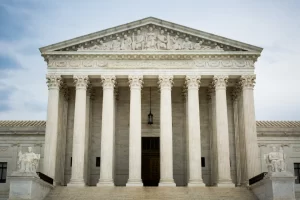
On the final day of its term, on the same morning it also gutted federal recognition of transgender athletes and gestured at the shape of birthright citizenship, the Supreme Court quietly finished a project it began sixteen years ago in Citizens United. By a 6-3 vote in National Republican Senatorial Committee v. Federal Election Commission, the conservative majority struck down the coordinated-expenditure limits that Congress passed in the wake of Watergate — the last remaining rule preventing donors from routing enormous sums through political parties and directly into a favored candidate’s campaign. It is the most consequential campaign-finance ruling since Citizens United itself, and it arrived with almost no public warning.
The case that ended those limits was not brought by an obscure activist or a fringe legal theorist. It was brought by then-Senate candidate J.D. Vance in 2022 — the same J.D. Vance who now sits one heartbeat from the presidency. And when the case reached the Court, the Trump Justice Department, whose FEC had already stopped enforcing the law, declined to defend it. The federal government, in effect, refused to argue for its own statute. A private lawyer had to be appointed by the Court to speak for the rule that Congress had passed.
That should be the first sentence of every story written about this ruling.
1. The Ruling
Writing for the majority, Justice Kavanaugh held that the Federal Election Campaign Act’s coordinated-expenditure limits “necessarily abridge political parties’ freedom of speech.” The opinion overruled the Court’s own 2001 precedent in Colorado II, which had upheld the same limits by a 5-4 vote a generation ago. To justify the reversal, Kavanaugh described that older decision as “a three-legged stool where all three legs have already been knocked out” — the legs being the string of subsequent 5-4 and 6-3 rulings, from Citizens United forward, that the Roberts Court itself authored.
To the argument that unlimited coordinated spending would allow wealthy donors to circumvent individual contribution limits, Kavanaugh responded that “prophylaxis upon prophylaxis upon prophylaxis” already exists in federal law. Disclosure rules, earmarking rules, and base contribution caps, in his telling, are sufficient to prevent corruption. The government’s interest in preventing “influence, ingratiation, gratitude, access, or the like” — the phrase is Kavanaugh’s own — was, he wrote, no longer enough to override the First Amendment claim of a political party that wants to spend without restriction on the candidate it just nominated.
Under the 2026 limits struck down Tuesday, party committees could spend between $65,300 and $130,600 in coordination with House candidates and up to $4 million with Senate candidates in the largest states. Those numbers are now meaningless, there is no ceiling.
2. The Dissent
Justice Elena Kagan, joined by Justices Sonia Sotomayor and Ketanji Brown Jackson, wrote a dissent that reads less like a legal disagreement than an obituary. She began with an inventory of what had been lost: fifty-two years of anti-corruption law, one 2001 precedent that had survived Citizens United and McCutcheon and every subsequent Roberts Court assault. She ended with a warning that the majority had “ushered in untold harm.”
Her central image is arresting because it is so mechanically simple. Under the old rule, an individual donor could give a candidate directly no more than about $7,000. Under the new regime, that same donor can give the national party roughly half a million dollars — and the party can turn around and spend every cent of it, in explicit coordination with the candidate, on that candidate’s advertisements, mail pieces, and staff. The party, Kagan wrote, becomes “an alternative checking account for a campaign.”
“The majority invalidates Congress’s restriction of coordinated expenditures, thus enabling a party to serve as an alternative checking account for a campaign… So the Court ushers back in the same opportunities for quid pro quo corruption that the contribution limits were meant to check.”
— Justice Elena Kagan, dissenting
What Kagan is describing is not a hypothetical. It is the entire logic of the American campaign-finance system that Congress built after Watergate, dismantled in a single paragraph. A “legal regime increasingly unable to stop political corruption” is her summary of what remains. The three legs of the anti-corruption stool that Kavanaugh described as long-broken? Kagan concluded that all the majority has left behind is “a remnant of a remnant.”
The Center for American Progress documents the pattern: Citizens United (2010), McCutcheon (2014), FEC v. Ted Cruz (2022), and now NRSC v. FEC (2026). Every ruling has fallen along ideological lines. Every ruling has removed a guardrail.
Public Citizen released a report the same day as the ruling documenting $517 million in corporate spending in the 2026 cycle alone, most of it flowing to industry-aligned super PACs and Trump-linked MAGA Inc.
The three national Republican committees ended May with $256 million in cash and no debt — more than double the roughly $126 million held by Democratic counterparts, who carry more than $18 million in debt.
In 2024, more than $1.3 billion in outside election spending came from dark money sources, according to OpenSecrets — money whose ultimate donors the public will never see.
3. The President’s Contradiction
Within hours of the ruling, President Trump celebrated on Truth Social: “A BIG WIN FOR REPUBLICANS and, more importantly, The First Amendment!” The all-caps enthusiasm was familiar. What deserves to be seen next to it is the parallel campaign he has been waging on the other end of American democracy — the end where ordinary voters live.
Since taking office, this President has issued two sweeping executive orders attempting to seize control of federal elections from the states and Congress. The first, in March 2025, sought to impose documentary proof of citizenship for federal voter registration, rescind voting-machine certifications, and threaten funding to states that refused to comply. The second, in March 2026, ordered the U.S. Postal Service to deliver mail ballots only to voters on newly compiled federal “citizenship lists” — an unprecedented federal takeover of an inherently state function.
Federal courts have already declared key provisions of the first order unlawful. In January, D.C. District Court Judge Colleen Kollar-Kotelly wrote plainly: “Our Constitution does not allow the President to impose unilateral changes to federal election procedures.” The Brookings Institution’s analysts concluded, based on the 2024 Survey of the Performance of American Elections, that only 48% of Americans possess an unexpired passport with their legal name — meaning tens of millions of citizens could be disenfranchised by a “show your papers” registration rule.
Consider the arithmetic of that position. The President has spent eighteen months attempting to make it harder for ordinary Americans — including deployed service members, disabled voters, elderly citizens, and Americans living abroad — to cast a single ballot. On Tuesday, he cheered a ruling that lets a single donor pump half a million dollars into a single candidate’s campaign. One vote is dangerous fraud. Half a million dollars is free speech. That is the entire theory of governance, expressed in one afternoon.
“Republicans have failed the American people with a record that has ripped away health care and raised costs on families, and they know voters will hold them accountable in November — which is exactly why they are rewriting the rules in an effort to drown out the will of the voters by flooding elections with more money from their billionaire backers.”
— DNC Chair Ken Martin, Sen. Kirsten Gillibrand, and Rep. Suzan DelBene, joint statement
4. The Vice President’s Project
None of this is accidental, and none of it is peripheral to Vice President J.D. Vance. He is not a bystander to this ruling. He is its author of record. The NRSC v. FEC case was filed in 2022 by Vance and former Rep. Steve Chabot alongside the two Republican congressional committees. When Solicitor General John Sauer wrote the government’s brief siding with the plaintiffs, he was writing on behalf of a Justice Department serving a Vice President who had personally launched the litigation.
Days before the decision came down, according to Common Dreams, Vance suggested that if Watergate happened today it would barely make the news. The 1974 law struck down Tuesday was passed because of Watergate. That is not subtext. That is the text.
Reporters at Rolling Stone, drawing on David Sirota and Jared Jacang Maher’s book Master Plan, describe this litigation as the deliberate final piece of a decades-long conservative legal project to transform party committees into “pass-through conduits for big donors to circumvent donation limits and deliver much larger payments in support of lawmakers who can reward them with government favors.” Michael Beckel of the reform group Issue One put it more directly to Newsweek: the ruling “further empowered wealthy donors and special interests with outsized influence in elections.”
Get Involved Today
Contribute to our mission and turn your concerns into action.
5. The Cost to Every Voter
What does this mean in practice? It means the next competitive Senate race in your state can be dominated by a small number of individuals writing party-level checks fifty or seventy times larger than what any one of them could legally give the candidate. It means the incumbent who takes those calls knows exactly who filled the checking account. It means the challenger with grassroots support and small donors is competing not against another candidate but against the party’s entire national donor list, funneled through a single campaign.
Michael Beckel described the pattern to Campaigns & Elections as “a string of disastrous campaign finance rulings from the Roberts Court that began with Citizens United.” Jon Golinger of Public Citizen told Common Dreams that the Court has “twisted the First Amendment to help billionaires and corporations buy our elections and bend our government to their will.” These are not fringe voices. They are the researchers who have been mapping the money for a generation, warning of exactly this outcome.
Citizens United v. FEC. The Roberts Court holds that corporations and unions have a First Amendment right to unlimited independent political expenditures. Outside spending explodes from $575 million in 2008 to nearly $4.5 billion by 2024.
McCutcheon v. FEC. A 5-4 majority strikes down aggregate limits on how much an individual can donate across all federal candidates and committees in a two-year cycle.
FEC v. Ted Cruz for Senate. The Court, 6-3, strikes down limits on repaying candidate personal loans from post-election contributions — effectively allowing donors to put money directly in an elected official’s pocket.
NRSC v. FEC. The Court, 6-3, strikes down coordinated-expenditure limits between political parties and their candidates. The last major restraint from the Watergate-era Federal Election Campaign Act falls.
“Unable to discharge the powers and duties of his office”
Section 4 of the Twenty-Fifth Amendment permits the Vice President and a majority of the Cabinet — or, in the alternative, “such other body as Congress may by law provide” — to declare that the President is “unable to discharge the powers and duties of his office,” transferring authority to the Vice President as Acting President. The amendment was ratified in 1967. The word unable is nowhere defined in the text.
That silence is not an oversight. It is the design. PBS NewsHour, working with legal historians, has documented that the amendment’s principal author, Sen. Birch Bayh, and his colleagues intentionally used open-ended language because they could not predict every scenario in which a president might be disabled. Rep. Richard Poff (R-Va.), one of the drafters, wrote explicitly that Section 4 was meant to apply not only to unconsciousness or physical illness but to situations where “the President, by reason of mental debility, is unable or unwilling to make any rational decision, including particularly the decision to stand aside.”
In April 2026, following the President’s profanity-laced Truth Social threats to “extinguish a civilization” in Iran, Rep. Jamie Raskin, ranking member of the House Judiciary Committee, formally demanded a comprehensive cognitive and neurological evaluation of the President. Sen. Chris Murphy (D-Conn.) wrote publicly that if he were in the Cabinet he would “spend Easter calling constitutional lawyers about the 25th Amendment.” Rep. Alexandria Ocasio-Cortez called for removal. Days later, Raskin and 50 House Democratic co-sponsors introduced legislation to establish the “such other body” the amendment contemplates: an independent Commission on Presidential Capacity of physicians, psychiatrists, and former officials empowered to conduct a formal 72-hour medical examination if Congress so requested.
The constitutional argument is not that this President dislikes coordinated-spending limits. It is that a President who governs by grievance and self-enrichment, who takes a victory lap when his own Vice President’s litigation dismantles anti-corruption safeguards passed after Watergate, while simultaneously ordering the Postal Service to withhold ballots from millions of eligible voters, has demonstrated an inability to distinguish his personal and factional interests from the constitutional duties of the office he holds. The oath is to “preserve, protect and defend the Constitution of the United States.” Cheering the collapse of the campaign-finance architecture Congress built to protect the republic from Watergate is not a partisan preference. It is a public statement about what the office is for.
Are there practical barriers? Yes, and it is important to name them honestly. Raskin’s Commission bill will not clear a Republican Senate. It would face a certain presidential veto. Vice President Vance — whose own lawsuit produced Tuesday’s ruling — would have to be the one to initiate Section 4 proceedings under the primary mechanism. None of that is remotely likely. But the drafters wrote the amendment the way they did precisely because they did not want a President’s ability to escape accountability to depend on his political allies’ willingness to act. The “such other body” clause was placed there as a democratic escape valve, and the moral and constitutional case for using it does not collapse merely because the political case is hard. The record — chronicled in real time by the Brennan Center — is not being made in secret. It is being made in signed executive orders and celebratory Truth Social posts. The question is who will be willing to read it.
Editorial Conclusion
The Roberts Court did not “restore” free speech on Tuesday. It restored the pre-Watergate world. A President who applauds that restoration while trying to disenfranchise disabled voters, deployed troops, and elderly citizens is not defending the Constitution — he is telling the country exactly whose voices he believes matter. A Vice President who architected the litigation to dissolve coordinated-spending limits, and who has publicly mused that Watergate itself would be a non-story today, is not a reformer of campaign finance. He is its undertaker. The stakes are not partisan. They are constitutional. American self-government cannot survive a system in which a half-million-dollar check is protected speech and a mail-in ballot is presumptive fraud. Congress must pass the DISCLOSE Act. States must expand public financing. And the country must decide, before November, whether the “such other body” the Twenty-Fifth Amendment names is worth becoming.
Sources & References
- NBC News. “Supreme Court strikes down long-standing campaign finance restrictions.” nbcnews.com
- SCOTUSblog. “Justices strike down campaign finance law.” scotusblog.com
- NPR. “Supreme Court strikes down limits on political party spending.” npr.org
- ABC News. “Supreme Court rolls back federal limits on campaign finance.” abcnews.com
- CBS News. “Supreme Court strikes down coordinated campaign spending limits.” cbsnews.com
- Al Jazeera. “Supreme Court strikes down US campaign spending limits in landmark ruling.” aljazeera.com
- CNBC. “Supreme Court strikes down limits on political parties’ campaign spending, in win for GOP.” cnbc.com
- Newsweek. “Campaign Finance Ruling: Kagan Warns Supreme Court Unleashed ‘Untold Harm.'” newsweek.com
- The Daily Beast. “Liberal Justices Raise Alarm on Corruption in Fiery Dissent.” thedailybeast.com
- Common Dreams. “In Gift to Billionaires, Supreme Court Buys Vance’s Argument Against Post-Watergate Campaign Finance Rule.” commondreams.org
- Rolling Stone. “J.D. Vance and the Right’s Plan to Help Billionaires Buy Elections.” rollingstone.com
- Center for American Progress. “Is the U.S. Supreme Court Preparing To Undermine Campaign Finance Reforms Again?” americanprogress.org
- Campaigns & Elections. “Supreme Court Strikes Down Campaign Finance Limits.” campaignsandelections.com
- OpenSecrets. “Dark Money Basics.” opensecrets.org
- Brennan Center for Justice. “The Trump Administration’s Campaign to Undermine the Next Election.” brennancenter.org
- Brennan Center for Justice. “Status of Trump’s 2025 Anti-Voting Executive Order.” brennancenter.org
- Brookings Institution. “Trump’s new elections executive order and what it would mean for voters.” brookings.edu
- NPR. “Trump tries to create verified voter list with executive order.” npr.org
- PBS NewsHour. “Could the 25th Amendment be invoked against Trump? Here’s how it works.” pbs.org
- House Judiciary Democrats. “Ranking Member Raskin Demands White House Physician Immediately Evaluate Donald Trump’s Cognitive Fitness.” democrats-judiciary.house.gov
- Deseret News. “Democrats introduce 25th Amendment commission bill after Trump rhetoric sparks impeachment talks.” deseret.com
Related News