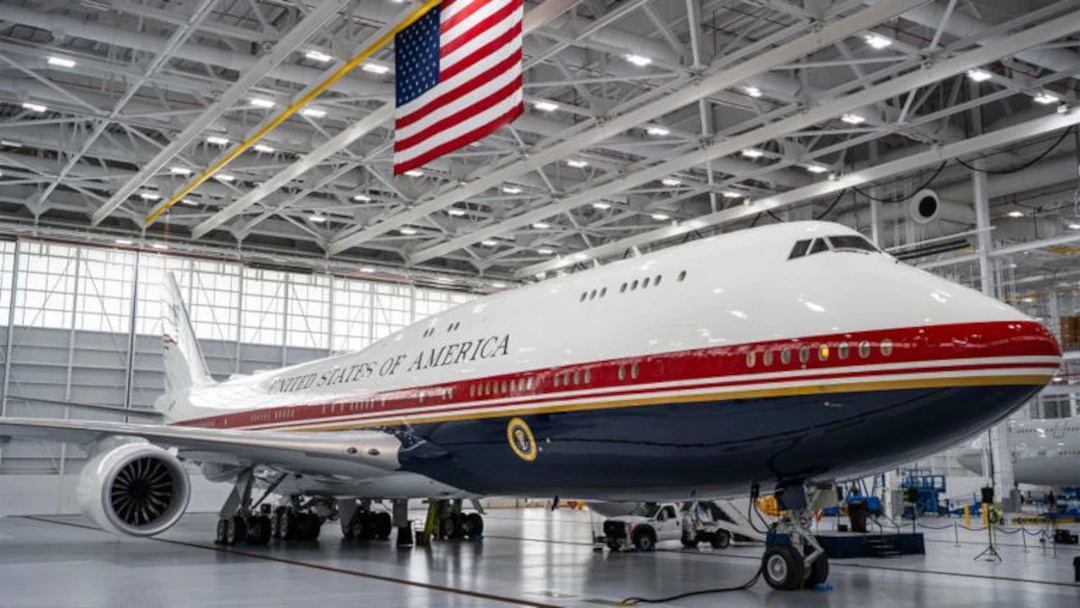
The Air Force’s VC-25B Bridge aircraft, pictured at Joint Base Andrews, Maryland. © US Air Force
On Friday the president unveiled a gold-trimmed Boeing 747, gifted by Qatar, as the new Air Force One — a “free” jet that will cost taxpayers more than a billion dollars to make safe, and the country far more in the precedent it sets. It arrived in a summer when nearly half of American households cannot cover their own necessities and the planet edged past yet another temperature record. This is what the administration chose to celebrate.
On Friday morning, under the lights of a new hangar at Joint Base Andrews, the president walked down the airstairs of a Boeing 747 finished in navy, crimson and gold and pronounced it the finest aircraft any nation has ever flown. The jet is a gift — handed to the United States by the government of Qatar, valued when new at roughly $400 million, and destined, the White House confirms, for Mr. Trump’s own presidential library foundation after he leaves office. He praised its leather lounges and wood paneling, promised a Fourth of July flyover, and hailed the refurbished cabin as the most opulent ever to carry a president. He did not mention the price.
But there is always a price. The aircraft the Air Force now calls the “VC-25B Bridge” was not free in any sense an ordinary family would recognize. It was free the way a gift from a creditor is free — the cost is simply deferred, and it is paid in something other than dollars. To understand what this gilded jumbo jet actually costs the country, you have to look past the paint.
1. The Spectacle
The choreography was the point. Mr. Trump exited the jet first, descended the stairs alone, and toured the cabin for an audience of assembled service members and cameras. The exterior abandons the pale “robin’s-egg” blue chosen in the Kennedy era for a darker, bolder scheme the president selected himself: a navy underbelly, a red stripe, gold accents, the presidential seal on the boarding side and an outsized flag on the tail. He told the room the plane had been transformed into a residence of unmatched luxury, and announced it would lead a flyover above the capital on July 4 unlike any the country has seen. The reporting on the event was wall-to-wall, which is precisely what a spectacle is designed to produce.
What the spectacle obscures is the substance. This is a thirteen-year-old jet that once carried the Qatari royal family, accepted by the Pentagon last year and stripped down by contractors to install secure communications and missile-defense systems before it could be trusted to fly the president of the United States. The luxury Mr. Trump celebrated — the master bedrooms, the lounges, the finishes — was left largely intact precisely to rush the plane into service. The grandeur, in other words, is borrowed. So is the plane.
“A flying White House at a level of luxury that nobody has ever seen.”
— President Donald Trump, Joint Base Andrews, June 19
2. The Math of a “Free” Jet
Begin with the contradiction at the center of the administration’s argument. The president has defended the gift as a windfall — a way to spare taxpayers the cost of a new presidential aircraft. Yet the United States is already paying for new presidential aircraft. Boeing holds a fixed-price contract worth roughly $3.9 billion to build two purpose-made VC-25B jets. That program — years behind schedule, with first delivery now slipped from 2024 to mid-2028 — has not been cancelled. The Qatari jet does not replace it. It is a stopgap layered on top of it.
Now add the cost of the gift itself. A donated airliner cannot simply be repainted and flown; it must be torn apart and rebuilt to military and counter-intelligence standards. Aviation experts and officials put the security overhaul at anywhere from several hundred million dollars to more than $1 billion — a figure the administration keeps classified. The result is a country paying twice: billions for the planes Boeing is building, and a fortune more to retrofit a “free” one that will fly for only a few years before being handed to the president’s personal foundation.
Already on the books
Fixed-price contract for two new Boeing jets, still unbuilt. Breaking Defense
America’s top worry
Share naming cost of living as their biggest economic concern. CAP / CNN poll
Maine’s congressional delegation, joined by eleven Senate Democrats, put the point bluntly in a letter to the administration: spending public money to upgrade a Qatari jet when the president already travels securely is, in their words, unnecessary and wasteful. An administration that built its brand on efficiency chose, here, the most extravagant option available.
3. How We Got Here
February 2025
Trump inspects the jet in West Palm Beach, touring the Qatari royal family’s 747-8 months before any deal is announced.
May 2025
The gift goes public and the president confirms it on Truth Social. Within days the Pentagon, under Defense Secretary Pete Hegseth, formally accepts the aircraft.
Summer 2025
The teardown begins. Contractors start stripping and rebuilding the jet to install classified security and communications systems.
June 19, 2026
The unveiling at Andrews. Commissioning flights are to follow, with a Fourth of July flyover promised.
Mid-2028 & beyond
The real planes, eventually. Boeing’s purpose-built VC-25Bs remain years away — and the Qatari jet is destined for Trump’s library foundation once he departs.
Get Involved Today
Contribute to our mission and turn your concerns into action.
4. The Constitution’s Plain Text
The Framers wrote a rule for exactly this moment. The Foreign Emoluments Clause forbids any person holding an office of trust from accepting any present “of any kind whatever” from a foreign state without the consent of Congress. Its purpose, as Cleveland State law professor David Forte told fact-checkers, is to prevent foreign nations from gaining improper influence; the Qatari offer, he said, looks precisely like the kind of gift the clause was written to prohibit. Penn State’s Stanley Brand reads the text the same way: acceptance, he says, would require Congress’s consent under the Constitution’s express terms. Norm Eisen, a former White House ethics lawyer who litigated emoluments cases in Mr. Trump’s first term, called this one obviously unconstitutional.
The administration’s defense, laid out in a memorandum from Attorney General Pam Bondi, rests on two claims: that the jet is a gift to the Air Force and then to a library foundation rather than to Mr. Trump as an individual, and that because it is not tied to any specific official act, it is not a bribe. But the foundation is the problem, not the solution. A presidential library bearing the president’s name, funded and controlled in his orbit, is a personal benefit by another route — the very kind of indirect enrichment the clause was meant to foreclose. Georgetown’s David Super put the common-sense objection plainly: no government, he warned, hands a $400 million present to anyone without expecting something in return. The question the clause forces is not whether a quid pro quo can be proved in a single transaction, but whether the republic wants its president financially indebted to a foreign government. The answer, written into the Constitution itself, is no.
“It’s not just bribery. It’s premium foreign influence with extra legroom.”
— Senate Democratic Leader Chuck Schumer
Congress has not been silent. House Judiciary Democrats Jamie Raskin and Pramila Jayapal opened an investigation, demanding the legal memos the administration used to bless the deal and warning that any such memo flies in the face of the clause’s plain text. Senator Angus King of Maine, an independent, called the gift crazy on every level and said it does not survive honest scrutiny — on national security grounds alone, he noted, the jet would have to be taken apart piece by piece to be sure it isn’t compromised. Even some of the president’s own allies have called the gift a potential stain on his legacy. This is not a partisan complaint. It is a constitutional one.
5. A Furnace in the Sky
Consider the timing. The president chose to enlarge the presidential fleet with one of the most fuel-hungry aircraft ever built in the same season that scientists warned the planet is running out of room. The World Meteorological Organization now estimates a three-in-four chance the average global temperature over 2026–2030 will exceed the 1.5°C threshold that nations pledged not to cross; 2025 was among the hottest years ever recorded. Against that backdrop, a four-engine jumbo jet is not a neutral choice. A 747-8 of this size burns thousands of gallons of jet fuel an hour and can run tens of thousands of dollars in fuel on a single flight — before counting the second, idle jumbo it is meant to replace, or the two more being built. The presidency necessarily travels; no one disputes that. But there is a difference between travel and ostentation, and the president drew it himself when he chose to celebrate the most luxurious, least efficient option as a triumph.
The contrast writes itself. A government that tells working families to be patient about clean-energy costs has just acquired a gold-trimmed palace that will spend the climate budget of a small town every time it crosses an ocean — and called it a gift.
6. What It Says to a Country Counting Pennies
Here is the America the jet flew into. By the Brookings Institution’s measure, 45.5 percent of U.S. households do not earn enough to cover their necessities. Food insecurity has climbed to levels not seen since the depths of the pandemic. Gas prices have jumped by roughly a dollar a gallon since late winter. Inflation has again outpaced wage growth, and three-quarters of Americans tell pollsters the cost of living is their single greatest worry. The federal minimum wage has not moved since 2009.
To a parent skipping meals so the children can eat, the master bedroom on a borrowed jumbo jet is not an abstraction. It is an answer — an answer about whose comfort comes first. Leadership is, in the end, a sequence of choices about what matters. Faced with a country pleading for relief at the grocery counter, the administration spent its energy, its political capital, and a classified fortune in public money on the staging of a flying palace. The message that sends is not subtle, and Americans are not slow to read it.
An open word, a high wall, and the right door
Some readers, watching a president treat the public treasury and a foreign government’s favor as personal property, ask whether the 25th Amendment applies. The mechanism is real but narrow. Section 4 lets the vice president, together with a majority of the Cabinet, declare that the president is “unable to discharge the powers and duties of his office,” making the vice president acting president. The president can contest it in writing; if he does, it falls to Congress, which must sustain the finding by a two-thirds vote of both chambers. It has never been invoked.
The text is deliberately open. As the amendment’s principal drafter, John Feerick, has explained, the words “unable” and “inability” were left undefined not by oversight but by design — the drafters judged a rigid definition unwise, and built a flexible standard for emergencies they could not foresee. The sponsors believed the ultimate judgment would be a political one, resolved by political actors.
The narrow reading of “inability” — physical incapacitation, coma, stroke — is not the only reading the text permits. A serious constitutional argument exists that “inability to discharge the powers and duties” extends to a president whose conduct demonstrates a categorical inability to discharge those duties faithfully. The duties of the office, as defined by Article II, include the obligation to “take Care that the Laws be faithfully executed.” A president who systematically channels federal enforcement and procurement decisions toward his personal donors is not faithfully executing the laws. He is using them as a private currency. Whether that constitutes the kind of “inability” Section 4 was drafted to address is precisely the constitutional question the framers left for future Americans to weigh.
The Practical Barriers — and Why They Don’t End the Argument
The practical barriers are real. Section 4 requires Vice President JD Vance and a majority of the Cabinet — Trump’s own appointees — to initiate the declaration. If the president disputes it, the question goes to Congress, where a two-thirds supermajority of both chambers is required to keep him out of office. In the current Congress, with Republican majorities in both, that bar is, as a matter of vote-counting, unreachable. More than seventy members of Congress have, at various moments of the second term, publicly called for Section 4. The path to enactment is closed by the math.
But the barriers do not negate the constitutional case — they describe the political failure surrounding it. A Constitution that explicitly contemplates the removal of a president for inability to discharge his duties does not vanish because Congress is too cowed to use the tool. The argument remains intact: a presidency reduced to the role of donor-services arm, where official acts pattern themselves around private contributions, is precisely the kind of derangement of executive function the framers gave the country a remedy to address. That the remedy will not, in this Congress, be applied is a comment on Congress. It is not a verdict on the Constitution.
Editorial Conclusion
An American president accepted a $400 million aircraft from a foreign government, will spend more than a billion public dollars to make it fly, and intends to keep its successor for his own foundation — and he staged the whole thing as a gift to the nation while that nation struggles to afford groceries.
The office of the presidency is not an asset to be furnished, mortgaged, or handed down. The Constitution’s answer to a foreign gift is congressional consent; its answer to corruption is oversight, the courts, and impeachment; and the people’s answer is the ballot. What is at stake on that gold-trimmed jet is not the president’s comfort. It is the principle that no one who holds power in this republic may be bought. That principle must be defended — in the committee room, in the courtroom, and at the polls — before the next gift arrives.
Sources & References
- NBC News — Trump unveils new Air Force One jet gifted by Qatar. nbcnews.com
- NPR — Air Force One, gifted to Trump from Qatar, arrives at Joint Base Andrews. npr.org
- Newsweek — Trump unveils Air Force One after $400M military overhaul of Qatar gift. newsweek.com
- Reuters — Trump plans to accept luxury 747 from Qatar to use as Air Force One. reuters via yahoo.com
- Scripps News — Qatari-gifted Boeing 747 joins fleet as aging Air Force One retires. scrippsnews.com
- The Hill — Qatar jet ‘obviously’ an Emoluments Clause violation: Norm Eisen. thehill.com
- PolitiFact / Poynter — Qatar’s $400M plane gift is likely unconstitutional, experts say. poynter.org
- LEX18 / Scripps — Attorney warns of Emoluments Clause violations (Georgetown’s David Super). lex18.com
- U.S. House — Judiciary Democrats open investigation into Trump’s Qatari plane deal. jayapal.house.gov
- Portland Press Herald — Maine delegation slams plan to accept $400M plane from Qatar. pressherald.com
- Scripps News — Sen. Angus King says the U.S. faces a constitutional crisis. scrippsnews.com
- Breaking Defense — Air Force expects first new VC-25B in ‘mid-2028’; Boeing’s losses. breakingdefense.com
- Simple Flying — How much does it cost to operate a Boeing 747-8. simpleflying.com
- PBS NewsHour — Could the 25th Amendment be invoked? Here’s how it works. pbs.org
- Just Security — The 25th Amendment: A Reader’s Guide (with John Feerick). justsecurity.org
- Center for American Progress — Lowering the cost of living for American families. americanprogress.org
- NPR — It’s not just inflation. Wages are falling behind too (Brookings). npr.org
- Al Jazeera — Hottest year almost certain by 2030, UN warns (WMO). aljazeera.com
Related News