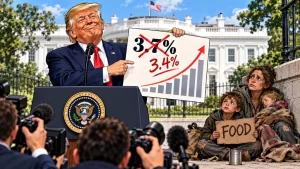
April’s Producer Price Index posted its largest annual jump in nearly four years. Real wages went negative. The president said he doesn’t “think about” Americans’ finances. And in the same week, his party tried to slip $1 billion in taxpayer money toward his White House ballroom.
On Wednesday, the Bureau of Labor Statistics released a Producer Price Index report that should have stopped Washington in its tracks. Wholesale prices — the costs that businesses pay for the goods and services they sell to consumers — jumped 1.4 percent in a single month, the largest monthly increase since March 2022. On a 12-month basis, the index rose 6.0 percent, the steepest annual gain since the inflation peak of late 2022. Core PPI, stripped of food and energy, surged 5.2 percent year over year. By every meaningful measure, the inflation Donald Trump promised to defeat “on day one” has returned with force, and it is coming for the American consumer next.
The PPI is not an obscure number. It is the leading indicator of where consumer prices are heading. As Groundwork Collaborative bluntly put it after Wednesday’s release, the wholesale costs measured by PPI “are what companies pay before they jack up prices on the rest of us.” More than three-quarters of April’s broad-based increase traced to a 7.8 percent jump in final demand energy — a direct consequence of the war Trump launched against Iran in late February and the resulting blockade of the Strait of Hormuz. Nationwide senior economist Ben Ayers warned that “the jump in input prices portends further increases for consumer prices in May,” with the next CPI report expected to push above 4 percent.
This is not, as the White House continues to insist, a transient blip. It is the predictable result of policy choices — chaotic tariffs piled on top of an unauthorized war — made by an administration whose stated priority, in the president’s own words this week, is not the financial well-being of the American people.
1. The Numbers: An economy in reverse, in four data points
Before turning to the politics, the data deserve to be seen plainly. Each of the following figures comes directly from the Bureau of Labor Statistics release of May 13, 2026, or from the Consumer Price Index report released the day before.
What those four cards describe is a country in which prices are accelerating, the underlying drivers are broad rather than narrow, and the paycheck of the average worker is now losing ground for the first time since the inflation crisis of 2022 and 2023. PNC chief economist Gus Faucher told Bloomberg that “inflation, which we thought was under control, is reaccelerating, and that’s a real problem.” Economist Sung Won Sohn of Loyola Marymount University put the experience of ordinary Americans more plainly: “For consumers, that means the cost of living remains uncomfortable.”
2. Whose Paycheck Shrank – The bills arriving now
Aggregate inflation statistics can mask the specific places where the pain lives. The PPI and CPI reports together — and the supply chain pressure documented by news organizations across the spectrum — paint a clear picture of who is paying for the administration’s choices. The following timeline reflects price movements documented in the April BLS reports and reporting from Time, Common Dreams, and Groundwork Collaborative.
Get Involved Today
Contribute to our mission and turn your concerns into action.
This is what a presidency that does not work for ordinary Americans looks like in numbers. The pain is not concentrated among any single constituency. It is the family of four at the grocery store, the worker commuting to a job that no longer pays for the commute, the retiree on a fixed income watching the electric bill outrun the Social Security adjustment.
“I don’t think about Americans’ financial situation. I don’t think about anybody. I think about one thing: we cannot let Iran have a nuclear weapon. That’s all.”
— President Donald Trump, May 12, 2026, before departing Washington to meet Xi Jinping in China
3. The Trends: A self-inflicted price shock
Inflation in a healthy economy comes from somewhere identifiable, and policymakers can argue honestly about how to respond. What April’s PPI reveals is something different: a price shock that flows directly from two policy decisions the president made alone, against the advice of his own party’s economists, and which Congress has so far failed to constrain.
The first decision is the global tariff regime — the so-called “Liberation Day” tariffs of April 2024, since ruled unlawful by the Supreme Court but still partially in force, layered on top of country-specific duties imposed in waves throughout 2025. The Boston Globe’s editorial board put the matter starkly: “The president has no one to blame but himself.” The tariff-exposed categories of the PPI tell the story — metals up more than a third, electronics up more than a quarter — and businesses have now exhausted their ability to absorb the costs internally. Inputs are flowing into final prices. That is exactly what the PPI is designed to predict.
The second decision is the war with Iran, launched alongside Israel on February 28, 2026 — without a congressional authorization for the use of military force, and according to a growing number of constitutional scholars and lawmakers, in direct violation of the War Powers Resolution. The Strait of Hormuz blockade that resulted has choked off not only oil but, as CNN reported, fertilizers, aluminum, and helium — the kind of inputs whose price moves quietly into everything from a loaf of bread to a hospital MRI. Trump told reporters Tuesday that inflation will fall to “one and a half percent” as soon as the war ends. Economists do not share this view. Even if a ceasefire were reached today, it would take months for normal oil shipments to resume.
Rep. Brendan Boyle of Pennsylvania, the ranking member of the House Budget Committee, summarized the connection between policy and price in a single sentence: “The only thing Trump has made great again is inflation. His disastrous policies — from his tariff taxes to his war in Iran — are making life even more expensive.”
4. Misplaced Priorities: While Americans pay more, the president builds more
The clearest indictment of an administration’s priorities is the comparison between what its leader chooses to do and what its citizens are forced to endure. In the same week that the PPI report landed, the Senate Republican leadership advanced a reconciliation bill containing a $1 billion taxpayer expenditure tied to the security infrastructure of Trump’s new 90,000-square-foot White House ballroom — a project the president had repeatedly insisted would cost the public “not one penny.” NBC News first reported the provision; NPR confirmed that the $1 billion was inserted into the same bill that funds Immigration and Customs Enforcement and Customs and Border Protection.
The ballroom itself, originally announced last summer at a price of $200 million, has now doubled to $400 million. The administration’s parallel Lincoln Memorial Reflecting Pool renovation, initially estimated at roughly $2 million, has ballooned to $13 million, according to federal contracting records first reported by The New York Times. When MS NOW’s Akayla Gardner pressed the president on the doubling of the ballroom’s cost, he responded: “I doubled the size of it, you dumb person.”
Senate Minority Leader Chuck Schumer’s response captured what is at stake. “This ballroom is a disgrace,” he told reporters. “Republicans are on a different planet than American families. Republicans looked at families drowning in bills and decided what they really needed was more raids and a Trump ballroom.” Rep. Maxine Dexter of Oregon connected the ballroom directly to the PPI release, observing that the same week the president complained of inflation he could not control, he asked Congress to spend a billion dollars of public money on a private vanity project. A Washington Post–ABC News poll taken in late April found 2-to-1 opposition to demolishing the historic East Wing for the ballroom in the first place.
“Trump’s war in Iran has driven prices through the roof and today’s reading shows there is no end in sight. Inflation has now eaten through a year’s worth of wage gains, painting a brutal picture for working families’ budgets heading into summer. Rather than focus on making life more affordable for Americans, Trump is spending time — and taxpayer funds — on his billion dollar ballroom.”
— Lindsay Owens, Executive Director, Groundwork Collaborative · May 13, 2026
This is the pattern. It is no longer a question of any single misjudgment or any one expensive vanity. It is a sustained, observable disconnect between what the country is enduring and what its president attends to. And under the Constitution, when that disconnect becomes severe enough to call into question the president’s capacity to discharge the duties of his office, there is a remedy.
The 25th Amendment and the question of capacity
Section 4 of the 25th Amendment to the United States Constitution, ratified in 1967 in the wake of John F. Kennedy’s assassination, provides a constitutional mechanism for the orderly removal of a president unable to discharge the powers and duties of office. It empowers the Vice President, together with either a majority of the Cabinet or “such other body as Congress may by law provide,” to transmit a written declaration of incapacity to Congress. Upon that declaration, the Vice President immediately assumes the role of Acting President.
For more than half a century, Congress never created the “other body” the amendment expressly contemplates. On April 14, 2026, Rep. Jamie Raskin of Maryland, ranking member of the House Judiciary Committee, introduced legislation to do exactly that — establishing a 17-member, nonpartisan Commission on Presidential Capacity to Discharge the Powers and Duties of Office. The bill currently has approximately 84 co-sponsors as of May 15th, 2026. According to Axios reporting, more than 85 House and Senate Democrats called for the president to be impeached or removed under the 25th Amendment in the days leading up to the bill’s introduction, following Trump’s public threat that “a whole civilization will die tonight, never to be brought back again” if Iran did not capitulate to his demands.
Rep. Alexandria Ocasio-Cortez was among those calling for removal. So, in a moment of unusual bipartisanship, was conservative commentator Candace Owens, according to Deseret News. Raskin separately wrote to the White House physician, Captain Sean Barbabella, demanding a comprehensive cognitive and neurological evaluation of the president with full public disclosure of the results.
The constitutional argument
The case for considering Section 4 here does not rest on partisan animus. It rests on a pattern. A president who tells reporters on camera that he does “not think about Americans’ financial situation” while wholesale inflation hits its highest annual rate in four years, who threatens the annihilation of an entire civilization in a social media post, who insists his ballroom is “under budget” while its cost doubles, who responds to a journalist’s factual question by calling her a “dumb person” — that is a pattern that goes to capacity, not merely to ideology. The Framers of the 25th Amendment understood that incapacity can take many forms. The text says only that the president must be “unable to discharge the powers and duties” of office. It does not require a coma.
The practical barriers
The barriers to actually invoking Section 4 in 2026 are real and should be stated honestly. Vice President JD Vance is a Trump loyalist who has shown no inclination to act. The Cabinet was assembled almost entirely on the basis of personal loyalty. Both chambers of Congress are Republican-controlled, and Raskin’s commission bill is likely to be blocked on procedural grounds or vetoed if it reaches the president’s desk. There is no realistic short-term path to removal.
Why the barriers do not negate the case
None of that diminishes the constitutional and moral importance of putting the question on the record. The 25th Amendment exists precisely so that the country has a vocabulary for what is happening — a framework that names presidential incapacity as a constitutional problem rather than a partisan grievance. The fact that the current Cabinet will not act, and the current Senate will not convict, is itself a separate constitutional failure: the breakdown of the structural checks the Framers built. Setting up the Commission Raskin proposes would not remove this president. It would build the institutional capacity that should have existed since 1967, so that the next time a president is genuinely incapable, the country is not relying on ad hoc improvisation. To do nothing — to pretend that what Americans are watching is normal governance — is itself a constitutional failure.
6. What Follows: The next report, and the one after that
The May PPI report will be released on June 11, 2026. Economists at Nationwide, Pantheon Macroeconomics, and elsewhere expect it to confirm that the wholesale pressure documented in April has flowed into the consumer prices Americans pay at the grocery store, the pump, and the utility window. Sen. Elizabeth Warren’s statement after the CPI release said it plainly: “Trump’s failed economic policies aren’t just raising costs, they’re shrinking families’ paychecks.” A new Federal Reserve Bank of New York report cited in the same CNN piece shows consumers are now becoming seriously delinquent on their loans, particularly student loans, at rising rates.
What follows from here depends on whether Congress is willing to act on three fronts simultaneously: to use its constitutional war powers to end the Iran conflict; to claw back the tariff authority the Supreme Court has now confirmed was unlawfully exercised; and to establish, through Raskin’s commission or some functional equivalent, the standing body the 25th Amendment has called for since 1967. None of those steps is easy. All of them are constitutional duties. The fact that they will be politically inconvenient for the majority party is not a constitutional defense.
Editorial Conclusion
April’s Producer Price Index is more than an economic data release. It is a record, written in the language of arithmetic, of a presidency that has stopped serving the public it was elected to govern. The price of bread, the price of gasoline, the price of a paycheck that no longer covers the rent — these are not abstractions. They are the texture of daily life for a country whose president told reporters this week, on camera, that he does not think about them. The Constitution provides remedies for the politics of this moment, and remedies for its constitutional crisis. Congress should use both. The American people are not, and have never been, an afterthought.
Sources & References
- U.S. Bureau of Labor Statistics — Producer Price Index News Release, April 2026 (May 13, 2026)
- CNBC — PPI inflation report April 2026: wholesale prices rise 1.4%
- CNN Business — America is in for yet another long spell of price pain
- CNN Business — US inflation rose to 3.8% in April, eroding Americans’ paychecks
- Common Dreams — Economic Pain ‘Just Beginning’ as Key Index Shows More Inflation
- Common Dreams (Groundwork) — Wholesale Horror: Producer Price Index Spells Disaster
- Time — This Is Where Inflation Is Biting the Hardest for Americans
- The Boston Globe — Breaking down the inflation report: Consumers are being hit by Trump’s war
- U.S. Senate Banking Committee — Senator Warren Statement on April 2026 CPI
- U.S. House Judiciary Democrats — Rep. Raskin Introduces Legislation Establishing Commission on Presidential Capacity
- Axios — House Democrats file long-shot 25th Amendment bill targeting Trump
- Deseret News — Democrats introduce 25th Amendment commission bill
- NBC News — Republicans propose $1 billion in taxpayer dollars to secure Trump ballroom
- NBC News — Some Republicans aren’t sold on $1B price tag for Trump’s ballroom project
- CNN Politics — The White House ballroom: Taxpayer money could go toward security
- The Hill — Senate GOP balks at $1B in security for White House ballroom
- NPR — Republicans want to add $1 billion for Trump’s ballroom security to ICE funding plan
- MS NOW — Trump attacked his foes for rising project costs. Now he’s dismissing his own
- Fortune — Trump’s promise to ‘end inflation’ saw families paying $2,120 more in 2025
- PolitiFact — Are Republicans seeking $1 billion in taxpayer money for Trump’s ballroom?
Related News