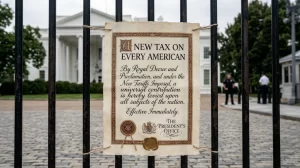
When the Consumer Price Index hit a three-year high, the man who pledged to end inflation on Day One celebrated. The numbers behind the smile tell the story of an American economy buckling under tariffs, war, and a White House that has stopped pretending to care.
When a reporter asked President Donald Trump in the Oval Office on Wednesday whether he was concerned about new inflation data showing consumer prices rising at their fastest annual pace in three years, the President of the United States smiled. “No, I love it,” he said. “The numbers were great. You know what I really love? I love the inflation.” The remark, captured on camera and quickly circulated by Democratic governors, senators, and ordinary Americans, was not a slip of the tongue. It was a confession — that the suffering documented in the morning’s Bureau of Labor Statistics report is, to this president, a political convenience he can spin, not a crisis he is obligated to solve.
The data does not lie, even when the man in charge of responding to it does. The Consumer Price Index rose 4.2 percent year-over-year in May 2026 — the first time the figure has topped 4 percent since 2023, and the third straight month of acceleration. Prices climbed 0.5 percent in May alone, on the heels of a 0.9 percent monthly jump in March and a 0.6 percent rise in April. The Federal Reserve’s preferred inflation gauge, the core Personal Consumption Expenditures index, came in at 3.3 percent in April. Overall PCE inflation registered 3.8 percent year-over-year. None of those numbers are good. None of them look like a president keeping his most repeated campaign promise. And none of them, evidently, are worth the President’s concern.
1. The Promise He Made — And the One He Kept
Standing in front of cartons of eggs and gallons of milk on the 2024 campaign trail, Donald Trump told voters that he would “immediately bring prices down, starting on day one.” At his inauguration he pledged to “end inflation and make America affordable again.” In January, speaking to global elites at Davos, he declared inflation “defeated” and bragged that grocery prices, energy prices, airfares, and mortgage rates were “coming down fast.” That was January. That was a lie.
What followed instead was a tariff regime that raised the retail prices of imported goods by an average of 6.8 percentage points above pre-tariff trends, according to the Center for American Progress, costing the average family more than $1,700 between February 2025 and January 2026. What followed was a unilateral war with Iran — initiated without a congressional declaration — that has parked Brent crude above $100 a barrel for the first time since 2022. What followed was a Republican-passed budget that gutted the Affordable Care Act subsidies on which millions of working Americans rely. The Commonwealth Fund estimates that nearly 5 million Americans will lose health insurance next year as coverage becomes unaffordable.
The promise the President made was to lower costs. The promise he kept was to never apologize for the costs he raised.
“People can’t afford to feed their families. Your struggle is a joke to him.”
— J.B. Pritzker, Governor of Illinois, responding to the President’s remark
2. What the Numbers Actually Show
The President wants the country to believe that inflation is high only because of the war with Iran, and that it will “come down like a rock” when the fighting stops. The data tells a more complicated, and more damning, story. Energy prices did surge — rising 3.9 percent in May after a 10.9 percent leap in March — and they account for more than 60 percent of the increase in the all-items index, according to the BLS. But the inflationary pressures were already in motion before the first U.S. strike on Tehran in late February, driven by tariffs the President himself imposed. The Center for American Progress and other economists have attributed as much as 0.7 percentage points of CPI inflation and 0.5 percentage points of PCE inflation directly to the administration’s trade policies.
The Institute for Supply Management’s May reports tell the same story from the producer side. Manufacturers’ input prices, as measured by the ISM Prices Index, registered 82.1 percent in May, with raw materials prices rising for the 20th consecutive month. In the survey, the Iran war was mentioned in 42 percent of panelists’ comments — and tariffs in 18 percent. Fifty-seven percent of panelists flagged pricing volatility as a concrete problem for their companies. On the services side, the ISM Prices Index reached 71.3 — its highest reading since 2022. The pressures the President says he can hand-wave away are baked into the supply chains that build the cars, deliver the groceries, and stock the pharmacies of the country he was elected to govern.
3. At the Kitchen Table
Statistics are abstract. The squeeze is not. Real consumer spending grew only 0.1 percent in April, with about half of that growth absorbed by basics — gasoline, energy, housing, and food. American households are not buying more. They are paying more to stand still. The personal savings rate has been more than halved over the course of this administration, sliding from 4.5 percent in January 2026 to 2.6 percent in April, the lowest reading since the post-pandemic spike of 2022. Households are tapping savings to cover rent, food, and fuel, and the buffer they once had — built during stimulus and a hot labor market — is exhausted.
What gets put on the credit card is the rest of the story. Americans now collectively owe a record $1.252 trillion on their credit cards, $325 billion above the pre-pandemic peak. Bankrate’s senior industry analyst Ted Rossman told reporters that 61 percent of Americans with card debt have been in debt for at least a year — up from 53 percent at the end of 2024 — at average interest rates above 19 percent. This is not consumer enthusiasm. It is consumer entrapment.
Medical care is a leading-edge indicator of how thin the margins have grown. A Century Foundation survey of 1,426 registered voters conducted by GQR found that roughly a quarter of Americans have forgone treatment or skipped medications in the past year to save money. That share is set to grow. In 2026, some 250 million Americans face health-insurance premium increases that far exceed inflation, wage growth, and Social Security adjustments — price hikes, in the foundation’s words, with few historical parallels. Roughly 14 percent of U.S. households reported food insecurity between January and October of last year, up from 12.5 percent in 2024, per Purdue University’s Center for Food Demand Analysis and Sustainability. In New York City alone, 40 percent of families now report they cannot afford their weekly food costs.
This is what 4.2 percent inflation looks like on the ground. It is a single mother choosing between a child’s asthma inhaler and the electric bill. It is a retired veteran skipping his blood-pressure medication for three days because the next refill costs more than the last one did. It is a working family swiping a credit card for groceries at 22 percent interest because the savings account dried up six months ago. And it is the President of the United States, watching the numbers tick higher, saying out loud, in front of the cameras, that he loves it.
Get Involved Today
Contribute to our mission and turn your concerns into action.
4. Wall Street and the Factory Floor
If the human costs were the only costs, they would still be unforgivable. They are not the only costs. On the day the President made his remark, the Dow Jones Industrial Average fell 953 points — a 1.87 percent drop. The S&P 500 lost 1.62 percent. The Nasdaq Composite shed nearly 2 percent. The selloff was not a referendum on a single comment; it was a referendum on an economy whose chief executive has stopped offering coherent stewardship. Investors, according to CNBC reporting, are pricing in what they call a “long grind” — elevated borrowing costs, war-driven inflation, and a Federal Reserve that may be forced to raise rates rather than cut them. The S&P 500 has already endured its worst quarterly performance since 2022, and the central bank, under new Chair Kevin Warsh, faces a brutal choice: hold rates high and choke off employment, or cut rates and let inflation embed even further.
The manufacturing data is no kinder. The ISM Manufacturing PMI did rise to 54.0 in May, its highest reading since mid-2022 — but survey respondents described the picture as one of “pricing volatility”, with 69 percent of panel comments negative and only 25 percent positive. The headline expansion is hollow: the Employment Index remained in contraction at 48.6, and the Prices Index — the index that captures the inflationary pressure embedded in tariffs and Middle East oil — sat at 82.1, signaling raw-materials price increases for the 20th consecutive month. The ISM Services PMI told a parallel story: services expanded for the 23rd straight month, but employment contracted for the third consecutive month, and the services Prices Index reached its highest level since August 2022.
This is what economists call stagflation-adjacent: prices rising, hiring stalling, growth held aloft only by inventory build-up and the optimism of accounting. The Federal Reserve’s room to maneuver narrows by the week. And the man whose policies created the squeeze has nothing more to offer than a smirk.
“Donald Trump’s chaotic tariffs and failed economic agenda continue to drive up costs for American families. Trump claims that he ‘defeated’ inflation, but today’s data shows that it is higher than when he was sworn into office.”
— Sen. Elizabeth Warren, Ranking Member, Senate Banking Committee
5. How We Got Here — A Timeline
When a president cheers the suffering of his citizens, the question is no longer political — it is constitutional.
Ratified in 1967 in the aftermath of the Kennedy assassination, the 25th Amendment to the United States Constitution exists for moments when the man holding the office can no longer be trusted to discharge it. Section 4 permits the Vice President and a majority of the Cabinet — or “such other body as Congress may by law provide” — to declare in writing that the President is unable to discharge the powers and duties of the office. Upon that declaration, the Vice President becomes Acting President.
That mechanism is now the subject of active legislation in the United States House. Rep. Jamie Raskin (D-Md.), Ranking Member of the House Judiciary Committee, has introduced a bill with fifty co-sponsors to create the bipartisan Commission on Presidential Capacity that the amendment’s text contemplates. Rep. Raja Krishnamoorthi (D-Ill.) has called outright for Vice President Vance and the Cabinet to invoke the amendment immediately. More than 70 House Democrats have echoed the call. Raskin’s April 10 letter to White House Physician Capt. Sean Barbabella documented a pattern of “incoherent, volatile, profane, deranged, and threatening” statements — including the threat that “a whole civilization will die tonight” — that he argued displayed signs “consistent with dementia and cognitive decline.”
“I love the inflation” belongs in that pattern. It is not a policy position. It is not a defensible piece of economic communication. It is a confession that the most catastrophic affordability crisis in a generation registers in this president’s mind as a media management problem to be wished away with bluster. A commander-in-chief who responds to documented, measurable human suffering with self-congratulation is, by any honest reading of the constitutional text, a president who is not discharging the powers and duties of the office.
The Practical Barriers
The honest argument requires the honest concession: the 25th Amendment does not run through Congress. It runs through the President’s own Cabinet — a Cabinet he selected, and a Vice President, JD Vance, whose political future is bound to the President’s survival. The Raskin commission bill is unlikely to clear a Republican-controlled House, and it would die in a Senate where the majority leadership has no interest in confronting the president of its own party. Even commentators who acknowledge the deterioration concede that the constitutional machinery requires the President’s hand-picked people to break with him — and there is little public evidence they will.
That barrier is real. It is not, however, a reason to abandon the argument. The 25th Amendment exists because the framers of the post-war constitutional settlement understood that the office of the presidency is larger than any one occupant, and that the American people have a right to a chief executive who is capable of the job. The bar is not whether Vance and the Cabinet will move. The bar is whether the country still believes that the Constitution means what it says. A president celebrating a three-year inflation high — while families ration insulin, skip meals, and finance groceries at 22 percent interest — is a president who has stopped being able to do the job. The political path may be hard. The constitutional case is not.
6. The Long Tail
Even if the Iran war ended tomorrow, even if oil settled back to $65, even if every tariff were suspended overnight, the damage already done would not vanish. Inflation embeds. Wages, which the Bureau of Economic Analysis reports are not outrunning prices, do not catch back up by accident. Credit card balances at 22 percent interest do not unwind because the headline number falls; they compound. A household that has spent its savings down to 2.6 percent of disposable income does not rebuild a financial buffer in a quarter. The Affordable Care Act tax credits that expire at year’s end will not be retroactively restored to the five million people about to lose their coverage. The factories that have absorbed two years of input-price shocks, the small-business importers who have stopped placing orders, the families who skipped a year of medical care — these are not metrics that snap back when a war ends.
The medium-term outlook is worse. The International Monetary Fund now projects the United States will have the worst inflation of any G7 country in 2026 — a remarkable status reversal for the world’s reserve-currency economy. The Federal Reserve, which traders had expected to be cutting rates by late summer, now faces a serious probability of a hike in late 2026 or early 2027. Higher rates mean higher mortgages, higher car loans, higher costs of business borrowing, and a labor market under additional strain. None of this is the work of an outside actor. All of it traces back to a policy posture the President himself chose — tariffs as economic strategy, war as foreign policy, and a refusal to acknowledge that his choices have consequences.
The long term is a question of trust. The President of the United States has, on camera, expressed affection for a metric that measures how badly his fellow citizens are being squeezed. There is no rhetorical contortion — no “out of context” defense, no spinning to a friendly New York Post reporter about how he “meant the numbers” — that recovers the moment. The country saw it. The country heard it. And the country now has to decide what kind of damage it is willing to absorb before the constitutional mechanisms designed for exactly this kind of failure are exercised, regardless of how long the political path takes.
Editorial Conclusion
A president who responds to a three-year inflation high — to children skipping meals, to seniors rationing medication, to the working middle class drowning in $1.25 trillion of credit card debt — by declaring on camera that he loves the inflation is not a leader who has lost a political argument. He is a leader who has lost the moral and practical capacity to discharge the office. The 25th Amendment was written for moments precisely like this one. The path to its invocation is hard. Its necessity is not. The question before the Republic is not whether this president still wants the job. It is whether the Constitution still means what it says when his own people refuse to read it. The American people have had enough — and the framework to act exists. It is past time for the Cabinet, the Vice President, and every elected official sworn to defend the Constitution to read the text, look at the data, and remember whose government this is.
Sources & References
- CNBC · Trump says ‘I love the inflation’ after consumer price index hits 3-year high
- TIME · Trump Says ‘I Love the Inflation’ as CPI Hits Three-Year High
- Newser / AP · Trump: ‘I Love the Inflation’ — Bring it on
- The New Republic · Trump Gives Pathetic Justification for Claim About Loving Inflation
- CNBC · Core inflation hit an annual rate of 3.3% in April, Fed’s preferred gauge shows
- Dallas Fed · Trimmed Mean PCE Inflation Rate, April 2026
- Marketplace · With prices rising, Americans are saving less
- Briefs.co / BEA · PCE Inflation Hits 3-Year High as Savings Rate Falls to 2.6%
- LendingTree · 2026 Credit Card Debt Statistics — $1.252 trillion outstanding
- Bankrate · Bankrate’s 2026 Credit Card Debt Report
- ISM / PRNewswire · Manufacturing PMI® at 54%; May 2026 ISM® Report
- ISM / PRNewswire · Services PMI® at 54.5%; May 2026 ISM® Report
- CNBC · Investors brace for a ‘long grind’ as Iran war escalation continues
- Center for American Progress · Lowering the Cost of Living for American Families
- Center for American Progress · A Year in Review: How Trump Administration Policies Made Life Less Affordable
- The Century Foundation · Survey: The Affordability Crisis Is Here, and It’s Hitting the Working Class the Hardest
- CBS News · America’s deepening affordability crisis summed up in 5 charts
- TIME · The Shutdown Highlighted America’s Affordability Crisis
- House Judiciary Dems · Raskin Demands White House Physician Evaluate Trump’s Cognitive Fitness
- The Hill · Raskin introduces bill to assess president’s fitness under 25th Amendment
- Rep. Krishnamoorthi · Krishnamoorthi Calls for President Trump’s Removal Under 25th Amendment
- The Hill (Opinion) · Concerns Grow Over Trump’s Mental Fitness for the Presidency
- Senate Banking Dems · Senator Warren Statement on January 2026 PCE
- Senate Democrats · One Year of Failed Promises: Trump’s Policies Are Raising Costs
- MoneyWise / AOL · Trump declared inflation ‘defeated’ — now the U.S. is projected to have the worst inflation among G7 countries in 2026
Related News