For the first time since records began in 1999, the United States has run a travel trade deficit. China is now on pace to overtake the U.S. as the world’s largest tourism economy in 2026. This is what self-inflicted decline looks like — and why it is no longer just an economic story.
For a century, the welcome mat in front of America was a kind of national infrastructure. It moved more money, more goodwill, and more soft power than any single act of Congress ever could. In April, the World Travel & Tourism Council confirmed in a report covered by Bloomberg what travel-industry analysts have spent a year quietly warning about: that mat is being rolled up. China is poised to surpass the United States as the world’s largest travel and tourism economy in 2026, with outbound spending alone projected to surge 22.5 percent to nearly $280 billion, according to WTTC.
The number is striking on its own. What is more striking is the context. The United States is, according to the WTTC’s CEO Julia Simpson, the only country among 184 studied to register an absolute decline in international visitor spending in 2025. While the global tourism economy posted record growth of 6.7 percent, the United States posted a decline of nearly 4.6 percent — translating to almost $9 billion in lost visitor spending in a single year, according to an analysis published by Foreign Policy.
This is not a story about the slow tides of geopolitics. It is a story about specific policies, specific rhetoric, and a specific president — and about a Congress that, increasingly, is asking whether the president retains the capacity to perform the duties of his office.
1. The Numbers Tell a Story Washington Will Not
It would be a mistake to dismiss this as the noise of a single bad year. The U.S. Congress Joint Economic Committee — Minority, in an April 2026 report, documented the architecture of the collapse. America’s tourism industry supports roughly 10 million American jobs and contributes more than $2 trillion to the U.S. economy each year. Nearly four in five hotel and lodging businesses employ fewer than 20 people. These are the small businesses Trump claims to defend. They are, instead, watching their customers walk away.
For comparison, China welcomed 68 million international visitors in 2025 — a 15.5 percent year-over-year jump, almost three times the global average. International spending in China rose 10.5 percent to $135 billion. Beijing has not won this race by accident. It has won it through visa liberalization, infrastructure investment, and a deliberate strategy that the WTTC’s Gloria Guevara has described as “targeted policy reforms”. Washington, meanwhile, has been pursuing the inverse.
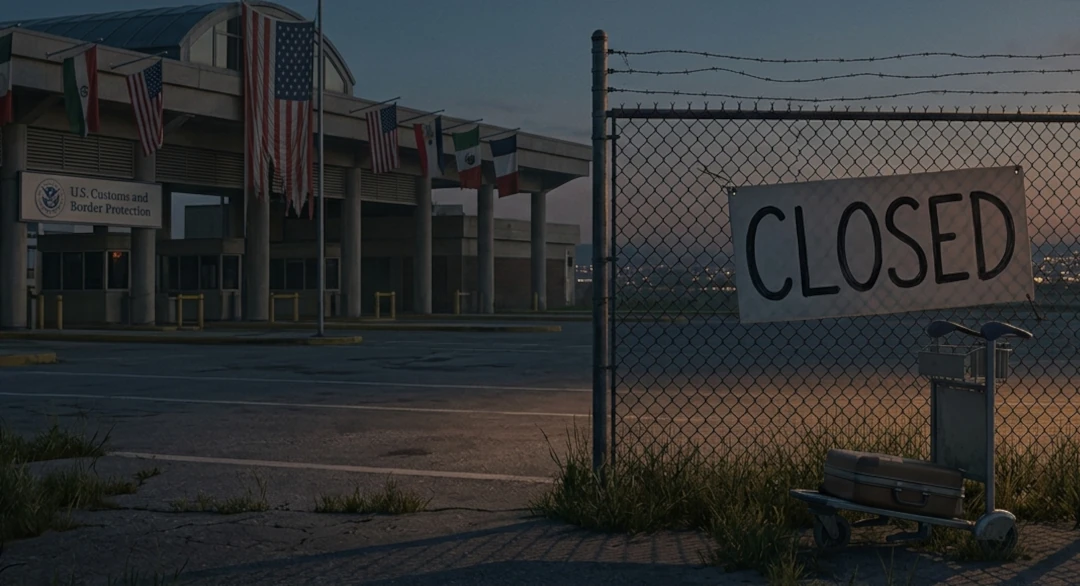
“While other nations are rolling out the welcome mat, the U.S. government is putting up the ‘closed’ sign.”
— Julia Simpson, President & CEO, World Travel & Tourism Council — May 2026
2. A Crisis Engineered in the Oval Office
The decline is not a mystery. It is the predictable consequence of a series of decisions made in the West Wing. The Trump administration has, in roughly eighteen months, imposed a sweeping new fee on tourist visas — now among the highest in the world — implemented partial or full travel bans against nationals of 19 countries, intensified searches of international visitors at airports, lengthened visa processing delays, and conducted aggressive immigration raids in tourism-heavy cities. Senator Ruben Gallego catalogued these policies in a November 2025 letter to the president and his Cabinet, warning that these measures jeopardize an industry that contributed $2.9 trillion in total economic output in 2024.
Then there are the words. Trump’s repeated suggestion that Canada become the 51st U.S. state, combined with his trade wars against America’s closest allies, has produced a backlash that travel economists are now treating as a structural factor rather than a passing storm. Adam Sacks, president of Tourism Economics, attributed the collapse in foreign bookings to “antipathy towards the US” — language a forecasting firm does not deploy lightly.
Even the libertarian Cato Institute has acknowledged what is happening. Speaking to Al Jazeera, Cato economist Ryan Bourne tied the decline to “the president’s trade wars and some of the fallout about fears about getting ensnared in immigration enforcement.” When ideological opponents of progressive politics independently confirm a progressive critique of presidential conduct, the question stops being partisan. It becomes empirical.
Get Involved Today
Contribute to our mission and turn your concerns into action.
3. Timeline of a Self-Inflicted Collapse
4. The Cost to Every American Kitchen Table
None of this stays abstract. A hotel housekeeper in Las Vegas working fewer shifts because international bookings have evaporated is paying the cost of these policies. A restaurant owner in Santa Monica losing the European tour groups that filled her tables in summer is paying it too. So is the cab driver in Times Square and the souvenir shop owner in Anaheim. The CNN analysis of the 2025 collapse identified Florida, Seattle, New York, Las Vegas, and Santa Monica as the cities most directly affected.
And the damage extends well beyond tourism. The nonpartisan Tax Foundation has documented that Trump’s tariffs amounted to an average tax increase of $1,000 per U.S. household in 2025, with projections that this will rise to $1,300 in 2026 if the policies remain in place. The Congressional Budget Office, in an analysis requested by Senate Budget Committee Chairman Sheldon Whitehouse, projected the combined cost of the tariff regime would shrink the U.S. economy by $165 billion over the next decade.
The Center for American Progress, in its February 2026 review of the administration’s economic record, found that electricity prices in 2025 rose at 2.5 times the annual inflation rate — the steepest annual increase since December 2014. Two-thirds of Americans reported being concerned about the impact of tariffs on their personal finances. Roughly seven in ten Americans predicted 2026 would be a year of economic difficulty. They were not being asked their views on tourism statistics. They were being asked about their own lives.
“The U.S. is definitely losing its crown. The sentiment drag has proven to be severe — bookings indicate the inbound slowdown will persist.”
— Adam Sacks, President, Tourism Economics — September 2025
5. The Vanishing of American Soft Power
Tourism is not merely an economic indicator. It is, as Joseph Nye argued for decades, the lived expression of a nation’s soft power — the everyday encounter that turns abstract admiration into concrete loyalty. The Brand Finance Global Soft Power Index 2026, released in January, recorded the United States as the steepest soft-power decliner among all 193 nations measured. The U.S. score fell 4.6 points; China now sits less than 1.5 points behind. Among the dimensions where the United States lost the most ground: friendliness, generosity, political stability, human rights, and ethical standards.
The geopolitical consequences are already arriving. The ISEAS 2026 regional survey, summarized in Asia Times, found that a majority of Southeast Asian respondents would now choose China over the United States if forced to align. Trump’s leadership was named the region’s top geopolitical concern. Richard Stengel, undersecretary of state for public diplomacy under President Obama, has compared the present moment to the contraction of post-war Britain — an empire, he said, shrinking into “Little America.”
This is the framework within which the tourism collapse must be understood. The closed sign on America’s front door is not just a sign to tourists. It is a signal to allies, to investors, to students choosing where to study, to scientists choosing where to research, and to companies choosing where to build their next factory. The question of whether China overtakes the United States in tourism in 2026 is, properly understood, a proxy for a much larger question: whether the United States retains the global stature it spent eight decades constructing.
6. A Constitutional Question Hidden Inside an Economic One
Every president makes policy mistakes. The 25th Amendment is not a remedy for bad policy. It is a remedy for the inability — physical, mental, or judgmental — to discharge the duties of the office. The question raised by the events of the past eighteen months is not whether Donald Trump’s tariff and immigration regime has been politically controversial. The question is whether the cumulative pattern of decisions reflects a presidency capable of meeting the constitutional standard of fitness for duty.
The Mechanism Congress Has Begun to Invoke
Section 4 of the 25th Amendment, ratified in 1967, permits the vice president and a majority of the Cabinet — or “such other body as Congress may by law provide” — to transmit a written declaration that the president is “unable to discharge the powers and duties of his office.” It is the only constitutional remedy for a sitting president whose incapacity is not the result of impeachable conduct but of the inability to perform the office itself.
The Legislative Action
On April 14, 2026, Rep. Jamie Raskin, ranking member of the House Judiciary Committee, introduced legislation to establish the “Commission on Presidential Capacity” — a 17-member panel of physicians, psychiatrists, and former senior officials authorized to conduct a medical evaluation of the president and report findings to Congress. The bill represents the first serious effort to operationalize the Amendment’s “such other body” provision since its ratification.
The Medical Voice
On April 30, 2026, Sens. Sheldon Whitehouse and Jack Reed entered into the Congressional Record a statement from 36 physicians — neurologists, psychiatrists, and cognitive specialists from Harvard, Tufts, Columbia, and George Washington University — formally raising concerns about the president’s capacity. A Reuters-Ipsos poll the same month found a majority of Americans, including 30 percent of Republicans, describing the president as having become erratic with age.
The Argument
Critics will say that economic policy disagreements do not rise to the constitutional standard. They are correct in narrow terms. But the pattern in question is broader than tariff policy: it is the simultaneous alienation of every major trading partner; the threats of military action against foreign leaders by social media post; the public insult of religious figures including the Pope; the dismantling of agencies whose work no successor administration could quickly reconstruct. Each individual decision can be defended as the choice of an elected official. The accumulation raises a separate question — whether the decision-making process itself remains intact.
The Practical Barriers
The political barriers are real. A Republican-controlled Congress will not advance the Raskin commission. Vice President Vance will not, on present evidence, initiate Section 4 proceedings. The Cabinet will not act. None of this is a refutation of the constitutional argument. The Framers wrote the 25th Amendment with the foreknowledge that political factions would attempt to obstruct it. They wrote it anyway, because they understood that the alternative — a head of state physically or mentally incapable of governing — was unacceptable to a constitutional republic.
Why It Still Matters
The point of raising Section 4 publicly, even when its political activation is unlikely, is to establish on the constitutional record that the question has been asked. As Raskin himself has put it, the present moment is a “matter of national security” — a phrase that, in his constitutional context, is a specific legal claim, not a rhetorical flourish.
7. What Comes Next
The 2026 FIFA World Cup will be co-hosted by the United States, Canada, and Mexico beginning this summer. The U.S. Travel Association has estimated the tournament could attract 1.24 million international visitors. That number now appears optimistic. Brand USA — the federally chartered tourism marketing entity — has launched what it has described as a campaign to “build traveler confidence,” largely an effort to clarify what the administration’s own policies are and are not, according to CNN’s reporting. That a federally chartered marketing agency must spend its budget reassuring foreigners about the policies of its own administration is, itself, a measure of how far things have come.
The choice, then, is not between accepting decline and reversing it. It is between confronting honestly what has happened — and continuing to pretend, against all available evidence, that nothing is wrong. The first step in confronting it is naming who is responsible. The second step is naming what the Constitution provides for situations in which the person responsible cannot or will not change course.
Editorial Conclusion
The United States did not lose the world’s largest tourism economy in a single year because the world stopped wanting to visit America. The world stopped feeling welcome here. That distinction is not cosmetic. It is the difference between a great power that has fallen on hard times and a great power that has chosen, through its own leader, to alienate the friends who made it great.
The tourism numbers, the soft-power index, the hospitality job losses, the household tariff costs, and the constitutional crisis are not separate stories. They are one story. They describe a presidency whose decisions are producing measurable, accelerating damage to the country it is supposed to lead — and a Congress that has finally begun to ask, in the words of its own constitutional duty, whether the man making those decisions is able to discharge them at all.
The 25th Amendment will not pass a Republican Congress. The question it raises will outlive this presidency anyway. That question is whether American democracy possesses the institutional courage to enforce its own Constitution when the cost of inaction can be measured in trillions of dollars, millions of jobs, and the diminished standing of every citizen who carries a U.S. passport abroad. America has had enough. The Constitution provides the answer. What remains is the will to use it.
Sources & References
- Bloomberg
China Set to Overtake US as World’s Largest Tourism Economy, WTTC Says - Connecting Travel
China projected to overtake US in tourism economy - FTN News
China Projected to Overtake US as the Number-One Global Tourism Economy - Foreign Policy
Donald Trump’s War on Tourism - CNN Travel
Tourism to the US dropped: The impact of how the world perceives America right now - Fortune
Tourism had a record-breaking 2025 everywhere but the U.S. - Reuters via Yahoo News
Foreign travel spending in US to decline 7% in 2025, report says - Gulf News
‘Antipathy’ to US: Tourists turning away from Trump’s America - Al JazeeraForeign tourism to the US drops amid Trump-era policies
- Morning Honey
Trump Blamed as U.S. Tourism Falls for First Time in 20 Years - U.S. Senate Joint Economic Committee — Minority
Under Trump, Declining Travel and Tourism is Hitting Local Economies (PDF) - Tax Foundation
Tracking the Economic Impact of the Trump Tariffs - Senate Budget Committee
Trump’s Tariffs Would Boost Inflation, Shrink the Economy, CBO Finds - Center for American Progress
A Year in Review: How Trump Administration’s Policies Made Life Less Affordable - Hotel Dive
How immigration policies are hurting the US hospitality industry - Skift
Largest U.S. Hotel Union Says Trump Actions Are Costing Jobs - Travel and Tour World
Immigration Crackdown of Trump Is Decimating U.S. Tourism and Jobs - Office of Senator Ruben Gallego
Letter to President Trump on Tourism Impacts (PDF, Nov. 2025) - Brand Finance
US Sees Steepest Decline in Global Soft Power Index 2026 - Asia Times
US isn’t losing soft power in SE Asia — it’s ceding it to China - FOX 26 Houston
25th Amendment: Raskin bill proposes new panel to declare presidential fitness - Deseret News
Democrats introduce Trump fitness bill - The Hill
Concerns Grow Over Trump’s Mental Fitness for Presidency - Media Matters for America
Fox stands behind Trump policies that are hurting America’s tourism industry
Related News