Chapter 12 farm bankruptcies surged 46% in 2025 — a third consecutive annual increase — with the Midwest leading the collapse at 70% higher than the year before. Behind the data is a deliberate policy landscape of tariff warfare, agency demolition, and willful neglect that reveals not a governing president, but a wrecking ball with a MAGA hat.
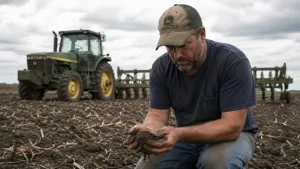
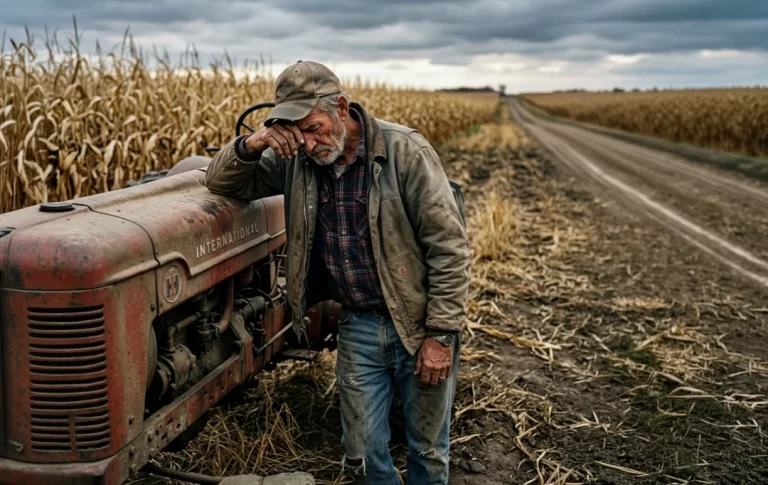
In the spring of 2026, as the planting season begins across the American heartland, the fields of Iowa, Wisconsin, Nebrasksadfsadasdasdasdaa, and Missouri tell a story that the White House refuses to speak plainly: the American family farm is in crisis, and the policies of the Trump administration lit the fuse. According to the American Farm Bureau Federation, 315 Chapter 12 farm bankruptcies were filed in calendar year 2025 — a 46% increase from 2024, the third consecutive year of rising filings, and the highest total since the pandemic years. In the Midwest alone — the backbone of American food production — filings jumped 70%, leaving a wake of shuttered operations, foreclosed equipment, and communities hollowed out one generation at a time.
This is not a natural disaster. It is not an act of God. It is the predictable and well-documented consequence of a governing philosophy that treats farmers as campaign props and their livelihoods as acceptable collateral in an ideological war against trade, regulation, expertise, and the very agencies designed to protect them. Understanding what has happened to American agriculture under Donald Trump’s second term is not merely an exercise in agricultural economics. It is a case study in the collapse of executive governance — and what it means when a president is incapable of the basic functions of leadership that his office demands.
1. The Numbers That Don’t Lie
The American Farm Bureau Federation’s February 2026 Market Intel report is as close to an alarm bell as the traditionally conservative agriculture establishment will ring. According to AFBF economist Samantha Ayoub, the 315 Chapter 12 filings in 2025 represent not just a statistic but the visible tip of a far larger iceberg. Chapter 12 is specifically designed for family farm businesses — it requires that the majority of household income comes from farming — which means that the tens of thousands of farm families who have taken off-farm jobs to stay afloat aren’t even counted in these numbers. When they go under, they often don’t file Chapter 12 at all. They simply close.
315 Chapter 12 farm bankruptcies filed in 2025 — up 46% from 216 in 2024, and the third straight annual increase, per the American Farm Bureau Federation.
The Midwest recorded 121 filings in 2025 — a 70% year-over-year increase. Iowa saw a 220% spike; Wisconsin a staggering 700%; Missouri up 167%; Minnesota up 300%.
Total U.S. farm debt is projected to hit a record $624.7 billion in 2026, with interest expenses expected to reach $33 billion — the highest level in modern agricultural history.
The average farm operating loan grew 30% in size in 2025, per the Federal Reserve Bank of Kansas City, as farmers borrowed simply to cover input costs — not to invest or grow.
The U.S. cattle herd stands at 86.2 million head — the lowest since 1951 — with meaningful herd recovery not feasible before 2028. Beef prices rose 16% in 2025 alone.
Arkansas led the nation with 33 Chapter 12 filings — the most in the state in the 21st century. Georgia filings rose 145%; Florida saw a 200% increase. Rice farmers lost over $200 per acre, even after aid.
2. How Trump Built This Crisis
The Trump administration’s defenders will point to its $12 billion farmer bridge payment program — announced in December 2025 — as evidence of presidential concern. But a coalition of 56 agriculture organizations told Congress in January 2026 that the aid “does not come close to offsetting agricultural losses over the past few years.” In plain terms: the administration is handing out bandages while operating the machine that keeps inflicting the wounds. The policy trail that produced this crisis is not ambiguous. It is documented, sequential, and damning.
“Our farmers and ranchers can compete with the world, but they can’t compete with the world with a chaotic set of policy circumstances.”
— Jon Doggett, former CEO, National Corn Growers Association — New York Times, 2026
3. The Tariff Trap: Paying Farmers to Undo What Tariffs Did
The internal logic of Trump’s agricultural policy is as contradictory as it is cruel. The administration imposed sweeping tariffs on steel, aluminum, and foreign goods — producing retaliatory duties from trading partners that devastated American agricultural exports. It then announced bailout packages totaling more than $30 billion in ad hoc assistance to partially compensate farmers for the market disruptions those very tariffs caused. The president has described this as a sign of his generosity. Economists and farmers call it what it is: a manufactured emergency followed by an insufficient rescue.
A January 2026 North Dakota State University Trade Monitor analysis found that tariffs on agriculture inputs — farm machinery, chemicals, fertilizers, and seeds — collected $958 million in revenue through October 2025. More than half of that came directly from farm machinery tariffs. This is money extracted from the very people Trump claims to be helping, funneled into the federal treasury rather than back to struggling farms. Meanwhile, American Farm Bureau President Zippy Duvall recalled a 2025 meeting with the president in which he told Trump that farmers preferred trade over tariffs. Trump’s response, according to Duvall: he needed tariffs to bring other nations to the negotiating table. “My comment to him was, ‘We pray to God that you’re right,'” Duvall said.
The prayer has not been answered. China, in retaliation for steep U.S. tariffs, sharply curbed its purchases of American soybeans — a market that once represented the cornerstone of Midwestern farm income. Cornell University estimated that in the first half of 2025, farm bankruptcies were running 60% higher than a year prior. Tariffs also drove up the cost of fertilizer, farm chemicals, and tractor parts — costs that farmers must absorb before they can sell a single bushel at whatever price a disrupted market will offer. Tractor maker John Deere warned shareholders that tariffs on steel and aluminum alone could cost the company $600 million in 2025, costs ultimately passed down the supply chain to farmers themselves.
4. Dismantling the Agency That Keeps Farms Alive
For decades, the U.S. Department of Agriculture has served as the institutional backbone of American agriculture — processing loans, administering disaster relief, conducting research, and providing the technical expertise that allows family farms to survive bad years. Under the Trump administration’s DOGE initiative, that backbone was systematically cracked.
More than 20,000 USDA employees departed between January and June 2025, representing a 27% reduction in the department’s workforce — nearly double the 12% average cut across the rest of the federal government. The Natural Resources Conservation Service, the Agricultural Research Service, and the Animal and Plant Health Inspection Service were among the hardest hit. The Forest Service, responsible for managing millions of acres that rural communities depend on, saw similar devastation.
Critically, the cuts did not target Washington bureaucrats, as the administration claimed. They targeted the people in the field. Kansas — a state that epitomizes the American farming identity — lost 32% of its USDA staff, more than 500 positions. Nick Levendofsky, executive director of the Kansas Farmers Union, described the practical consequence in terms any farmer would recognize: “If you don’t have the folks that are there to do the work that’s needed to be done — whether that’s paperwork or following up with farmers on a project that they are wanting to do — then where do those farmers go for those services?”
“Farmers are struggling because of the administration’s tariffs: lost export markets, higher input costs and uncertainty. We need to end the tariff chaos to keep family farms strong.”
— Senator Amy Klobuchar (D-MN) — Statement, February 2026
5. What This Means for the Average American
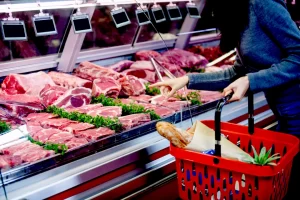
The farm crisis is not an abstract rural problem. It is a grocery store problem. It is a school lunch problem. It is a question of whether Americans — particularly those at the economic margins — will be able to afford the food that sustains their families.
Food inflation already ran at 3.1% in 2025, outpacing the overall Consumer Price Index of 2.7%, according to the Bureau of Labor Statistics. In 2025 alone, beef prices rose 16%, eggs climbed 26%, and coffee jumped 20%. In March 2026, food and beverage company inflation surged 7.9% year-over-year — the largest single-month jump in at least a year — and analysts warn the full impact of rising fertilizer costs has not yet reached store shelves.
Get Involved Today
Contribute to our mission and turn your concerns into action.
As tariffs pushed up the price of imported beef, fruits, vegetables, and coffee, the administration simultaneously cut SNAP benefits for an estimated 2.4 million Americans through the One Big Beautiful Bill Act, and discontinued the federal food security survey that tracked household hunger. In the same stroke, the government made food more expensive, made feeding programs less available, and eliminated the instrument that would document the resulting suffering. This is not incompetence. It is a policy choice — one that prioritizes the appearance of fiscal discipline over the physical wellbeing of vulnerable Americans.
The downstream effects extend far beyond individual households. When a farm fails, the rural ecosystem around it begins to collapse: feed suppliers, implement dealers, local banks, grain elevators, and ultimately the schools and churches of small towns all feel the contraction. Younger farmers — who enter the industry with higher debt loads and fewer safety nets — are particularly vulnerable, with USDA data showing roughly three percent of producers under 40 experiencing extreme financial stress, triple the overall rate. The generation that would carry American agriculture forward is being priced out of it before they can begin.
When Policy Becomes Incapacity: The Constitutional Case for Executive Accountability
The Twenty-Fifth Amendment to the Constitution, ratified in 1967, provides the mechanisms by which the executive branch can address a president who is unable to discharge the powers and duties of his office. Section 4 — the most consequential provision — allows the Vice President and a majority of the Cabinet to transmit a written declaration to congressional leadership that the President is unable to fulfill his duties, triggering an immediate transfer of authority to the Vice President as Acting President.
The mechanism was designed for physical incapacitation. But legal scholars — including Yale constitutional law professor Akhil Reed Amar and former federal judge J. Michael Luttig, who has warned publicly about the constitutional crisis Trump represents — have noted that the amendment’s language does not exclude governing incapacity rooted in cognitive impairment, psychological unsuitability, or the willful disregard of basic executive responsibility. When a president systematically dismantles the agencies responsible for protecting the food supply, wages trade war against the farmers whose votes delivered his electoral coalition, cuts food assistance for vulnerable Americans, and then suppresses the data that would document the consequences, the question of whether he is “able to discharge the powers and duties of his office” — or merely unwilling to discharge them responsibly — is not merely rhetorical.
Several Democratic lawmakers have raised the question directly. Senator Jamie Raskin (D-MD), a constitutional scholar, has stated that the administration’s pattern of policy incoherence, institutional demolition, and factual denial warrants a serious examination of executive fitness. Representative Alexandria Ocasio-Cortez (D-NY) has been among those calling for formal congressional inquiry into whether the executive branch retains the functional capacity to govern. These are not frivolous political attacks. They are questions rooted in observable governance failure.
The practical barriers are substantial. Section 4 requires Vice President JD Vance to lead the Cabinet declaration — an act of political self-immolation that no member of this administration appears willing to perform. Congressional Republicans, who hold majorities in both chambers, have shown no appetite for accountability, preferring to protect their legislative agenda over the welfare of the rural constituents whose farms are failing. A two-thirds majority of both houses of Congress would be required to override a presidential contestation.
But constitutional mechanisms exist precisely because their necessity was anticipated. The Framers understood that the republic could not survive a president for whom governing was secondary to performance — who would rather hold a rally than read a briefing, rather escalate a trade war than read the agricultural devastation it produced. The Twenty-Fifth Amendment does not require unanimity of political will to be relevant. It requires that the American people — and their elected representatives — reckon honestly with what they are witnessing: a president whose policy decisions are producing documented, measurable, generational harm to the people he swore to protect, and who shows no evidence of understanding, caring, or correcting course. The constitutional case for accountability does not depend on invoking the 25th Amendment. But the 25th Amendment exists because cases like this one were exactly what the Founders feared.
6. A Presidency of Priorities Laid Bare
It is worth pausing to absorb what this administration has chosen to do and chosen not to do, in sequence, in the agricultural domain alone. It has imposed tariffs that devastated export markets, then offered bailouts insufficient to cover the losses. It has dismantled the federal workforce responsible for supporting farms in crisis, then blamed the resulting failures on the previous administration. It has cut nutrition programs for food-insecure Americans, eliminated the survey that would measure the impact of those cuts, and raised income limits on conservation programs so that large agricultural corporations receive funding designed for family farms. It has presided over a 46% single-year jump in farm bankruptcies and responded, in the words of a USDA spokesperson, by insisting that this is agriculture’s “golden age.”
This is not a governing agenda. It is the performance of governing — the theatrical assertion of strength while the actual machinery of rural American life seizes and fails. The February 2026 bipartisan letter from former USDA officials and farm group leaders — signatories who have spent their careers in agriculture and who are not, by any measure, progressive activists — was unambiguous in its conclusion: “The policies of this Administration have caused tremendous harm to U.S. Agriculture.” They warned of “widespread collapse.” They called for Congress to act.
Congress has not acted. The administration has not changed course. And as Farm Aid’s ongoing 2026 tracker documents, with fertilizer costs spiking due to the Iran conflict’s disruption of the Strait of Hormuz, with farm income forecast to decline for a fourth consecutive year, and with record debt loads stretching toward a horizon that shows no relief, the trajectory is not toward recovery. It is toward a crisis that the administration has chosen, repeatedly and deliberately, not to prevent.
Editorial Conclusion
The collapse of American farm solvency is not a weather event. It is a policy event. Tariff warfare destroyed export markets. DOGE gutted the USDA. Immigration enforcement stripped the farm labor force. Conservation funds were redirected to corporate operations. Food security data was suppressed. And at every juncture, the farmers who supported this president at the ballot box — counties that voted for Trump by an average margin of 77 points — were told that everything was fine, that the golden age had arrived, that help was coming. The help has not come. The golden age is 315 bankruptcy filings and a cattle herd not seen since 1951. What is required now is not more bridge payments from an administration that built the chasm. What is required is accountability: from Congress, from the courts, and ultimately from the American electorate that must reckon with what it means when the leader of a nation this powerful chooses, in full view of the evidence, not to lead.
Sources & References
- American Farm Bureau Federation — “Farm Bankruptcies Continued to Climb in 2025” (Feb. 9, 2026)
- Investigate Midwest — “Farm Bankruptcies Jumped 46% in 2025 as Debt Loads and Costs Rise” (Feb. 25, 2026)
- Farm Aid — “Tracking the Farm Economy in Crisis” (Updated April 2026)
- Farm Policy News (U of Illinois) — “U.S. Farm Bankruptcies Increased 46% in 2025” (Feb. 10, 2026)
- Farm Progress — “Farm Leaders Warn Congress of Agriculture Crisis” (Feb. 4, 2026)
- Farm Progress — “Trump’s Tariffs Generate $958M but Cost Farmers Far More” (Jan. 22, 2026)
- KCUR (NPR) — “USDA Lost 24,000 Workers Under Trump, Hurting Critical Resources for Farmers” (Feb. 24, 2026)
- Wisconsin Public Radio — “USDA Lost 24K Workers Under Trump, Hurting Critical Resources for Farmers” (Mar. 11, 2026)
- Tennessee Lookout — “Billions of Dollars at Stake for Farmers Hit by Trump Funding Freeze” (Feb. 19, 2025)
- Al Jazeera — “Trump’s $12bn Aid Package: Are Tariffs Bleeding US Farmers?” (Dec. 10, 2025)
- Center for American Progress — “Stopping Sticker Shock at the Grocery Store” (Feb. 19, 2026)
- Yahoo Finance / MoneyWise — “US Agriculture Leaders Warn of ‘Widespread Collapse’ Due to Economic Policies” (Feb. 24, 2026)
- BeInCrypto — “Why Americans Are Likely to Face Higher Grocery Bills in 2026” (Apr. 26, 2026)
- Adams and Reese — “Rising Farm Distress: Agriculture Bankruptcies 2026–2027” (Mar. 31, 2026)
- Inside Climate News — “Under Trump, the Department of Agriculture Has Ditched Conservation and Climate Efforts” (Apr. 8, 2026)
- Contrarian Unicus — “How the 2025 Farm Bankruptcy Cycle Hits the U.S. Food Supply and Prices” (Apr. 2026)
- Farm Aid — “The Latest Updates on the Farm Bill” (Updated May 2026)
- AGDAILY — “Farm Bureau Data Shows Farm Bankruptcies Jumped 46% in 2025” (Feb. 27, 2026)
Related News