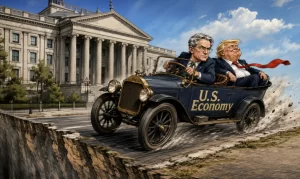
The Beijing Bargain: A President Out of His Depth, A Country Out of Its Lane
Twelve billionaires went to China. The American people got a Boeing order and a humiliation. What Trump’s summit with Xi Jinping revealed about the priorities of this administration — and why constitutional alarms are ringing louder than ever.
For two days in the middle of May, the most senior officials of two of the world’s largest economies sat across from each other in the Great Hall of the People in Beijing. On one side of the table, China sent the architects of its statecraft — Xi Jinping flanked by Politburo Standing Committee member Cai Qi, Vice Premier He Lifeng, Commerce Minister Wang Wentao, and a phalanx of trade and economic specialists whose careers have been built around managing the U.S. relationship. On the American side, behind President Trump, sat Secretary of State Marco Rubio, Treasury Secretary Scott Bessent, Defense Secretary Pete Hegseth, senior adviser Stephen Miller — and, conspicuously, more than a dozen of the wealthiest men and women in the United States. Apple’s outgoing chief Tim Cook. Tesla and SpaceX’s Elon Musk. Nvidia’s Jensen Huang. BlackRock’s Larry Fink. Blackstone’s Stephen Schwarzman. Goldman Sachs’ David Solomon. Citigroup’s Jane Fraser. Boeing’s Kelly Ortberg. According to Fox News’ own reporting, several of the executives traveling with the president rank among the wealthiest people on Earth.
This is the central, undeniable fact of the Beijing summit, and everything else flows from it: the United States went into the most consequential geopolitical conversation of the year not as a nation, but as a holding company. The president himself underscored the point. He described the executives traveling with him as “brilliant people” who could “work their magic.” He pulled Jensen Huang onto Air Force One at the last minute, after media noted Huang’s name had been left off the original invite list. The signal to Beijing was unmistakable. Xi got the message and pocketed it.
1. The Verified Record: What Actually Happened, Versus What Was Sold
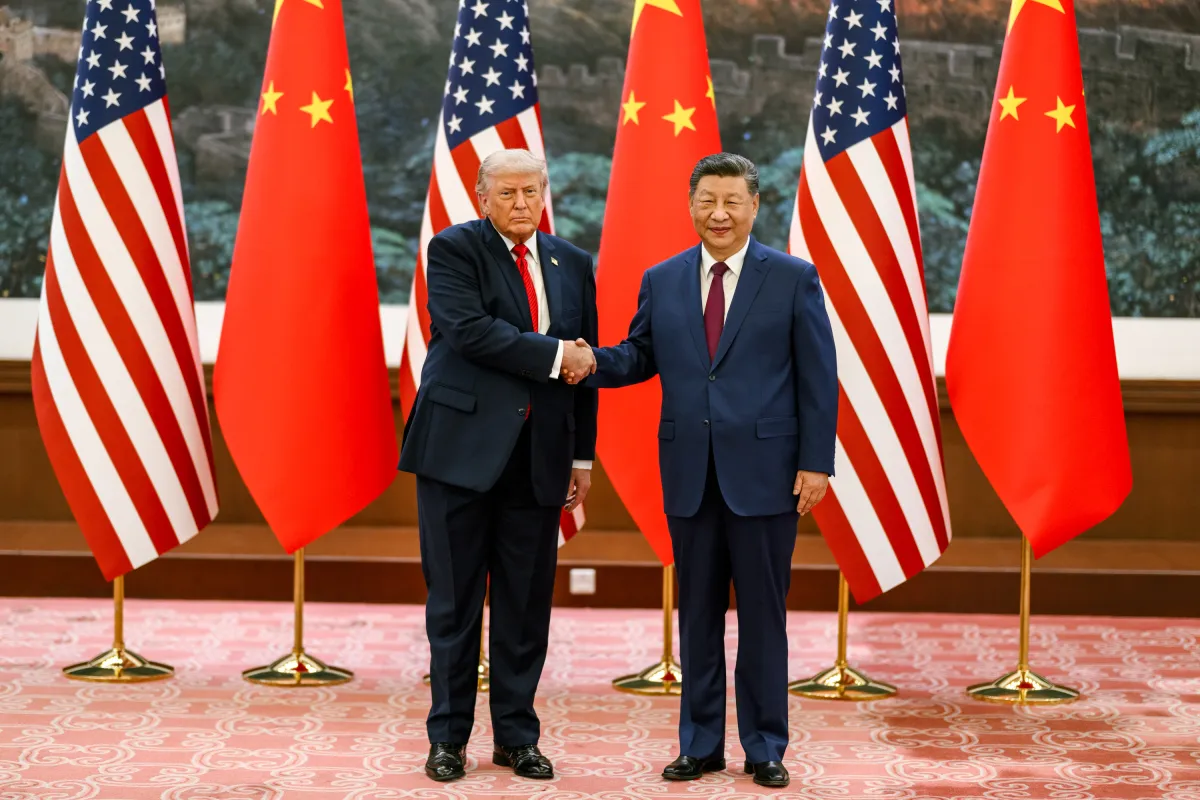
Strip away the choreography — the red carpet at Beijing Capital International Airport, the children chanting in Mandarin, the state banquet, the Ming Dynasty Temple of Heaven photo backdrop — and the verified deliverables of this summit are remarkably thin. After two days, twenty-one hours of meetings, and a delegation that could have bought a small country, here is the publicly confirmed scorecard.
One Boeing Order — At Less Than Half the Promised Size
China agreed to purchase 200 Boeing jets. Trump had publicly floated 500. Boeing shares fell 4% on Wall Street after the announcement, per Euronews reporting.
Trump Declined to Defend U.S. Policy in the Room
Xi warned of “clashes and even conflicts.” Trump responded with “China is beautiful,” per TIME’s account. Rubio scrambled afterward to insist policy was unchanged.
A One-Sided Claim About Military Aid
Trump told Fox News that Xi pledged not to arm Iran and would help reopen the Strait of Hormuz. Beijing’s readout, per NBC News, did not corroborate that pledge.
No Joint Statement. No Communiqué.
The summit produced no formal joint document. CBS News noted Trump praised “fantastic trade deals” but no major agreements were announced before he left Beijing.
That is the entire ledger. Compare it to what was promised. In the days before departure, the White House briefed reporters that the summit would produce breakthroughs on rare-earth minerals, advanced semiconductor exports, agricultural purchases, fentanyl, and Iran. In the event, the leaders agreed to keep the existing fragile trade truce — itself a downgrade from the October 2025 Busan meeting, which had at least produced a one-year rare-earth supply commitment and tariff rollback. Almost everything else was, in the analysis of Council on Foreign Relations senior fellow Zongyuan Zoe Liu, simply the fact that the meeting took place. The summit itself was the achievement. For Xi.
This is what the official record shows. The rhetoric coming from the White House — “tremendous progress,” “fantastic,” “many, many things accomplished” — is, in measurable terms, untethered from what occurred in the room.
“The behavior of Donald Trump is more extreme than any African dictator.”
— African Diplomat, Quoted by Howard W. French · Foreign Policy · May 13, 2026
2. The Delegation: When the President Brings Customers Instead of Counselors
The composition of an American delegation is itself a foreign policy statement. Past presidents — Republican and Democratic — have traveled to Beijing flanked by assistant secretaries of state for East Asia, regional specialists at the National Security Council, career diplomats with decades of language and cultural expertise, and a handful of business representatives whose role was strictly advisory. Trump inverted that structure. According to the Al Jazeera roster, his delegation was largely composed of executives whose companies depend on Chinese supply chains, Chinese consumers, or — in Nvidia’s case — Chinese regulatory approval to sell semiconductors.
Every one of those executives walked into the Great Hall of the People with personal financial exposure to the outcome of the negotiations. Tesla operates its largest export hub in Shanghai. Apple manufactures roughly 80 percent of the iPhones it sells in the U.S. in Chinese factories, according to Reuters figures cited by Al Jazeera. Nvidia has spent years lobbying to be allowed to sell its more advanced AI chips in China. Boeing has been chasing a major Chinese order since its last big sale during Trump’s 2017 trip. BlackRock manages billions in assets that depend on Chinese market stability.
These are the people who advised the president on what to ask for. They are also the people who stood to gain from what he asked for. Steve Tsang, director of the SOAS China Institute at the University of London, told Newsweek the executives’ presence reflected Trump’s prioritization of business deals — but that he doubted their presence would shift the structural issues holding the U.S.-China relationship back. He was right. The structural issues — Taiwan, semiconductor controls, human rights, fentanyl, the militarization of the South China Sea — were either dodged, deferred, or barely raised. The deals that were chased were the ones the executives wanted.
That is not a foreign policy. That is a sales call. And the criticism is not coming only from the left. Even Steve Bannon, the architect of Trump’s original America First agenda, called the delegation a “mercantilist class” tying American economic power to a regime openly challenging U.S. supremacy. When Bannon and Senate Democratic Leader Chuck Schumer arrive at the same diagnosis, the diagnosis is the disease.
The contrast on the Chinese side was stark. As Newsweek noted, Xi was surrounded by his most senior policy hands — the people who actually run the trade, technology, and diplomatic portfolios of the Chinese state. The seating itself was a tell. To Xi’s immediate right was Cai Qi, the gatekeeper of the Chinese leadership. To Trump’s immediate right was a secretary of state who, in a previous life as a Florida senator, was sanctioned by Beijing for his criticism of the Hong Kong crackdown. The Chinese came prepared to govern. The Americans came prepared to invoice.
3. The Global Reading: How the World Saw the Summit
The summit’s most damaging consequence is not in any agreement or its absence. It is in the optics, and optics in diplomacy are not cosmetic — they are leverage. The image that has crystallized around the world is of a president who, when asked by reporters outside the Temple of Heaven whether he had discussed Taiwan with Xi, replied: “China is beautiful.” TIME magazine called the moment a stark illustration of the shifting balance of global power. Sung Wen-ti, the Taiwan scholar quoted in the piece, said Xi felt licensed to issue discordant warnings without fear of blowback. That license was granted by the American president’s posture.
The reading from Europe was no kinder. Within hours of the summit’s conclusion, China’s foreign ministry issued a pointed statement that the U.S.-Israeli war with Iran “should never have happened” and “has no need to continue” — a public rebuke of American foreign policy delivered to a global audience while the American president was still on Chinese soil. Germany’s Chancellor Friedrich Merz had already remarked the United States was “humiliated” in Iran; Trump retaliated by pulling 5,000 troops out of Germany, TIME reported. The pattern, visible from every capital, is of a superpower whose responses to friction are now personal rather than strategic.
The most candid summary came from Howard W. French in Foreign Policy, who recorded an African diplomat’s verdict at a recent New York dinner. The pull quote above captures the diplomat’s full assessment. It is the kind of thing American officials used to overhear about other governments. It is now overheard about ours.
The Washington Post’s diplomatic correspondents put it more clinically in a Saturday assessment: the war with Iran and economic strain at home are now actively constraining the president’s ability to negotiate abroad. He arrived in Beijing with what Reuters analysts described as a weakened hand — courts limiting his tariff authority, inflation rising from the Iran conflict, Republican losses looming in November. The Chinese delegation knew it. The American delegation knew it. The summit was the proof.
Get Involved Today
Contribute to our mission and turn your concerns into action.
4. The Cost at Home: What This Means for the Average American
Translated out of the language of grand strategy, here is what the Beijing summit means for a household in Ohio, in Iowa, in upstate New York. Tariffs on Chinese imports remained at an average rate of roughly 31.6 percent in early 2026, according to the Penn Wharton Budget Model figures published by U.S. News. Tariffs are taxes paid by the American importer and passed to the American consumer. The Beijing summit did not produce a meaningful reduction in those tariffs. The cost of consumer electronics, clothing, household goods, and components for American manufacturers remains elevated. That is a regressive tax — it falls hardest on working families and retirees on fixed incomes.
For American farmers, the picture is worse. CSIS analysis showed that U.S. agricultural exports to China dropped by more than 50 percent under the Trump tariff regime, and the soybean purchase commitments Beijing made under the October 2025 truce have not been fully delivered, with Chinese importers facing the awkward fact that U.S. soybeans have grown more expensive than Brazilian alternatives. The Senate Democrats’ joint statement on the summit, signed by Senators Chuck Schumer, Dick Durbin, Jack Reed, Jeanne Shaheen, Mark Warner, Chris Coons, Brian Schatz, Elizabeth Warren, and Andy Kim, noted the drop in agricultural exports directly. The statement, published by Senate Democratic Leadership, characterized the administration’s China policy as squeezing farmers, weakening alliances, and failing to stop the flow of fentanyl.
For workers in semiconductor-adjacent industries, the calculation is different but no less troubling. The administration’s willingness to allow Nvidia to sell its H200 chips to Chinese firms — a concession reportedly under consideration during the summit, per Reuters reporting cited by Fox News — represents a reversal of the bipartisan consensus that advanced AI chips should not be exported to Chinese firms that may share them with the Chinese military. The Senate Foreign Relations Democrats, in their post-summit statement led by Ranking Member Jeanne Shaheen and joined by Senators Chris Coons, Chris Murphy, Tim Kaine, Jeff Merkley, Cory Booker, Brian Schatz, Chris Van Hollen, Tammy Duckworth, and Jacky Rosen, called for stricter export control enforcement, not weaker.
And for the 23.5 million Americans of Taiwanese ancestry, business interests, or family ties — and the global community that depends on the chip supply chain Taiwan dominates — the president’s refusal to defend American policy on Taiwan in front of Xi is a structural betrayal. The $14 billion arms package Congress pre-approved in January 2026 still sits unsigned. Whether Trump approves it now will signal whether his deference in Beijing extends back into formal policy.
A Chronology of the Damage
“The Trump Administration’s China policy has been one failure after another for American taxpayers and U.S. national security.”
The Trump Administration’s China policy has been one failure after another for American taxpayers and U.S. national security.
5. The Pattern: What This Tells Us About Priorities and Leadership
It is a serious thing to say that the priorities of a presidential administration have shifted away from the constitutional duty of the office and toward private benefit. The Beijing summit is, by itself, not proof of such a shift — but it is the most public confirmation yet of a pattern that has been building for the entire second term. The pattern is this: when the interests of the American people and the interests of the wealthiest Americans diverge, this administration acts on behalf of the latter. The trip to Beijing made the pattern clear.
Consider the simplest test. Whose deals got chased in the summit? Not the wheat and soybean farmer in Iowa, whose export market has collapsed. Not the small manufacturer in Pennsylvania paying more for Chinese inputs because of the tariff regime. Not the union electrician in Michigan whose pension fund is exposed to a slowing Chinese economy. The deals that got chased were Nvidia’s AI chip licenses, Boeing’s aircraft order, Apple’s manufacturing arrangements, and Tesla’s Shanghai Gigafactory. There is nothing wrong with American companies wanting Chinese market access. There is something profoundly wrong when their wants set the foreign policy agenda of the United States, displacing the interests of every American who is not in the room.
This is the structural critique of the second Trump administration that progressive analysts have been making for over a year, and that the Beijing summit illuminated with unusual clarity. As Michael Tomasky observed in The New Republic, just 300 billionaires and their families accounted for 19 percent of all federal campaign contributions in 2024 — more than $3 billion. The Beijing delegation was not a coincidence. It was a return on investment.
The 25th Amendment Question Is No Longer Theoretical
The Twenty-Fifth Amendment, ratified in 1967 in the wake of the Kennedy assassination, exists precisely for moments when the country must decide whether the president can continue to discharge the duties of the office. Section 4 of the amendment provides that whenever the Vice President and a majority of the principal officers of the executive departments — or “such other body as Congress may by law provide” — transmit to Congress a written declaration that the president is unable to discharge the powers and duties of his office, those powers transfer to the Vice President as Acting President.
The Beijing summit is not, by itself, evidence of incapacity. Presidents can have bad summits. They can return home empty-handed. They can be outplayed by more prepared counterparts. None of that, in isolation, is constitutionally disqualifying. What is constitutionally significant is the pattern: a chief executive who cannot or will not defend American policy commitments under direct foreign pressure, who substitutes a delegation of personal financial allies for the career professionals who staff a state visit, and who repeatedly issues public statements that allies and adversaries alike describe as incoherent.
Who is making the constitutional case
Representative Jamie Raskin, the ranking Democrat on the House Judiciary Committee, has been the most systematic voice on this question. On April 10, 2026, he formally wrote to White House Physician Captain Sean Barbabella demanding a comprehensive cognitive and neurological evaluation of the president, with full public disclosure. Four days later, on April 14, Raskin introduced legislation with 50 Democratic co-sponsors to establish a Commission on Presidential Capacity to Discharge the Powers and Duties of Office — a 17-member body that would constitute the “other body” the amendment explicitly allows Congress to designate.
Beyond Raskin, Illinois Governor J.B. Pritzker has publicly questioned Trump’s cognitive state. Representative Maxine Waters called for invoking the amendment over the president’s recent conduct. The International Bar Association published a comment-and-analysis piece noting that the debate “underscores the fragility of America’s constitutional safeguards of presidential competence and the depth of unease about President Trump’s capacity to govern.”
The argument, plainly stated
The constitutional argument is not a partisan one. It is that the office of the presidency is a fiduciary office — the president holds power in trust for the American people — and that when the holder of that office demonstrates a sustained pattern of conduct inconsistent with the discharge of its duties, the Constitution itself provides a remedy. The Beijing summit is one data point among many: erratic public statements about an ongoing war, the deferral of constitutional foreign policy to a delegation of executives with personal financial stakes, and the president’s apparent inability or unwillingness to publicly defend long-standing American commitments under direct foreign challenge.
The honest barriers
The political path to invocation is, at present, foreclosed. Section 4 requires the Vice President and a majority of the Cabinet — and Vice President JD Vance and the current Cabinet are not going to invoke it. The Raskin commission bill is unlikely to receive a vote in a Republican-controlled House. The Senate would not convict on impeachment. These are real, honest barriers, and we will not pretend they do not exist.
But the moral and constitutional case does not depend on the political path being open today. The case depends on the duty of public officials and the press to name what they see. Section 4 was placed in the Constitution because the framers of the amendment knew that history would deliver moments when the office’s occupant could not discharge its duties, and that the country would need a process to acknowledge that fact. The case for transparency — for the president’s medical records, for a cognitive evaluation conducted by physicians answerable to Congress, for the public disclosure of those findings — does not require 51 senators. It requires moral seriousness. The Beijing summit made that seriousness more urgent, not less.
Editorial Conclusion
The Beijing summit was not a diplomatic event. It was a sales convention with a foreign policy backdrop, and the American president was its closer. The deliverables flowed to the executives in the room. The costs flow to the families who were not.
The deeper damage is not in any single deal or its absence. It is in what the summit revealed about who this administration serves and what it is now capable of defending under pressure. A president who answers “China is beautiful” when asked about Taiwan, who substitutes billionaires for diplomats, and who returns home claiming victories his own scoreboard does not support is a president whose fitness for the office is a legitimate matter of public inquiry.
The Twenty-Fifth Amendment exists for a reason. The path to invocation may be politically closed today. The constitutional question is not. The country is owed the truth — about the president’s capacity, about whose interests are being defended in its name, and about what it will take to restore a foreign policy that belongs to the American people rather than to the dozen wealthiest of them. That is the bottom line. That is what is required.
Sources & References
- Newsweek — Who Attended Trump-Xi Meeting, and Why It Matters
- CNBC — In Photos: Trump Kicks Off High-Stakes Summit With Xi
- CNN Politics — Trump Arrives in China for Summit With Xi Jinping
- CBS News — Trump Touts “Fantastic Trade Deals” With Xi as Nations Try to Stabilize Relationship
- NBC News — Trump Returns to Washington After Leaving Beijing Summit With Few Clear Wins
- TIME — Trump’s China Trip Underscores How Power Has Shifted East
- Foreign Policy — Both China and the U.S. Overestimate Themselves on the Global Stage
- Washington Post — The China Summit Showed How Trump’s Problems Hobble His Diplomacy
- Al Jazeera — Who Are the U.S. CEOs in China With Trump, and What’s in It for Them?
- Euronews — Underwhelming Summit Outcome in China Brings Trump Back to Reality
- The Hill — Trump Talks Trade With China, Xi Presses on Taiwan
- Fast Company — Why Nvidia’s Jensen Huang Joined Trump’s China Summit in the End
- Fox News — China Cozies Up as Trump Touts Delegation of Richest Business Heavyweights at Xi Summit
- Senate Democratic Leadership — Joint Statement on Trump’s China Policy Ahead of His Summit With President Xi
- Senate Foreign Relations Committee — Senate Foreign Relations Democrats Statement on Trump-Xi Summit
- House Judiciary Democrats — Raskin Demands White House Physician Immediately Evaluate Trump’s Cognitive Fitness
- Axios — Raskin Demands Trump Cognitive Test in 25th Amendment Push
- CSIS — How Might the Trump-Xi Summit Impact U.S. Farmers?
- U.S. News & World Report — Trump-Xi Summit Key for Both Geopolitics, Consumer Pricing
- International Bar Association — President Trump and the 25th Amendment: Comment and Analysis
- The New Republic — How Do We Know the China Summit Was a Failure? Because Trump Did It.
- CNBC — Nvidia’s Jensen Huang on China Trip: “President Trump Asked Me to Come”
- Newsweek — Steve Bannon, MAGA Response to China Summit Reveals Cracks in Trump Base
Related News