Trump’s Shadow Army: How a Presidency Built a Force of Its Own
The administration has never used the word “paramilitary.” It hasn’t had to. A $170 billion enforcement surge, masked agents in unmarked vehicles, repeated federalizations of the National Guard, threats to invoke the Insurrection Act — and now a $1.776 billion taxpayer-funded compensation pool that the police officers who defended the Capitol on January 6 are formally calling a slush fund for paramilitary groups — have done the work. Civil liberties lawyers, federal judges, historians, and members of Congress are finally saying what the architecture itself plainly is.
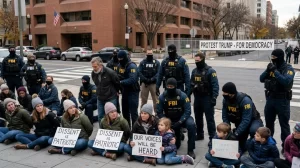
The president of the United States does not call it a paramilitary force. He calls it law enforcement. He calls it border security. He calls it, on a good day, “the toughest people you’ve ever seen.” But strip away the branding and look at what has actually been built over the past sixteen months, and the picture is harder to dismiss. An Immigration and Customs Enforcement agency now funded at a level that exceeds the combined budgets of every state and local police agency in the country. Agents in tactical gear and balaclavas, or ski masks, pulling people from cars and sidewalks. National Guard units federalized over the objection of state governors. A president who, when blocked by the courts, openly muses about invoking the Insurrection Act. The administration may refuse the label. The architecture refuses to lie.
Civil liberties organizations have stopped hedging. Historians of authoritarianism have stopped hedging. Federal judges, in the rare moments they break from their characteristic restraint, have stopped hedging. What follows is a documentary case for why a growing chorus of constitutional scholars, lawmakers, and judges now believe the executive has assembled something that, in any other country, observers would not hesitate to name.
1. The $170 Billion Question
The fiscal scaffolding for the force in question was poured in a single piece of legislation. The 2025 reconciliation bill — the administration’s so-called “One Big Beautiful Bill” — directed over $170 billion across four years to border and interior immigration enforcement. The Brennan Center for Justice has called what the bill funds a “deportation-industrial complex.” The National Immigration Law Center notes that on top of this, Congress is being asked for hundreds of millions more in new ICE appropriations.
The numbers are not abstract. ICE’s annual budget is now roughly four times what it was the day Donald Trump returned to office. The agency has been authorized to hire 10,000 new deportation officers and to build out detention capacity to nearly 100,000 beds. As Brookings researchers have documented in their analysis of ICE accountability, this expansion has been paired with sharply reduced training requirements for new recruits — a combination that places thousands of armed federal agents on American streets with thinner preparation than most municipal police forces require of their officers.
The question of why a domestic immigration agency needs the budget of a mid-sized national military has not been satisfactorily answered by the White House. The question of who, exactly, this force is being designed to confront has been answered — by the administration’s own actions — far more clearly than any spokesperson would like.
2. Masks, Unmarked Cars, and the End of Accountability
A police force in a democracy identifies itself. That is not a stylistic preference; it is the precondition of accountability. The current administration’s enforcement apparatus, by deliberate policy, does the opposite. Across more than a dozen U.S. cities, ICE agents have been documented operating in masks, in tactical body armor, in unmarked vehicles without license plates, and without identifying badges or insignia. The New York City Bar Association formally objected to the practice, warning that it severs the link between state action and the citizens whose rights state action must respect.
In February 2026, U.S. District Judge Joseph E. Goodwin, sitting in the Southern District of West Virginia, became the first federal jurist to put the constitutional problem on the record in plain language. Ruling on the case of Anderson Jesus Urquilla-Ramos — a man pulled from his car by masked agents who never identified themselves — Goodwin found that the manner of the arrest violated both the Fourth and Fifth Amendments. He described the practice as a “regime of secret policing” and observed that masked agents in unmarked vehicles were, in his words, indistinguishable from lawbreakers. His ruling drew an explicit comparison to the historical use of facial concealment by the Ku Klux Klan.
That is a federal judge. That is the language of the federal bench in the United States in 2026.
“ICE, Trump’s domestic army, is now attempting to occupy Minneapolis. This is a Trump authoritarian power grab — an open attempt to suppress dissent.”
— Sen. Bernie Sanders, January 2026, on the killing of Renée Good
3. The National Guard Goes Federal
The second leg of the apparatus is the repeated federalization of state National Guard units against the explicit objection of state leadership. Beginning in June 2025, the administration invoked 10 U.S.C. § 12406 — a rarely-used statute Congress wrote for invasions and rebellions — to seize control of the California National Guard and deploy it onto the streets of Los Angeles. Similar attempts followed in Oregon and Illinois. In each case, the relevant governor had not requested federal troops. In each case, the deployment was, in the unambiguous assessment of the American Civil Liberties Union’s National Security Project director Hina Shamsi, “an intolerable threat to our liberties.”
The courts have, so far, agreed. In August 2025, a federal district court in California found that the deployments violated the Posse Comitatus Act — the foundational American statute that bars the military from acting as a domestic police force. In December 2025, the U.S. Supreme Court itself, hardly a body friendly to constraints on this administration, ruled in Trump v. Illinois that the administration’s attempt to deploy the National Guard to Chicago was unlawful. California Attorney General Rob Bonta announced shortly afterward that the administration had withdrawn its legal effort to keep the California Guard federalized, and command returned to the governor.
The pattern is what matters. Critics of the administration’s strategy quoted by The Hill have described the deployments as the use of the National Guard as a “private army” to punish jurisdictions whose politics the president dislikes. Three courts and the Supreme Court itself have, in effect, said the same thing in legal terms.
4. What the Public Has Already Seen
The pattern is not theoretical. It can be measured.
Federal immigration agents have been involved in at least 17 documented open-fire incidents since July 2025, per data compiled by The Trace and reported across state news outlets.
Renée Good and Alex Pretti, both American citizens, were shot to death by ICE agents in Minneapolis within seventeen days of one another, according to Brookings.
ProPublica has documented more than 50 ICE arrests since 2025 involving smashed car windows or masked agents in unmarked vehicles — compared with eight such cases in the entire preceding decade.
One in three of California’s active National Guard members were federalized and reassigned to a civilian law enforcement role in June 2025 — an action a federal court ruled violated the Posse Comitatus Act.
The cases are not statistical artifacts. They are people. Renée Good was thirty-seven years old and the mother of three children. Alex Pretti was an intensive care nurse. The Hennepin County Medical Examiner ruled Good’s death a homicide. The U.S. Attorney’s Office then asserted exclusive federal jurisdiction and prevented Minnesota state officials from obtaining the underlying investigative evidence — itself a remarkable inversion of how federalism is supposed to work in cases involving the death of an American citizen at the hands of a federal officer.
5. The $1.776 Billion Slush Fund
On May 18, 2026 — three days before this publication went to press — the Department of Justice announced the creation of a $1.776 billion “Anti-Weaponization Fund.” The figure is, almost certainly, no accident: it echoes the year of American independence, dressed up as patriotic symbolism for what is, in legal substance, the closest thing to a presidential discretionary war chest the country has produced in modern memory.
The fund was established as part of a settlement of the president’s own $10 billion lawsuit against the Internal Revenue Service — a suit filed over the leak of his tax returns by a single contractor who has already been convicted, sentenced, and imprisoned. In exchange for dropping that suit and two further civil claims (one tied to the Russia investigation, one tied to the 2022 search of Mar-a-Lago), the president’s Department of Justice has agreed to draw nearly two billion dollars from the federal Judgment Fund to compensate so-called “victims of weaponization and lawfare.”
Who qualifies as a victim is, in the fund’s official structure, deliberately undefined. The one-page DOJ memo obtained by PBS NewsHour states only that there are no partisan restrictions. A five-person commission appointed by Acting Attorney General Todd Blanche — a man who, before joining this administration, served as Donald Trump’s personal criminal defense attorney — will decide which claims to honor. The president retains the right to remove any member of the commission. The fund reports only to the attorney general. Its audits are conducted at the attorney general’s discretion. Congress had no role in creating it and has no statutory authority to oversee it. It expires on December 1, 2028 — little more than a month before the next president takes office.
The plainest description of who benefits has come not from progressives but from two of the police officers who defended the U.S. Capitol on January 6, 2021. In a federal lawsuit filed this week to block the fund, former Capitol Police Officer Harry Dunn and Metropolitan Police Officer Daniel Hodges have described it in their complaint as a taxpayer-funded mechanism to finance paramilitary groups that commit violence in the president’s name. That is the operative language, written into a federal pleading by uniformed officers who were beaten on the Capitol steps. The word “paramilitary” was not chosen by progressive journalists or political opponents. It was chosen by the police.
“A taxpayer-funded slush fund to finance the insurrectionists and paramilitary groups that commit violence in his name.”
— Officers Harry Dunn & Daniel Hodges, Federal Lawsuit, May 20, 2026
House Judiciary Ranking Member Jamie Raskin — the same lawmaker pursuing the 25th Amendment commission discussed below — has been more specific still. In a statement on the day of the announcement, Raskin described the structure as a vehicle by which the president would dispense taxpayer money to what he called “his private militia of insurrectionists, rioters, and white supremacists.” Raskin has introduced the No Taxpayer-Funded Settlement Slush Funds Act of 2026 to block the fund outright, and has prepared a discharge petition to force a floor vote should Republican leadership refuse to bring the bill up. Sen. Elizabeth Warren called the fund an insane level of corruption. Vice President JD Vance, asked directly whether January 6 defendants could draw from the fund, declined to rule it out, telling reporters the question would be addressed on a case-by-case basis.
The connection to the paramilitary thesis is direct, and the loop it closes is what gives this development its weight. A separate House Judiciary demand letter from Raskin has already documented that the Department of Homeland Security has been actively recruiting pardoned January 6 participants into ICE — offering a $50,000 sign-on bonus, eliminating college-degree requirements, and relaxing standard vetting in the process. Trace the path: a paramilitary actor is pardoned for assaulting police on January 6, 2021. He is recruited into ICE, armed, issued tactical gear, and authorized to operate masked and anonymous on American streets. And now, ahead of the 2026 midterms and the 2028 presidential cycle, a $1.776 billion taxpayer-funded compensation pool sits ready to pay him out should he ever claim that the government’s response to his conduct constituted “weaponization.”
Each step alone can be litigated and contested. The pattern, taken as a whole, is the architecture of a force the administration insists does not formally exist — financed, recruited, deployed, and now indemnified.
Get Involved Today
Contribute to our mission and turn your concerns into action.
6. The Ballot Box in the Crosshairs
None of the foregoing matters in isolation. It matters because the United States is six months away from a midterm election the administration is treating as an existential threat.
The signaling has been overt. Steve Bannon, one of the administration’s most consequential outside advisers, declared on his podcast in February that ICE would be “around the polls” in the 2026 midterms. The president himself, asked whether National Guard or ICE personnel would be sent to voting locations, answered that he would do “anything necessary” to ensure what he termed honest elections. Former DHS Secretary Kristi Noem, before her departure, spoke publicly of being “proactive to make sure that we have the right people voting.” On NPR’s Fresh Air, Atlantic journalist David A. Graham laid out the specific mechanisms by which heavily-armed federal personnel near polling places — even absent a single arrest — would chill turnout, particularly in minority neighborhoods and among voters whose immigration status is mixed.
Senator Adam Schiff, in a February ABC News appearance, stated plainly that he believes the president intends to subvert the midterm results if they go against him, and warned that this White House has repeatedly shown itself willing to go to extraordinary and lawless lengths to retain power. That is not the language of normal partisan competition. That is the language of a senior member of the U.S. Senate Intelligence Committee describing what he believes is coming.
The implications for 2028 are graver still. A federal force trained over four years to operate with masks, without insignia, and without warrant — and whose deployment has been routinely justified by reference to vaguely-defined threats — is a force whose operating procedures will not be unlearned by January 2029, regardless of who wins the presidency. Institutions do not snap back. The Brennan Center’s analysts have warned that the new ICE bureaucracy was deliberately constructed to be politically difficult to dismantle. The next administration, of either party, will inherit it. And it will inherit, too, the $1.776 billion compensation pool that runs through December 2028.
7. A Timeline of the Year That Changed the Question
The 25th Amendment Was Written for Exactly This — A President Whose Conduct Outruns His Capacity
Section 4 of the Twenty-Fifth Amendment, ratified in 1967, provides that the Vice President and a majority of the Cabinet — or such other body as Congress may by law provide — may declare a sitting president unable to discharge the powers and duties of his office. The amendment was designed by its drafters not merely for the medically incapacitated, but for any president whose judgment, conduct, or grasp on reality has deteriorated to the point that the office is functionally beyond him.
That standard is the one Rep. Jamie Raskin (D-Md.), ranking member of the House Judiciary Committee, invoked when he formally requested a cognitive evaluation from the White House physician on April 10, 2026, describing the president’s recent conduct as having entered “the realm of profound medical difficulty and concern.” Days later, Raskin introduced legislation with fifty co-sponsors to finally constitute the independent Commission on Presidential Capacity — the body the 25th Amendment authorizes Congress to create and that, fifty-nine years after ratification, Congress has still failed to establish. Rep. Raja Krishnamoorthi (D-Ill.) called outright for Vice President Vance and the Cabinet to invoke Section 4, citing what he termed a dangerous pattern of reckless escalation. Sen. Chris Murphy (D-Conn.) described the president’s Easter morning threats against Iran as “completely, utterly unhinged” and called on the Cabinet to consult constitutional lawyers immediately.
The relevance to a paramilitary force is direct. Section 4 is not a remedy for ordinary policy disagreement. It is a remedy for a president whose decisions — to threaten the obliteration of a civilization on social media, to deploy federal troops into American cities against the wishes of governors, to permit a domestic enforcement agency to operate masked and unmarked, and now to direct nearly $1.8 billion of taxpayer money toward a compensation pool that Capitol Police officers have formally identified as financing paramilitary groups in his name — create concrete dangers his office is supposed to prevent, not generate. A chief executive who has assembled what looks like a personal force, who openly contemplates invoking the Insurrection Act against U.S. citizens engaged in lawful protest, and who has just funded a discretionary compensation pool for those who commit violence in his name, is not exercising the powers and duties of his office. He is failing to discharge them.
The practical barriers are formidable and worth naming honestly. Vice President JD Vance will not voluntarily invoke Section 4 against the man who placed him a heartbeat from the presidency. The current Cabinet was selected, more than any in modern history, for personal loyalty over institutional independence. A Republican Senate would not produce the two-thirds vote required to sustain a removal if the president contested it. The Raskin commission bill is, in the cold arithmetic of the 119th Congress, almost certainly going to fail.
But these are political obstacles, not constitutional ones. They do not negate the case; they reveal the failure of the political class to act on a case that exists. The 25th Amendment is not a partisan weapon. It is the constitutional system’s last fuse before the breaker box itself catches fire. The argument for invoking it does not become wrong because the actors authorized to invoke it have, so far, chosen self-preservation over the oath each of them swore. The argument simply becomes a record — for the courts, for history, and for the voters who will, in November and in 2028, have the next available remedy in their hands.
8. Leadership, Priorities, and the Cost of Compliance
What does any of this say about the man holding the office? It says, first, what his priorities are. A president whose central legislative achievement is the construction of the largest federal law enforcement agency in American history — funded at the expense of Medicaid, of nutritional assistance, of the social fabric that holds working communities together — is a president whose stated concern for the working American is rhetoric. The same bill that financed ICE’s expansion is projected to leave an additional 11.8 million Americans without health insurance by 2034. The choice is not hidden. It is itemized in the appropriations.
It says, second, what his model of leadership is. A president who governs through fear of federal force — who threatens the Insurrection Act on social media, who deploys troops into American cities for political effect, who permits agents to operate masked and anonymous in the streets of Charleston and Chicago and Charlotte — is not leading the country. He is performing dominance over it. The two are not the same. The first requires consent. The second requires only that the rest of us stop withholding it.
And it says, third, what historians have been trying to say since 2016 and that we should now, finally, hear. Yale historian Timothy Snyder has written, in his ongoing analysis of the administration’s trajectory, that the United States is operating under a system of “competitive authoritarianism” — not yet full autocracy, but a regime in which democratic procedures coexist with the systematic abuse of state power against political opponents. Snyder has further argued that the seven months separating the country from the 2026 midterms are precisely the conditions under which heads of state in his historical specialty have attempted to consolidate power by force. He named the scenarios in April. He did so as a scholar of the twentieth century, not as a partisan.
The administration’s defenders will say that none of this rises to the level of a paramilitary. They will note that ICE is a civilian law enforcement agency on paper. They will note that the National Guard deployments were, technically, conducted under existing statute. They will note that the courts have, after all, struck down the worst of the abuses, and that the system is therefore working. Each of these observations contains a kernel of truth. Each evades the central question.
A democracy is not measured by the legality of an executive’s worst impulses. It is measured by whether his worst impulses must continually be restrained by the courts, the press, the states, and the public — at increasing cost, against decreasing margins, while the institutions of restraint themselves are systematically weakened. By that measurement, the United States in May of 2026 is not the country it was in May of 2024.
Editorial Conclusion
The administration will never use the word paramilitary. It does not need to. A $170 billion enforcement apparatus, masked agents arresting U.S. citizens without warrants, governors stripped of command over their own Guard, a president who treats the Insurrection Act as an applause line, and a $1.776 billion taxpayer-funded compensation pool that the police officers beaten on January 6 are formally calling a slush fund for paramilitary violence have together built the thing the word names. The 25th Amendment exists for exactly this kind of office-holder, and the failure of his Cabinet to consider it is itself a failure of constitutional duty. The remaining remedy is the one the founders trusted last and most: the voters of 2026, then the voters of 2028, and the institutions — courts, states, free press, organized opposition — that must hold the line in between. The line is not abstract. It is everything.
Sources & References
- Jacobin “ICE Has Become a Rogue Paramilitary” (Jan. 2026)
- Washington Post “ICE missteps prompt comparisons to paramilitary forces abroad” by Ishaan Tharoor (Jan. 30, 2026)
- Brookings “ICE expansion has outpaced accountability. What are the remedies?” (Jan. 26, 2026)
- Brennan Center “Big Budget Act Creates a ‘Deportation-Industrial Complex'”
- ACLU “ACLU Statement on Supreme Court Blocking President Trump’s Troop Deployment to Illinois” (Dec. 2025)
- ACLU “Trump’s Threat to Invoke the Insurrection Act, Explained” (Jan. 30, 2026)
- California AG Press release on litigation victory ending National Guard federalization (Dec. 31, 2025)
- Bloomberg Law “Judge Rebukes Masked ICE Arrests as ‘Secret-Policing’ Regime” (Feb. 2026)
- WV Metro News Judge Goodwin’s Fourth Amendment ruling on masked ICE agents
- House Judiciary Raskin letter demanding presidential cognitive evaluation (Apr. 10, 2026)
- House Judiciary Raskin introduces Commission on Presidential Capacity legislation (Apr. 14, 2026)
- Rep. Krishnamoorthi “Krishnamoorthi Calls for President Trump’s Removal Under 25th Amendment” (Apr. 7, 2026)
- HuffPost “Democrats Ramp Up Calls For 25th Amendment After Trump’s ‘Unhinged’ Iran Rant”
- Axios “Raskin demands Trump cognitive test in 25th Amendment push”
- The Hill “Trump critics see ‘run around’ of Insurrection Act”
- NPR Fresh Air “A reporter outlines Trump’s options to subvert the 2026 midterm elections”
- ABC News / AOL “Schiff says Trump intends to ‘subvert’ 2026 midterm elections”
- NYC Bar Assn. “Statement on Wearing of Masks by ICE Agents”
- Project Syndicate “The State of Trump” by Timothy Snyder (Feb. 25, 2026)
- Newsweek “One Big Beautiful Bill Sparks Outrage Over ICE Funding”
- NILC “Amidst ICE and CBP’s brutal violence, Congress is planning to give them even more money”
- TIME “What to Know About the DOJ’s New ‘Anti-Weaponization Fund'” (May 18, 2026)
- NBC News “Jan. 6 officers sue over $1.8B pot they call ‘slush fund’ for ‘insurrectionists'”
- Salon “‘Highway robbery’: Dems accuse Trump of creating $1.7 billion ‘slush fund'”
- The Hill “DOJ launches anti-weaponization fund”
- PBS NewsHour DOJ memo on the $1.8B fund obtained by PBS
- CBS News “Is Trump’s $1.7+ billion ‘anti-weaponization fund’ legal? Experts weigh in.”
- Common Dreams “Police Officers Who Defended Capitol From Jan. 6 Insurrectionists Sue to Dissolve $1.8 Billion Trump Slush Fund”
- House Judiciary Raskin demands records on DHS hiring of Jan. 6 participants
Related News