A presidential directive instructs the FBI, the IRS, and the Treasury to investigate and “disrupt” the people who fund, organize, and join progressive movements — and lists their beliefs as warning signs of terror. This is what it says, how it is already being used, and why it amounts to a failure of the oath the president swore to uphold.
On September 25, 2025, the president signed a four-page memorandum that did not create a single new law, yet quietly redrew the boundary between a citizen and a suspect. National Security Presidential Memorandum 7 (NSPM-7) — “Countering Domestic Terrorism and Organized Political Violence” — directs the Department of Justice, the FBI, the Department of Homeland Security, and the Treasury to investigate, prosecute, and “disrupt” the networks behind what it calls organized political violence. The trouble is not that the government wants to stop violence. The trouble is who the memorandum says is behind it.
According to the text published in the Federal Register, the “common threads” animating this supposed terror campaign include “anti-Americanism, anti-capitalism, and anti-Christianity,” “extremism on migration, race, and gender,” and “hostility towards those who hold traditional American views on family, religion, and morality.” Those are not descriptions of bombs or guns. They are descriptions of opinions — the ordinary, constitutionally protected opinions of tens of millions of Americans. By naming a set of beliefs and treating them as indicators of potential terrorism, NSPM-7 converts a political viewpoint into the predicate for a federal investigation.
1. What the President Actually Signed
The administration frames NSPM-7 as a response to real bloodshed. The memorandum opens by citing the assassination of conservative activist Charlie Kirk and other recent attacks, and the accompanying White House fact sheet describes a “comprehensive strategy to investigate, disrupt, and dismantle” organized political violence. No serious person disputes that political violence is real or that the government should prevent it. But the analysts at the Charity & Security Network noted what the document does not contain: facts. It asserts that a coordinated left-wing campaign is responsible for rising violence, then reaches that conclusion through generalities about ideology rather than evidence about conduct.
Crucially, the memorandum does not stop at people who commit violence. As the law firm Morgan Lewis warned its clients, NSPM-7 reaches “all participants” in what it calls these conspiracies — including “institutional and individual funders,” and the officers and employees of organizations accused of aiding the principal actors. It directs the Treasury and the IRS to follow the money into the financial networks of nonprofits, and it empowers the attorney general to recommend that groups be labeled “domestic terrorist organizations,” even though, as the ACLU points out, no such legal designation for domestic groups actually exists in federal law.
The directive’s machinery runs through the FBI’s Joint Terrorism Task Forces — the same post-9/11 apparatus built to hunt foreign terror cells, now pointed inward at American civil society. On the very day NSPM-7 was signed, the Justice Department announced an investigation into the Open Society Foundations, a longtime target of the right. The signal was unmistakable.
“The Presidential Memorandum makes clear that DOJ intends to target tax-exempt organizations and their funders for investigation and potential criminal prosecution — based on activities historically viewed as protected by the First Amendment.”
— Arnold & Porter, in a client alert to corporate clients
2. From Paper to Power: How It Is Being Used
A memorandum is only a statement of intent until an enforcement bureaucracy gives it teeth. That happened fast. Within days, Attorney General Pam Bondi issued an operational directive; on December 4, 2025, she followed with a sweeping implementation memo that, as Arnold & Porter documented, ordered every federal law-enforcement agency to refer suspected domestic terrorism to the task forces, instructed the FBI to compile a list of “domestic terrorism” groups, and even told the Bureau to promote its tip line and establish cash rewards for reports leading to arrests. Treasury Secretary Scott Bessent, serving as acting IRS commissioner, publicly promised the government would “follow the money” through the financial flows of targeted organizations.
The escalation has continued into 2026. In March, CBS News reported that the FBI and IRS were forming a joint initiative — a “mission control command center” housed at the Bureau — specifically to investigate nonprofits over suspected links to domestic terrorism. By April, budget documents disclosed an “NSPM-7 Joint Mission Center” staffed by personnel drawn from roughly ten federal agencies, as the Charity & Security Network reported. What began as rhetoric is now a permanent interagency structure with a budget line.
The Foundation for Individual Rights and Expression — no one’s idea of a partisan outfit — warned that the Bondi memo flags activities like doxing as “terrorism,” and that Americans, acting rationally, will simply become less willing to say what they think. That is the point. The most effective censorship never has to make an arrest.
Timeline Eight Months of Escalation
Sept 22, 2025
The president signs an order purporting to designate “Antifa” as a domestic terrorist organization — a leaderless movement with no membership rolls to designate.
Sept 25, 2025
NSPM-7 is signed. The same day, the DOJ announces an investigation into the Open Society Foundations.
Oct 16, 2025
More than 30 House Democrats, led by Reps. Pocan, Huffman, and Jayapal, demand the directives be rescinded over First Amendment and due-process concerns.
Dec 4, 2025
Attorney General Pam Bondi issues the implementation memo, ordering files reviewed, lists compiled, tip lines promoted, and cash rewards offered.
March 18, 2026
CBS News reports a new FBI–IRS joint initiative to investigate nonprofits over alleged domestic-terrorism links.
April 2026
Budget documents reveal a standing “NSPM-7 Joint Mission Center” staffed across roughly ten agencies — the directive made permanent.
3. What It Means If You Protest, Donate, or Organize
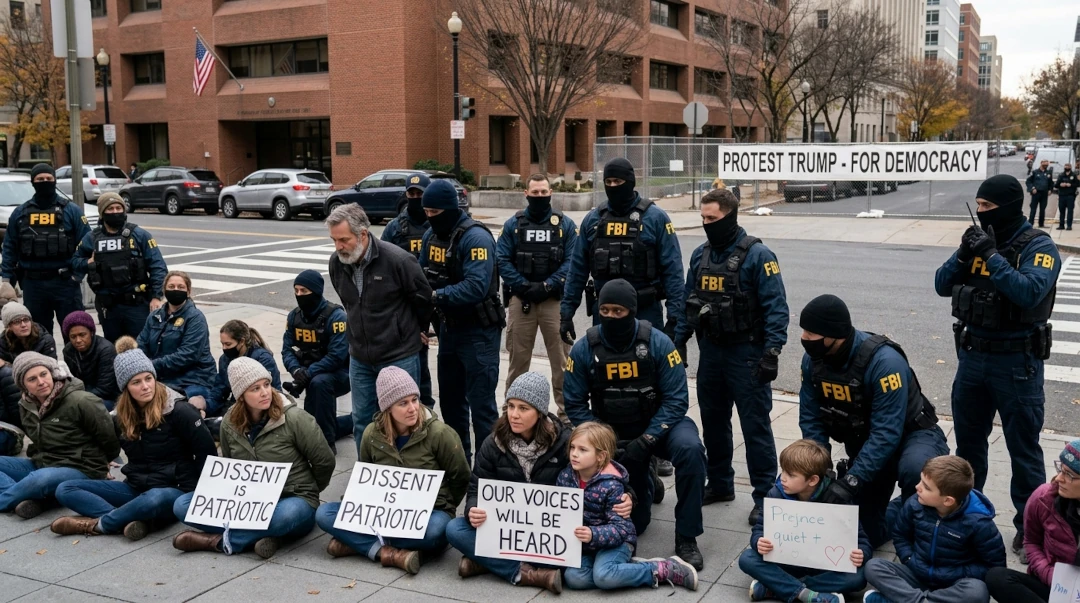
Strip away the legalese and ask the practical question: what changes for an ordinary American? If you give money to an immigrant-rights group, a reproductive-justice fund, an environmental nonprofit, or a racial-justice organization, the directive places your donation inside a “financial network” the government is told to map. If you organize a protest, the language about “changing or directing policy outcomes” — which is the entire purpose of protest in a democracy — can be read to describe you. If you run a 501(c)(3), the law firm guidance to clients now includes warnings about possible IRS audits, terrorism designations, and asset freezes aimed at organizations and their officers alike.
This is how a chilling effect works. No one has to be convicted; the threat does the labor. Diane Yentel, who leads the National Council of Nonprofits, called the memo a blatant attack on the freedom of speech. Donors grow cautious. Boards grow nervous. Groups self-censor the very advocacy that holds power accountable. The New York Civil Liberties Union put the danger plainly: there is no federal crime called “domestic terrorism,” so the memo appears designed to let protected speech become the opening that justifies an investigation — one that may then dig for some other charge.
The lesson of the last two decades is whose doors get knocked on first. As the ACLU’s affiliates have documented, post-9/11 surveillance powers fell hardest on Black, brown, and Muslim communities, then spread outward to activists of every stripe. Powers built to target an unpopular few rarely stay confined to them.
Get Involved Today
Contribute to our mission and turn your concerns into action.
4. What This Says About His Priorities
A government’s priorities are revealed by what it chooses to chase — and what it chooses to ignore. Senate Minority Leader Chuck Schumer, in a letter to the Justice Department, made the sharpest version of the point: NSPM-7 builds its definition of terrorism almost entirely around ideologies the president opposes, while saying nothing about groups with documented histories of violence such as the Proud Boys, the Oath Keepers, or the Aryan Brotherhood. A counterterrorism strategy that catalogs your critics and overlooks the people who actually stormed the Capitol is not a counterterrorism strategy. It is an enemies list with a national-security letterhead.
That inversion — protecting the powerful from accountability while turning the apparatus of the state against the powerless — is the through-line. Georgia Rep. Hank Johnson called the directive an “edict coming from an authoritarian.” Reps. Pocan, Huffman, and Jayapal, leading more than 30 House members, warned that the sweeping language poses real constitutional and civil-liberties risks if aimed at dissent. California Rep. Ro Khanna said bluntly that the directive represses freedom of speech and association by investigating anyone with “anti-capitalist” or “anti-American” views. These are not fringe complaints. They describe a president treating the First Amendment as an obstacle to be managed rather than an oath to be kept.
The case for reading “inability” to mean a president who will not faithfully discharge his office.
Section 4 of the 25th Amendment lets the vice president and a majority of the Cabinet declare a president “unable to discharge the powers and duties of his office,” elevating the vice president to acting president unless two-thirds of both chambers of Congress vote otherwise. The lazy objection is that this is reserved for strokes and comas. It is not — and the people who wrote it took pains to make sure it was not.
The amendment never defines “unable” or “inability.” That silence was deliberate. John Feerick, the provision’s principal drafter, has explained that the terms were left undefined not by oversight but on the judgment that a rigid definition was undesirable, because inability could take forms no fixed list would anticipate. Yale Law School’s Rule of Law Clinic, working directly with Feerick, reached the same finding: the framers expressly disclaimed any intent to define “inability” and built a flexible standard for a wide range of unforeseen emergencies. Their recommended test is not a medical diagnosis but a functional one — look to whether the totality of the circumstances shows the president cannot discharge the powers and duties of the office.
Read that way, NSPM-7 is not a side issue; it is evidence. The powers and duties of the presidency are defined by an oath — to preserve, protect, and defend the Constitution and to take care that the laws be faithfully executed. A president who turns the nation’s counterterrorism machinery against citizens for holding “anti-capitalist” or insufficiently “traditional” beliefs is not faithfully discharging those duties. He is inverting them. That is the substance of the argument a growing bloc of lawmakers is now pressing. Rep. Jamie Raskin, the senior Democrat on the House Judiciary Committee, has introduced legislation with 50 co-sponsors to create a standing Commission on Presidential Capacity under Section 4; Rep. Jasmine Crockett has written directly to Vice President Vance urging the Cabinet to act; and Sens. Ed Markey and Chris Murphy are among more than seventy members who have said the same. In candor, those calls were triggered chiefly by the president’s volatile conduct around the conflict with Iran and his erratic public statements — but they rest on one coherent thread, and NSPM-7 belongs to it: a presidency exercising power in ways its occupant’s oath forbids.
The honest counterargument deserves its hearing. Scholar Joel Goldstein, who has studied the legislative record closely, concludes it shows the amendment was not meant to remove a president merely for an unpopular decision, and skeptics like Jonathan Turley warn that loose invocations are exactly the partisan danger the amendment risks. There is a real line between a president who cannot discharge his duties and one who discharges them in ways we oppose. And the practical barriers are steep: the trigger sits with Vice President Vance and a Cabinet of the president’s own loyalists, the bar to sustain it exceeds impeachment, and a compliant Republican Congress will not supply the votes.
But none of that closes the question — it was deliberately left open, to be answered by political actors in the moment, and it has never been tested. The procedural odds are a fact about power, not a verdict on the merits. A president who treats dissent as terrorism is precisely the kind of functional failure the drafters refused to define away, and the Constitution’s other instruments — oversight that refuses to fund an enemies list, courts that hold the First Amendment line, impeachment, and the ballot box — are not optional courtesies. They are the obligations of a Congress and a citizenry that still mean to keep their republic.
Editorial Conclusion
A president who instructs the FBI, the IRS, and the Treasury to investigate Americans for being “anti-capitalist” or insufficiently “traditional” has not mistaken the job. He has understood it perfectly and chosen to turn it against the people he is sworn to serve.
The remedy is not a constitutional shortcut. It is the harder, slower work the drafters intended: a Congress that conducts real oversight and refuses to fund an enemies list, courts that hold the line on the First Amendment, and citizens who keep donating, keep organizing, and keep protesting precisely because a memorandum told them not to. What is at stake is not one party’s advantage. It is whether dissent remains a right in America — or becomes the thing the government investigates you for. That question has only ever had one acceptable answer.
Sources & References
- The White House — “Countering Domestic Terrorism and Organized Political Violence” (NSPM-7), full text. whitehouse.gov
- Federal Register — Official published text of NSPM-7 (Doc. 2025-19141). federalregister.gov
- American Presidency Project — White House Fact Sheet on the new domestic-terrorism strategy. presidency.ucsb.edu
- U.S. Department of Justice — Attorney General memorandum implementing NSPM-7 enforcement. justice.gov
- ACLU — “How NSPM-7 Seeks to Use ‘Domestic Terrorism’ to Target Nonprofits and Activists.” aclu.org
- ACLU of D.C. — Analysis of NSPM-7’s First Amendment and surveillance risks. acludc.org
- Democracy Docket — “‘Stakes Are High’: Big Law Alerts Clients on Trump’s Domestic Terrorism Order.” democracydocket.com
- Newsweek — “What Is NSPM-7? Over 3,000 Nonprofits Sound Alarm on New Trump Directive.” newsweek.com
- Common Dreams — “House Democrats Blast Trump’s Antifa Designation and Terrorism Memo Targeting Critics.” commondreams.org
- Rep. Mark Pocan — Pocan, Huffman, Jayapal letter to the president demanding rescission. pocan.house.gov
- Office of Sen. Chuck Schumer — Letter slamming the DOJ for targeting perceived political enemies. democrats.senate.gov
- Courthouse News — “Dems condemn Trump’s broad ‘domestic terrorism’ directive.” courthousenews.com
- Charity & Security Network — Summary and commentary on NSPM-7. charityandsecurity.org
- Charity & Security Network — “FBI and IRS Concretize Implementation of NSPM-7.” charityandsecurity.org
- Common Dreams — “Trump FBI and IRS Team Up to Probe US Nonprofit Groups.” commondreams.org
- DLA Piper — “NSPM-7: New federal strategy adds enforcement risks.” dlapiper.com
- Arnold & Porter — “DOJ Issues Sweeping New Domestic Terrorism Directive.” arnoldporter.com
- Morgan Lewis — “Presidential Memorandum on Countering Domestic Terrorism: Legal and Enforcement Implications.” morganlewis.com
- NYCLU — “Trump Is Using Task Forces to Criminalize Activists and Nonprofits.” nyclu.org
- FIRE — “DOJ plan to target ‘domestic terrorists’ risks chilling speech.” fire.org
- Stanford Law School — Michael McConnell on the 25th Amendment’s scope. law.stanford.edu
- National Affairs — “The Limits of the 25th Amendment.” nationalaffairs.com
- Yale Law School — Rule of Law Clinic, “Reader’s Guide” to the 25th Amendment (with John Feerick). law.yale.edu
- Executive Functions — On the undefined meaning of “inability,” citing drafter John Feerick. execfunctions.org
- PolitiFact — “When can the 25th Amendment be used against a president?” (Joel Goldstein). politifact.com
- University of Colorado Law Review — “Using the 25th Amendment to Remove an Unfit President” (incl. Turley critique). scholar.law.colorado.edu
- The Hill — “Raskin bill proposes 25th Amendment fitness commission” (50 co-sponsors). thehill.com
- Rep. Jasmine Crockett — Letter to VP Vance urging Section 4 of the 25th Amendment. crockett.house.gov
- Newsweek — “Lawmakers Demand 25th Amendment Be Invoked Against Donald Trump: Full List.” newsweek.com
Related News